Blog · Bookkeeping & accounting
A treasurer's guide to church bookkeeping
June 27, 2026 · By Benjamin Reinke
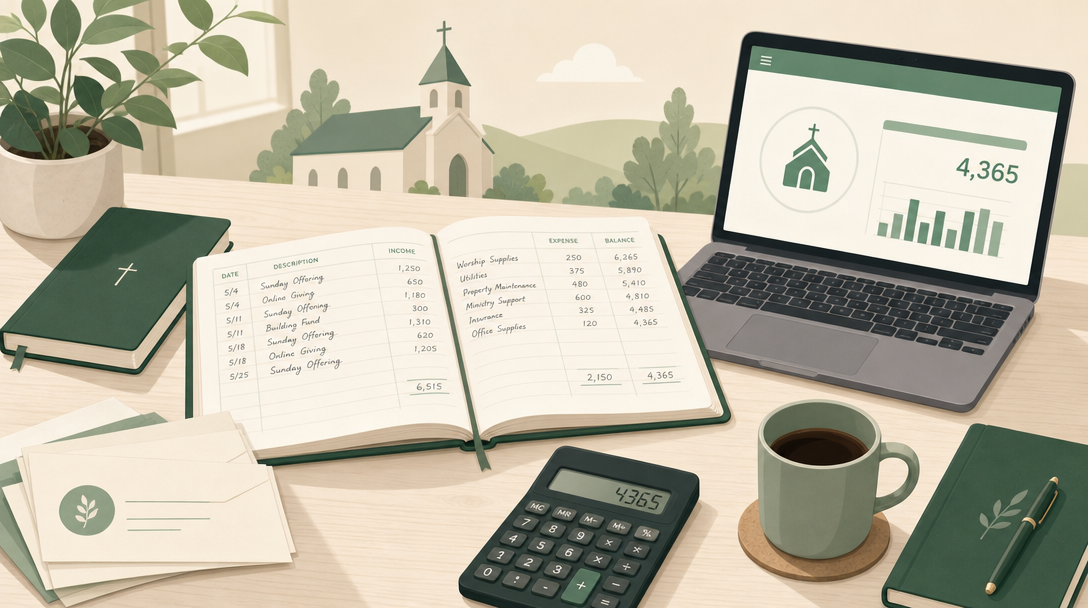
Short answer: Church bookkeeping is the routine of recording every dollar your church takes in and pays out, tracked by purpose rather than as one pot, so you can always show donors and your board where the money went. It runs on three things: a chart of accounts that lists your income and expense categories, fund accounting that keeps restricted gifts separate, and a monthly rhythm of recording giving, entering bills, and reconciling the bank. You do not need an accounting degree — you need a consistent system and someone other than the person who signs checks to review it. Bookkeeping is the recording layer of the broader church accounting system and one piece of managing the church’s finances overall; this guide is the hands-on side of it.
How church bookkeeping is different from business bookkeeping
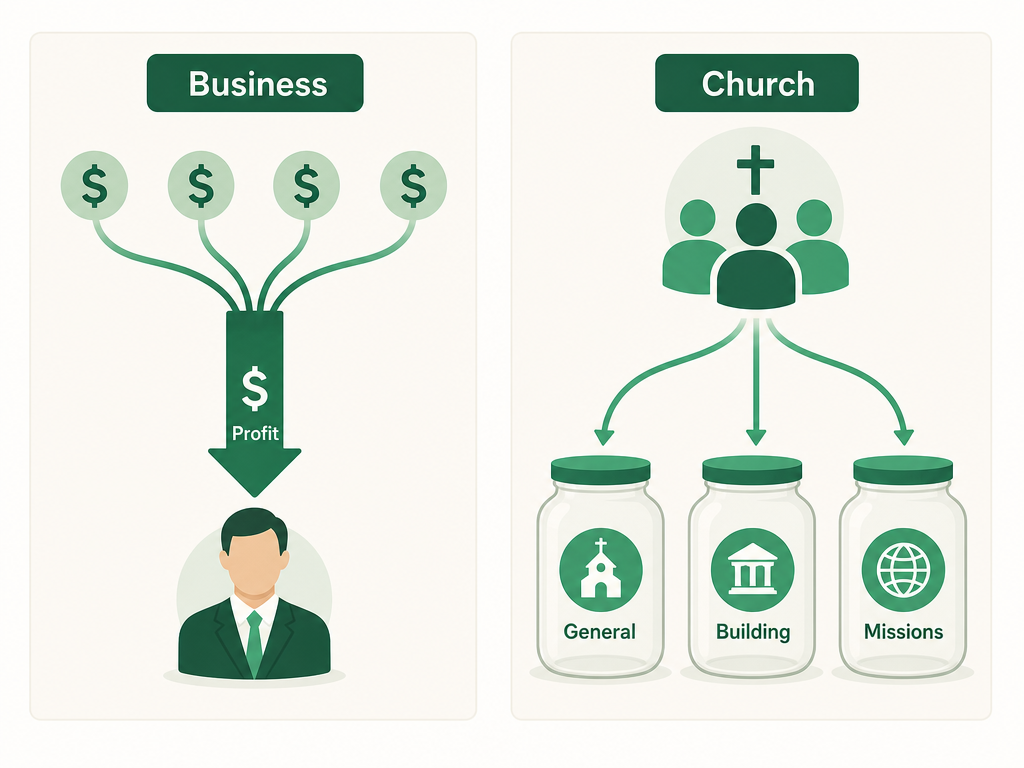
A business keeps books to answer one question: did we make a profit, and how much? Everything rolls up to a single bottom line for the owners.
A church has no owners and no profit motive. It holds money in trust for the people who gave it, and much of that money arrives tagged for a specific purpose — the building, missions, a family in crisis. So church bookkeeping has to answer a harder question at any moment: is every restricted dollar still being used for what it was given for? That single difference drives almost everything else — why churches use fund accounting, why the reports look different, and why the IRS lets most churches skip the annual Form 990 but still expects them to keep records that substantiate income and expenses (IRS Publication 1828). A church is really just a nonprofit with a few extra breaks, so the same routine covers any organization — see nonprofit bookkeeping for the general recording routine and nonprofit accounting for the standards-and-statements view behind it.
Set your books up on fund accounting first
Before you record a single transaction, decide how you’ll separate money by purpose. That method is fund accounting, and it’s the foundation church bookkeeping sits on. A “fund” is just a self-contained set of books for one purpose — general, building, missions, benevolence — each with its own running balance.
The distinction that trips up new church treasurers is restricted versus designated. Donor-restricted money is bound by the giver (“this is for the roof”) and you can’t redirect it. Board-designated money is set aside by the church itself, so the board can un-set it. Get that one idea right and most bookkeeping problems never start. The full mechanics are in the guide on church fund accounting — read it before you build your accounts, because your fund structure shapes everything downstream.
One thing fund accounting does not require: a separate bank account for every fund. Funds are an accounting separation tracked inside one shared bank balance. Most churches run one or two bank accounts and let the books do the dividing.
Build a church chart of accounts
The chart of accounts is the master list of buckets every transaction drops into. Keep it short and plain — a list nobody understands is a list nobody uses. A small church usually needs five categories of accounts:
| Type | What it holds | Examples |
|---|---|---|
| Assets | What the church owns | Checking, savings, building |
| Liabilities | What the church owes | Payroll taxes due, mortgage |
| Net assets (funds) | Balances by purpose | General, building, missions |
| Income | Money coming in | Tithes & offerings, designated gifts, facility rental |
| Expenses | Money going out | Salaries, utilities, ministry, missions |
Resist the urge to create an account for every little thing. Twenty clean accounts that get reconciled beat eighty that nobody maintains. There’s a full walkthrough — with a sample numbering system — in the guide to a church chart of accounts.
The monthly church bookkeeping routine
Most of church bookkeeping is the same short loop, run every month. Do it on a set day and it never piles up; skip it for a quarter and you’ll spend a weekend untangling it. The loop is:
- Record the giving. Enter each week’s contributions, split by fund, and post them against each giver’s record so you can produce year-end statements. (A simple tithe and offering spreadsheet works to start.)
- Enter the bills and payroll. Record what was paid and what it was for, coding each to the right expense account and fund.
- Reconcile every bank and credit-card account. Match your books to the statement, line by line, until they agree to the penny. This is the step that catches errors and theft — never skip it. (Here’s how bank reconciliation and credit-card tracking work in practice.)
- Review the numbers. Run a budget-versus-actual and a balance by fund. Look for funds going negative (you may be spending restricted money) and categories blowing past budget.
- File the paperwork. Keep deposit slips, invoices, and approvals where you can find them in a year.
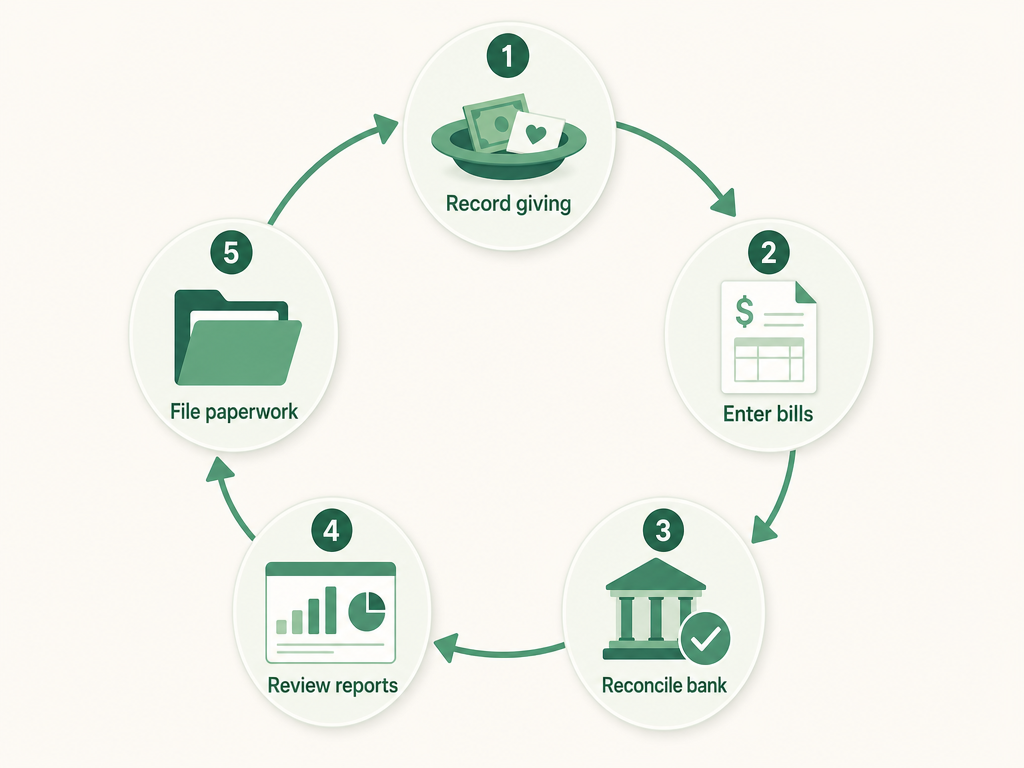
That’s the whole job most months. The skill isn’t speed — it’s doing the loop the same way every time so the books are always trustworthy. If you’ve just inherited the books, the new church treasurer checklist walks you through the first 90 days before the monthly loop settles in.
Internal controls that keep church bookkeeping honest
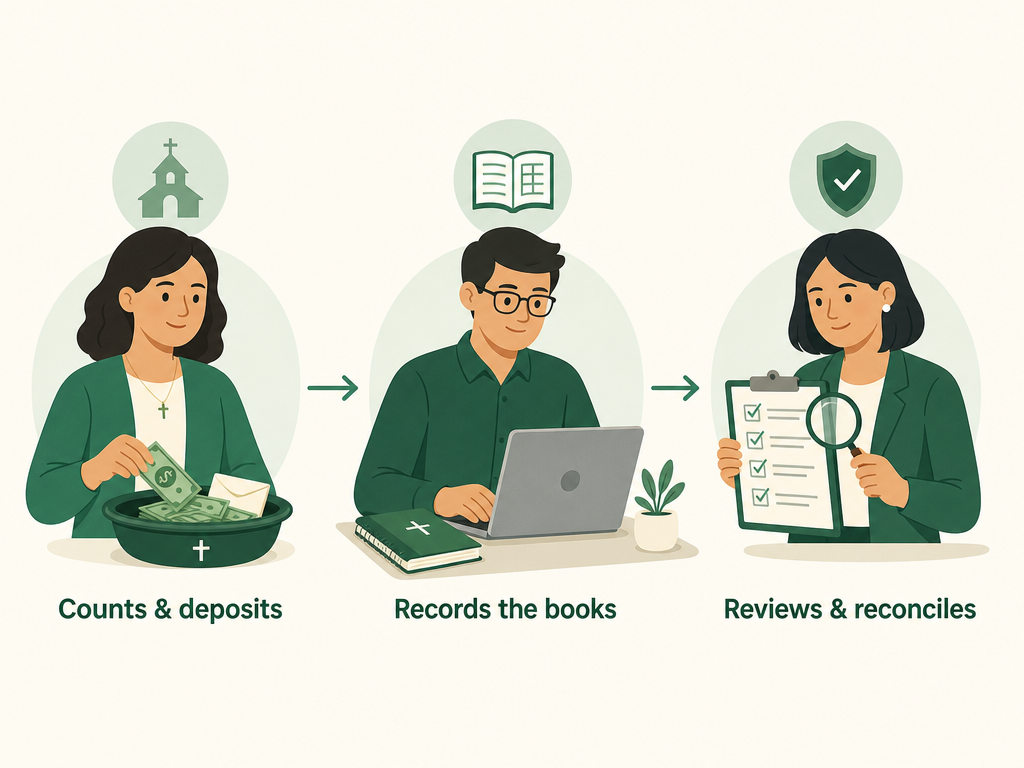
The hard truth is that churches are easy targets for embezzlement, because they run on trust and often let one person handle everything. The fix isn’t suspicion; it’s separating the work so no single person controls a transaction from start to finish.
- Two unrelated people count the offering together and both sign the count sheet, before anyone is alone with the cash.
- The person who records the books is not the person who signs checks or reconciles the bank. Split those three jobs across different people.
- Require a second signature or approval for payments over a set amount.
- Someone outside the bookkeeping seat reviews the reconciliation each month — usually a finance committee member or treasurer who isn’t doing the data entry.
The full system — segregation of duties, dual approval, and a one-page policy your board adopts — is laid out in the guide to church internal controls, including how a church with only two or three volunteers builds real controls anyway.
These aren’t bureaucracy for its own sake. Segregation of duties is the single most effective control a small organization has, and church-finance bodies like the ECFA treat it as baseline stewardship. Even a two-person church can split counting from recording. The classic church version of this split is the financial secretary and the treasurer — one records the money coming in, the other pays what goes out. Once a year, an independent set of eyes should review the whole thing — that’s what a church audit does.
The reports church bookkeeping produces
Bookkeeping isn’t the goal; the reports are. Clean books exist so you can hand your board and your donors a few clear statements. The core ones for a church are:
- Statement of financial position — the church’s version of a balance sheet: what you own, what you owe, and your balance in each fund. (See the guide to a church balance sheet.)
- Statement of activities — income and expenses over a period, the church’s income statement, broken out by fund.
- Budget versus actual — the report your board actually reads each month, showing where you are against the plan.
- Annual contribution statements — each donor’s giving for the year. These matter for taxes: a donor needs a written acknowledgment from the church for any single gift of $250 or more to deduct it (IRS Publication 1771). Producing these, alongside the payroll forms and a final reconciliation, is the work of the church year-end financial close.
If your books are reconciled and coded by fund, all of these fall out of the system in a few clicks, and together they make up the monthly treasurer’s report the board reviews. The full set is covered in the guide to church financial statements. And the spending side of those reports starts with a realistic plan — see how to build a church budget the board will follow.
Software, a volunteer, or an outsourced bookkeeper
There’s no single right answer — it depends on your size and the volunteers you have. Most church treasurers and bookkeepers are unpaid volunteers, though larger churches sometimes pay the role. The honest trade-offs:
| Option | Fits | Watch out for |
|---|---|---|
| Spreadsheet | The smallest churches, under ~$50k | Breaks down fast once funds and donors multiply |
| General accounting software | Churches that already have a QuickBooks-savvy volunteer | No real fund accounting — you bolt it on with “classes” |
| Church-specific software | Most churches that want fund accounting built in | A monthly cost; a short learning curve |
| Outsourced bookkeeper | Churches with money but no reliable volunteer | Cost; you still need someone in-house reviewing |
QuickBooks is the most common general tool, and you can run a church on it by using classes to stand in for funds — there’s a full walkthrough in the guide to QuickBooks for churches. Purpose-built church packages (Aplos, PowerChurch, ChurchTrac, Breeze) handle funds natively, which is why many treasurers eventually move to one — and a few, including free options, cost little or nothing to start. Some are tuned to your situation, too — for small churches run by a volunteer, or Catholic parishes tracking second collections. Whatever you choose, the controls above matter more than the tool — software records what you tell it; it won’t catch a transaction nobody separated. As a church grows, the books may outgrow a volunteer — that’s the point to weigh whether you need a church accountant.
FAQ
How do you do bookkeeping for a church? Set up a chart of accounts and a list of funds, then run the same monthly loop: record giving by fund, enter bills and payroll, reconcile every bank account, review a budget-versus-actual, and file the paperwork. The key is separating duties so the person recording the books isn’t the only one who sees the money.
What does a bookkeeper do at a church? A church bookkeeper records contributions and expenses, codes each to the right account and fund, reconciles the bank statements, produces the monthly reports for the board, and prepares year-end giving statements for donors. In larger churches they also run payroll and track restricted funds.
Can I use QuickBooks for church accounting? Yes. QuickBooks doesn’t do true fund accounting, but you can use its “class” feature to track each fund, which works well enough for many churches. The setup is what makes or breaks it — every fund becomes a class, and you tag each transaction to one so your reports can split by fund.
What bookkeeping software do most churches use? QuickBooks is the most common general option. Among church-specific tools, Aplos, PowerChurch, ChurchTrac, and Breeze are widely used because they build fund accounting and contribution tracking in — see how the church-specific tools compare. Small churches sometimes start in a spreadsheet and move to software once funds and donors multiply.
Vestrybooks handles the whole loop above — fund accounting, reconciliation, and the board reports — in one place built for churches. See how it works.
This article is general information for church treasurers, not professional tax or legal advice. For your church's situation, consult a qualified accountant or attorney.
Church accounting a volunteer can actually do.
Vestrybooks is church accounting + giving for the volunteer treasurer — fund tracking, one-click year-end statements, and online giving with $0 taken from every gift.
A real free plan · no credit card · your data stays yours