Blog · Bookkeeping & accounting
What a church accountant does, and whether you need one
June 27, 2026 · By Benjamin Reinke

Short answer: A church accountant is a finance professional who manages a church’s accounting — overseeing fund accounting, producing the financial statements, running payroll (including clergy pay), and keeping the church compliant with the IRS. The honest truth most small churches need to hear: you probably don’t need a full-time one. Software plus a reliable bookkeeper handles the day-to-day, and you bring in an accountant or CPA for the higher-stakes work — setting up the system, reviewing the books, or advising on payroll and clergy taxes.
What a church accountant does
A church accountant works one level above the bookkeeping. Where a bookkeeper records the transactions, the accountant turns those records into reports and judgment calls. The role usually covers:
- Overseeing fund accounting so restricted gifts stay tied to their purpose.
- Producing the financial statements the board and donors rely on.
- Running or reviewing payroll, including the special rules for ministers’ pay and housing allowance.
- Keeping the church compliant — payroll filings, 1099s, donor acknowledgments, and the church’s exempt status.
- Advising leadership on budgets, reserves, and big financial decisions.
In other words, they own the system — the broader accounting discipline — rather than the daily data entry.
Church accountant vs. bookkeeper vs. CPA
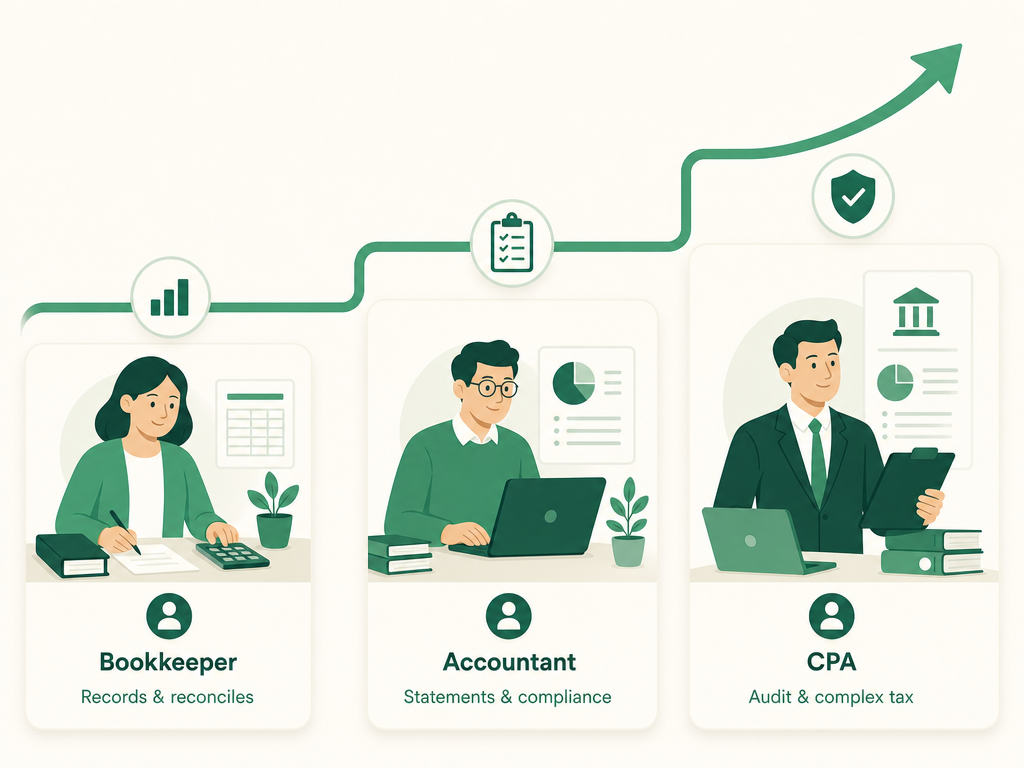
A church accountant, a bookkeeper, and a CPA get blurred together constantly, and the difference matters when you’re deciding who to hire. Each does a distinct job, and they escalate in cost and expertise.
| Role | What they do | When you need them |
|---|---|---|
| Bookkeeper | Records contributions and expenses, reconciles the bank, runs the monthly cycle | Every church, weekly |
| Accountant | Builds the statements, oversees payroll and compliance, advises the board | Growing churches, monthly or quarterly |
| CPA | Audits or reviews the books, handles complex tax questions, signs off for outside parties | Periodically, or when a lender or denomination requires it |
A bookkeeper keeps the records; an accountant interprets and reports them; a CPA is the licensed expert you bring in for assurance and hard tax calls. Many churches run beautifully on a bookkeeper plus the right church software, with a CPA on call — no dedicated accountant in between.
Does your church actually need an accountant?
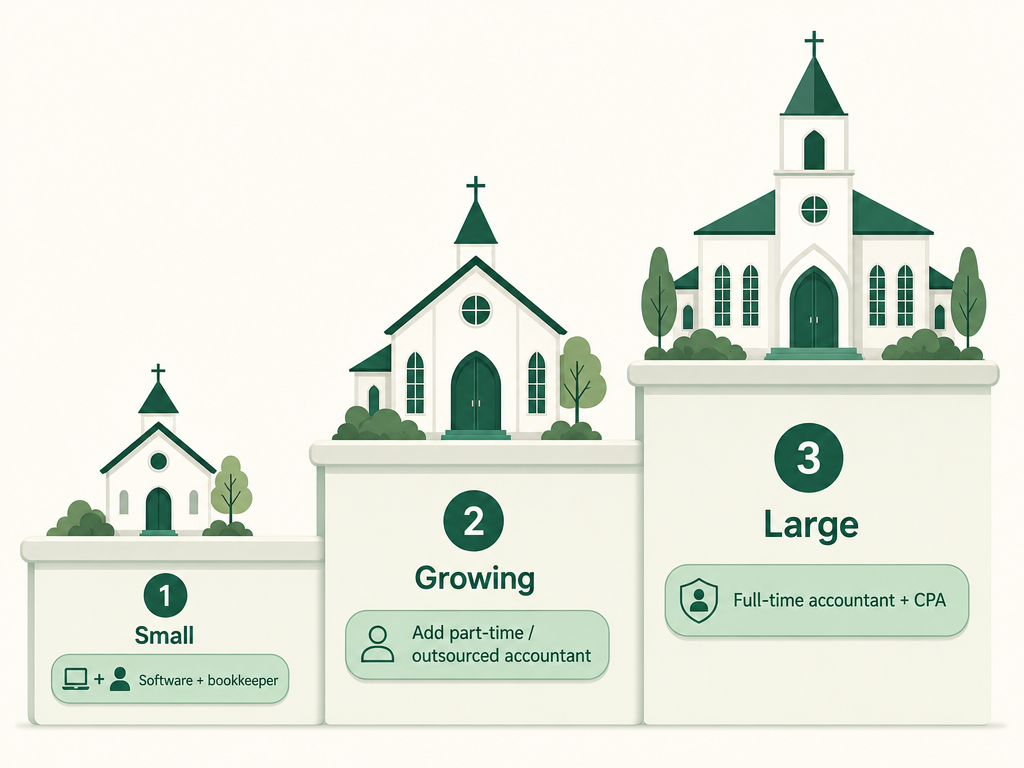
Whether your church needs a dedicated accountant comes down to size and complexity, not budget guilt. A useful way to think about it:
- Small church (under ~$250k budget). Software plus a diligent bookkeeper, with a CPA reviewed once a year. No accountant needed.
- Growing church (~$250k–$1M). This is where a part-time or outsourced accountant starts to earn their keep — payroll gets complicated, reserves grow, and the board wants real reporting.
- Large church or multi-site ($1M+). A full-time accountant or finance director, often with a CPA firm for the annual audit.
In-house, outsourced, or a CPA firm
If you do need accounting help beyond a bookkeeper, there are three ways to get it:
- In-house — a part-time or full-time staff accountant. Best for larger churches that need someone close to the day-to-day. The most expensive option, since it’s a salary.
- Outsourced church-accounting service — a firm that does your accounting remotely for a monthly fee that scales with your size. Popular with midsize churches that want expertise without a hire.
- A CPA firm, as needed — you keep bookkeeping in-house and bring in the CPA for the audit, the tax questions, and the year-end review. The cheapest way to get licensed expertise.
Costs vary widely: a full-time accountant is a real salary, an outsourced service is a recurring monthly fee, and a CPA charges by the engagement. For most churches, the cheapest combination that works — software, a bookkeeper, and a CPA on call — is also the right one.
What to look for in a church accountant
Not every accountant understands churches, and the gaps are expensive. Whoever you hire should know:
- Fund accounting — the single most important skill; general business accountants often don’t have it. Clean books start with the right church bookkeeping foundation.
- Clergy tax rules — minister payroll, the housing allowance, and SECA are their own world (IRS Publication 517).
- Nonprofit compliance — exempt status, unrelated business income, and donor substantiation.
- References from other churches — proof they’ve done this in a ministry context, not just a business.
FAQ
What is a church accountant? A finance professional who manages a church’s accounting — fund accounting, financial statements, payroll, and IRS compliance. They can be in-house, outsourced, or a CPA firm engaged as needed, and they work a level above the bookkeeper who records the daily transactions.
Does a church need an accountant? Most small churches don’t need a dedicated one. Software plus a bookkeeper handles the day-to-day, and a CPA is brought in periodically for review and tax questions. A part-time or outsourced accountant starts to make sense as a church grows past roughly $250k in annual budget.
How does church accounting work? Churches use fund accounting to track money by purpose, produce a set of financial statements, and handle their own payroll and tax filings. The full picture is in the guide to church accounting.
Vestrybooks gives a church the reporting an accountant would build — fund accounting, statements, and payroll-ready records — without the salary. See how it works.
This article is general information for church treasurers, not professional tax or legal advice. For your church's situation, consult a qualified accountant or attorney.
Church accounting a volunteer can actually do.
Vestrybooks is church accounting + giving for the volunteer treasurer — fund tracking, one-click year-end statements, and online giving with $0 taken from every gift.
A real free plan · no credit card · your data stays yours