Blog · Bookkeeping & accounting
How to manage church finances without an accounting background
June 28, 2026 · By Benjamin Reinke

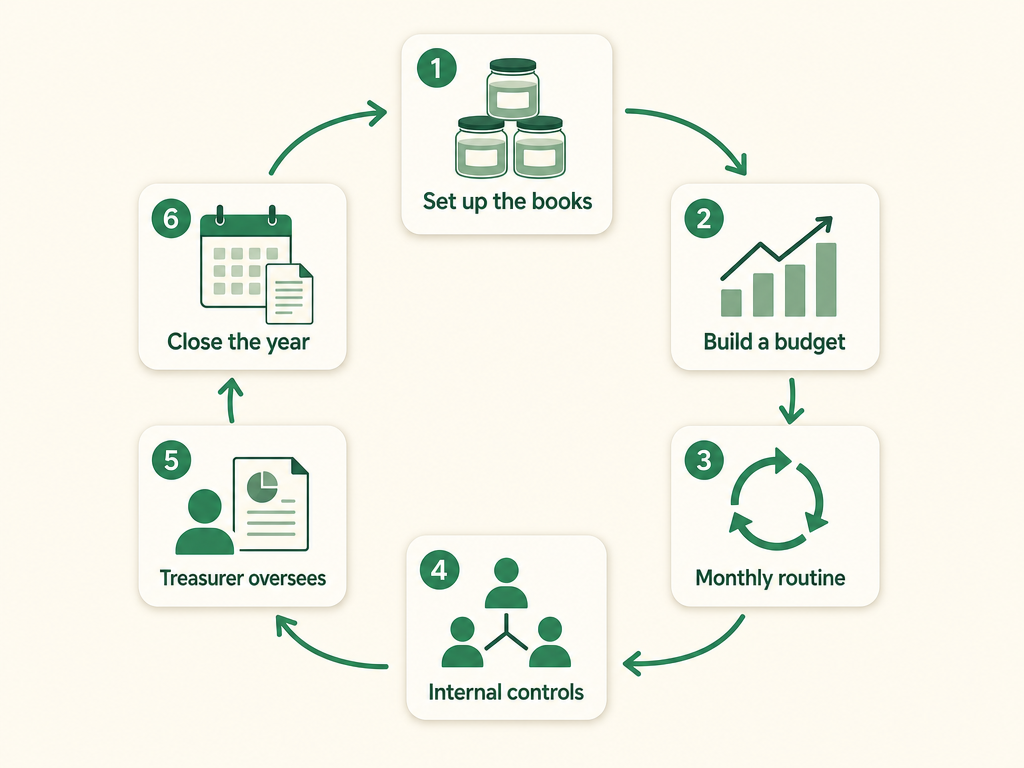
Short answer: Managing a church’s finances is running one system, not pulling off a series of heroics. The system has six moving parts: books set up on fund accounting, a yearly budget (and the budget software to run it), a monthly routine of recording and reconciling, internal controls that split the work so no one person controls the money, a treasurer who answers for it to a separate board, and year-end statements for the IRS and your donors. You do not need an accounting degree to run it — you need each part in place and the discipline to repeat the monthly loop the same way every time. This page is the map of the whole system; each section links to the in-depth guide for that part.
Manage church finances as one connected system
A church handles money differently from a business, and that shapes everything below. A business keeps books to find its profit. A church has no owners and no profit — it holds money in trust for the people who gave it, and much of that money arrives tagged for a purpose: the building, missions, a family in crisis. So managing church finances means always being able to answer one question: is every dollar still going where it was given to go?
Most churches that get into trouble didn’t lack effort. They ran the parts in isolation — a budget nobody compared against, giving recorded by the one person who also wrote the checks, a year that ended with no statements for donors. The parts only protect the church when they connect. Here’s the whole system at a glance, with the guide for each:
| Part of the system | What it does | When |
|---|---|---|
| Set up the books | Separate money by purpose and list your categories | Once, at the start |
| Build a budget | Turn the ministry plan into a money plan | Once a year |
| The monthly routine | Record giving, pay bills, reconcile, report | Every month |
| Internal controls | Split the work so no one controls the money | Always on |
| The treasurer’s role | One person oversees, a separate board reviews | Always on |
| Year-end | Donor statements and annual reports | Once a year |
Each row below gets its own section, and each links to the deep guide for that part.
Set up the books on fund accounting and a chart of accounts
Before you record a single transaction, decide how the money will be separated. Churches use fund accounting, which keeps each pot of money — general, building, missions, benevolence — on its own set of books with its own running balance. A donor who gives “for the roof” has tied that gift to a purpose, and fund accounting is what keeps you from quietly spending it on the electric bill.
The idea that trips people up is restricted versus designated. Restricted money is bound by the giver and you cannot redirect it; designated money is set aside by the church itself, so the board can un-set it. Get that one distinction right and most problems never start. Fund accounting does not require a separate bank account per fund — it’s an accounting separation tracked inside one shared bank balance. The full mechanics, including how to set your fund structure up before anything else, are in the guide to church fund accounting.
On top of the funds sits a chart of accounts — the short master list of buckets every transaction drops into: assets, liabilities, fund balances, income, and expenses. Keep it short. Twenty clean accounts that get used beat eighty nobody maintains. There’s a sample numbering system in the guide to a church chart of accounts.
Build a church budget the board will actually follow
A church budget is the year’s money plan — your best estimate of what will come in and an agreement on where it goes. It’s the difference between leading the church’s money and reacting to it. Build it once a year with the pastor and board, working from the ministry plan, not from last year’s spreadsheet copied forward.
A practical budget comes together in a handful of moves:
- Estimate income — regular giving, designated gifts, and any facility rental, built from a conservative read of last year’s numbers.
- List expenses by category — staff and salaries, facilities and utilities, ministry and outreach, administration, and a line for debt or reserves.
- Balance the two and decide what gives if giving comes in soft.
- Set aside reserves — a common target is three to six months of operating expenses, built up over time, so one bad quarter isn’t a crisis. Before you park reserves in the market, know the rules on whether a church can invest.
The point of a budget isn’t the document; it’s the monthly comparison against it. A plan you never check is just a wish. How to size each category — and realistic percentages by church size — is in the guide to building a church budget.
Run the monthly church finance routine
Most of managing church finances is the same short loop, run every month. Do it on a set day and it never piles up; skip it for a quarter and you’ll lose a weekend untangling it. The loop is:
- Record the giving. Enter each week’s contributions, split by fund, posted to each giver’s record so you can produce year-end statements.
- Pay the bills and payroll. Record what was paid and what for, coded to the right expense account and fund.
- Reconcile every account. Match your books to the bank statement, line by line, until they agree to the penny. This is the step that catches both honest errors and theft — never skip it.
- Review the numbers. Run a budget-versus-actual and a balance by fund. Watch for funds going negative (a sign you’re spending restricted money) and categories blowing past plan.
- File the paperwork. Keep deposit slips, invoices, and approvals where you can find them in a year — the IRS expects a church to keep records that substantiate its income and expenses (IRS Publication 1828).
That’s the whole job most months. The skill isn’t speed; it’s doing the loop the same way every time so the books are always trustworthy. The hands-on mechanics of each step — and what software does versus a spreadsheet — are in the guide to church bookkeeping, the recording layer this whole system runs on.
Put internal controls in so no one person controls the money
Churches are unusually easy targets for fraud, because they run on trust and often hand one person the offering, the checkbook, and the bank login all at once. The fix isn’t suspicion — it’s separating the work so no single person controls a transaction from offering plate to bank statement. This is called segregation of duties, and it’s the single most effective control a small organization has.
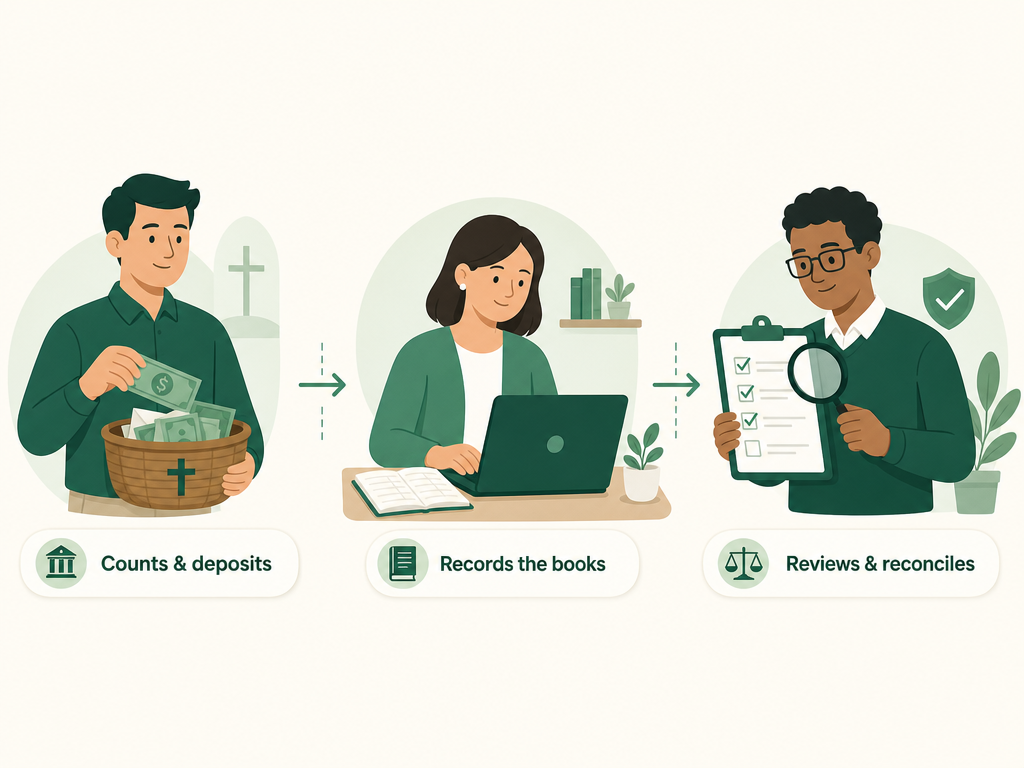
- Two unrelated people count the offering together and both sign the count sheet, before anyone is alone with the cash.
- The person who records the books is not the person who signs checks or reconciles the bank. Split those three jobs across different people.
- A second signature or approval is required for payments over a set amount.
- Someone outside the bookkeeping seat reviews the reconciliation each month.
Church-finance bodies like the ECFA treat this as baseline stewardship, not bureaucracy. Even a two-person church can split counting from recording. And once a year, an independent set of eyes should review the whole thing — what a church audit does, and the reason a treasurer who keeps clean records has nothing to dread.
Know who is responsible for church finances
Someone has to answer for the money, and in most churches that’s the treasurer — usually an elected or appointed volunteer, not a hired professional. The treasurer’s job is oversight, not data entry: making sure giving is recorded and deposited, bills are paid, the bank is reconciled, and the board gets a clear monthly report. A good treasurer doesn’t do all of that alone, because the role only works when the money passes through more than one set of hands.
The treasurer reports up to a separate body — the board, finance committee, or congregation, depending on how the church is governed. That separation is the point: one seat manages the money, a different seat reviews it and approves the budget, so authority never rests in one place. Who does what, the qualities that matter more than an accounting degree, and how the role splits as a church grows are in the guide to the church treasurer.
Close out the year with statements and donor receipts
Year-end is when the system pays off. If you ran the monthly loop and coded everything by fund, closing the year is mostly assembly, not archaeology. Two things have to come out of it:
- Annual giving statements for donors. Each giver needs a written record of their contributions for the year. This matters for their taxes: a donor needs a written acknowledgment from the church for any single gift of $250 or more to deduct it (IRS Publication 1828).
- Annual financial statements for the church. A statement of financial position (the church’s balance sheet — what you own, owe, and hold in each fund) and a statement of activities (income and expenses over the year, broken out by fund). These are the reports your board and any lender or auditor will ask for.
Both fall out of clean, reconciled books in a few clicks. The full set, and how each statement reads, is in the guide to church financial statements.
Be transparent with the board and the congregation
Transparency is what turns a clean set of books into trust. The people who give want to know their money is handled well, and the fastest way to lose a congregation’s confidence is to go quiet about its money. You don’t fix that with a vault of detail — you fix it with a short, consistent report, every month.
A good treasurer’s report is one page: income and expenses for the month and year-to-date against the budget, the balance in each fund so restricted money is visibly intact, cash on hand tied to the reconciliations, and anything that needs the board’s attention. Same format every month, so the board can read it at a glance and spot when something changes. Churches that share a plain summary on a regular rhythm rarely face the “where did the money go?” suspicion that quiet churches do. Transparency isn’t a disclosure event; it’s a habit.
The right tool makes a volunteer’s job runnable
None of this requires an accountant, but it does require a system, and the tool you pick decides how much of that system you carry by hand. A spreadsheet works for the smallest churches and breaks down fast once funds and donors multiply. General accounting software like QuickBooks can run a church if a volunteer bolts fund tracking onto its “class” feature. Software built for churches does the fund accounting, reconciliation, and year-end statements natively, which is what turns the treasurer’s job from “know accounting” into “run the process.” Whichever you choose, the controls above matter more than the tool — software records what you tell it; it won’t separate a duty nobody separated.
FAQ
What is the best way to manage church finances? Run one connected system rather than handling money ad hoc: set the books up on fund accounting, build a yearly budget, run a fixed monthly routine of recording giving and reconciling the bank, split the duties so no one person controls a transaction, have a treasurer report to a separate board, and produce year-end statements for donors and the church. The best way isn’t a clever trick — it’s a plain system repeated the same way every month so the books are always ready to be shown.
Who is responsible for church finances? In most churches the treasurer — usually an elected or appointed volunteer — oversees the money and answers for it, while a separate board or finance committee reviews the reports and approves the budget. That split is deliberate: the person managing the money is not the only person watching it. The day-to-day recording may be done by a bookkeeper or the treasurer, but accountability rests with the treasurer and the board together.
What is the 80/20 rule for churches? It’s the common observation that roughly 80% of a church’s giving comes from about 20% of its givers. For managing finances, the practical takeaway is that a budget built on a handful of large donors is fragile — if one or two families leave, the income drops sharply. Build the budget conservatively, keep a reserve, and don’t treat last year’s giving as guaranteed.
How do churches survive financially? Most small churches run on regular giving from members, supplemented by designated gifts, and sometimes facility rental or fundraising. Survival comes down to spending within that income, building a reserve of a few months’ expenses for lean seasons, and keeping enough trust through transparent reporting that people keep giving. The churches that struggle are usually the ones that stopped comparing spending to a budget, not the ones with the smallest income.
Do you need an accountant to manage a church’s finances? No. A diligent volunteer with the right software and a real review process runs a clean church treasury without an accounting degree. A church relies on a volunteer treasurer to oversee and a bookkeeper to record; it only needs a paid accountant when payroll, complex tax questions, or its size outgrow what volunteers can handle. The system and the controls matter more than the credential.
Vestrybooks runs this whole system — fund accounting, the monthly loop, board reports, and the January giving statements — in one place built for volunteer treasurers. See how it works.
This article is general information for church treasurers, not professional tax or legal advice. For your church's situation, consult a qualified accountant or attorney.
Church accounting a volunteer can actually do.
Vestrybooks is church accounting + giving for the volunteer treasurer — fund tracking, one-click year-end statements, and online giving with $0 taken from every gift.
A real free plan · no credit card · your data stays yours