Blog · Financial reporting
Church financial statements, from balance sheet to cash flow
June 26, 2026 · By Benjamin Reinke

Short answer: Church financial statements are the reports that show where a church’s money stands and how it moved. Churches use the same four nonprofit statements: the statement of financial position (the balance sheet), the statement of activities (the income statement), the statement of cash flows, and the statement of functional expenses. The big difference from a business is that churches report net assets, not profit or owner’s equity, and split those net assets by donor restriction. Most churches aren’t required by the IRS to file them, but the board, donors, and any lender will want them.
What church financial statements are
Church financial statements are summary reports built from the church’s books that answer three questions: what the church owns and owes, where its money came from and went, and how cash actually moved. They turn a year of individual transactions into a picture the board can read in a few minutes. Because a church is a nonprofit, the statements follow nonprofit accounting standards (FASB’s ASC 958) — the same set of nonprofit financial statements any 501(c)(3) uses — not the profit-and-loss format a business uses. Two of those statements have their own deep dives that apply to any nonprofit: the nonprofit balance sheet and the nonprofit statement of activities.
The four core church financial statements
A complete set has four reports, each answering a different question:
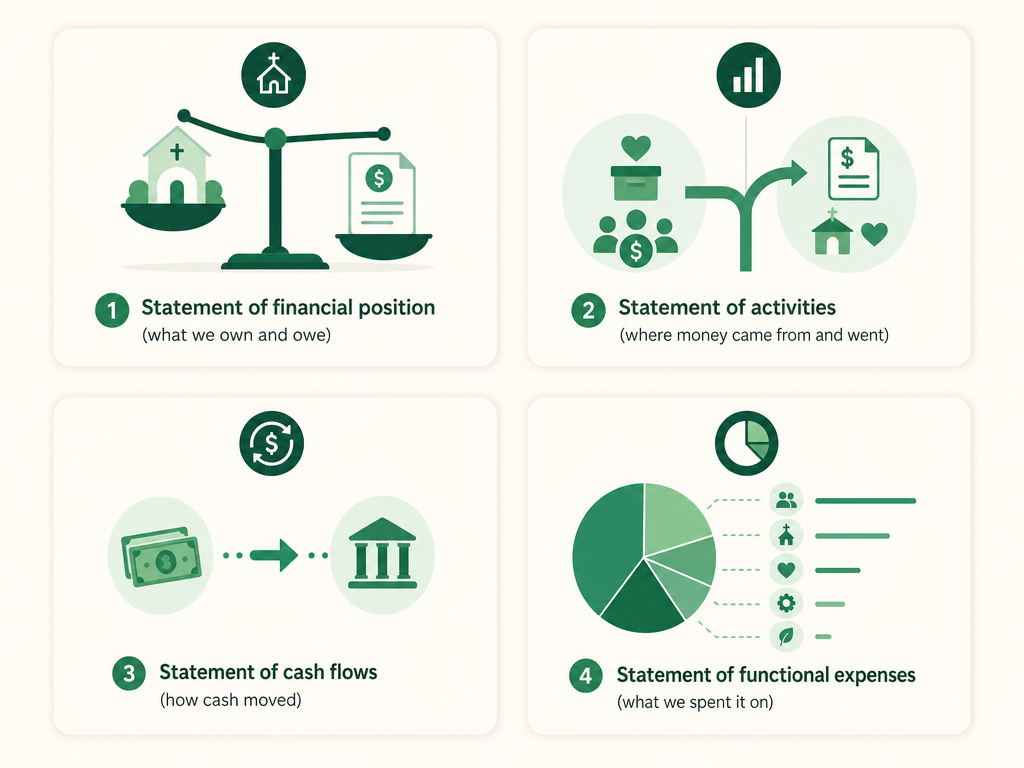
| Statement | What it shows |
|---|---|
| Statement of financial position (church balance sheet) | Assets, liabilities, and net assets at a point in time |
| Statement of activities (the income statement) | Revenue, expenses, and the change in net assets over a period |
| Statement of cash flows (nonprofit cash flow statement) | How cash moved through operating, investing, and financing |
| Statement of functional expenses (the functional-expense statement) | Spending split by function — program, management, fundraising |
Small churches often run mainly on the first two; the cash-flow and functional-expense statements matter most for larger churches and audits.
Why church statements report net assets, not profit
A business statement ends in profit and tracks owner’s equity; a church has neither owner nor profit motive, so its statements end in the change in net assets instead. Net assets are simply what’s left after liabilities — and they’re split into without donor restrictions and with donor restrictions, so the statements always show how much of the church’s money is free to use versus committed to a donor’s purpose. That restriction split is the financial-statement side of fund accounting.
What kind of accounting churches use
Churches use fund accounting — tracking money by purpose rather than as one pool — on either a cash or accrual basis. Cash basis (record it when money changes hands) is simpler and common for small churches; accrual (record it when earned or owed) is required for an audit and gives a truer picture for larger budgets. The chart of accounts behind the statements is covered in the church chart of accounts.
Does a church have to produce financial statements?
Most churches are not required by the IRS to file an annual return — churches are explicitly exempt from filing Form 990, the annual return most other nonprofits must file (IRS Publication 1828) — which is also why a church’s finances generally aren’t public record. But “not required to file with the IRS” is not “no one needs them”:
- The board has a fiduciary duty to oversee the church’s money and needs statements to do it.
- Donors and members increasingly expect financial transparency before they give — and for most nonprofits, anyone can look up the Form 990 (though a church’s isn’t filed).
- A bank will require them for any loan or mortgage.
- Some denominations and states require an annual report or review.
So the practical answer is that nearly every church should produce statements regularly, even though the IRS doesn’t demand them. Many organizations go a step further and fold these numbers into a donor-facing nonprofit annual report — the public summary of impact and finances that sits on top of the formal statements.
How a church creates its financial statements
The statements aren’t written from scratch — they’re generated from the books. Every gift, bill, and transfer is recorded to a fund and an account through the year; at month- or year-end, the accounting system rolls those balances up into each statement. That’s the whole reason clean bookkeeping matters: the statements are only as trustworthy as the records under them.
Vestrybooks builds these statements from your everyday entries automatically — record money in and out, and the board’s reports are always one click away. See plans →
FAQ
What are the financial statements of a church? The statement of financial position (balance sheet), the statement of activities (income statement), the statement of cash flows, and the statement of functional expenses — the standard nonprofit set.
Does a 501(c)(3) have to show financials? Churches are exempt from filing Form 990 with the IRS, but boards, donors, and lenders typically expect financial statements, and some states or denominations require a report.
How do you make a financial statement for a church? Record every transaction to a fund and account through the year, then roll those balances into each statement — accounting software does this automatically from your entries.
What type of accounting do churches use? Fund accounting (money tracked by purpose), on either a cash or accrual basis; accrual is required for an audit.
This is general information, not accounting or legal advice — confirm your church’s requirements with a qualified professional.
This article is general information for church treasurers, not professional tax or legal advice. For your church's situation, consult a qualified accountant or attorney.
Church accounting a volunteer can actually do.
Vestrybooks is church accounting + giving for the volunteer treasurer — fund tracking, one-click year-end statements, and online giving with $0 taken from every gift.
A real free plan · no credit card · your data stays yours