Blog · Bookkeeping & accounting
Church internal controls that actually work
July 4, 2026 · By Benjamin Reinke
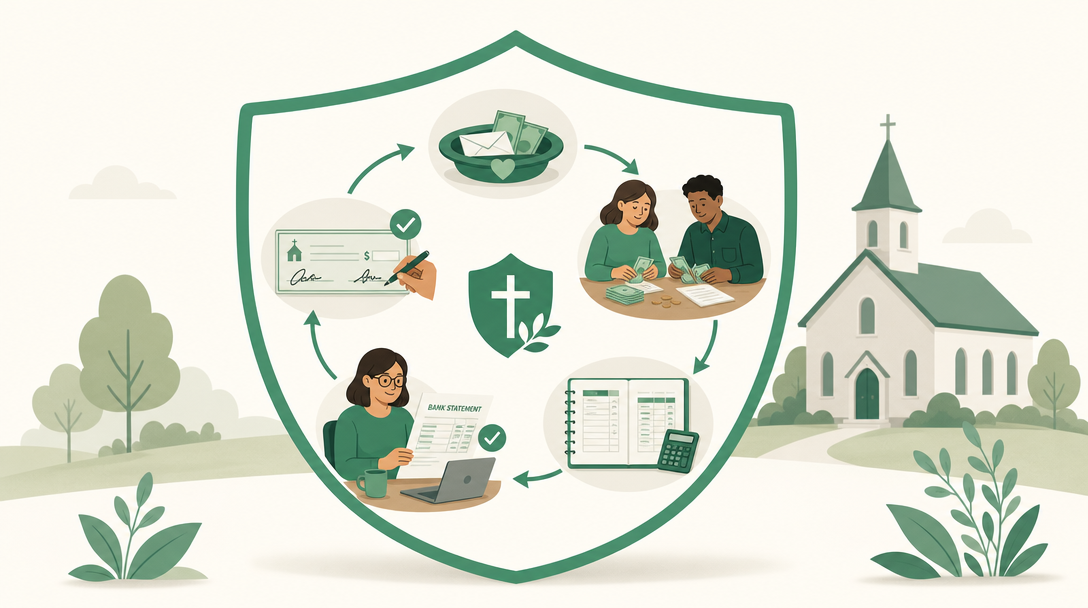
Short answer: Church internal controls are the everyday procedures that keep a church’s money honest before anything goes wrong — not a reaction to fraud, but the system that prevents it. The core five: two unrelated people count every offering together, the person who records the books is not the person who reconciles the bank, someone outside the books reviews the monthly reconciliation, large payments need a second approver, and it’s all written down in a short financial-controls policy the board adopts. The principle underneath is segregation of duties — splitting each money task so no one person can both take money and hide it. A church with only two or three volunteers can still do this, by rearranging who touches what and letting the software be the extra set of eyes.
What church internal controls are, in plain terms
Church internal controls are the checks built into how a church handles money so that mistakes get caught and theft becomes hard to pull off. They are procedures, not software and not suspicion: who counts the offering, who writes the checks, who reconciles the bank, who signs off on a big payment, and who reviews the whole thing each month. Done right, they run quietly in the background and nobody thinks about them — until the year a control catches a $40 error, or the year one saves a good volunteer from ever being suspected.
Auditors sort controls into three jobs, and a healthy church needs all three:
- Preventive controls stop a problem before it happens — two people counting the offering, a second signature on large checks, locking down who can log into the bank.
- Detective controls catch a problem after the fact — the monthly bank reconciliation, a board member reviewing the statements, an annual review of the books.
- Corrective controls fix the gap once something is found — a reversing entry to correct a miscoded gift, a policy change so the same hole can’t open twice.
Most churches over-invest in trusting the right people and under-invest in the two-person, second-look procedures that make trust safe. Internal controls are the part of church bookkeeping that protects the church from the inside, and they cost almost nothing to put in place.
Segregation of duties: who counts, records, reconciles, and approves
Segregation of duties is the backbone of church internal controls: no single person should control a transaction from start to finish. The four money jobs — custody (handling the cash or the checkbook), recording (entering it in the books), reconciling (confirming the books match the bank), and authorizing (approving what gets paid) — should sit with different people. When one person holds two or more of them, they can both commit an error or theft and erase the evidence of it. Split them, and every job becomes a check on another.
Here is what that looks like in practice for a typical small church:
| Money job | Who should hold it | Who must NOT also hold it |
|---|---|---|
| Count the offering (custody of cash) | Two unrelated counters, together | The person who records giving in the books |
| Deposit to the bank | A counter or usher, same day | The sole record-keeper acting alone |
| Record income & write checks (recording) | Bookkeeper or financial secretary | The person who reconciles the bank |
| Reconcile the bank (independent check) | Treasurer or a finance-committee member | The person who records the transactions |
| Approve payments (authorization) | Pastor or board, above a set dollar limit | The person who writes and enters the check |
| Review it monthly (oversight) | A board or finance committee member | Anyone who touches the day-to-day money |

The single most important split — the one most churches never make — is in those last two rows: the person who records the money is not the person who confirms it landed in the bank. That one separation catches the great majority of both honest errors and dishonest ones. This is also why the roles of church treasurer and financial secretary are traditionally kept separate — one handles the giving records, the other handles the bank, and each checks the other.
The two-person offering count, step by step
The offering count is where church money is most exposed, because until it’s counted and recorded, no record exists that it ever came in — so a dollar skimmed there leaves no trace. The control is simple and non-negotiable: cash is never in one person’s sole possession, from the moment the plate is passed to the moment it’s deposited.
A sound offering-counting procedure looks like this:
- Secure it immediately. Ushers move the offering to a locked bag or safe; it’s never left loose or carried home by one person.
- Two unrelated counters, always together. Two people who aren’t related and don’t live together count the offering in the same room. No one counts alone, ever — not even “just this once.”
- Count loose cash and checks separately, and log them. Both counters agree on the totals and record them on a count sheet, broken out by fund where a gift is designated.
- Both counters sign the count sheet. Their two signatures are the record that the amount banked matches the amount received.
- Deposit promptly, ideally the same day. The sooner it’s in the bank, the smaller the window for anything to go missing.
- Hand the count sheet to the record-keeper — a different person. Whoever enters giving into the books works from the signed count sheet, not from loose cash, and never counts the money they later record.
That last handoff is the quiet genius of the procedure: the counters have custody but don’t keep the books, and the record-keeper keeps the books but never had the cash. Neither can make money disappear without the other noticing the gap.

Dual approval and check-signing controls for church payments
Dual approval is the control on money going out: above a set dollar threshold, a payment needs a second person’s sign-off before it leaves the church. One person should never be able to originate, approve, and record a payment alone — that combination is how church checkbooks get quietly drained.
The practical controls on outgoing money:
- Set a dual-approval threshold. Pick a number that fits your budget — say, any single payment over $500 or $1,000 needs a second approver. Small recurring bills can flow on a pre-approved budget; anything unusual or large gets a second set of eyes.
- Two signatures on large checks. For checks above the threshold, require two signatures. It’s a small friction that stops a lot of trouble.
- Never pre-sign blank checks. A stack of signed blanks “to save time” destroys every other control at once.
- Every payment needs backup. No check or card charge goes out without an invoice or receipt attached. Real expenses leave paper; invented ones don’t.
- Guard the debit card and online banking. Limit who has a church card, keep a receipt for every swipe, and make sure more than one trusted person can see the online banking — a sole login is a single point of failure.
- The approver isn’t the bookkeeper. Whoever approves a payment should not be the same person who enters it and reconciles it later.
The IRS expects a church to keep records that substantiate its income and expenses (IRS Publication 1828, the tax guide for churches); dual approval and required backup are what make those records trustworthy instead of just present.
Monthly bank reconciliation review — the control that catches everything
The monthly bank reconciliation, reviewed by someone who doesn’t keep the books, is the most powerful detective control a church has. Reconciliation means confirming that the church’s records agree with the bank statement, line by line — and the review by an independent person is what turns a routine chore into real oversight. It’s the point where a skimmed deposit, a personal charge, or a phantom check shows up as a number that doesn’t match.
To make it a real control, not a rubber stamp:
- Reconcile every account every month, promptly after the statement closes. Reconciliations that are perpetually “almost done” are how missing money stays hidden.
- The reviewer is not the record-keeper. A church treasurer or finance-committee member who doesn’t do the data entry actually opens the statement and the reconciliation — not just a summary — and follows a few transactions from the statement back to the books.
- Statements shouldn’t land with only one person. If bank statements go to a single individual, unopened by anyone else, the one place theft shows up has no witness. Route a copy, paper or electronic, to a second person.
- Watch the tells. Deposits smaller or later than the count sheets suggest, checks without invoices, designated-fund balances that don’t move the way giving suggests — these are what the review is looking for.
This same monthly discipline is what makes the treasurer’s report to the board trustworthy: the numbers on it have already been checked against the bank by a second person.
How a church with only 2–3 volunteers builds real controls anyway
“You can’t segregate duties with two people” is the most common — and most defeating — objection in small churches, and it isn’t quite true. With two or three willing people you can’t achieve perfect separation, but you can build compensating controls that get most of the protection. The goal isn’t a finance department; it’s making sure no single person operates in the dark.
Practical moves when you’re short on people:
- Pull in the “non-money” people you already have. The two offering counters don’t have to be officers — any two trustworthy members who aren’t related can count. That alone removes the highest-risk step from the bookkeeper’s plate.
- Give oversight, not the ledger, to a board member. One board member who never touches the books but reviews the bank statement and reconciliation each month is a full detective control. Reviewing is quick; it doesn’t require accounting skill.
- Split the two duties that matter most. If you can only separate one thing, separate recording from reconciling — bookkeeper enters, a second person confirms it matches the bank. If you can separate a second thing, take custody of the cash away from the bookkeeper via the two-person count.
- Let the software be the third set of eyes. Modern church accounting software enforces controls a small volunteer team can’t staff by hand: giving matched to signed count totals, an immutable audit log that records who changed what and can’t be edited, dual-approval flags on large payments, and a bank match that has to be confirmed by a human rather than applied silently. That’s the compensating control the ECFA-style guidance points small churches toward when they can’t add people.
- Write down the exceptions. When the pastor’s spouse is one of only three volunteers and has to help with money, put the extra check in the policy — a board member reviews those transactions specifically. Documenting the compensating control is itself a control.
None of this requires distrusting anyone. A two-person church that adds a monthly board review and a two-person count has closed the two biggest gaps — and protected its handful of volunteers from ever being suspected, which is the whole point. Fraud takes root when one person handles money from start to finish; even a tiny church can break that chain. (For how those schemes actually unfold and the red flags to watch, see protecting your church from embezzlement.)
Writing a church financial-controls policy the board adopts
A written financial-controls policy is the control that holds all the others in place: it turns “the way we usually do it” into a standard the board has adopted, so a control doesn’t quietly lapse when a volunteer changes. It doesn’t need to be long — a page or two that any new treasurer can read and follow.
A workable policy names, at minimum:
- Who counts — two unrelated counters, the count-sheet and signature requirement, and same-day deposit.
- Who records and who reconciles — the two kept separate, and the reconciliation timeline.
- The approval thresholds — the dollar limit above which a payment needs a second approver or two signatures, and who those approvers are.
- The monthly review — who reviews the reconciliation and statements, and reports to the board.
- The annual review or audit — an independent look at the whole system once a year. For most churches a volunteer committee version is enough; here’s what a church audit involves.
- A confidential way to raise a concern — a channel that bypasses the person a complaint might be about.
Once the board adopts it, the policy protects the church even as people come and go — and it’s the document an insurer, a bank, or an accreditation body will ask to see. The Evangelical Council for Financial Accountability builds its guidance for ministries around exactly these written, segregated controls (ECFA fraud-prevention checklist for ministries).
A church internal-controls checklist
Run this list once a year. Every “no” is a gap worth closing before it costs you.
- Two unrelated people count every offering together, and both sign the count sheet.
- Offerings are secured immediately and deposited the same day or next business day.
- The person who records giving is not one of the counters.
- The person who records the books is not the person who reconciles the bank.
- Every bank account is reconciled monthly, on time.
- Someone outside the books reviews the reconciliation and statements each month.
- Payments above a set dollar threshold require a second approver or two signatures.
- No blank checks are ever pre-signed.
- Every payment has an invoice or receipt attached.
- Debit-card and online-banking access is limited and visible to more than one person.
- Designated and restricted funds are tracked so their balances can’t be quietly drained.
- An independent review or audit happens once a year.
- There’s a confidential way for anyone to report a financial concern.
- All of the above is written in a board-adopted financial-controls policy.
FAQ
What are the 5 main internal controls? The five widely taught internal-control components (the COSO framework) are: a control environment (leadership setting the tone that controls matter), risk assessment (identifying where money is exposed), control activities (the actual procedures — segregation of duties, approvals, reconciliations), information and communication (reliable records and reporting), and monitoring (ongoing review that the controls are working). In a church, the practical version is: separate who counts, records, reconciles, and approves; review reconciliations monthly; and audit annually.
What are the 7 internal control procedures? The seven commonly listed internal-control procedures are: segregation of duties, proper authorization of transactions, adequate documentation (invoices and receipts), physical controls over cash and assets (locked bags, limited access), independent reconciliation and verification, periodic review of performance, and appropriate access controls (limiting who can touch the bank and the books). A church that does all seven has strong controls even with a small team.
What are the four types of internal controls? Internal controls are commonly grouped four ways. By purpose: preventive (stop a problem — two-person counts, dual approval), detective (catch it — reconciliations, reviews), and corrective (fix the gap once found). The fourth type usually named is directive controls — the policies and written procedures that tell people the right way to handle money in the first place, like a board-adopted financial-controls policy.
What is the 80/20 rule for churches? The 80/20 rule is the common observation that roughly 80% of a church’s giving comes from about 20% of its givers. It’s a stewardship and budgeting insight, not an internal control — but it’s relevant to controls in one way: because a small number of large gifts carries the budget, a single skimmed or misrecorded major gift can distort the church’s whole financial picture, which is one more reason every gift should be counted by two people and tracked to its fund.
Can a small church really segregate duties with only a few volunteers? Yes, imperfectly but meaningfully. With two or three people you can’t achieve full separation, so you use compensating controls: two members count the offering, one board member reviews the bank reconciliation each month, and you separate at least recording from reconciling. Church accounting software fills the remaining gap with an immutable audit log, dual-approval flags, and human-confirmed bank matching — the extra set of eyes a small team can’t staff by hand.
This is general information, not tax or legal advice. For your church’s specific situation, consult a qualified accountant or attorney.
Vestrybooks builds these controls in — two-person counts, recording separated from reconciliation, dual approval on large payments, and an immutable audit log that no one can edit — so the money stays protected even when you only have a few volunteers. See how it works.
This article is general information for church treasurers, not professional tax or legal advice. For your church's situation, consult a qualified accountant or attorney.
Church accounting a volunteer can actually do.
Vestrybooks is church accounting + giving for the volunteer treasurer — fund tracking, one-click year-end statements, and online giving with $0 taken from every gift.
A real free plan · no credit card · your data stays yours