Blog · Budgeting
How to build a church budget that actually holds
June 26, 2026 · By Benjamin Reinke
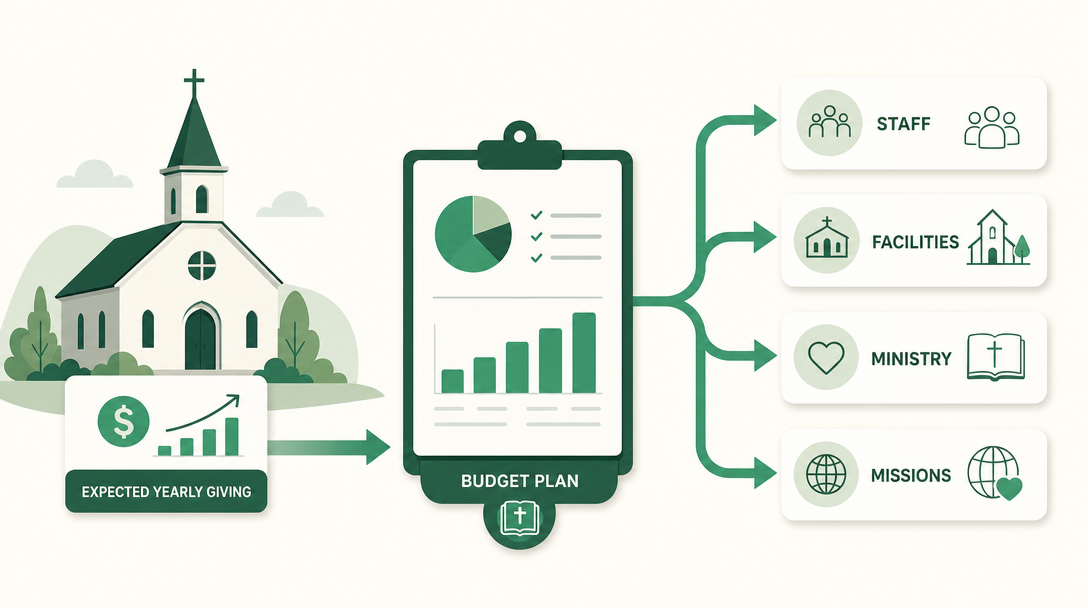
Short answer: A church budget is a written plan for the year’s income and spending, built around the church’s ministry priorities and funded mostly by giving. You build it by estimating income from your giving history, planning expenses by ministry area, and balancing the two so the plan is realistic — then you check it against actual numbers every month. A good church budget isn’t a spending limit the treasurer enforces; it’s the board’s plan for turning the congregation’s gifts into ministry.
What a church budget is
A church budget is the financial plan a church adopts for its fiscal year — a forecast of what will come in (giving and other income) and a plan for what will go out (staff, facilities, ministry, missions). It translates the church’s priorities into dollars: a budget that puts most of its money into buildings says something different than one that funds outreach. Because almost all of a church’s income is voluntary giving, a church budget is part forecast, part faith, and part discipline. A church is a nonprofit, so the same build-it-and-track-it discipline covers any organization — the general version is budgeting for nonprofits.
What a church budget should include
A complete church budget covers both sides of the ledger:
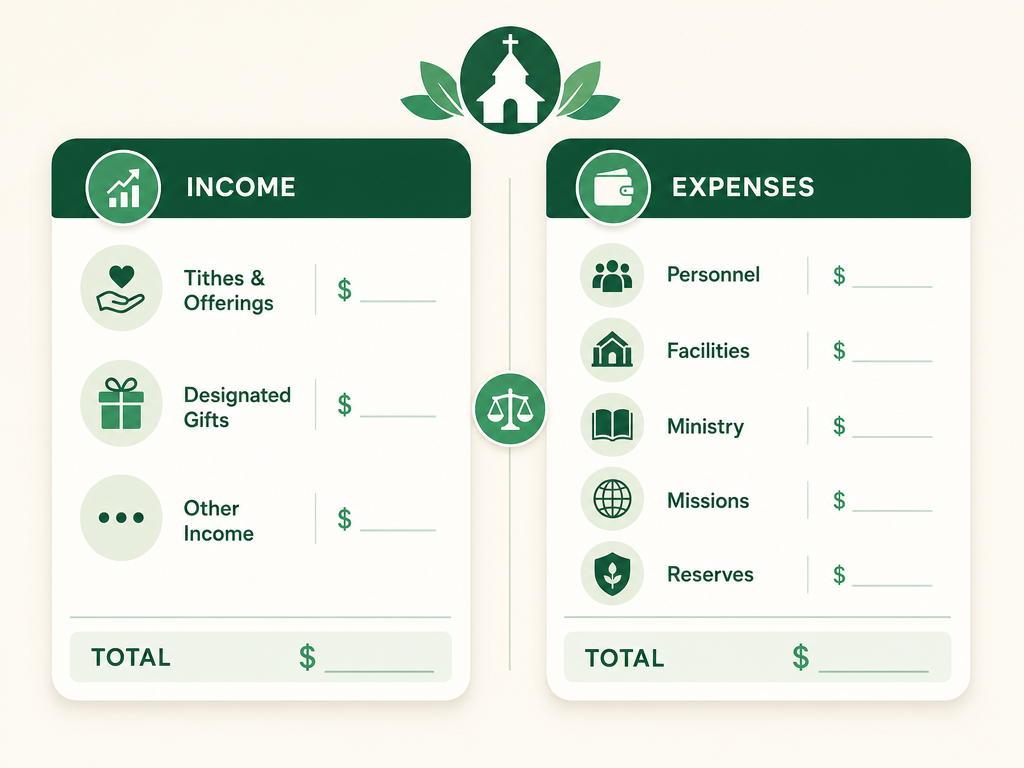
- Income — regular tithes and offerings, designated gifts, and any other income (facility rental, interest).
- Personnel — pastoral and staff salaries, the housing allowance, payroll taxes, and benefits.
- Facilities — mortgage or rent, utilities, insurance, maintenance.
- Ministry and programs — worship, education, youth, benevolence.
- Missions and outreach — local and global giving.
- Reserves — a planned contribution to savings for emergencies and big repairs.
How to create a church budget, step by step
Building a church budget follows a repeatable process, ideally finished a month or two before the new year:
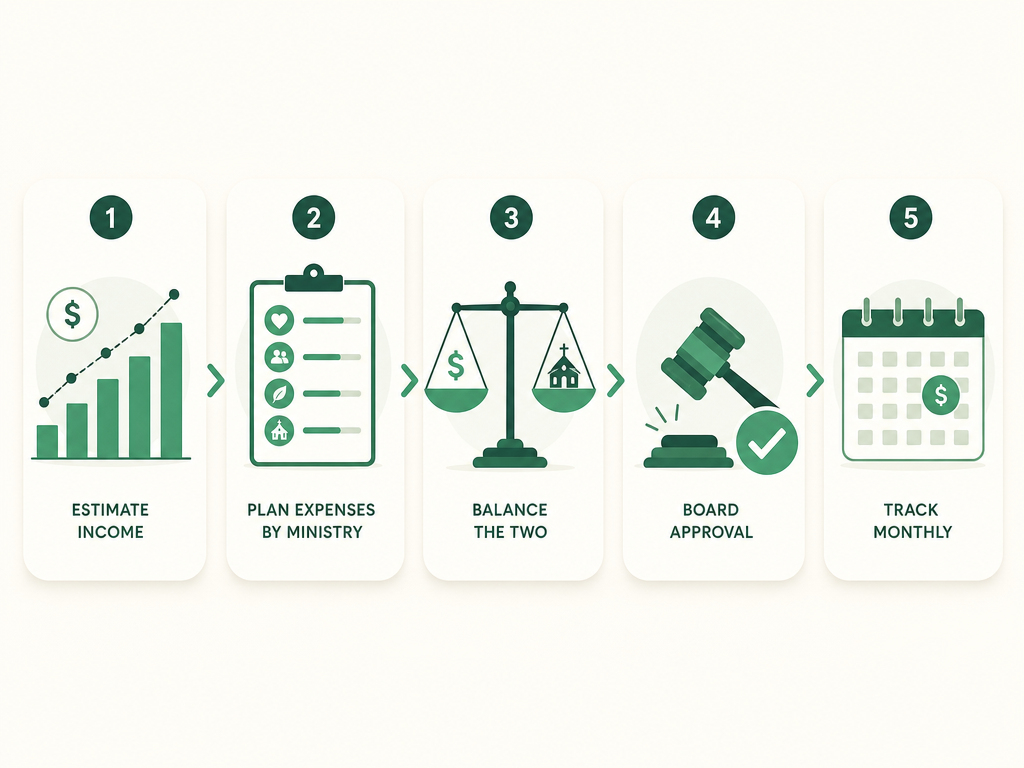
- Estimate income from the last two or three years of giving, adjusted for known changes — not wishful thinking.
- Plan expenses by ministry, asking each area what it actually needs.
- Balance the plan so expenses don’t exceed realistic income; cut or phase the gap.
- Approve it through the board, and communicate it to the congregation.
- Track it monthly against actual giving and spending so you can adjust early.
A typical church budget breakdown
While every church is different, most healthy church budgets land in similar ranges — roughly half to personnel, a quarter to facilities, and the rest split across ministry, missions, and reserves. The specific percentages, and the guidance on keeping staff costs under control, are covered in church budget percentages — or split your income across categories with the church budget calculator. To see the whole thing as real dollar figures, here’s a full sample church budget, and how yours compares to the average church budget by size.
Zero-based vs. incremental budgeting
Two methods dominate. Incremental budgeting starts with last year’s numbers and adjusts — fast, but it carries forward old assumptions. Zero-based budgeting starts each line at zero and makes every ministry justify its request — more work, but it catches spending that no longer earns its place. Many churches alternate: incremental most years, a zero-based reset every few. Either way, our free church budget template gives you the categories and percentages to start from.
What the “80/20 rule” really means for a church
The “80/20 rule” people ask about isn’t a budgeting formula — it’s the common observation that roughly 80% of a church’s giving comes from about 20% of its givers. It matters for budgeting because it means your income is more concentrated, and more fragile, than a head count suggests: a few families moving can swing the budget. It’s a reason to budget income conservatively and build reserves, not a rule about how to split spending.
Keeping the budget on track
A budget adopted in January and ignored until December isn’t a budget — it’s a wish. The discipline is the monthly budget-versus-actual review: comparing planned to real numbers on the church financial statements, catching a giving shortfall while there’s still time to respond. The right church budget software makes that comparison automatic, and it’s only as good as the books under it — which is why clean fund accounting and budgeting go together.
Vestrybooks builds your budget in, then shows budget-versus-actual automatically as money comes and goes — so the plan stays a living tool, not a forgotten spreadsheet. See plans →
FAQ
What should a church budget include? Expected income (tithes, offerings, designated gifts, other income) and planned expenses across personnel, facilities, ministry and programs, missions, and a reserve contribution.
How do you make a church budget? Estimate income from your giving history, plan expenses by ministry area, balance the two, get board approval, and track it monthly against actual numbers.
What is the 80/20 rule for churches? The observation that about 80% of giving comes from about 20% of givers — a reason to budget income conservatively, not a rule for splitting spending.
What does the Bible say about a church budget? Scripture doesn’t prescribe a budget format, but it consistently calls for stewardship, planning, and counting the cost — the principles a budget puts into practice.
Should a church have a budget? Yes. A budget turns the year’s giving into a ministry plan, sets clear spending guardrails, and gives the board a way to oversee where the money goes. Even a small church benefits — it’s less about the size of the numbers than about deciding on purpose rather than reacting month to month.
What does a healthy church budget look like? Most healthy church budgets land in similar ranges: roughly half to personnel, about a quarter to facilities, and the rest split across ministry, missions, and reserves. The exact split depends on your size and stage, and a higher staff share isn’t automatically wrong — see the full breakdown in church budget percentages above for where the lines usually fall.
What is a good church budget? A good church budget projects income realistically from your actual giving history, balances so planned spending doesn’t outrun that income, and sets aside a reserve line. Just as important is that it’s reviewed every month against actual numbers, so a shortfall shows up while there’s still time to act rather than at year-end. When the gap is real, a well-run round of church fundraising ideas can help close it without cutting ministry.
Are church budgets public? A church isn’t legally required to publish its budget — most churches file no Form 990 — so there’s no public document the way there is for many nonprofits. Still, sharing the budget with members and the board is best practice: open numbers build the trust that giving depends on. For what a church does and doesn’t have to disclose, see are church finances public.
How much should a church keep in reserve? A common guideline is a few months of operating expenses — enough to cover payroll and the building through a slow giving stretch or a surprise repair. Treat it as a deliberate budget line you fund a little each month, not whatever happens to be left over at year-end.
This is general information, not financial advice — set your church’s budget with its leadership and a qualified advisor.
This article is general information for church treasurers, not professional tax or legal advice. For your church's situation, consult a qualified accountant or attorney.
Church accounting a volunteer can actually do.
Vestrybooks is church accounting + giving for the volunteer treasurer — fund tracking, one-click year-end statements, and online giving with $0 taken from every gift.
A real free plan · no credit card · your data stays yours