Blog · Bookkeeping & accounting
How do churches make money?
July 4, 2026 · By Benjamin Reinke
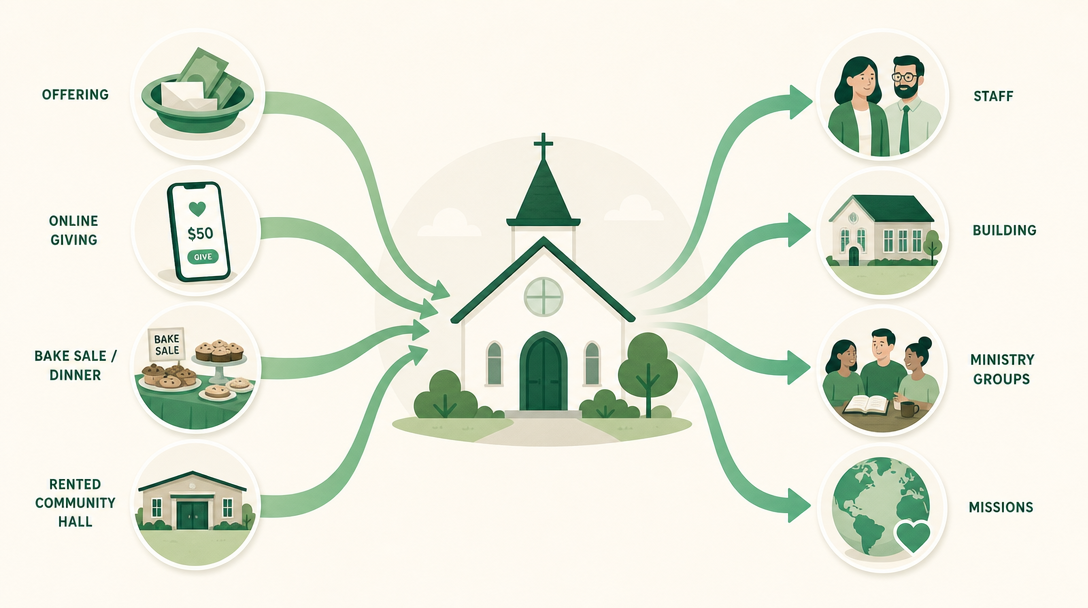
Short answer: For most churches, the overwhelming majority of the money comes from tithes and offerings — the regular giving of the people who attend, dropped in a plate, mailed in, or given online. On top of that base, churches add smaller streams: designated gifts for a specific need, occasional fundraisers and events, renting out the building, sometimes a bookstore or café, investment income, grants for community programs, and denominational support. A church doesn’t earn a “profit” — it’s a nonprofit, so every dollar that comes in is held in trust and goes back out to staff, the building, ministry, and missions.
Where do churches get their money?
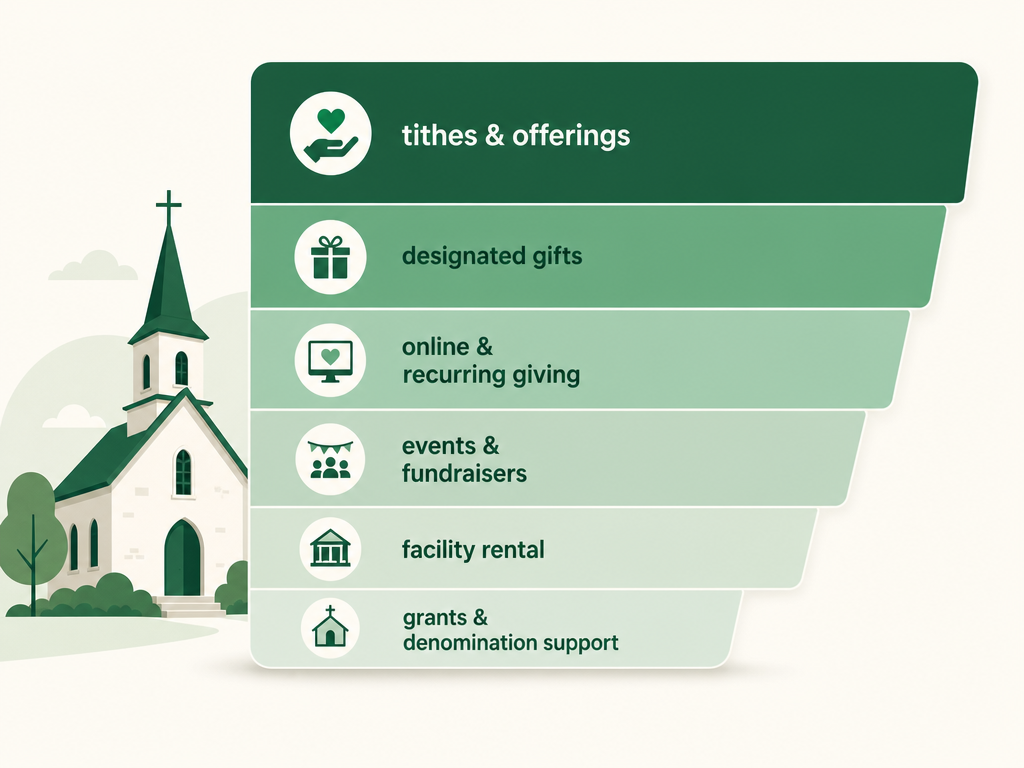
Nearly all of a typical church’s income is voluntary giving. There’s no product being sold and no owner drawing earnings — the money comes from people who believe in what the church does and choose to fund it. Here’s the whole picture, biggest source first.
Tithes and offerings (the overwhelming majority)
This is the base, and for most churches it’s not close. A tithe is a person giving a portion of their income to the church as a regular commitment (traditionally a tenth); an offering is a gift over and above that. Together they fund the operating budget — the salaries, the lights, the ministry that runs week to week.
The honest numbers: across all attenders, average giving runs about 2.5% of income, well under the traditional 10% tithe, and only about 27% of churchgoers tithe at the full 10% mark (Aplos, citing Christianity Today / Barna). So a church’s income depends less on everyone giving a perfect tithe and more on a committed core giving faithfully. That’s why the deeper distinction between a tithe and an offering — and the tax side of it — is worth understanding on its own; there’s a full walkthrough in the guide to tithing at church.
Online and recurring giving
The plate still passes, but the money increasingly arrives digitally. About half of all church donations now come by card or online, and recurring (automatic) gifts made up roughly 42% of digital giving in a recent year (Aplos). Recurring giving matters because it doesn’t dip when attendance dips — the gift keeps coming whether the giver made it to church that Sunday or not, which steadies a church’s income more than any single fundraiser can.
Designated and special offerings
Some gifts come tagged for a purpose: a building fund, a mission trip, benevolence for a family in crisis, a Christmas Eve offering for a specific cause. These are designated gifts, and they’re a real income stream — but with a string attached. Money given “for the roof” can only be spent on the roof. That constraint is the single most important idea in church money, and it’s why churches track income by purpose rather than as one lump. More on how that works in the “where it goes” section below.
Fundraisers and events
Bake sales, dinners, auctions, seasonal appeals, a capital campaign for a new building — these raise money for a specific need beyond the regular budget. For a healthy church they’re a supplement, not the base: if a church is leaning on fundraisers to cover the electric bill, the real problem is the giving base, not the fundraiser. Done well, a targeted event funds one clear goal. For a grouped list of what actually works and how to run one, see church fundraising ideas.
Facility rental and small business income
Many churches let outside groups use the building — a preschool during the week, a recovery group, a wedding, another congregation renting the sanctuary on a different day. Some run a bookstore or a café. This is real income, and it’s usually welcome, but it comes with a wrinkle: when a church earns money from an activity that isn’t part of its religious mission, that income can be taxable as unrelated business income, even though the church itself is tax-exempt. It’s not a reason to avoid renting the hall — it’s a reason to track that money separately. The rules are laid out in the guide to whether do churches pay taxes.
Investment income, grants, and denominational support
Rounding out the picture:
- Investment income — interest or returns on savings and reserves. For most small churches this is minor; for larger churches with an endowment it can matter.
- Grants — some churches receive grants for community programs (a food pantry, after-school care, disaster relief) from foundations or, occasionally, government sources for the non-religious service side.
- Denominational support — smaller or church-plant congregations sometimes receive funding from their denomination or a sending church, especially in early years.
None of these is the main event for a typical small church, but together they can make the difference between a tight year and a stable one.
Do churches make a profit?
No — not in the way a business does. A church is a nonprofit, which means there are no owners and no shareholders taking home earnings. When more money comes in than goes out in a year, that surplus doesn’t become anyone’s income; it stays in the church’s accounts as reserves for future ministry, a building repair, or a lean season ahead.
It’s fair to ask the cynical version of this question, so here’s the honest answer: most small churches run lean. The money that comes in gets committed almost entirely to running the church — and the biggest line is usually people. Are pastors rich? A few high-profile megachurch pastors are, and they get the headlines. The typical pastor of a small congregation is not; the salary is modest and often the church is one bad quarter away from a hard conversation. What actually protects a congregation from the rare bad actor isn’t hoping for the best — it’s accountability: clear records, more than one person watching the money, and a board that can see exactly where every dollar came from and went. That’s the whole reason church bookkeeping exists.
Where does the money go?
Money in a church is held in trust and spent back out on the mission. A typical small-church operating budget breaks down roughly like this:
| Where it goes | Typical share | What it covers |
|---|---|---|
| Personnel | ~45–55% (up to 60% for smaller churches) | Pastor and staff salaries, benefits, payroll taxes |
| Facilities | ~20–30% | Mortgage or rent, utilities, insurance, upkeep |
| Ministry programs | ~10–15% | Kids and youth, worship, small groups, discipleship |
| Missions and outreach | ~10% (often 10–25%) | Missionaries, benevolence, community programs |
| Admin and reserves | ~5–10% | Software, office, and savings for a rainy day |
Source: Vanderbloemen, ChurchTrac. These are rules of thumb, not laws — every church’s split reflects its own priorities.
The pattern most people don’t expect: the single biggest expense in almost every church is people, not buildings. Ministry is labor-intensive, and the pastor and staff are how the church actually does what it exists to do.
The catch: much of the money is restricted
Here’s what makes church money different from a business’s. A big chunk of what comes in isn’t the church’s to spend freely — it’s restricted by the donor to a specific purpose. That $500 “for the building fund” can’t pay the electric bill, even if the electric bill is overdue and the building fund is flush. So a church can’t just look at its bank balance and know what it can spend; it has to know how much of that balance is promised elsewhere.
The system that keeps those promises straight is church fund accounting: every dollar is tagged to a “fund” — general, building, missions, benevolence — each with its own balance, so the church can prove at any moment that restricted money went where it was given. It’s the difference between “we have $30,000 in the bank” and “we have $12,000 we can actually spend, because $18,000 belongs to the building fund.”
Track every income source so you can always show where the money came from
The through-line of everything above is accountability. A church that can’t say where its money came from and where it went isn’t just disorganized — it’s one honest question away from an awkward board meeting, and one bad actor away from a real problem.
Vestrybooks is built around exactly this: every gift is recorded by fund and by giver, so tithes, designated gifts, event income, and rental income each stay in their own bucket. When someone asks where the building-fund money is, the answer is one click — and free online giving with no platform cut means more of every dollar reaches the mission instead of a processor. See how it works.
FAQ
Where do churches get their money? Mostly from the voluntary giving of the people who attend — tithes and offerings, given in the plate, by mail, or online. Smaller streams add to that base: designated gifts for a specific need, fundraisers and events, renting out the building, sometimes a bookstore or investment income, grants for community programs, and denominational support for younger churches.
Do churches make a profit? No. A church is a nonprofit with no owners, so it doesn’t earn profit the way a business does. If more comes in than goes out in a year, that surplus stays in the church’s accounts as reserves for future ministry and repairs — it doesn’t become anyone’s income.
What percentage of church income comes from tithes and offerings? For most churches, the large majority. There’s no single national figure because it varies by congregation, but regular giving is the base almost every other stream sits on top of. Average giving runs about 2.5% of income across all attenders, and only about 27% of churchgoers tithe the full 10%, so churches lean heavily on a committed core of faithful givers.
Are church offerings taxed? No — offerings and tithes are gifts, not taxable income to the church, which is exempt from federal income tax as a nonprofit. The exception is money a church earns from activities unrelated to its mission, like renting space to a business, which can be taxable as unrelated business income. The full rundown is in the guide to whether churches pay taxes.
Where does the money go? Back out to the mission. In a typical small church, personnel (salaries and benefits) is the biggest slice at roughly 45–55%, then facilities at 20–30%, then ministry programs, missions and outreach, and a small amount for admin and reserves.
This is general information, not tax or legal advice. For your church’s specific situation, consult a qualified accountant or tax professional.
This article is general information for church treasurers, not professional tax or legal advice. For your church's situation, consult a qualified accountant or attorney.
Church accounting a volunteer can actually do.
Vestrybooks is church accounting + giving for the volunteer treasurer — fund tracking, one-click year-end statements, and online giving with $0 taken from every gift.
A real free plan · no credit card · your data stays yours