Blog · Bookkeeping & accounting
The church year-end financial checklist
July 4, 2026 · By Benjamin Reinke

Short answer: The church year-end financial close is a short, ordered checklist, not a January emergency. In December you reconcile every bank and credit-card account through the 31st, review your budget-versus-actual and fund balances, confirm all giving is recorded and restricted funds are correct, then close the books for the year. In January you issue W-2s and 1099-NECs and file your Q4 Form 941 — all due by January 31 — send every donor a year-end contribution statement, prepare an annual report for the board, and carry balances forward into the new year’s budget and funds. Do it in that order and each step takes an evening, not a lost weekend.
The reason year-end feels like a panic is that people try to do all of it at once, in January, under a deadline. It doesn’t have to be that. If your books were reconciled every month, the close is mostly confirmation — you’re checking that December ties out, then producing a handful of documents the year’s records already contain. This is the annual counterpart to the monthly rhythm in the guide to church bookkeeping: that post covers the loop you run all year; this one covers the close you run once, at the turn of the year.
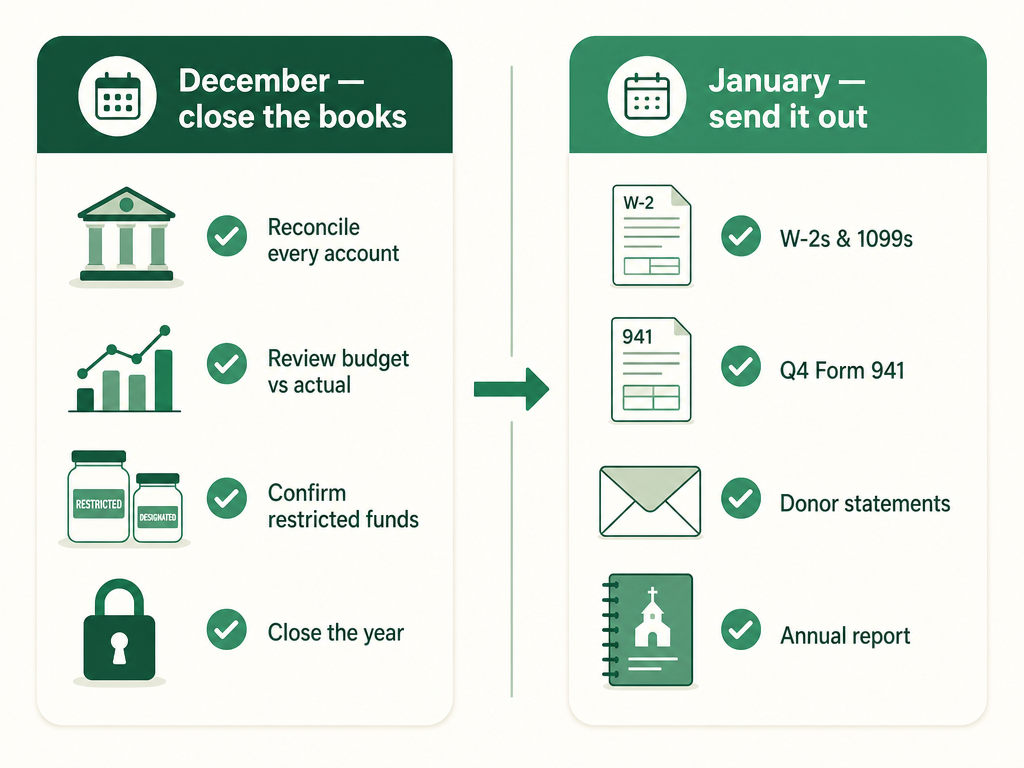
Part one — closing December’s books
Everything downstream depends on December being finished and correct. Do these four steps in order before you touch a single January deliverable, because a statement or a report built on unreconciled books just has to be redone.
Reconcile every bank and credit-card account through December 31
Start here, always. Pull the December statement for each account — checking, savings, and every credit or debit card — and match it to your books line by line until they agree to the penny. This is the step that catches a missed deposit, a duplicate entry, or a check that never cleared, and it’s the one that makes every later number trustworthy. Do not close the year on an account that doesn’t reconcile; chase the difference until you find it.
Reconciliation is also the anti-fraud step. A church that ties its books to the bank every month, and formally at year-end, is far harder to steal from quietly. If any account is behind, catch it up now — an account reconciled through November but not December isn’t closed.
Review the budget-versus-actual for the full year
With the accounts reconciled, run a budget-versus-actual for the whole year. You’re looking for two things: categories that blew past what you planned, and income lines that fell short. This isn’t about assigning blame — it’s the story you’ll tell the board in the annual report, and it’s the raw material for next year’s budget. Note the big variances and a one-line reason for each while the year is fresh in your memory.
Confirm every fund balance and that restricted money is intact
Now check the funds. Run a balance by fund — general, building, missions, benevolence — and confirm two things. First, that no fund is negative: a fund in the red usually means you spent restricted money on something it wasn’t given for, and that’s a problem to fix, not to bury. Second, that every donor-restricted gift landed in the right fund and that restricted balances still equal what donors gave for that purpose minus what was properly spent on it.
This is the heart of church accounting — the promise that a gift given for the roof is still there for the roof. Getting it right at year-end is what lets you tell donors and the board, honestly, that every restricted dollar is accounted for. The distinction that matters: donor-restricted money is bound by the giver and you can’t redirect it; board-designated money the board set aside itself, so the board can un-set it. Confirm the restricted balances are clean before you close.
Make sure all giving is recorded, then close the year
Before you close, confirm every contribution for the year is entered and posted against the right donor — the December offerings, any year-end gifts that arrived by the 31st, and online giving. Gifts mailed with a December postmark or given by December 31 count for that tax year, even if you deposit them in January; get the dates right so donor statements are correct.
Then close the books for the year. In practice that means locking the period so the totals can’t shift — no back-dating a January transaction into the closed year. Once December is reconciled, the budget reviewed, the funds confirmed, and giving recorded, you close, and the year’s numbers are final. That’s part one done.
Part two — the January deliverables
With the books closed, the rest of the close is producing documents from records you already have. Three of these carry a hard January 31 federal deadline, so do them first.
Issue W-2s and W-3, and 1099-NECs, by January 31
If your church paid employees — most commonly the pastor, and often office or music staff — you must furnish each a Form W-2 and file those W-2s with the Social Security Administration, along with the Form W-3 transmittal that summarizes them, by January 31 (SSA: Employer W-2 Filing). Note that clergy pay has its own quirks — a minister’s wages generally aren’t subject to Social Security and Medicare withholding the way a lay employee’s are — so make sure the pastor’s W-2 was set up correctly during the year.
If your church paid $2,000 or more (the threshold for payments made in 2026, up from $600 through 2025) to an unincorporated contractor — a guest speaker, a bookkeeper, a repair crew, a musician who isn’t an employee — you must send each a Form 1099-NEC and file it with the IRS, also by January 31 (IRS: About Form 1099-NEC). The details of who gets which form, and how clergy differ, are in the guide to church tax forms. (Note: when January 31 falls on a weekend, the deadline shifts to the next business day — but plan around the 31st so a calendar quirk never catches you short.)
File the fourth-quarter Form 941
If you withheld income tax, Social Security, or Medicare from any employee’s pay, you file a Form 941 each quarter. The fourth-quarter return — covering October through December — is due January 31 (IRS: About Form 941). File it alongside your W-2s so all the payroll paperwork clears in one sitting. A church with no employees and no withholding generally has no 941 to file, but confirm that’s actually your situation before you skip it.
Send every donor a year-end contribution statement
This is the deliverable your congregation actually feels — the one where a shoebox of records becomes a moment of trust. Every donor needs a written statement of their giving for the year so they can substantiate a deduction. The IRS requires a contemporaneous written acknowledgment for any single gift of $250 or more, and most churches satisfy the whole year’s rules with one year-end statement sent by January 31 (IRS Publication 1771).
The statement lists each gift by date and fund, totals the year, and carries the specific “no goods or services were provided in exchange, other than intangible religious benefits” line that makes the gifts deductible. Get that closing language and the thresholds right — the full rules, including the quid-pro-quo disclosure over $75, are in the guide to church contribution statement requirements. Because you already confirmed all giving was recorded in part one, this step is generating documents, not reconstructing a year of gifts.
Prepare the annual report for the board and congregation
The annual report is where the year’s numbers become a story the people who govern and support the church can read. It’s the year-end version of the monthly treasurer’s report — the full year against budget, fund-by-fund balances, the cash tied to your December reconciliation, and a few plain sentences on how the year went and what needs attention. Many churches present it at the annual meeting alongside the year-end statements and the coming year’s proposed budget. Lead with the answer the board and members want most: is the money handled well, and is every restricted fund intact? The variance notes you jotted down in part one are most of this report already written.
Carry balances forward and set up the new year
The last step turns the page. Carry each fund’s ending balance forward as the new year’s opening balance — the missions fund doesn’t reset to zero on January 1; it starts wherever December 31 left it. Then set up the new year: adopt the budget (informed by the variances you just reviewed), confirm your fund list still matches your ministries, and make sure your books are ready to record January’s first giving. Now you’re back to the monthly loop, and next year’s close will be even shorter.
The whole year-end close, in order
Here’s the entire checklist in the sequence to run it. December first, then January — never the other way around.
| # | Step | When | Why it’s in this spot |
|---|---|---|---|
| 1 | Reconcile every bank and card account through Dec 31 | December | Every later number depends on the books tying to the bank |
| 2 | Review budget-versus-actual for the full year | December | Surfaces variances and feeds the annual report + next budget |
| 3 | Confirm fund balances; check restricted money is intact | December | Proves every restricted dollar is still set aside for its purpose |
| 4 | Record all giving, then close the year | December | Locks final totals so statements and reports are correct |
| 5 | Issue W-2s / W-3 and 1099-NECs | By Jan 31 | Hard federal deadline for payroll and contractor forms |
| 6 | File Q4 Form 941 | By Jan 31 | Hard federal deadline for quarterly payroll tax |
| 7 | Send donor year-end contribution statements | By Jan 31 | Donors need them to substantiate deductions before they file |
| 8 | Prepare the annual report | January | Presents the closed year to the board and congregation |
| 9 | Carry balances forward; set up the new year | January | Opens the new year’s funds and budget cleanly |
How Vestrybooks turns the close into a checklist, not a panic
Most of the January panic comes from a year that wasn’t kept up. Vestrybooks removes it from three directions. Reconciliation is a guided match-the-bank step you can run all year, so December is already tied out when you get there. Fund balances are tracked as you go, so confirming restricted money is a glance, not a rebuild. And the year-end contribution statements — the deliverable that used to eat your January — are one click: because every gift, whether you entered it by hand or it came through free online giving, is already tied to the donor, the January Button generates an IRS-ready statement for every donor with the correct disclaimer wording and sends them.
Vestrybooks takes $0 of your online giving, and the year-end statements are included. See pricing →
FAQ
What is a church year-end financial checklist? It’s the ordered set of tasks a treasurer runs to close the year: reconcile every bank and credit-card account through December 31, review the budget-versus-actual, confirm fund balances and restricted money, record all giving and close the books, then in January issue W-2s and 1099-NECs, file the Q4 Form 941, send donors their contribution statements, prepare an annual report, and carry balances into the new year’s budget.
When are church W-2s, 1099s, and Form 941 due? All three carry a January 31 federal deadline. Employers must furnish W-2s and file them with the SSA (with the W-3 transmittal), send 1099-NECs to contractors paid $2,000 or more and file them with the IRS, and file the fourth-quarter Form 941 for payroll taxes. When January 31 lands on a weekend, the deadline moves to the next business day.
When should a church send year-end giving statements? There’s no hard federal deadline on the church, but January 31 is the practical one, since donors start filing early in the year. Sending by then gives every donor their written acknowledgment before they need it — and the IRS requires that acknowledgment for any single gift of $250 or more.
How do you close out a church’s books for the year? Reconcile every account through December 31, confirm all income and expenses are recorded, verify each fund balance (especially that restricted funds aren’t negative), then lock the period so the year’s totals are final. After closing, you carry each fund’s ending balance forward as the new year’s opening balance.
Do small churches with no employees still have a year-end close? Yes, just a shorter one. You still reconcile every account, confirm fund balances, record all giving, close the books, send donor contribution statements, and prepare an annual report. You skip the payroll forms — no W-2s, 1099s, or Form 941 — if the church truly had no employees and paid no contractor $2,000 or more.
This guide is general information, not tax or legal advice — consult a qualified professional for your church’s situation.
This article is general information for church treasurers, not professional tax or legal advice. For your church's situation, consult a qualified accountant or attorney.
Church accounting a volunteer can actually do.
Vestrybooks is church accounting + giving for the volunteer treasurer — fund tracking, one-click year-end statements, and online giving with $0 taken from every gift.
A real free plan · no credit card · your data stays yours