Blog · Bookkeeping & accounting
How to count the church offering the right way
July 4, 2026 · By Benjamin Reinke

Short answer: Count the church offering with two unrelated people, together, in a secured room, and never let the cash sit in one person’s sole possession. Secure the plate the moment it leaves the sanctuary, count loose cash and checks separately, write the totals on a count sheet, and have both counters sign it in ink. Deposit the same day or the next business day, then hand the signed count sheet to a different person who records giving — so whoever counted the money never records it, and whoever records it never had the cash. That signed sheet is the linchpin: it’s the record that the amount received equals the amount banked, and it’s what protects every volunteer who touches the money from ever being suspected.
What counting the offering actually protects
Counting the offering is the single most exposed moment in a church’s money, because until the plate is counted and written down, no record exists that the money ever came in. A dollar that goes missing before the count leaves no trace — there’s nothing to reconcile it against. That’s not a reason for suspicion; it’s the reason for procedure. A clean, two-person count with a signed sheet does two things at once: it makes theft hard to pull off, and it makes an honest volunteer impossible to accuse. If the numbers always match and two signatures always back them, no one can ever wonder about the person who carried the bag.
This page is the hands-on operational manual — the actual step-by-step of counting the offering and handling church cash. It sits alongside the broader system of church internal controls, which explains why the jobs are split (segregation of duties, dual approval, monthly review) and how the count fits among the other controls. Here we go deep on the procedure itself: who counts, what goes on the sheet, how you deposit, and what to do with the money that doesn’t arrive in the Sunday plate.
The offering-count procedure, step by step
The rule underneath every step is one sentence: the cash is never in one person’s sole possession, from the moment the plate is passed to the moment it’s deposited. Here is the full workflow for a normal Sunday.
- Secure the offering immediately. The instant the plates come out of the service, ushers move the loose offering into a locked tamper-evident bag or the church safe. It is never left on a table, never carried home by one person “to count later,” never stored in a car. Church funds belong in the church’s safe until they go to the bank — cash receipts should never sit in an automobile or in someone’s home (Church Law & Tax, tips for counting cash).
- Bring in two unrelated counters, together. Two people who aren’t related and don’t live together open and count the offering in the same room. Spouses, partners, parent-and-child, and coworkers should never be the pair — the whole point of two people is that each is an independent witness, and relatives aren’t independent (Church Law & Tax). No one counts alone, ever, not even “just this once because the other person didn’t show.”
- Count in a secured room, on church premises. The count happens where there’s no through-traffic and no interruptions — a room people can’t wander into for a bathroom or a supply closet. The money never leaves the building to be counted (Church Law & Tax).
- Count loose cash and checks separately. Total the currency and coin as one figure and the checks as another. Keeping them separate is what lets you later prove the deposit matches — and it’s how you catch a check accidentally counted as cash. As each check comes out, stamp it “for deposit only” right away so a lost or stolen check can’t be cashed.
- Record designated and restricted gifts as you go. When a gift is marked for a purpose — an envelope that says “missions,” a check memo reading “building fund,” a special second-collection envelope — pull it into its own labeled bundle and write it on the sheet as a separate line by fund. Don’t let designated money melt into the general total; once it’s mixed in, you’ve lost the record of a promise the church made to the donor. (More on this below.)
- Both counters complete and sign the count sheet, in ink. The two counters agree on every total, one records while the other verifies, then a recount confirms it. Both sign — in ink, not pencil — and the two signatures are the church’s record that the amount received equals the amount that will be banked (Church Law & Tax).
- Deposit the same day, or the next business day. The signed count sheet and the cash go to the bank as soon as possible — ideally that day via a night-deposit drop, otherwise first thing the next business day. The shorter the window between count and deposit, the smaller the chance for anything to go missing (Church Law & Tax).
- Hand the signed count sheet to a separate record-keeper. Whoever enters giving into the books works from the signed count sheet — not from loose cash, and never from money they counted themselves. The counters had custody but don’t keep the books; the record-keeper keeps the books but never touched the cash. Neither can make a dollar disappear without the other’s gap showing.
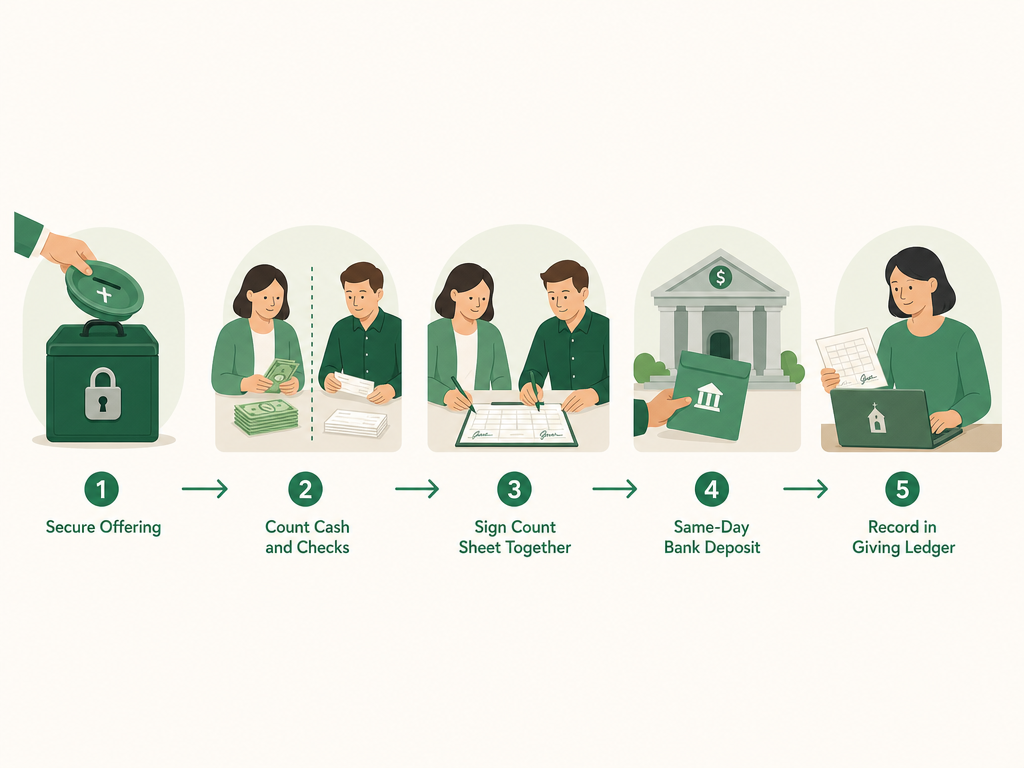
That last handoff in step 8 is the quiet genius of the whole thing. It’s a piece of the recording routine covered in the guide to church bookkeeping — the count feeds the books, but the counter and the bookkeeper are never the same person.
What a count sheet contains, and why it’s the linchpin
The count sheet is the document that turns a pile of cash into a trustworthy record. It’s the single most important artifact of the whole procedure, because it’s the fixed number everything downstream reconciles to: the bank deposit, the books, and each donor’s giving record all have to match the sheet. Fill it out in ink and completely, and a missing dollar has nowhere to hide.
A good count sheet captures, at minimum:
- Date and service — which Sunday and which service the offering came from.
- Loose currency and coin — the cash total, ideally broken out by denomination so a recount is quick.
- Checks — the check total, kept separate from cash, often with a list of individual checks.
- Designated and restricted gifts — each purpose-tagged gift on its own line, by fund (missions, building, benevolence), so restricted money is tracked from the very first moment it’s counted.
- Envelope detail for giving records — for gifts in numbered or named envelopes, the donor and amount, so the record-keeper can post each gift to the right giver for year-end statements.
- The grand total — cash plus checks, the number that must equal the bank deposit.
- Two counter signatures, in ink — the proof that two independent people agree on the figures above.
Everything after the count is a comparison against this sheet. When the bank deposit equals the sheet total and the books equal the sheet total, the money is fully accounted for from plate to ledger. When they don’t, the sheet is where you start looking. Keep a copy of every signed count sheet filed with that day’s deposit slip so the two always travel together.
Choosing and rotating your counters
Who counts matters as much as how they count. The counters don’t have to be officers — any two trustworthy members who aren’t related to each other will do, and pulling in ordinary members is actually better, because it keeps the highest-risk step off the bookkeeper’s plate entirely. A few rules make the choice sound:
- Two unrelated people, never relatives or a couple. Independence is the entire point; two people from the same household are one witness, not two.
- Not the bookkeeper, treasurer, or financial secretary. The people who record giving or handle the bank shouldn’t also be the ones counting — that’s the separation that makes the count a real control. (For how those money roles divide up, see the church treasurer guide.)
- Rotate the teams. Don’t let the same two people count every single week. Build a small pool of counters and rotate the pairings so no one pair “owns” the offering. Rotation is itself a control — it means more eyes see the process over time.
- Be thoughtful about who you ask. It’s kind and wise not to hand sole cash duties to someone in acute financial hardship; it protects them from temptation and from suspicion alike (Church Law & Tax).
None of this implies distrust of any particular person. Rotation and independence protect the volunteers who serve — the person who never counts alone is the person who can never be blamed.
Handling designated and restricted gifts noted in the plate
Designated gifts are the count’s easiest thing to get wrong, because they arrive mixed into the same plate as everything else. A check with “roof fund” in the memo, an envelope pre-printed for missions, a bill tucked in an envelope marked “benevolence” — each of those is a promise the church made to use that money for that purpose, and the promise only survives if it’s captured at the count. Once a designated gift disappears into the general total, there’s usually no way to reconstruct it.
So handle them at the table, not later:
- Pull them out as you find them. Separate designated gifts into clearly labeled bundles so they never blend into the general offering.
- Write each on its own count-sheet line, by fund. The sheet should show, for that Sunday, how much went to general, how much to missions, how much to building, and so on.
- Respect the donor’s restriction versus the church’s designation. A gift the donor restricts (“this is for the roof”) is legally bound to that use. Money the board designates it can later re-designate. Both get tracked as separate funds; the difference matters when you spend it. This is the heart of fund accounting, which the church’s books are built to keep straight.
- Deposit and record with the designation intact. The record-keeper posts each designated gift to its fund from the count sheet, so the fund balances always reflect what was actually given.
Track designated money from the count sheet forward and its balance can never be quietly drained — one of the specific red flags that oversight looks for in protecting your church from embezzlement.
Reconciling the count to the actual bank deposit
The count sheet is only proven once it matches what the bank actually received. Reconciling the count to the deposit is the step that closes the loop between the sanctuary and the bank account, and it should happen for every service, not just at month-end. The comparison is simple: the grand total on the signed count sheet must equal the amount the bank credited.
- Match the deposit slip to the count sheet. The bank-stamped deposit total should equal the sheet’s cash-plus-checks total to the penny.
- Watch for deposits that come in short or late. A deposit smaller than the count sheet, or one that took days to reach the bank, is exactly the kind of gap the count is designed to expose.
- Have someone independent do the checking. The person who confirms the deposit matches the books should not be one of the counters and should not be the record-keeper — a third set of eyes, usually as part of the monthly bank reconciliation. That independent review is where a skimmed deposit shows up as a number that doesn’t add up.
- Resolve any difference immediately, with different people. If the count and the deposit disagree, recount and re-check using someone other than the original counters, and write down what the discrepancy was and how it was cleared.
When the count sheet, the deposit slip, and the books all carry the same number, the money is genuinely accounted for — and that reconciled figure is what makes the treasurer’s numbers trustworthy to the board.
Cash that arrives outside the Sunday offering
The Sunday plate isn’t the only way money walks in the door, and the cash that arrives outside the offering is where controls most often quietly break down. Event income at a bake sale, facility-rental checks, registration fees for a retreat, cash handed to the office mid-week, checks that come in the mail — none of it passes through the Sunday count unless you build it in. Every one of those streams needs the same discipline: two hands on it, a written record at the point it arrives, and a prompt deposit.
- Event and program income. For a fundraiser, potluck, or ministry event, have two people count the take on-site, complete a short count sheet, and treat it exactly like an offering. Cash that’s “roughly this much” is cash that’s already lost its record.
- Mail and mid-week gifts. Open the mail with two people present, log every check and cash gift the day it arrives, and stamp checks “for deposit only” immediately. A mail log the office keeps is the count sheet for money that never touches the plate.
- Fees and rentals. Route facility rentals, class fees, and registrations through a written receipt so there’s a record independent of whoever collected the money.
The common thread is that money should never be recorded from memory. If it arrived in cash, two people counted it and wrote it down before anyone was alone with it.
A note on petty cash
Petty cash is the small exception where a little loose cash lives on-site for minor expenses, and it needs its own tight rules because it’s the one place cash sits around. Keep it small — many churches hold around $100 — in a locked box with a single custodian and a designated backup (Free Church Accounting, petty cash procedures). Run it as an imprest fund: every dollar spent is backed by a receipt, so the receipts plus the remaining cash always equal the starting amount. Reconcile it at least monthly, and never use it to pay wages, vendors, or anyone for personal services. Petty cash is for stamps and coffee filters, not a second, unwatched checkbook.
The offering-count checklist
Run this every Sunday. Every “no” is a gap worth closing before it costs you.
- The offering was secured in a locked bag or safe the moment it left the service.
- Two unrelated people counted it together, in a secured room, on church premises.
- Neither counter is the bookkeeper, treasurer, or financial secretary.
- Loose cash and checks were counted separately, and checks were stamped “for deposit only.”
- Designated and restricted gifts were pulled out and written on the sheet by fund.
- Both counters completed and signed the count sheet in ink.
- The deposit went to the bank the same day or the next business day.
- The signed count sheet was filed with the deposit slip.
- The signed sheet was handed to a separate record-keeper to enter the giving.
- Someone independent reconciled the deposit to the count sheet.
- Counters are rotated so the same pair doesn’t count every week.
How Vestrybooks fits the count
The count procedure runs on paper and people — but the record-keeping after the count is where a small church stays honest without staffing a finance department. Vestrybooks records giving against the signed count-sheet total, so the books, the bank, and the sheet all trace to the same number. Every financial change writes to an immutable audit log — a record of who entered or edited what, that no one can quietly alter. And a bank match is always confirmed by a human, never applied silently, so the deposit that lands is checked against the count that was recorded. That’s the extra set of eyes a two-person church can’t hire, doing the reconciling in the background.
FAQ
How should church offerings be counted? By two unrelated people, together, in a secured room, immediately after the offering is secured. Count loose cash and checks separately, write the totals on a count sheet with any designated gifts broken out by fund, and have both counters sign in ink. Deposit the same day or the next business day, then give the signed count sheet to a different person who records the giving. The counters never keep the books, and the bookkeeper never had the cash.
How many people should count the offering? At least two, and they must be unrelated to each other — not spouses, partners, or immediate family. Two independent people is the minimum that makes each a real witness to the count. One person counting alone has no witness and no protection from suspicion; a related pair is effectively one witness. Many churches keep a small pool of counters and rotate the pairings week to week.
Why do both counters have to sign the count sheet? The two signatures are the church’s record that the amount received equals the amount that will be banked. Signed in ink, the sheet becomes the fixed figure that the bank deposit, the books, and each donor’s giving record all reconcile against. If a number later doesn’t match, the signed sheet is where you start looking — and it’s what clears the counters of any doubt.
How soon should the offering be deposited? The same day if possible — many churches use a bank night-deposit drop after the service — or first thing the next business day at the latest. The shorter the gap between counting and depositing, the smaller the window for anything to go missing. Offerings should never be stored at someone’s home or left in a car; they belong in the church safe until they reach the bank.
How do you handle designated gifts in the offering? Pull them out during the count and record each on its own count-sheet line by fund — missions, building, benevolence — rather than letting them blend into the general total. A gift the donor restricts is legally bound to that purpose, so the designation has to survive from the plate all the way into the books. The record-keeper then posts each designated gift to its fund, so the fund balances always reflect what was actually given.
This is general information, not tax or legal advice. For your church’s specific situation, consult a qualified accountant or attorney.
Vestrybooks records giving against your signed count total, keeps an immutable audit log of every change, and has a human confirm each bank match — so the money stays accounted for even when you only have a few volunteers. See how it works.
This article is general information for church treasurers, not professional tax or legal advice. For your church's situation, consult a qualified accountant or attorney.
Church accounting a volunteer can actually do.
Vestrybooks is church accounting + giving for the volunteer treasurer — fund tracking, one-click year-end statements, and online giving with $0 taken from every gift.
A real free plan · no credit card · your data stays yours