Blog · Fund accounting
How church fund accounting actually works
June 26, 2026 · By Benjamin Reinke

Short answer: Fund accounting is the method churches use to track money by its purpose instead of as one big pot. Every gift is assigned to a “fund” — general, building, missions, benevolence — so you can always show that money given for the new roof was actually spent on the new roof. Churches and nonprofits use it because you’re accountable to donors for keeping their gifts on-purpose, not to owners for making a profit. You don’t need an accounting degree to do it well — you need a clear list of funds and a way to tag every dollar to one.
Why churches use fund accounting (and businesses don’t)
A business has one question to answer: did we make a profit, and how much? Everything rolls up to a single bottom line for the owners.
A church has a different job. Money arrives for many different purposes, and you’re trusted to honor each one. When someone gives $500 “for the building fund,” that $500 isn’t yours to spend on the electric bill — even if the electric bill is overdue. Fund accounting is simply the system that keeps those purposes separate, so you can prove, at any moment, that restricted money went where it was promised.
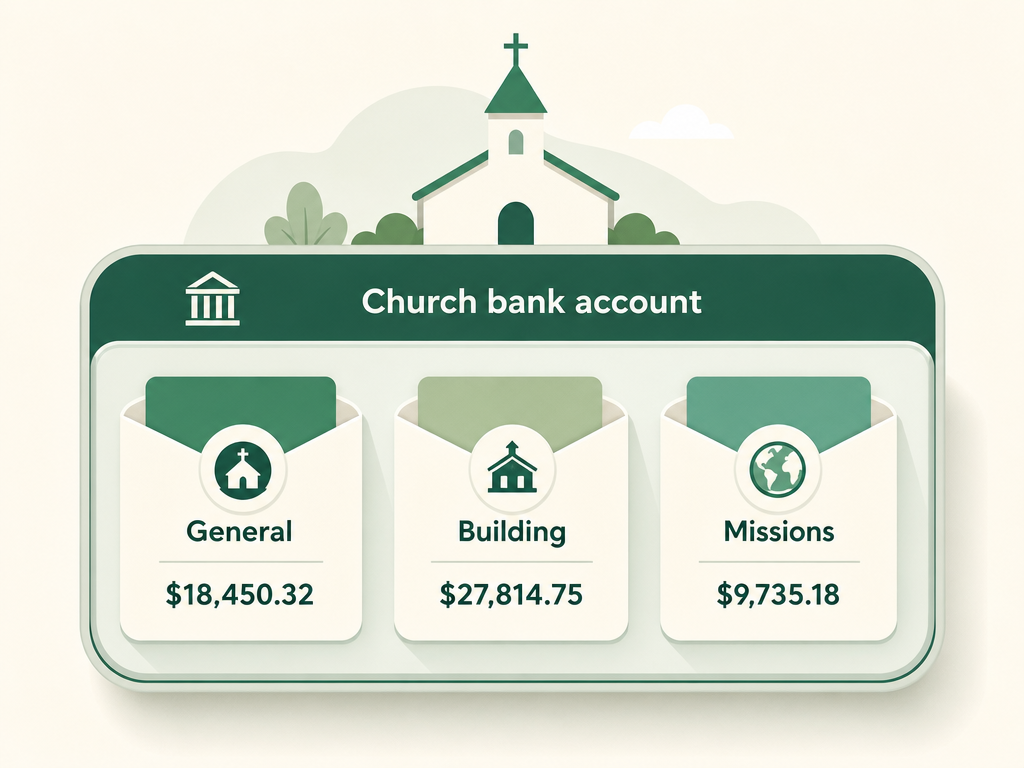
Think of it the way the image above shows it: one stream of giving comes in, and it’s split into labeled jars. A “fund” is really just a self-contained set of books for one purpose, each with its own running balance that carries over year to year.
The funds a typical church has
Most small churches run a handful of funds:
- General (operating) fund — the day-to-day money for salaries, utilities, and ministry. Usually unrestricted: you can spend it on whatever the church needs.
- Building fund — gifts for a construction project, repairs, or a mortgage.
- Missions fund — money for missionaries, trips, or outreach.
- Benevolence fund — help for families in need.
- Designated and memorial funds — money set aside for a specific gift, person, or one-time purpose.
You don’t need dozens. A church with five clear funds, each tracked cleanly, is in far better shape than one with twenty funds nobody reconciles.
Restricted vs. designated funds — the distinction churches get wrong
The restricted-versus-designated distinction is the single most important idea in church fund accounting, and it trips up almost every new treasurer.
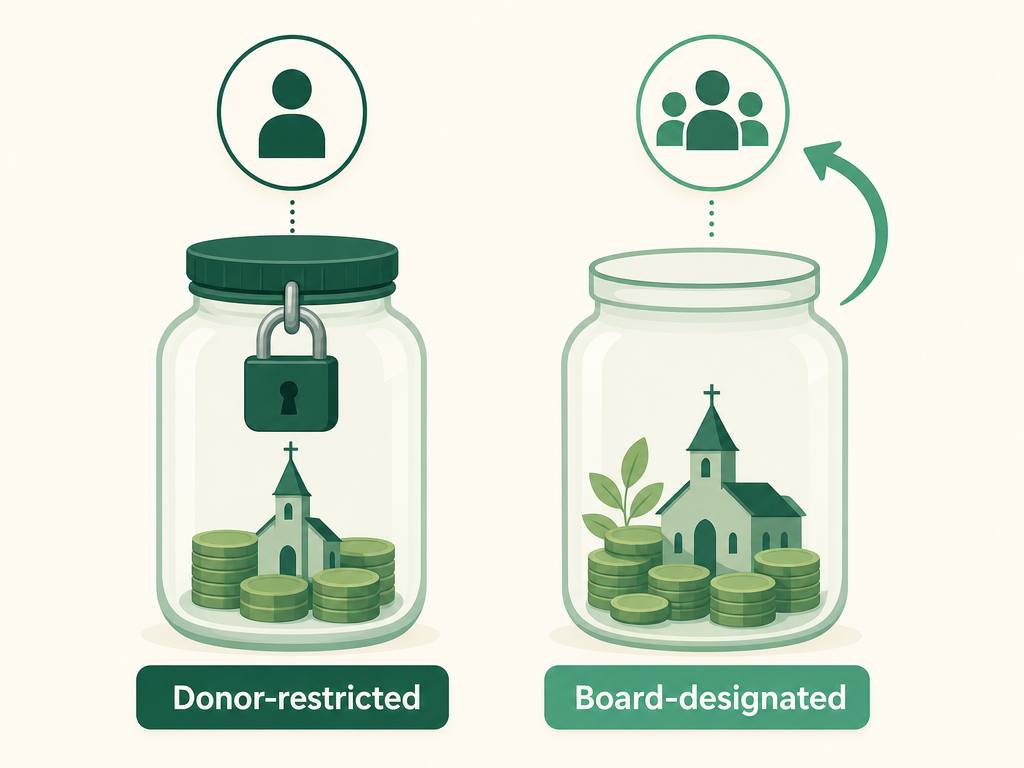
- Donor-restricted funds are restricted by the giver — a donor, or a foundation making a grant. When they specify the purpose — “this is for missions” — you are bound, ethically and often legally, to use it only for that. You cannot redirect it without the donor’s permission, even if another fund is short.
- Board-designated funds are set aside by the church itself. The board decides to earmark some general money for, say, a future van. Because the board created the designation, the board can undo it. It’s an internal plan, not a legal restriction.
Why it matters: spending donor-restricted money on something else is a breach of donor intent and can expose the church to real legal and reputational risk. Board-designated money is flexible — it’s your own plan, and you can change it. There’s more nuance to church designated funds — including an IRS rule that can quietly make some gifts non-deductible. Get this distinction right and most fund-accounting problems disappear.
”What are the three types of fund accounting?”
People usually mean the three classic categories nonprofits used for years:
- Unrestricted — no donor strings; use it for the mission generally.
- Temporarily restricted — for a specific purpose or time (a building project, a missions trip) until that purpose is met.
- Permanently restricted — endowment gifts where the principal is kept forever and invested so only the earnings are used.
One thing to know for accuracy: for external financial statements, U.S. accounting rules (FASB ASU 2016-14) simplified these into just two net-asset classes — “without donor restrictions” and “with donor restrictions.” Day to day, though, most churches still think in terms of general, restricted, and designated funds, which is the practical version of the same idea. The general-nonprofit version of these net-asset classes — donor-restricted vs. unrestricted, and how to release a restriction — is in restricted funds for nonprofits.
What type of accounting do churches use?
Two separate choices often get mixed up:
- Cash vs. accrual. Most small churches use cash or modified-cash basis — you record money when it actually moves. Larger churches may use accrual. Fund accounting works with either; it’s a layer on top, not a replacement.
- Single- vs. double-entry. Proper fund accounting is double-entry under the hood (every transaction balances). That sounds intimidating, but good church accounting software does the double-entry for you — you just pick the fund, and the balancing happens behind the scenes. (Weighing the tools? See the best fund accounting software.)
So the honest answer is: churches use fund accounting, usually on a cash basis, with double-entry handled by their software. If you’re weighing it against business bookkeeping, see fund accounting vs. regular accounting.
How to record church finances with funds
The mechanics are simpler than they sound:
- List your funds. Start with general, plus one fund per real purpose (building, missions, benevolence). Don’t over-create — funds sit as a dimension over your church chart of accounts (or, for any nonprofit, a nonprofit chart of accounts).
- Tag every transaction to a fund. When money comes in or goes out, it’s assigned to exactly one fund. A $500 building gift increases the building fund; a $200 roof repair decreases it.
- Keep a running balance per fund. Each fund has its own balance that rolls forward — last year’s leftover missions money is still missions money this year.
- Reconcile to the bank. Your funds all share one (or a few) bank accounts. The sum of your fund balances should match what’s actually in the bank, every month.
That last point matters: funds are an accounting separation, not separate bank accounts. You don’t need a bank account per fund — you need accurate tagging.
The reports fund accounting gives you
Two reports do most of the work:
- Statement of financial position (the nonprofit balance sheet) — what the church owns and owes, with net assets broken out by fund.
- Statement of activities (the nonprofit income statement) — money in and out over a period, by fund, so the board can see exactly how the building fund or missions fund moved.
These are what you hand a board or a donor to show the money was handled faithfully.
Common fund-accounting mistakes
- Borrowing from restricted funds to cover operating shortfalls. Even “temporarily,” this is the mistake that gets churches in trouble.
- Commingling — losing track of which money is restricted because it all sits in one account and nobody tags it.
- Forgetting designated gifts people gave months ago, so the money quietly gets spent on something else.
- Treating fund balances as new each year. They carry over — restricted money stays restricted until it’s used for its purpose.
Do churches have to file fund reports with the IRS?
Churches are tax-exempt and, unlike most nonprofits, are generally exempt from filing IRS Form 990 (IRS: Annual Exempt Organization Return — Who Must File). That’s a real break — but it doesn’t remove your duty to your donors and board. Good internal fund reports are how you keep their trust, and they make year-end giving statements painless because every gift is already tagged to a fund.
In Vestrybooks, fund accounting is invisible: you pick a fund from a dropdown, and the double-entry happens behind the scenes. The treasurer never sees a debit or a journal entry — just clear balances for each fund, always matching the bank. See plans →
FAQ
What are the three types of fund accounting? Classically: unrestricted, temporarily restricted, and permanently restricted. For external statements, U.S. rules now group these into “without donor restrictions” and “with donor restrictions.” Most churches think of it day-to-day as general, restricted, and designated funds.
What’s the difference between a restricted fund and a designated fund? A restricted fund is restricted by the donor — you’re bound to use it only for the purpose they named. A designated fund is set aside by the church’s board, which can change its own designation. Donor restrictions you must honor; board designations you can revisit.
What type of accounting do churches use? Fund accounting, usually on a cash or modified-cash basis, with double-entry handled by their software.
Is fund accounting hard? The concept is simple — track money by purpose. The hard part used to be doing the double-entry by hand. Software that lets you pick a fund and balances automatically removes nearly all of that difficulty.
Do small churches need fund accounting? Yes — even a tiny church usually has at least a general fund plus a building or benevolence fund. The moment one donor gives “for” a specific purpose, you need a way to keep that money separate.
This article is general information for church treasurers, not professional tax or legal advice. For your church's situation, consult a qualified accountant or attorney.
Track every fund the easy way.
Vestrybooks does real fund accounting in plain language — pick a fund, and restricted gifts stay separate automatically, across every account and card.
A real free plan · no credit card · your data stays yours