Blog · Bookkeeping & accounting
New church treasurer? Your first 90 days
July 4, 2026 · By Benjamin Reinke

Short answer: You’re going to be fine. A brand-new church treasurer doesn’t need an accounting degree — you need a plan for the first 90 days. In roughly this order: get your name added to the bank accounts and take away the old treasurer’s access, collect every record from the outgoing treasurer, learn which funds the church tracks, run one clean bank reconciliation to prove the books match reality, and hand the board a short, honest report. Do those five things and you’ve caught up. Everything after that is a monthly loop you’ll repeat, not a mountain you have to climb.
This guide is the onboarding checklist — what to do in your first weeks. For what the job actually is over the long haul (the duties, who you answer to, why it’s a fiduciary role), read the guide to the church treasurer’s role. This page is about the part nobody hands you: I just took over — now what?
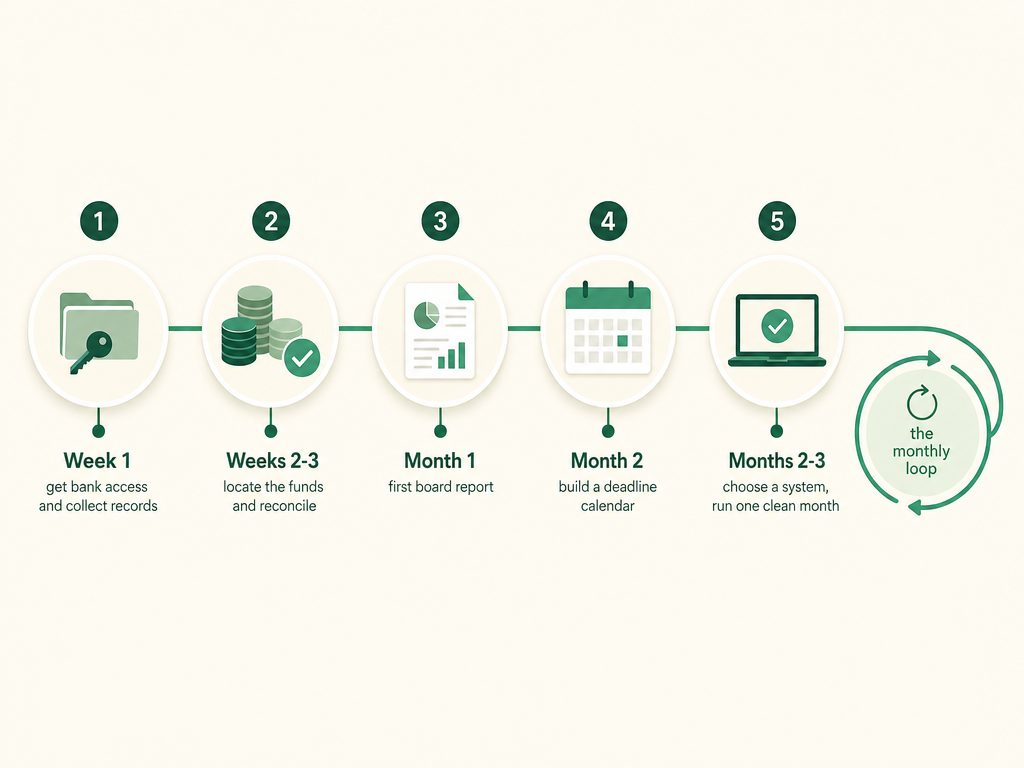
Your first 90 days as a new church treasurer, week by week
The new church treasurer’s first task is not to understand accounting — it’s to take control of the accounts and confirm nothing is missing. Work through the checklist below roughly in order. If your church is tiny, you’ll blow through it in an afternoon or two; if it’s larger, spread it across the first month. The point is that none of it gets skipped.
| When | What to do | Why it matters |
|---|---|---|
| Week 1 | Get added as a signer on every bank and savings account; remove the outgoing treasurer’s access and change online-banking passwords. | Until the bank recognizes you, you can’t do the job — and stale access is the #1 way money walks out a church. |
| Week 1 | Sit down with the outgoing treasurer. Collect every record: bank statements, deposit slips, invoices, the checkbook, giving records, prior board reports, logins, and any software. | You can’t reconcile books you don’t have. A warm handoff answers 100 questions a cold one leaves open. |
| Week 2 | Find the current balance in every account and every fund. Write down what’s restricted (given for a purpose) vs. general. | This is your starting line. You can’t report on money you haven’t located and labeled. |
| Weeks 2–3 | Run one full bank reconciliation for the most recent month — match the books to the statement, line by line, until they agree to the penny. | This is the single step that proves the books are real and catches the previous person’s errors before they become yours. |
| Week 3 | Learn the counting routine: who counts the offering, when, and whether two unrelated people sign off. Fix it if it’s one person. | Two-person counting protects the church and protects you from ever being the only suspect. |
| Month 1 | Bring the board a short, plain first report: what’s in each fund, what came in and went out last month, and anything that needs attention. | Your first report sets the tone. A clear one buys you trust; silence breeds worry. |
| Month 2 | Build a simple calendar of deadlines — payroll tax dates, giving-statement season, insurance renewal, the audit or review. | Deadlines are the part of the job that bites volunteers. A calendar means nothing surprises you. |
| Months 2–3 | Pick your system — spreadsheet, general software, or church-specific software — and get one clean month recorded in it end to end. | Once one month runs cleanly through your system, every month after is a repeat, not a fresh puzzle. |
Get access to the accounts and take it back from the old treasurer
The first thing a new church treasurer should do is become the person the bank recognizes — and make sure the previous person no longer is. Nothing else in the job works until this is done. Getting on the accounts usually means the board passing a resolution naming you an authorized signer, then you visiting the bank in person with ID and that resolution.
In the same week, close the door behind the outgoing treasurer:
- Change the authorized signers on every checking and savings account so the previous treasurer can no longer write checks.
- Reset online-banking logins and passwords, and remove the old treasurer’s user access entirely — don’t just “assume” they’ll stop logging in.
- Update anyone who has a debit card or bill-pay access tied to a church account.
- Have the board minute the change with the date of transfer, so there’s a clean record of exactly when responsibility passed to you.
This isn’t about suspecting a good person who served faithfully. Leaving a former treasurer with live bank access is simply how churches lose money — and it leaves you accountable for transactions you didn’t make. A clean cutover on day one protects everyone, including the person stepping down.
Collect every financial record from the outgoing treasurer
A new treasurer’s second job is to gather everything the last one had, because you can’t reconcile, report, or file what you can’t find. Ask for a warm handoff — ideally a sit-down where you can ask questions — and don’t leave until you have this list:
- Bank and credit-card statements for at least the last full year (12 months lets you see the whole giving-and-spending cycle).
- The checkbook, unused checks, and deposit slips, plus any petty cash and its log.
- Giving records — each donor’s contribution history, so you can produce year-end statements. This is the record that’s hardest to reconstruct if it’s lost.
- Unpaid bills and pledges outstanding, so you know what’s owed and what’s still coming in.
- The most recent board reports and the current budget, so you can see what “normal” looks like here.
- Every login — bank, payroll, giving platform, accounting software — and the software itself.
- The bylaws or finance policy, which usually spell out who you report to and any spending-approval rules.
If the outgoing treasurer has already left or records are patchy, don’t panic. Start from the bank statements — they’re the ground truth. Everything else can be rebuilt from what actually moved through the account.
Learn your church’s funds before you record anything
Before a new treasurer records a single transaction, they need to understand the church’s funds — because a church doesn’t keep its money in one pot, it tracks it by purpose. A “fund” is a self-contained balance for one job: general, building, missions, benevolence. The money can all sit in one bank account, but the books split it so you always know how much of that balance is spoken for.
The one distinction to get right early is restricted vs. designated:
- Donor-restricted money is bound by the person who gave it — “this is for the new roof.” You cannot redirect it to something else, even if the board wants to.
- Board-designated money is set aside by the church itself. Because the board created the restriction, the board can lift it.
Getting that one idea straight prevents most of the mistakes new treasurers make — like paying the electric bill out of the mission fund because that’s where the cash happened to be. The hands-on mechanics of tracking all this live in the broader practice of church bookkeeping; as the new treasurer, your job in week two is just to list the funds you inherited and write down each one’s balance and whether it’s restricted.
Run your first bank reconciliation to prove the books are real
The most important thing a new treasurer does in the first month is one clean bank reconciliation — matching the church’s books against the bank statement, line by line, until they agree to the penny. This is how you confirm the balance you inherited is real and not a number someone hoped was right.
To reconcile a month:
- Start with the ending balance on the bank statement.
- Check off every transaction in your books that also appears on the statement.
- Track down anything that doesn’t match — a check that hasn’t cleared, a deposit recorded twice, a fee nobody entered.
- Keep going until your books and the statement land on the same number.
If they don’t agree, you’ve found something — an error, a missing entry, or occasionally worse. Reconciliation is the single control that catches both honest mistakes and theft, which is exactly why doing one early gives you a clean starting point you can stand behind. From here on, you’ll do this every month; the first one is just the hardest because it’s the one where you learn how the previous person kept things.
Set up two-person counting and separate the money jobs
A new treasurer inherits not just the books but the system around them — and the most important system is that no single person controls the church’s money from offering plate to bank statement. If the church you just took over has one person counting, recording, and banking the offering alone, fixing that is part of your first 90 days.
The controls to check for (and put in place if they’re missing):
- Two unrelated people count the offering together and both sign the count sheet, before anyone is alone with the cash.
- The person who records the books isn’t the person who signs the checks, and ideally not the one who reconciles either.
- A second approval is required for payments over a set amount.
- Someone outside your seat reviews the monthly reconciliation — a finance committee member or another officer.
Churches are unusually easy targets for fraud precisely because they run on trust and hand one person everything at once. Building these splits early is the best way to protect the church from embezzlement — and it protects you, because when the money passes through more than one set of hands, suspicion can never land on a single person. The classic church version of this is splitting the incoming side (a financial secretary who records giving) from the outgoing side (you, paying bills and reporting).
Give your first treasurer’s report to the board
A new treasurer’s first report to the board matters more than any single one that follows, because it sets whether the church sees a steady hand or a nervous one. Keep it short, plain, and honest. You don’t need polished financial statements in month one — you need to answer the two questions every board actually has: is the money okay, and is there anything I need to know?
A good first report shows:
- The balance in each fund — so restricted money is visibly intact.
- What came in and what went out last month, and how that compares to the budget.
- Cash on hand across the accounts, tied back to your reconciliation.
- Anything that needs attention — a fund running low, a bill you couldn’t find backup for, a category over budget.
If your first reconciliation surfaced a problem, say so plainly; a board trusts a treasurer who reports the messy truth far more than one who quietly hopes it resolves. There’s a full walkthrough — with what to include and a sample layout — in the guide to writing a treasurer’s report. Use the same format every month from here, so the board can read it at a glance and notice when something changes.
Build your calendar of deadlines
The part of the treasurer’s job that surprises volunteers isn’t the monthly loop — it’s the deadlines scattered across the year. A new treasurer should build a simple calendar in the first couple of months so nothing sneaks up. The recurring dates most small churches have:
- Payroll tax deposits and filings, if the church has any paid staff or clergy. Missed payroll-tax deadlines carry IRS penalties, so these are the ones to nail down first.
- Year-end giving statements, due to donors early in the new year. The IRS requires a written acknowledgment from the church for any single gift of $250 or more before a donor can deduct it (IRS Publication 1771).
- Insurance renewals — including any fidelity bond or employee-dishonesty coverage.
- Your annual review or audit, and the budget cycle that feeds next year’s plan.
Most churches are exempt from filing a Form 990 because churches aren’t required to file annual information returns (IRS Publication 1828) — a rare break that takes one big deadline off your plate. But you still have to keep records that substantiate income and expenses, which is exactly what the monthly loop produces.
Do church treasurers get paid, and do you need to be qualified?
New church treasurers almost always serve as unpaid volunteers, and you almost certainly don’t need to be an accountant. The role is an elected or appointed officer position — like a board seat — and in the vast majority of churches it carries no salary. Larger churches sometimes pay a bookkeeper or finance director to do the hands-on recording, but the treasurer role itself is typically volunteer. (More on when and why in the guide to whether church treasurers get paid.)
As for qualifications: the best treasurer is trustworthy, organized, and willing to be checked — not the one with the most credentials. What you actually need is consistency (the job is a monthly loop), attention to detail (reconciling to the penny), plain communication (making numbers clear to non-accountants), and discretion (you’ll see who gives what and can never let it change how you treat people). A diligent volunteer with good software and a real review process runs a cleaner treasury than a distracted CPA. The system, not the degree, is what makes it trustworthy.
FAQ
Does a church treasurer get paid? In most churches, no. The treasurer is an elected or appointed volunteer officer, the same as a board member, and the role carries no salary. Larger churches sometimes pay a bookkeeper or finance director for the hands-on recording, but the treasurer position itself is usually unpaid. If a church does compensate the treasurer, the pay has to be reasonable and approved by the board — never set by the treasurer.
What are the duties of a church treasurer? The core duties are overseeing giving (making sure it’s counted, deposited, and recorded), paying the church’s bills, reconciling the bank every month, reporting to the board, helping build the annual budget, and issuing year-end giving statements. It’s oversight and accountability more than data entry, and the work is best spread across several people so the treasurer isn’t the only one who touches the money.
What qualifications do I need to be a church treasurer? None formal in most churches — you don’t need an accounting degree or a CPA. What matters is integrity, consistency, attention to detail, and a willingness to be checked. Basic comfort with a spreadsheet or church software helps, but the system and the review process do the heavy lifting that an accounting background used to require. Churches choose treasurers on trustworthiness first, credentials a distant second.
Does a church treasurer need to be bonded? Not required, but worth considering. A fidelity bond — often already part of a church’s insurance package as “employee dishonesty” coverage — reimburses the church if someone who handles its money steals it. Bonding doesn’t replace good controls like two-person counting and separating recording from check-signing, but it’s a sensible backstop and it protects an honest treasurer too. Check whether your existing church insurance already includes fidelity coverage before buying a separate bond.
What should a new church treasurer do first? Get added to the bank accounts as an authorized signer, remove the previous treasurer’s access and reset the online-banking passwords, and collect every financial record from the person stepping down. Those three steps in your first week give you control of the accounts and the paperwork you need to catch up. After that, locate every fund’s balance, run one bank reconciliation, and bring the board a short, honest first report.
This is general information, not tax or legal advice — for your church’s specific situation, consult a qualified accountant or attorney.
Vestrybooks gives a brand-new volunteer treasurer the fund accounting, one-click reconciliation, and board-ready reports the first 90 days demand — no accounting background required. See how it works.
This article is general information for church treasurers, not professional tax or legal advice. For your church's situation, consult a qualified accountant or attorney.
Church accounting a volunteer can actually do.
Vestrybooks is church accounting + giving for the volunteer treasurer — fund tracking, one-click year-end statements, and online giving with $0 taken from every gift.
A real free plan · no credit card · your data stays yours