Blog · Financial reporting
How to read a church balance sheet
June 26, 2026 · By Benjamin Reinke
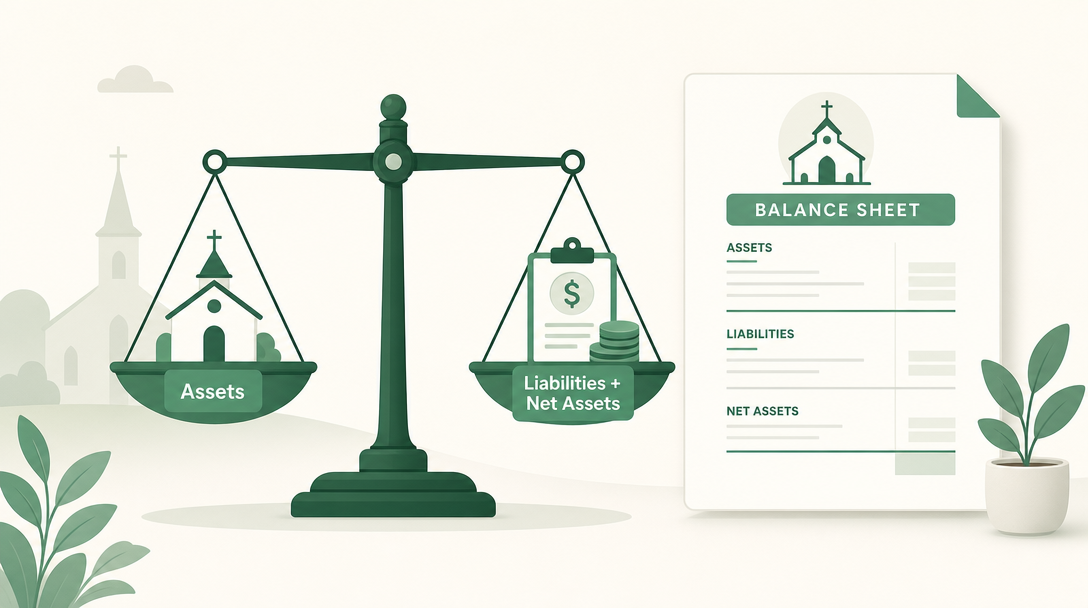
Short answer: A church balance sheet — formally the statement of financial position — is a snapshot of what a church owns and owes on a single date. It has three parts that always balance: assets (cash, accounts, property) equal liabilities (what’s owed) plus net assets (what’s left over). Because a church has no owners, “net assets” replaces a business’s equity, and they’re split into amounts with and without donor restrictions so you can see what’s actually free to spend.
What a church balance sheet is
A church balance sheet is one of the core church financial statements, and it answers a single question: where does the church stand financially, right now? Unlike the income statement, which covers a period of time, the balance sheet is a point-in-time snapshot — “as of December 31.” Nonprofits call it the statement of financial position, but it’s the same idea as a business balance sheet, with one twist in the bottom section.
The three parts of a church balance sheet
Every balance sheet is built on one equation that must always hold:
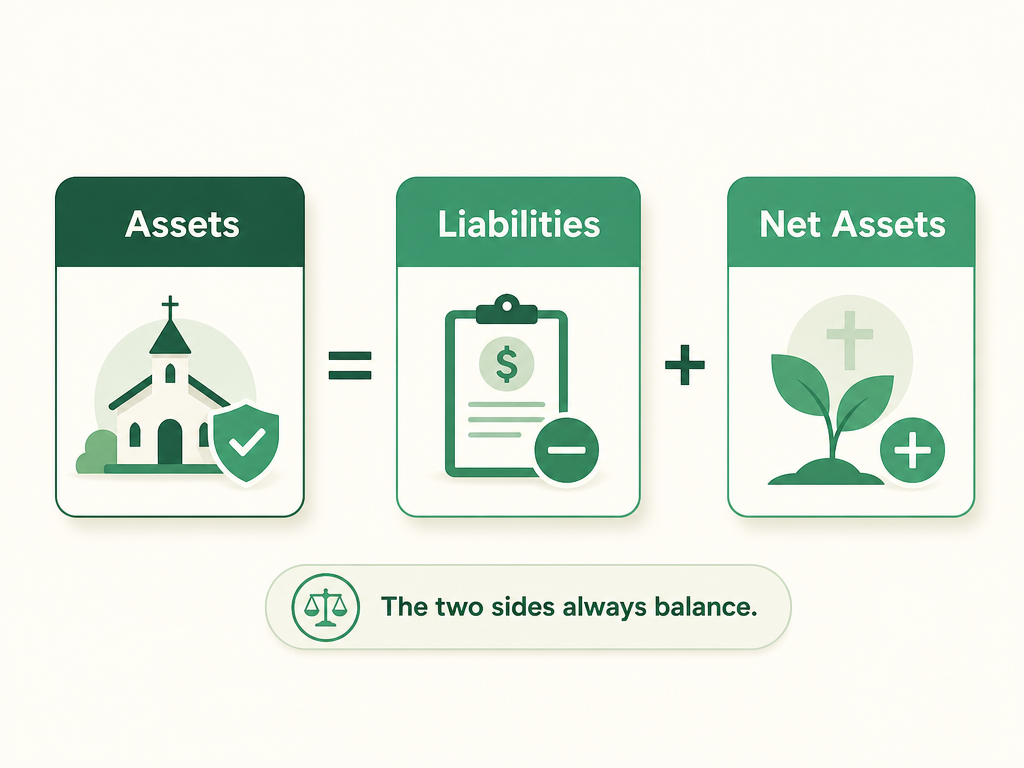
- Assets — what the church owns: checking and savings, money owed to it, prepaid expenses, and property or equipment.
- Liabilities — what the church owes: unpaid bills, payroll owed, loans, and mortgages.
- Net assets — assets minus liabilities; the church’s accumulated financial position.
Net assets, with and without donor restrictions
The part that makes a church balance sheet different is net assets, which a nonprofit reports in two buckets (ASC 958):
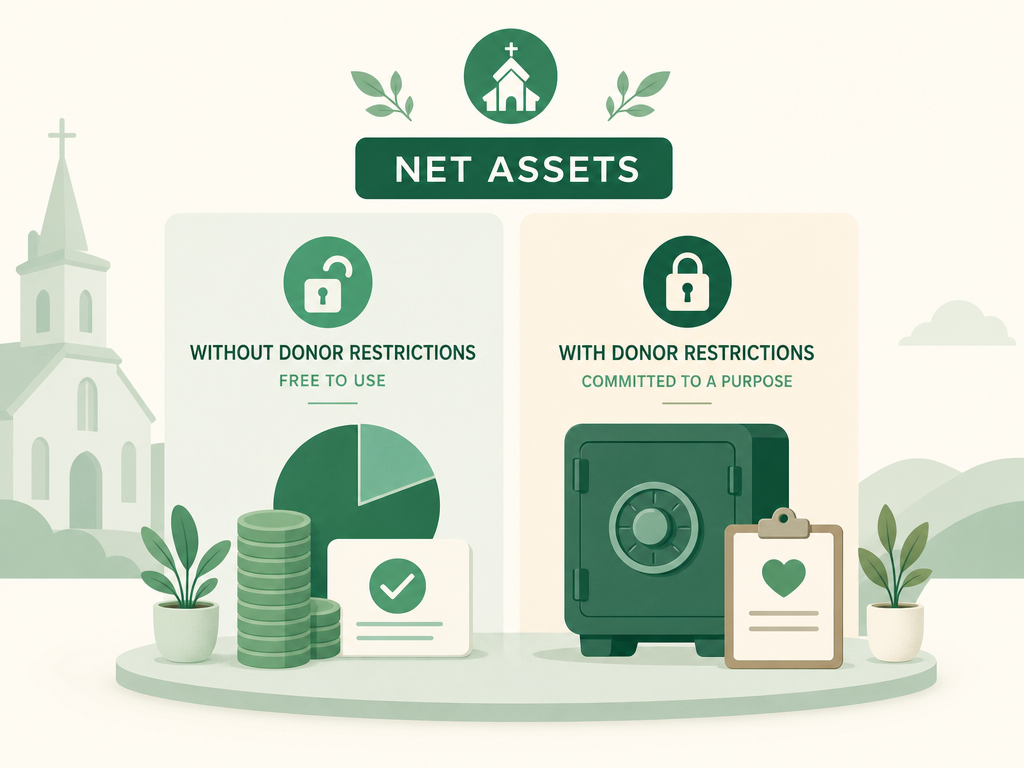
- Without donor restrictions — money the church can use for any purpose.
- With donor restrictions — gifts the donor designated for a specific purpose (a building fund, missions) that can’t be spent on anything else.
This split is the balance-sheet view of restricted and designated funds: the fund balances you track all year show up here as restricted net assets. It’s why a church can show a healthy total while still being unable to cover payroll — much of the balance may be restricted.
How to read a church balance sheet
Reading a church balance sheet means looking past the total to the composition. Compare cash and other liquid assets against near-term liabilities to gauge whether the church can pay its bills. Then check how much of net assets is without restrictions — that unrestricted figure, not the grand total, is what’s genuinely available for general ministry. A large balance that’s mostly restricted is a common reason a church feels broke while looking wealthy on paper.
Balance sheet vs. statement of activities
The balance sheet is often confused with the income statement, but they answer different questions. The balance sheet is a snapshot of financial position on one date; the statement of activities covers what happened over a period — revenue in, expenses out, and the change in net assets. The change in net assets on the activities statement is exactly what moves the net-assets figure on the balance sheet from one period to the next.
Vestrybooks builds your statement of financial position straight from your entries, with restricted and unrestricted net assets already separated. See plans →
FAQ
What is a balance sheet for a church? A point-in-time statement (the statement of financial position) showing the church’s assets, liabilities, and net assets, with net assets split by donor restriction.
What are the net assets on a church balance sheet? Assets minus liabilities — the church’s accumulated position, reported in two buckets: without donor restrictions (free to use) and with donor restrictions (committed to a purpose).
How do churches record their finances? With fund accounting, recording each transaction to a fund and account; those balances roll up into the balance sheet and the other financial statements.
What’s the difference between a balance sheet and an income statement? The balance sheet is a snapshot on one date; the income statement (statement of activities) covers money in and out over a period.
This is general information, not accounting advice — confirm your church’s reporting with a qualified professional.
This article is general information for church treasurers, not professional tax or legal advice. For your church's situation, consult a qualified accountant or attorney.
Church accounting a volunteer can actually do.
Vestrybooks is church accounting + giving for the volunteer treasurer — fund tracking, one-click year-end statements, and online giving with $0 taken from every gift.
A real free plan · no credit card · your data stays yours