Blog · Bookkeeping & accounting
How nonprofit accounting works
June 27, 2026 · By Benjamin Reinke

Short answer: Nonprofit accounting is the system a tax-exempt organization uses to track, report, and stay compliant on its money — recording transactions by purpose, classifying its resources as net assets rather than equity, producing a defined set of financial statements, and filing an annual return with the IRS. It differs from for-profit accounting in one fundamental way: a nonprofit has no owners and no profit to measure, so it reports net assets instead of owner’s equity and answers to donors, grantmakers, and the IRS for stewardship rather than to shareholders for returns. The rules come from FASB (the financial-statement standard, ASC 958) and the IRS (tax-exempt status and the Form 990 filing).
What nonprofit accounting is and why it exists
Nonprofit accounting is the full discipline of measuring and reporting a tax-exempt organization’s finances — the method, the reports, and the compliance, not just the data entry. A business runs its accounting to value the company and prove a return for its owners. A nonprofit runs its accounting to prove the opposite kind of thing: that money given for a purpose was used for that purpose. That single change in goal reshapes the whole system.
The recording layer — entering income and expenses, coding them, reconciling the bank — is the bookkeeping piece. The standards-and-reporting layer built on top of it is accounting. If you want the hands-on monthly routine of keeping the books, that’s covered in our guide to nonprofit bookkeeping. This page is the system around it: the method, the standards, the statements, and the filing.
How nonprofit accounting differs from for-profit accounting
For-profit accounting measures one thing: profit for the owners. Every transaction rolls toward a single bottom line, and the balance sheet ends in owner’s equity — what the owners would keep if the business were sold. A nonprofit has no owners and isn’t trying to turn a profit, so its accounting answers a different question: is every dollar still being used for the purpose it was given for?
That changes the mechanics in three concrete ways:
- Net assets, not owner’s equity. With no owners to pay out, a nonprofit reports net assets — assets minus liabilities — and splits them by whether donors restricted them.
- Fund accounting, not one ledger. Money is tracked in separate funds by purpose, so a grant for a youth program never gets spent on rent.
- Stewardship, not profitability. The reports exist to prove a gift was honored, not to value the organization for a sale.
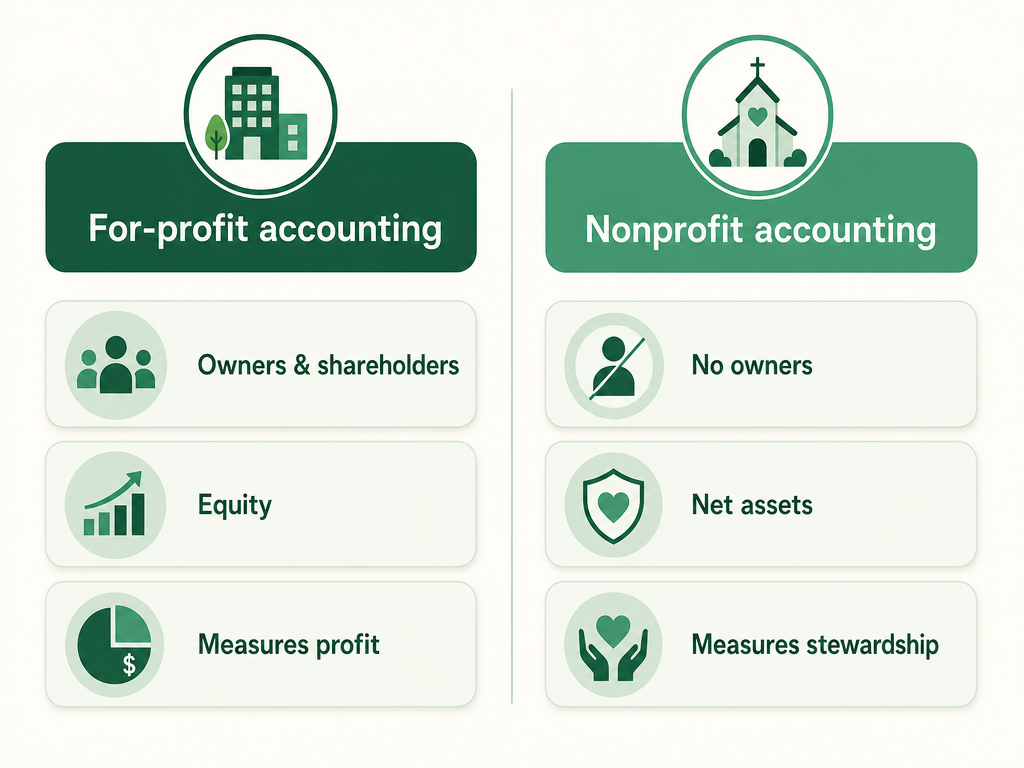
| For-profit accounting | Nonprofit accounting | |
|---|---|---|
| Who it answers to | Owners and shareholders | Donors, grantmakers, the IRS |
| What it measures | Profit | Stewardship of restricted money |
| The “bottom line” | Net income | Change in net assets |
| Bottom of the balance sheet | Owner’s equity | Net assets (with / without donor restrictions) |
| Income statement | Profit and loss | Statement of activities |
| Annual tax filing | Form 1120 / 1065 | Form 990 |
Fund accounting — tracking money by its purpose
Fund accounting is the method at the center of nonprofit accounting. Instead of pooling every dollar in one checkbook, the organization divides its money into funds defined by purpose — a general operating fund, a building fund, a scholarship fund, a specific grant — and tracks each one separately. A gift given for the scholarship fund stays in the scholarship fund until it’s spent on scholarships. That’s how a nonprofit can prove, at any moment, that restricted money hasn’t been quietly used for something else.
This is the same method a church uses, which is why a church’s books look so much like any other nonprofit’s. The full mechanics — restricted versus designated funds, how the dollars move — are in our church fund accounting guide.
Net assets with and without donor restrictions under ASC 958
Where fund accounting tracks money internally by purpose, the financial statements report it externally in two buckets defined by FASB’s nonprofit standard, ASC 958:
- Net assets without donor restrictions — money the organization is free to spend on any part of its mission. General donations, earned revenue, and reserves sit here.
- Net assets with donor restrictions — money a donor or grantmaker tied to a specific purpose or time. A grant for a literacy program, a pledge payable next year, or an endowment all sit here until the restriction is met or expires.
This two-class split is the whole point of nonprofit reporting. A reader can see at a glance how much of the organization’s money is actually free to use versus already promised to something. Before 2018 the standard used three classes; ASC 958 collapsed them into these two, so older guides showing “unrestricted, temporarily restricted, permanently restricted” are out of date.
Cash basis vs. accrual basis for nonprofits
Nonprofit accounting can run on either of two methods, the same two a business chooses between:
- Cash basis records income when money actually arrives and expenses when they’re paid. It’s simpler, and plenty of small nonprofits use it day to day.
- Accrual basis records income when it’s earned or pledged and expenses when they’re incurred, regardless of when cash moves. A grant award counts as income when promised, not when the check clears.
The catch: financial statements prepared under U.S. GAAP — the ones an auditor signs and many grantmakers require — must be on the accrual basis. A common setup is to keep the books on cash or modified-cash basis through the year for simplicity, then convert to accrual for the year-end statements and audit. The bigger your grants and the more formal your reporting, the sooner accrual becomes non-optional.
The four nonprofit financial statements
The point of all the recording is a defined set of reports. Under ASC 958, a nonprofit produces four core statements:
| Statement | What it shows | For-profit equivalent |
|---|---|---|
| Statement of financial position | Assets, liabilities, and net assets at a point in time | Balance sheet |
| Statement of activities | Revenue and expenses over a period, by restriction | Income statement |
| Statement of functional expenses | Spending split across program, management, and fundraising | — |
| Statement of cash flows | Cash moving in and out over a period | Cash flow statement |
The functional-expense statement is the one with no business equivalent: it forces a nonprofit to show how much of its spending went to its actual programs versus overhead and fundraising — the ratio donors and watchdogs care about most. The full breakdown of each report is in our guide to nonprofit financial statements.
Form 990 — the annual return nonprofit accounting feeds
Tax-exempt doesn’t mean filing-free. Most 501(c)(3) organizations must file a Form 990 with the IRS every year, and that return is built directly from the year’s accounting. Which version you file depends on size:
- Form 990-N (the e-Postcard) — for organizations with gross receipts normally $50,000 or less.
- Form 990-EZ — for mid-size organizations under the IRS thresholds.
- Form 990 (full) — for larger organizations.
The 990 is public — anyone can read it — so it doubles as a transparency document, and donors do look. Miss it three years running and the IRS automatically revokes your exempt status. The IRS’s plain-language overview of who files what is on its about Form 990 page, and the broader rules for staying exempt are in IRS Publication 557.
Who does nonprofit accounting — bookkeeper, accountant, or CPA
Most small nonprofits don’t need a full-time accountant. The honest division of labor:
- A bookkeeper (volunteer or paid) does the recurring work — entering income and expenses, coding to funds, and reconciling the bank.
- An accountant sets up the system, prepares or reviews the financial statements, and converts cash-basis books to accrual at year-end.
- A CPA signs off on the work that needs licensed judgment: an independent audit or review, the Form 990, and advice on tricky restriction or tax questions.
Software handles the recording and the reports for the vast majority of organizations; you bring in a person when you need judgment, not data entry. The one trap to avoid is letting a single trusted person record the money, review it, and sign the checks with no oversight — separate who records from who reviews, no matter how small you are.
Church accounting is nonprofit accounting, minus the 990
A church is a nonprofit, so everything on this page applies to it: fund accounting, net assets with and without donor restrictions, the four statements, cash versus accrual. The accounting method is identical. The difference is purely tax treatment. Churches get two breaks the rest of the nonprofit world doesn’t: automatic recognition as tax-exempt without applying to the IRS, and exemption from filing Form 990. For the church-specific version of this system, see our guide to church accounting, and for the hands-on recording routine, our church bookkeeping walkthrough.
FAQ
What kind of accounting do nonprofits use? Fund accounting on a GAAP framework. Money is tracked in separate funds by purpose, and the financial statements report net assets split into two classes — with and without donor restrictions — under FASB ASC 958, instead of the owner’s equity a business reports. Statements signed by an auditor must be on the accrual basis.
What is the accounting for a nonprofit organization? It’s a system for proving stewardship rather than profit. The organization records income and expenses by fund, classifies its resources as net assets, produces four statements (financial position, activities, functional expenses, and cash flows), and files an annual Form 990 with the IRS. There are no owners and no profit, so the bottom line is the change in net assets.
Do nonprofits need a CPA? Not usually a full-time one. Most nonprofits run on nonprofit accounting software — including free options for tight budgets — plus a bookkeeper, and bring in a CPA periodically to prepare or review the Form 990, perform an audit or review when a grantmaker or state requires it, and advise on restriction and tax questions. The recurring recording doesn’t need a CPA; the licensed judgment work does.
Is nonprofit accounting hard? The mechanics aren’t harder than business accounting, but fund accounting and restriction tracking add a layer business books don’t have, and the GAAP-versus-cash and Form 990 rules take some learning. With a clear chart of accounts and software built for funds, a diligent volunteer plus periodic professional help can run it well.
What are the basics of nonprofit accounting? The starter set is four ideas. Money is tracked by purpose using fund accounting; resources are reported as net assets split into two classes — with and without donor restrictions — instead of owner’s equity; the organization produces four core statements (financial position, activities, functional expenses, and cash flows); and most file an annual Form 990 with the IRS. Get those four right and the rest is detail.
Is nonprofit accounting different from regular accounting? Yes, in goal more than mechanics. The double-entry bookkeeping underneath is the same, but a nonprofit measures the change in net assets rather than profit, tracks money in separate funds by purpose, and reports to prove accountability to donors and the IRS rather than profitability to owners. The concept is simple; the software does the heavy lifting on the entries.
Are nonprofits required to follow GAAP? The IRS does not require GAAP for the Form 990 itself. But an independent audit, many lenders, most large grantmakers, and some state charity regulators do require GAAP-basis (accrual) financial statements prepared under FASB ASC 958, the standard for not-for-profit entities. So whether you must follow GAAP depends less on the IRS and more on who you answer to outside it.
Do nonprofits have to use accrual accounting? Not always. A small nonprofit can keep its internal books and even file the 990 on a cash or modified-cash basis, which is simpler. Accrual is required once you need GAAP-basis statements — for an independent audit, and usually for serious grant and lender reporting — because accrual gives a truer picture of pledges owed and obligations incurred.
What are nonprofit accounting standards? The financial-statement standards come from FASB and live in ASC 958, the not-for-profit topic. It sets the two net-asset classes, the statement of functional expenses, and how contributions and restrictions are recognized. The IRS layers separate tax-compliance rules on top through the Form 990; a church accountant or nonprofit accountant works within both.
Vestrybooks does fund accounting the way nonprofits and churches actually need it — restrictions tracked, the core statements ready, and clean books behind every filing. See how it works.
This article is general information for church treasurers, not professional tax or legal advice. For your church's situation, consult a qualified accountant or attorney.
Church accounting a volunteer can actually do.
Vestrybooks is church accounting + giving for the volunteer treasurer — fund tracking, one-click year-end statements, and online giving with $0 taken from every gift.
A real free plan · no credit card · your data stays yours