Blog · Church accounting software
Using QuickBooks for churches: what works and what doesn't
June 26, 2026 · By Benjamin Reinke
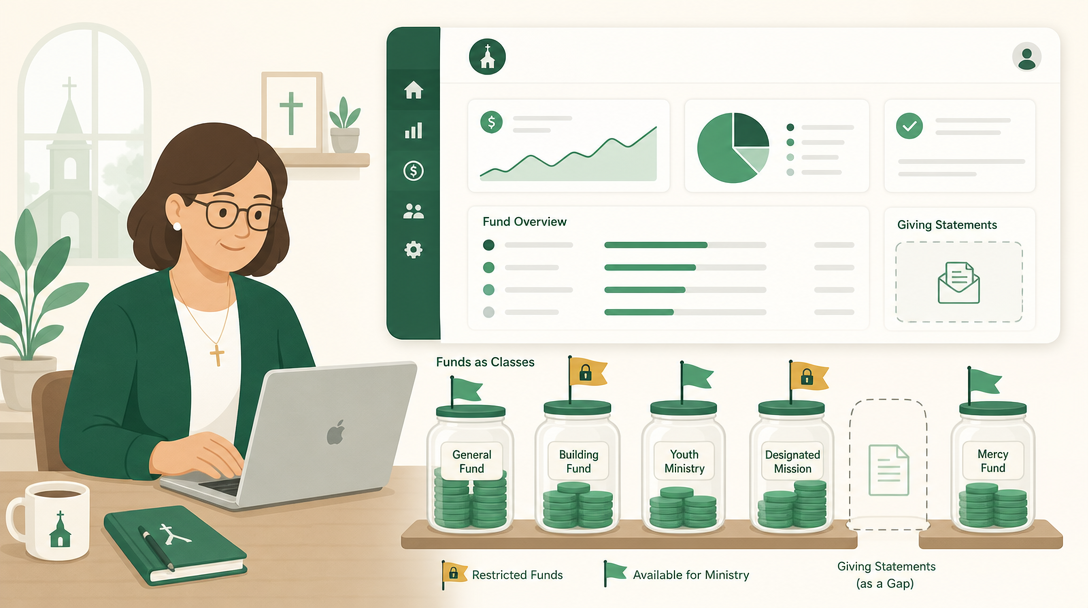
Short answer: You can run a church on QuickBooks — there’s no dedicated church edition, so you use classes (or locations) to approximate fund accounting. It works, especially for a smaller church, but QuickBooks was built for businesses, so restricted funds, donor giving statements, and fund-balance reports are workarounds rather than built-in. Many churches start on QuickBooks and move to church-specific software once designated giving and year-end statements get painful — there’s a QuickBooks alternative for churches built for exactly that, and an honest Aplos vs QuickBooks breakdown if you’re weighing both. (The same trade-off applies to nonprofits generally — see QuickBooks for nonprofits.)
Can you use QuickBooks for a church?
Yes — plenty of churches do. QuickBooks doesn’t have a church version, but it’s flexible enough to be bent into church use (QuickBooks). The catch is that everything church-specific — tracking money by fund, keeping restricted gifts separate, producing donor statements — is something you configure and maintain, not something the software does for you. That’s fine if you’re comfortable in accounting software; it’s a real burden if you’re a volunteer treasurer.
How to set up QuickBooks for church fund accounting
QuickBooks doesn’t do fund accounting natively, so churches approximate it with classes:
- Create a class for each fund — General, Building, Missions, Benevolence.
- Tag every transaction with its class, so each fund’s activity is separable.
- Run reports by class to see each fund’s income and spending.
It’s a workable system, but it leans entirely on discipline: miss a class on a transaction and a fund’s numbers quietly drift. There’s no guardrail stopping you from spending a restricted gift on the wrong thing.
What QuickBooks doesn’t do well for churches
The gaps show up exactly where church accounting differs from business accounting:
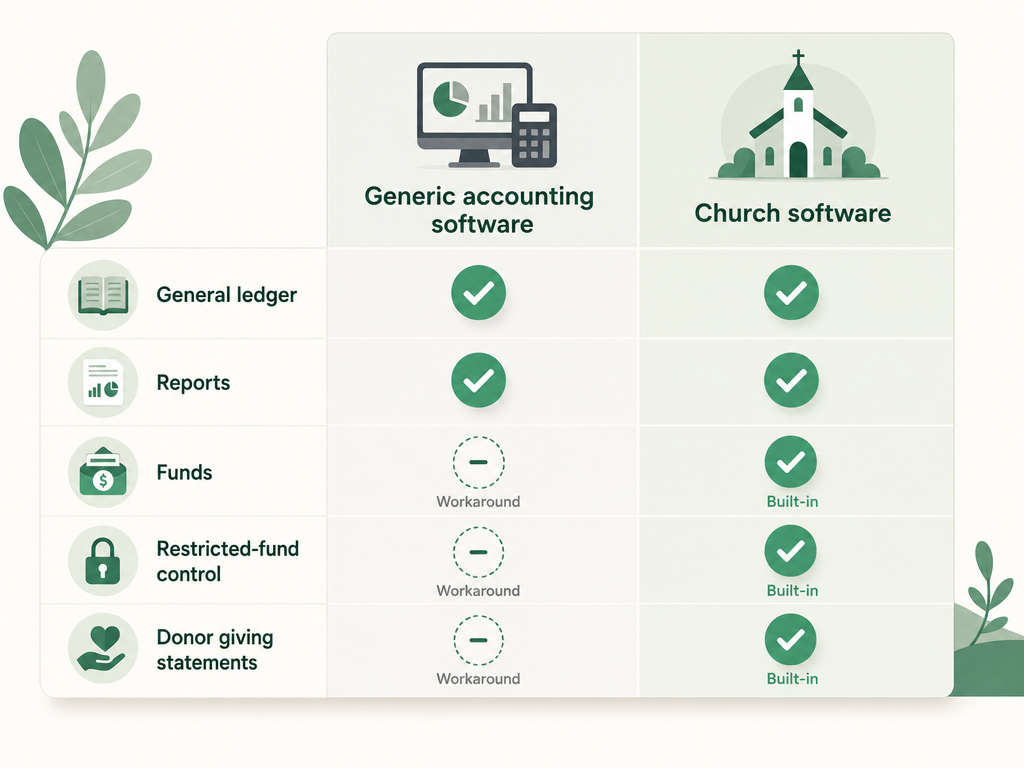
- Restricted funds — classes track activity but don’t enforce that a building gift stays a building gift.
- Donor giving statements — QuickBooks isn’t built to produce IRS-ready year-end contribution statements; you bolt on another tool or do it by hand.
- Fund-balance reporting — getting a clean “how much is in each fund” view takes setup that church software gives you by default.
- Plain language — debits, journal entries, and “FASB” are the native tongue, which a volunteer rarely speaks.
QuickBooks vs. church accounting software
The real question isn’t whether QuickBooks can work — it’s whether the workarounds are worth it for your church. A tiny church with one fund and no designated giving may be perfectly happy on QuickBooks. A church with building, missions, and benevolence funds, and a few hundred donors expecting statements in January, is doing a lot of manual work that software built for churches handles by default. Pricing is similar enough that the deciding factor is usually fit, not cost.
When QuickBooks is fine — and when to switch
QuickBooks is fine when your books are simple: one or two funds, few designated gifts, and someone comfortable with accounting software. The signs it’s time to switch are the ones that mean more church-specific work: designated giving you’re tracking by hand, year-end statements eating your January, or a volunteer treasurer drowning in class tags. That’s the point where software built for church fund accounting and giving starts paying for itself.
Vestrybooks does the church-specific parts QuickBooks makes you build — fund accounting, restricted funds, and one-click giving statements — in plain language a volunteer can run. See plans →
FAQ
Does QuickBooks have a church version? No. Churches use standard QuickBooks and approximate fund accounting with classes or locations; there’s no dedicated church edition.
How do churches use QuickBooks for fund accounting? By setting up a class for each fund, tagging every transaction with its class, and running reports by class — a workaround for true fund accounting.
Is QuickBooks good for churches? It works, especially for small churches with simple books, but restricted funds, donor statements, and fund-balance reports are manual workarounds rather than built-in features.
What’s the best alternative to QuickBooks for churches? Software built specifically for church fund accounting and giving, which handles restricted funds and year-end statements natively instead of through class workarounds — see our best church accounting software guide for the options.
This is general information to help you evaluate tools, not a specific endorsement for your situation.
This article is general information for church treasurers, not professional tax or legal advice. For your church's situation, consult a qualified accountant or attorney.
Church accounting a volunteer can actually do.
Vestrybooks is church accounting + giving for the volunteer treasurer — fund tracking, one-click year-end statements, and online giving with $0 taken from every gift.
A real free plan · no credit card · your data stays yours