Blog · Bookkeeping & accounting
What a treasurer's report is and how to write one
June 27, 2026 · By Benjamin Reinke

Short answer: A treasurer’s report is the short financial summary a treasurer brings to a church or nonprofit board (or the congregation) at each meeting — usually monthly — to show where the money stands. A good one fits on a single page: income and expenses for the period and year-to-date against the budget, the balance in each fund, the cash on hand tied back to the bank reconciliation, and a few lines of notes on anything that needs attention. For a church, this report is the same thing members mean when they ask for a “financial report for church” — it’s how the church shows its people the money is being handled well.
What a treasurer’s report is and who it’s for
A treasurer’s report is the recurring financial update the treasurer presents to the people who govern an organization — a church board or vestry, a nonprofit board of directors, or the membership at an annual meeting. It is not the same document as the church treasurer — that’s the person and the role; this is the report they hand over. It’s the main way a board that doesn’t see the books day to day can satisfy its duty to oversee the money.
The audience decides the format. A board of non-accountants does not want a printout of every transaction. They want to answer three questions in about two minutes: Is the money coming in roughly as planned? Is spending on track against the budget? Is every restricted fund still intact? Write the report to answer those three things first, and put the detail in attachments for anyone who wants to dig.
What goes in a good treasurer’s report
A complete treasurer’s report has six parts, in the same order every time. The discipline isn’t fancy formatting — it’s consistency, so the board reads the same shape each month and spots the line that changed.
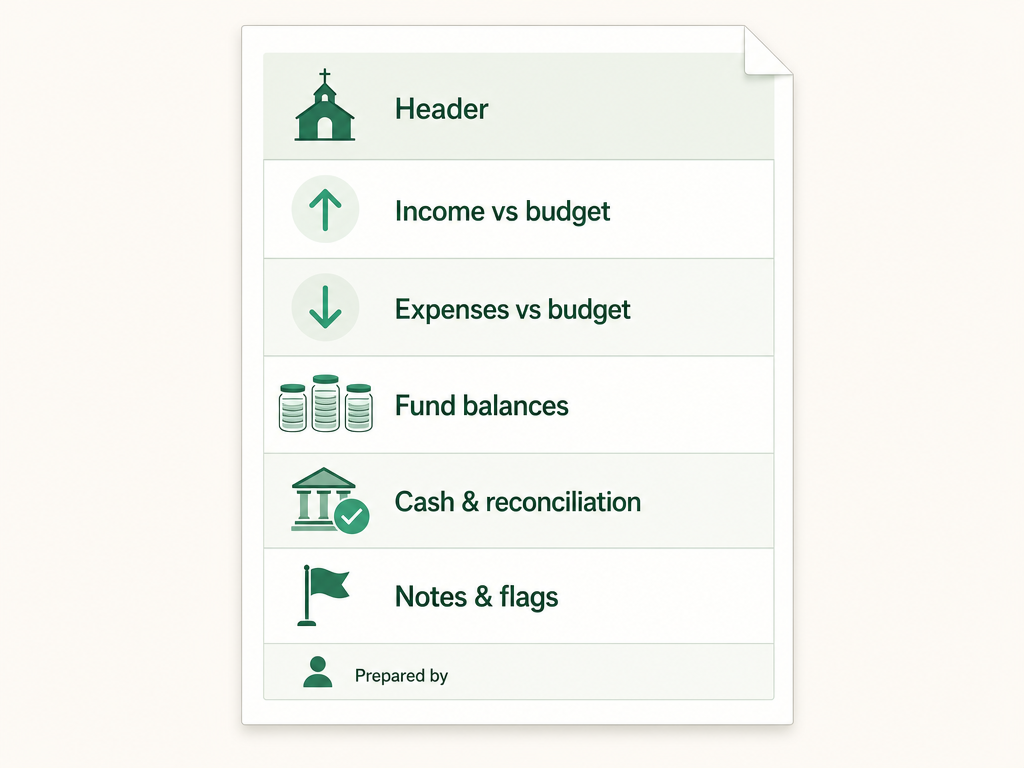
| Section | What it shows | Why the board cares |
|---|---|---|
| Header | Organization name and the exact period covered (e.g. “May 2026”) | Anchors the numbers to a date so nothing gets read against the wrong month |
| Income vs. budget | Money in for the period and year-to-date, next to what the budget expected | Tells the board if giving or revenue is keeping pace |
| Expenses vs. budget | Money out for the period and year-to-date, next to the budgeted amount | Flags any category running over before it becomes a problem |
| Fund balances | The balance in each fund — general, building, missions, benevolence | Proves restricted money is still set aside for its purpose |
| Cash and reconciliation | The bank and cash balances, tied to the latest reconciliation | Shows the numbers match the bank, not just the books |
| Notes and flags | A few plain sentences on anything unusual or needing a decision | Turns numbers into the one or two things the board must act on |
The non-negotiable is the budget comparison. A column of numbers with no budget beside it tells the board nothing — they can’t tell a healthy month from a worrying one without the line they planned for. The other non-negotiable is that the cash figure ties to the reconciliation: the report should never show a balance the bank statement can’t confirm. Recording those balances correctly through the month is ordinary church bookkeeping; the report is just the monthly readout of it.
Monthly vs. annual treasurer’s reports
A treasurer usually produces two kinds of report, and they do different jobs. The monthly report is for steering; the annual report is for accountability.
| Monthly report | Annual report | |
|---|---|---|
| Purpose | Keep the board current and catch problems early | Close the year and show the full picture |
| Audience | The board or finance committee | The board and often the whole membership |
| Detail | One page, this period vs. budget | The full year vs. budget, plus fund-by-fund totals |
| Backed by | The latest bank reconciliation | The year’s church financial statements |
The monthly report is the trimmed-down board version of the formal statements — the statement of activities and the statement of financial position summarized to what a board needs to make decisions. The annual report is where you present the full year, often alongside the year-end statements and the next year’s proposed budget. Many organizations fold the annual numbers into a member-facing summary at the yearly meeting, which for a church is exactly the “financial report” the congregation expects to see.
How to present a treasurer’s report a board can read in two minutes
The goal is a one-page report a non-accountant reads in two minutes. A few rules get you there:
- One page. If it spills onto a second page, the detail belongs in an attachment, not the summary.
- Same format every month. The board learns where to look. Changing the layout hides the very changes they’re watching for.
- Always show the budget. Every income and expense line sits next to its budgeted amount and the year-to-date figure.
- Lead with the flags. Put the one or two things that need a decision in plain words at the top of the notes, not buried at the bottom.
- Round to whole dollars. Cents add visual noise and help no one read faster.
- Tie cash to the bank. State that the accounts are reconciled through a given date, so the board knows the numbers are confirmed, not estimated.
This is also where good software earns its keep: a tool that already tracks each fund and walks the treasurer through reconciliation can produce the board report with the budget comparison built in, so a volunteer isn’t rebuilding a spreadsheet every month.
A simple treasurer’s report example
Here’s what a clean monthly report looks like for a small church. The same shape works for any nonprofit — swap “offerings” for “donations” and the funds for your own.
Grace Community Church — Treasurer’s Report — May 2026
Income (May / YTD vs. budget)
- General offerings: $9,400 / $48,200 (budget YTD $47,500)
- Building fund gifts: $1,200 / $6,300
- Total income: $10,600 / $54,500
Expenses (May / YTD vs. budget)
- Salaries & payroll: $6,100 / $30,500 (budget YTD $30,000)
- Facilities & utilities: $1,850 / $9,900 (budget YTD $9,200)
- Ministry & programs: $900 / $4,600
- Total expenses: $8,850 / $45,000
Fund balances (as of May 31)
- General fund: $12,300
- Building fund: $18,750
- Benevolence fund: $2,100
Cash
- Checking: $31,050 · Savings: $2,100 — reconciled through May 31, 2026
Notes
- Utilities running ~$700 over budget YTD; spring HVAC repair was the cause, no further overage expected.
- Building fund on track for the roof project; no action needed this month.
Prepared by: [Treasurer name] · June 3, 2026
A board can read that in well under two minutes and know exactly where things stand. It builds straight off the year’s church budget — without a budget to compare against, the “vs. budget” columns have nothing to show. You can start from our treasurer’s report template and fill in your own numbers.
Common treasurer’s report mistakes that cost a board its trust
Most weak treasurer’s reports fail in one of a few predictable ways. Each one quietly tells the board less than it should:
- Too much detail. Handing the board a 12-page transaction dump instead of a one-page summary. The board can’t see the forest, and the real signals get lost.
- No budget comparison. Showing actual numbers with nothing to measure them against. Without the budget column, no one can tell a normal month from a bad one.
- Numbers that don’t tie to the bank. Reporting a balance the latest reconciliation doesn’t support. The fastest way to lose a board’s confidence is to be off from the bank statement.
- Inconsistent format. Reformatting the report every month so the board has to relearn it and can’t spot what changed.
- Burying the bad news. Leaving an over-budget line or a low fund balance unexplained at the bottom. Flag it plainly at the top instead — boards forgive a problem they were told about.
A clean, consistent report is also what makes a church audit or an outside review painless instead of dreaded, because every figure already ties back to a reconciliation. The IRS expects a tax-exempt organization to keep records that let it account for its funds and lets its board exercise real oversight (IRS Publication 1828); a monthly report that ties to the bank is how a small organization meets that standard in practice.
FAQ
What is a treasurer report? A treasurer’s report is the short financial summary a treasurer presents to a board or membership at each meeting, usually monthly, showing income and expenses against budget, the balance in each fund, the cash on hand tied to the bank reconciliation, and notes on anything that needs attention. It’s how the people who govern an organization see that its money is being handled correctly without reading the full books.
How do you write a simple treasurer’s report? Start with a header naming the organization and the period. List income for the period and year-to-date next to the budget, then expenses the same way. Show the balance in each fund, then the cash on hand with the date it was reconciled through. Finish with a few plain sentences flagging anything unusual and a “prepared by” line. Keep it to one page and use the same format every time.
Does the treasurer’s report need to be approved? The treasurer’s report is usually received and filed rather than formally approved — the board notes it was presented, and it’s typically reviewed or accepted pending the year-end audit. Specific actions the report raises, like approving a large expense or a budget change, do get a formal vote. Many bylaws spell out exactly how reports are handled, so check yours.
How do you spell treasurer’s report? It’s spelled “treasurer’s report” — treasurer (t-r-e-a-s-u-r-e-r), then an apostrophe-s for the possessive, because the report belongs to the treasurer’s office. “Treasurer report” without the apostrophe is common shorthand and means the same thing.
Is a church’s financial report the same as the treasurer’s report? Yes — when a church reports its finances to its members or board, that report is the treasurer’s report. The monthly version keeps the board current; the annual version, presented at the yearly meeting alongside the year-end statements, is the financial report the whole congregation expects to see.
Vestrybooks gives a volunteer treasurer fund balances, reconciliation, and a board-ready report with the budget comparison built in — no accounting background needed. See how it works.
This is general information, not accounting or legal advice — confirm your organization’s requirements with a qualified professional.
This article is general information for church treasurers, not professional tax or legal advice. For your church's situation, consult a qualified accountant or attorney.
Church accounting a volunteer can actually do.
Vestrybooks is church accounting + giving for the volunteer treasurer — fund tracking, one-click year-end statements, and online giving with $0 taken from every gift.
A real free plan · no credit card · your data stays yours