Blog · Bookkeeping & accounting
Nonprofit bookkeeping, start to finish
June 27, 2026 · By Benjamin Reinke
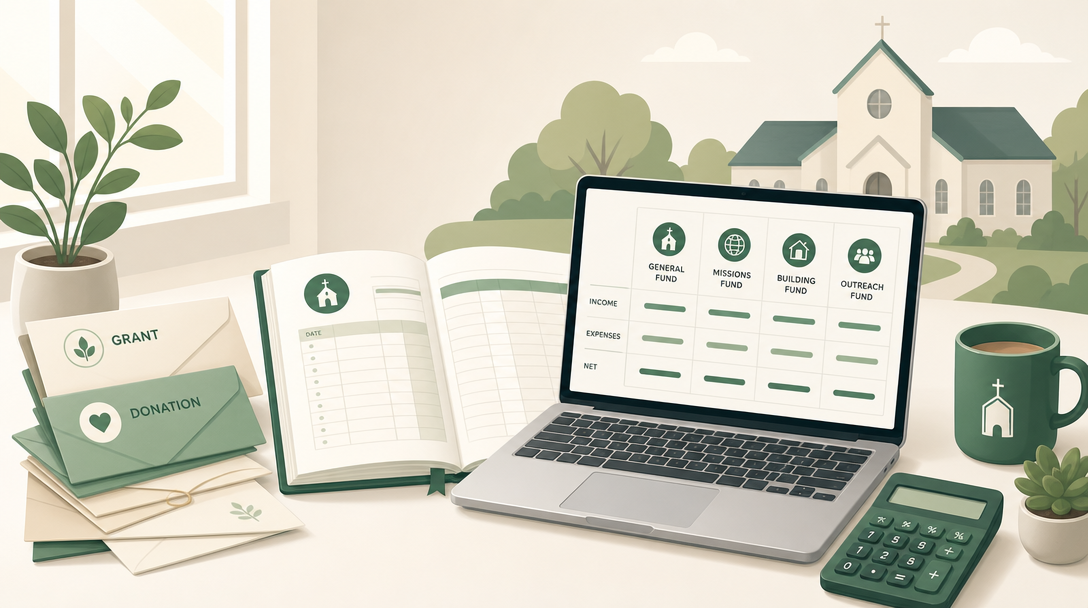
Short answer: Nonprofit bookkeeping is the routine of recording a nonprofit’s income and expenses by purpose — tracking which money is restricted by donors and grants and which is free to spend — so the organization can prove every dollar went where it was meant to. It differs from business bookkeeping in one big way: a nonprofit answers to donors, grantors, and the IRS for stewardship, not to owners for profit. The work runs on fund accounting, a monthly routine of recording and reconciling, and a year-end that produces financial statements and, for most nonprofits, a Form 990.
How nonprofit bookkeeping differs from for-profit bookkeeping
A business tracks one bottom line: profit. A nonprofit has no owners and no profit to chase, so its books answer a different question — is every restricted dollar still being used for its intended purpose? That single difference drives the rest:
- Fund accounting, not one ledger. Money is tracked in separate funds by purpose, so a grant for a literacy program never gets spent on rent.
- Net assets, not equity. A nonprofit reports net assets split into two classes under accounting standards (FASB ASC 958): with donor restrictions and without donor restrictions.
- Form 990, not a tax return. Most tax-exempt nonprofits file an annual Form 990 with the IRS, which makes the books public. (Churches are a notable exception — they’re exempt from filing.)
The mechanics are nearly identical to church books, which is why churches are just nonprofits with a few special breaks. If you run a church, the church bookkeeping guide is the version written for you.
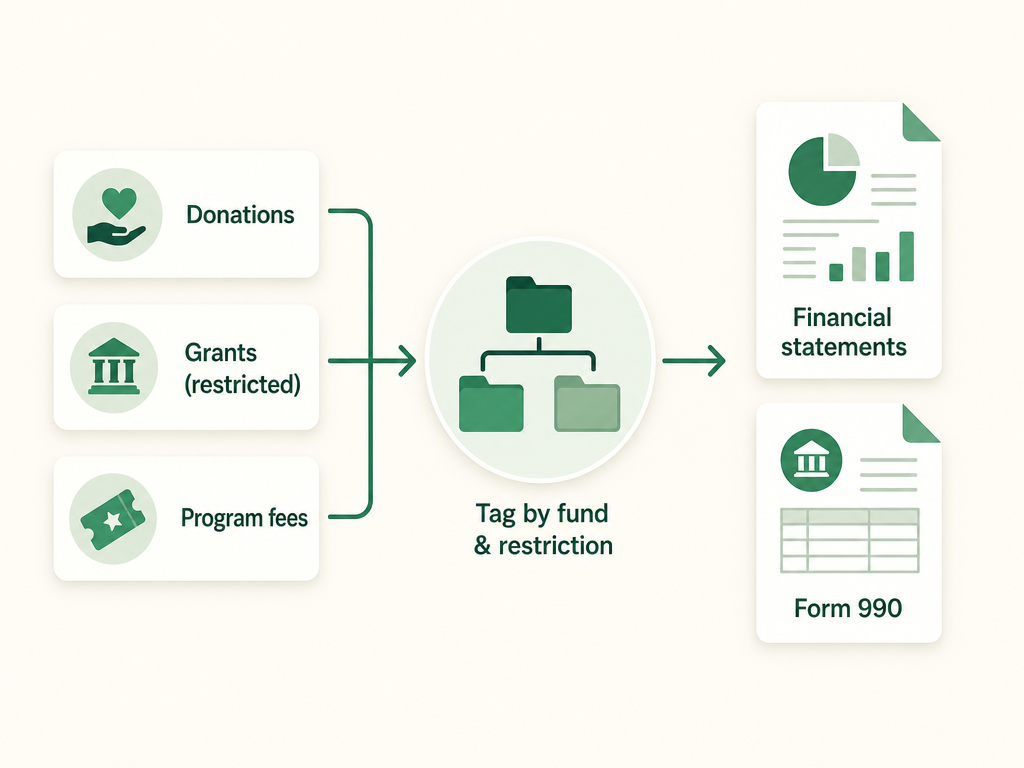
Recording restricted and unrestricted money
The skill at the heart of nonprofit bookkeeping is handling restrictions. When a donor or grantor specifies a purpose, that money is restricted — you’re bound to use it only for that, and you track it separately until it’s spent. Money given with no strings is unrestricted and funds general operations. Getting this right is what keeps a nonprofit out of trouble: spending restricted money on the wrong thing is a breach of donor intent, and grantors audit for it.
The monthly nonprofit bookkeeping routine
Most of the job is the same short loop every month:
- Record income — donations, grants, and earned revenue, each tagged to the right fund and restriction.
- Record expenses — coded to the right account and, where required, allocated across program, administrative, and fundraising functions.
- Reconcile every account — match the books to the bank, to the penny.
- Review — run a budget-versus-actual (start from a free nonprofit budget template) and check that no restricted fund has gone negative.
Do it on a set day each month and it never piles up. Skip a quarter and you’ll spend a weekend untangling it.
The reports nonprofit bookkeeping produces
Clean books exist to produce a few reports: the statement of financial position (the nonprofit balance sheet), the statement of activities (income and expenses), the statement of functional expenses, and — for most nonprofits — the annual Form 990. If the books are reconciled and coded by fund, all of these fall out of the system.
Do you need a nonprofit bookkeeper?
Most small nonprofits run on software plus a part-time or volunteer bookkeeper, bringing in a CPA periodically for the 990 and a review. Software handles the recording and the reports; a bookkeeper does the weekly entry and reconciliation; an accountant or CPA handles the judgment calls. The trap is letting one trusted person do all of it with no oversight — separate who records the money from who reviews it, no matter how small you are.
FAQ
What is the 33% rule for nonprofits? It’s the public support test. To qualify as a public charity (rather than a private foundation), a 501(c)(3) generally must receive at least one-third — 33⅓% — of its support from the general public or government sources over a rolling period. Your bookkeeping has to track support by source to prove it. Churches are automatically public charities, so the test doesn’t bind them.
Do nonprofits need bookkeepers? Effectively yes — someone has to record income and expenses by fund, reconcile the bank, and prepare the year-end reports and Form 990. It doesn’t have to be a full-time hire; many nonprofits use a part-time or volunteer bookkeeper plus software, with a CPA for the 990.
Is nonprofit bookkeeping hard? The mechanics aren’t harder than business bookkeeping, but fund accounting and restriction tracking add a layer business books don’t have. With a clear chart of accounts and software built for funds, it’s very manageable.
Is there a free alternative to QuickBooks for nonprofits? Yes — several nonprofit- and church-specific tools offer real fund accounting (some with free tiers) that QuickBooks only approximates with classes. The right pick depends on your size and whether you need grant or donor tracking — see our rundown of the best nonprofit accounting software, or, if budget is the constraint, the free nonprofit accounting software options. Outgrowing a free tool like Wave? There’s a Wave alternative for nonprofits with real funds built in.
Vestrybooks does fund-based bookkeeping the way nonprofits and churches actually need it — restrictions tracked, books reconciled, reports ready. See how it works.
This article is general information for church treasurers, not professional tax or legal advice. For your church's situation, consult a qualified accountant or attorney.
Church accounting a volunteer can actually do.
Vestrybooks is church accounting + giving for the volunteer treasurer — fund tracking, one-click year-end statements, and online giving with $0 taken from every gift.
A real free plan · no credit card · your data stays yours