Blog · Bookkeeping & accounting
How church accounting works
June 27, 2026 · By Benjamin Reinke
Short answer: Church accounting is the full system a church uses to track, report, and stay compliant on its money — recording transactions, organizing them by fund, producing financial statements, and handling the church’s tax filings. It differs from business accounting in one fundamental way: a church has no owners and no profit to measure, so it accounts for money by purpose (fund accounting) and answers to donors and the IRS for stewardship instead of to shareholders for returns. Bookkeeping is one piece of it — the recording — while accounting is the whole picture, through to the reports and filings.
Church accounting vs. bookkeeping — where one ends and the other begins
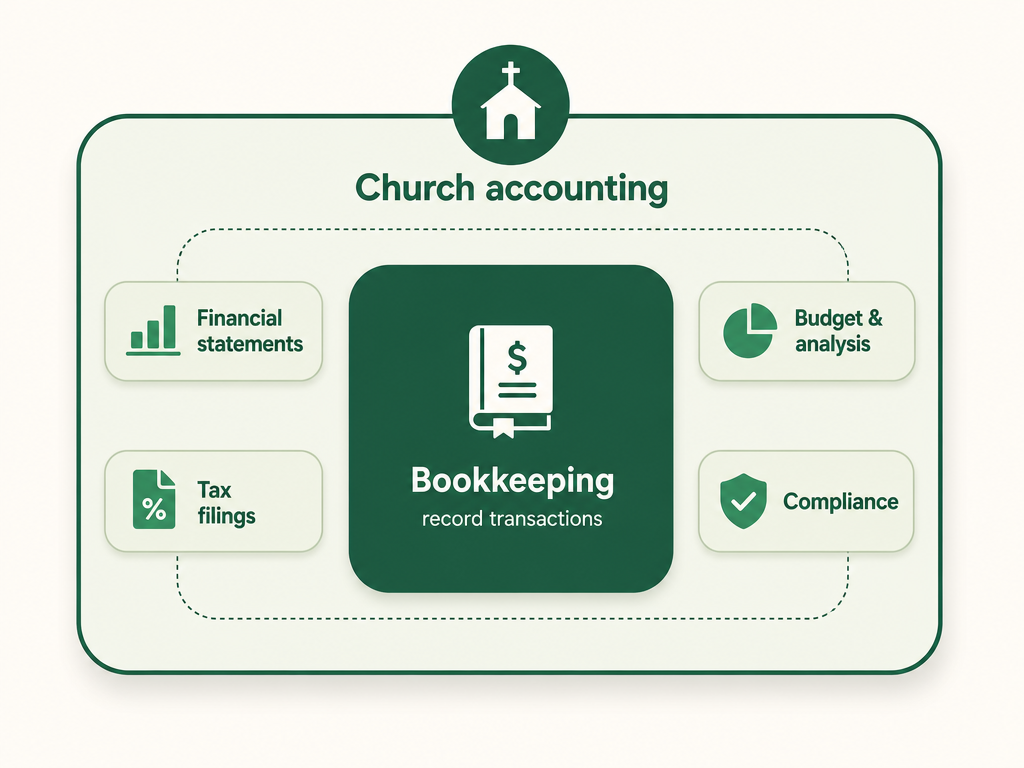
People use “church accounting” and “church bookkeeping” interchangeably, but they’re different layers of the same job. Bookkeeping is the recording layer: entering contributions and expenses, coding them to the right fund, and reconciling the bank. Accounting is the broader discipline built on top of it — summarizing those records into financial statements, building and analyzing the budget, and meeting tax and reporting obligations.
If you want the hands-on routine for keeping the books — the monthly cycle, reconciliation, and internal controls — that’s covered in the guide to church bookkeeping. This page is about the system around it: the method, the reports, and the compliance. For the operating side — budget, monthly routine, and oversight — see managing church finances.
Why church accounting differs from for-profit accounting
A business measures one thing: profit for its owners. Every transaction rolls up toward a single bottom line. A church has no owners and isn’t trying to turn a profit, so its accounting answers a different question — is every dollar being used for the purpose it was given for?
That changes the mechanics in three concrete ways:
- Fund accounting instead of one ledger. Money is tracked in separate “funds” by purpose — general, building, missions, benevolence — so restricted gifts never get spent on the wrong thing. This is the method churches use; the full mechanics are in the guide to church fund accounting.
- Net assets instead of owner’s equity. Where a business reports equity, a church reports net assets, split into two classes under accounting standards (FASB ASC 958): with donor restrictions and without donor restrictions. That split is the whole point — it shows at a glance how much of the church’s money is spoken for.
- Accountability instead of profitability. The reports exist to prove stewardship to donors and regulators, not to value the organization for a sale.
Is church accounting the same as nonprofit accounting?
Churches are nonprofits, so church accounting follows the same fund-accounting and net-asset rules as nonprofit accounting more broadly. The difference is tax treatment, not bookkeeping method. Churches get two unusual breaks the rest of the nonprofit world doesn’t:
- Automatic tax-exempt status. A church is recognized as tax-exempt under section 501(c)(3) without having to apply to the IRS, though many still apply for a determination letter so donors have proof.
- No annual Form 990. Most nonprofits must file a Form 990 every year; churches are specifically exempt from that filing requirement (IRS Publication 1828).
Those breaks don’t excuse a church from keeping clean books — the IRS still expects records adequate to substantiate income and expenses, and the exemptions disappear fast if a church drifts from its exempt purpose. For the full tax picture, see whether churches pay taxes.
The financial documents church accounting produces
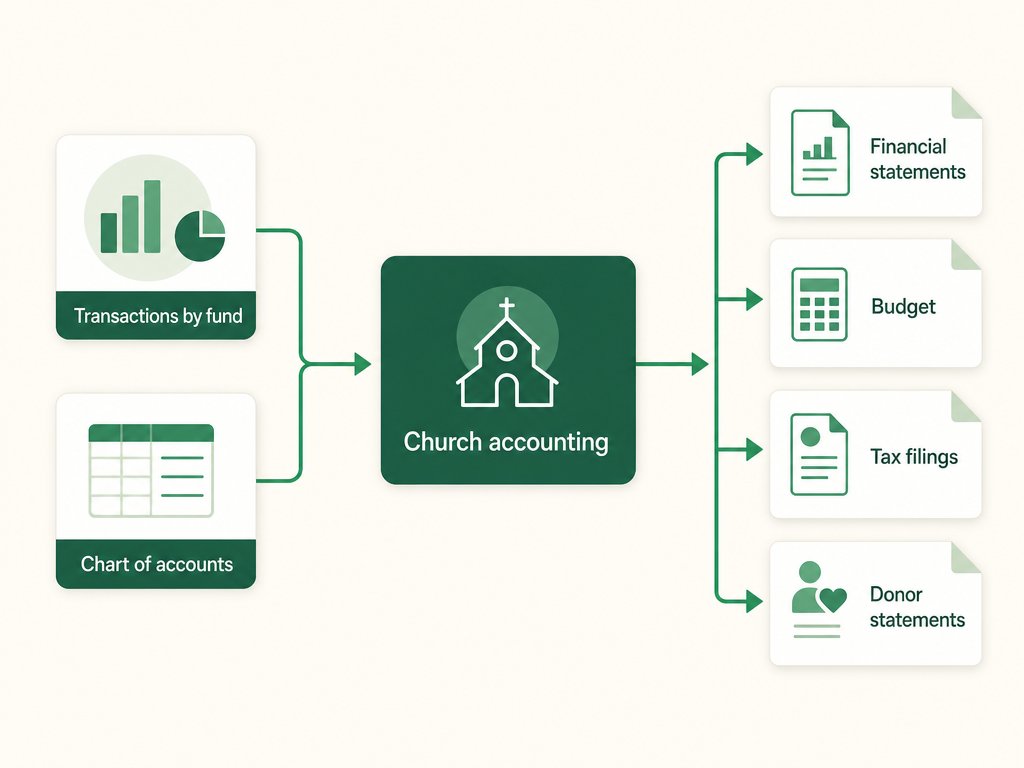
The point of all the recording is a small set of reports. Church accounting produces the same core statements as any nonprofit, just named for the church context:
| Document | What it shows | Business equivalent |
|---|---|---|
| Statement of financial position | Assets, liabilities, and net assets by fund | Balance sheet |
| Statement of activities | Income and expenses over a period, by fund | Income statement |
| Statement of functional expenses | Spending split by program vs. admin vs. fundraising | — |
| Statement of cash flows | Cash moving in and out | Cash flow statement |
| Operating budget | The plan the board tracks against monthly | Budget |
Two building blocks feed all of them: the church chart of accounts (the master list of categories) and the church budget (the plan). The full breakdown of each statement is in the guide to church financial statements.
Tax forms church accounting still has to handle
“Exempt from Form 990” doesn’t mean exempt from all filings. A church’s accounting still has to produce several forms:
- Form 990-T — if the church runs an unrelated business (say, renting commercial space), it owes tax on that income and files this.
- Payroll forms — Form 941 each quarter plus W-2s for employees, including ministers (whose pay has its own clergy-tax rules).
- Form 1099-NEC — for contractors paid $2,000 or more in a year (the 2026 threshold, up from $600 through 2025).
- Annual giving statements — donors need a written acknowledgment for any single gift of $250 or more to deduct it (IRS Publication 1771).
Clean fund-based books make every one of these straightforward, because the numbers are already coded and reconciled when filing season arrives.
Does your church need an accountant, a bookkeeper, or just software?
Most small churches don’t need a full-time accountant. The honest breakdown of who does what:
- Software handles the recording and the reports for the vast majority of churches. QuickBooks works with its “class” feature standing in for funds — see QuickBooks for churches — and purpose-built church packages like Vestrybooks do fund accounting natively.
- A bookkeeper (volunteer or paid) does the weekly entry and reconciliation. Plenty of churches run well on a diligent volunteer plus software.
- An accountant or CPA is worth bringing in for the once-a-year or higher-stakes work: setting up the system, reviewing the statements, advising on payroll and clergy taxes, or handling a voluntary audit. You hire the expertise when you need judgment, not data entry.
The trap is having one trusted person do all three with no oversight — that’s how most church fraud happens. Separate the recording from the reviewing no matter how small you are.
FAQ
What type of accounting do churches use? Fund accounting — money is tracked in separate funds by purpose rather than as one pool, so restricted gifts stay tied to what they were given for. Most churches keep their books on a cash or modified-cash basis, though larger churches may use accrual.
Can I use QuickBooks for church accounting? Yes. QuickBooks has no church edition, but its “class” feature can stand in for funds, which works for many churches. Purpose-built church software handles funds without the workaround.
What is the 80/20 rule for churches? It’s the Pareto principle applied to giving — the common observation that roughly 80% of a church’s contributions come from about 20% of its givers. It’s a stewardship rule of thumb for planning, not an accounting rule or an IRS requirement, and the real split varies a lot by congregation.
Does a church need an accountant? Not usually a full-time one. Most churches run on software plus a bookkeeper, and bring in an accountant or CPA periodically to set up the system, review the financials, or advise on payroll and clergy taxes. The key is separating who records the money from who reviews it. The full breakdown is in the guide to hiring a church accountant.
What are the basics of church accounting? Five things make up the starter view: track money by fund (general, building, missions) instead of one pool, code every transaction to a category in a chart of accounts, reconcile each fund against the bank monthly, and roll the year’s records into the core financial statements at year-end. Get those four habits right and the rest is detail. Fund accounting is the one concept that’s specific to churches and nonprofits — everything else is ordinary bookkeeping discipline.
Is church accounting hard? The concept is simple: track every dollar by the purpose it was given for. The double-entry mechanics that used to make it tedious are handled by software now, so what’s left is discipline more than difficulty — entering transactions promptly, reconciling on schedule, and keeping funds separate. A diligent volunteer with the right tool can run a small church’s books without an accounting background.
How is church accounting different from regular accounting? A business measures profit for its owners; a church has no owners and isn’t chasing profit, so it reports net assets instead of equity and tracks money by fund instead of in one ledger. The reports exist to prove every restricted gift went where it was meant to, not to value the organization. The side-by-side is in fund accounting vs. regular accounting.
What are church accounting best practices? Use fund accounting so restricted gifts stay tied to their purpose, separate who records money from who reviews and approves it, reconcile every account monthly, and run an independent review of the books each year. Keep clean, complete records behind every number — the IRS still expects documentation even though most churches skip Form 990. The recurring theme is oversight: no single person should record, approve, and reconcile alone.
Vestrybooks does church accounting the way it actually works — fund accounting, the core statements, and donor statements in one place built for churches. See how it works.
This article is general information for church treasurers, not professional tax or legal advice. For your church's situation, consult a qualified accountant or attorney.
Church accounting a volunteer can actually do.
Vestrybooks is church accounting + giving for the volunteer treasurer — fund tracking, one-click year-end statements, and online giving with $0 taken from every gift.
A real free plan · no credit card · your data stays yours