Blog · Bookkeeping & accounting
Church treasurer vs. financial secretary: who does what
June 28, 2026 · By Benjamin Reinke

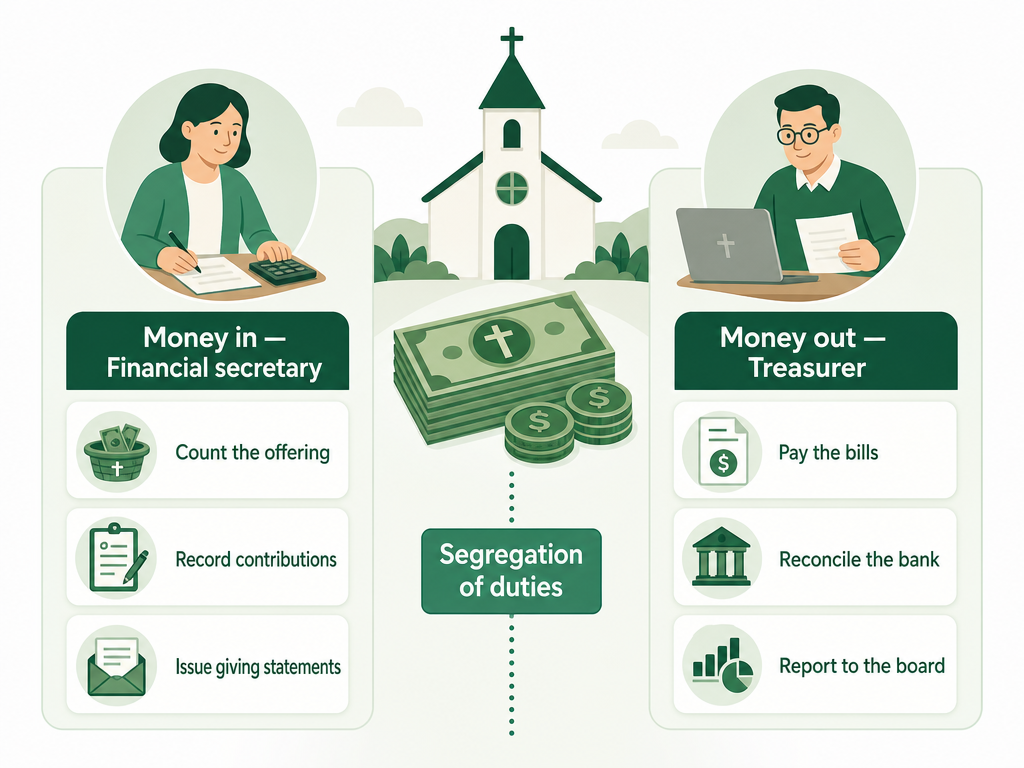
Short answer: In many churches the financial secretary handles the money coming in — recording contributions, counting and depositing the offering, keeping each giver’s record, and issuing year-end giving statements — while the treasurer handles the money going out and the reporting: paying the bills, managing the bank accounts, overseeing the budget, and reporting to the board. Splitting the two is not red tape. It’s a deliberate internal control, so the same person never both records the gifts and writes the checks. That single separation is the most important fraud protection a church has.
Two roles, two halves of the same money. A church needs someone to handle what comes in and someone to handle what goes out, and the safest churches make sure those are different people. Below is what each one actually does, why the split matters, and what to do when your church is too small to fill both seats.
What a financial secretary does
The financial secretary owns the incoming side of the money — everything that happens between the offering plate and the church’s deposit. The work is concrete and weekly:
- Count and deposit the offering. Tally the week’s cash and checks, ideally alongside a second counter, and get the deposit to the bank promptly.
- Post contributions to giving records. Record each gift against the right giver and the right fund, so every donor’s annual total is accurate and every restricted gift lands where it belongs.
- Track pledges and contributions. Keep running records of who pledged what and what’s actually come in, so the church can follow through on its giving commitments.
- Produce donor statements. Generate the year-end contribution statements donors need to substantiate their gifts to the IRS.
Notice the boundary: the financial secretary records and receives money, but does not write checks, pay bills, or sign on the bank account. That line is the whole point. The person who knows exactly how much came in is kept away from the side that decides where it goes. Done well, the financial secretary produces a clean record of every dollar received — which is also the raw material the treasurer needs to report honestly to the board.
What a church treasurer does
The church treasurer owns the outgoing side and the oversight. Where the financial secretary records what comes in, the treasurer answers for what happens after that:
- Disburse funds. Approve and pay invoices, payroll, and reimbursements, coding each to the correct budget line and fund.
- Manage the bank accounts. Hold signing authority, watch the cash position across accounts, and keep the church solvent month to month.
- Reconcile the accounts. Match the books to the bank statement every month until they agree to the penny — the step that catches both honest mistakes and theft.
- Oversee the budget and report to the board. Compare actual spending to the plan, flag anything off track, and bring a clear summary to the board or finance committee.
That last duty is the treasurer’s signature deliverable. For a deeper look at the role itself, see the church treasurer page; for the monthly document it produces, see the treasurer report. Together, recording and reporting are two distinct jobs — and keeping them in two distinct seats is the design, not an accident. The day-to-day mechanics of both sit inside the broader discipline of church bookkeeping; this page is about who does which half.
Why churches split the two roles (segregation of duties)
Segregation of duties is the principle that no single person should control a transaction from start to finish. For a church it comes down to one rule: the person who records and receives money should not also be the person who disburses and reconciles it. Split those, and a thief would need a second person to cooperate before anything could be hidden.
Here’s why this is the number-one fraud control churches have. When one person counts the offering, records the gifts, writes the checks, and reconciles the bank, there is no independent check anywhere in the chain. They can skim cash before it’s recorded and no record will ever show it’s missing. They can write a check to themselves and then reconcile the statement so the books look clean. Almost every church embezzlement case follows that exact shape — one trusted person holding both halves of the money with no one positioned to notice. The deeper mechanics, and how these schemes get caught, are covered in the page on church embezzlement.
Separating the financial secretary from the treasurer breaks the chain in the most important place. The financial secretary knows what came in but can’t move it out; the treasurer pays what’s owed but can’t quietly alter what was received. Each one’s records become a check on the other’s. Church-finance bodies like the ECFA treat this separation as baseline stewardship, not bureaucracy. That’s why churches that run on trust still split the seats — not because anyone is suspected, but because a clean separation protects honest volunteers as much as it deters dishonest ones. When suspicion can’t land on a single person, nobody has to prove their innocence.
When the roles are combined (small churches)
Plenty of small churches can’t fill both seats. There simply aren’t two willing, capable volunteers, so one person ends up handling money in and money out. That’s a real constraint, not a moral failure — but it does remove the built-in check, so the church has to add compensating controls to replace what the split would have provided. Three work well:
- Use a second counter. Even if one person does the recording and the disbursing, never let that person be alone with uncounted cash. Two unrelated people count the offering together and both sign the count sheet, so the amount is fixed before the combined-role person ever touches it.
- Have the board review the statements. A board or finance-committee member looks at the bank statements and giving records on a regular schedule — not to redo the work, but to confirm deposits match what was counted and that nothing unusual is moving through the accounts.
- Send the reconciliation to someone else. The monthly bank reconciliation goes to a second person — anyone outside the combined role — who confirms the books tie to the statement. This is the single most valuable check you can add, because it’s exactly the step a combined role would otherwise grade itself on.
Layer those in and a one-person finance operation can still be safe. The goal isn’t to pretend you have two seats; it’s to make sure no single person can both move the money and be the only one who ever looks at where it went.
A quick side-by-side
When people ask who does what, a simple table settles it. The financial secretary lives on the left of the bank deposit; the treasurer lives on the right of it.
| Task | Financial secretary | Treasurer |
|---|---|---|
| Receives and counts the offering | Yes | No |
| Records contributions to giving records | Yes | No |
| Issues year-end giving statements | Yes | No |
| Writes checks and pays bills | No | Yes |
| Reconciles the bank | No | Yes |
| Reports to the board | No | Yes |
Read the table top to bottom and the dividing line is obvious: every “money in” task sits with the financial secretary, every “money out” and oversight task sits with the treasurer, and the two columns never overlap. That gap down the middle is the internal control doing its job.
FAQ
What is the difference between a church treasurer and a financial secretary? The financial secretary handles the money coming in — counting and depositing the offering, recording each contribution to the right giver and fund, and issuing year-end giving statements. The treasurer handles the money going out and the reporting — paying bills, managing the bank accounts, reconciling the books, overseeing the budget, and reporting to the board. Keeping the two roles separate is a deliberate internal control, so the person who records what comes in isn’t the same person who controls what goes out.
Can one person be both? One person can, and in small churches one person often is — but combining the roles removes the built-in check that protects the church and the volunteer alike. If you have to combine the roles, add compensating controls: a second person counts the offering, a board member reviews the bank statements and giving records, and the monthly reconciliation goes to someone outside the combined role. Those substitutes restore most of what the split would have provided.
Which one handles the offering? The financial secretary. Counting and depositing the weekly offering, then recording each gift against the right giver and fund, is the incoming side of the money — and that’s the financial secretary’s job. Best practice is for two unrelated people to count it together so no one is ever alone with the cash, even before it reaches the financial secretary’s records.
Which one writes the checks? The treasurer. Paying bills, payroll, and reimbursements is the outgoing side of the money, and it belongs with the treasurer, who also reconciles the accounts and reports to the board. The financial secretary deliberately does not write checks or sign on the account — keeping the recording of gifts separate from the spending of them is the whole reason the two roles exist.
Vestrybooks keeps the two roles separated — gifts recorded on one side, payments and reconciliation on the other — with an audit trail tying every dollar from offering plate to bank statement, all in one system. See how it works.
This article is general information for church treasurers, not professional tax or legal advice. For your church's situation, consult a qualified accountant or attorney.
Church accounting a volunteer can actually do.
Vestrybooks is church accounting + giving for the volunteer treasurer — fund tracking, one-click year-end statements, and online giving with $0 taken from every gift.
A real free plan · no credit card · your data stays yours