Blog · Bookkeeping & accounting
The church treasurer's role, duties, and accountability
June 27, 2026 · By Benjamin Reinke

Short answer: A church treasurer is the officer — usually an elected or appointed volunteer, not a hired professional — who oversees the church’s money and answers for it to the congregation and the board. The job is oversight, not data entry: making sure giving is recorded and deposited, bills get paid, the bank is reconciled, and the board gets a clear monthly report. A good treasurer doesn’t do all of that alone. The role only works when the money passes through more than one set of hands, so no single person controls a transaction from offering plate to bank statement.
What a church treasurer is responsible for
The church treasurer is the steward of the congregation’s money — accountable to the members for every dollar given. In most churches the treasurer is a lay officer elected by the congregation or appointed by the board, and the work is volunteer. The title sounds like an accounting job, but the heart of it is fiduciary: you hold money that belongs to other people, given in trust for the church’s mission, and you have to be able to show at any time where it went. When you appoint someone, spell out the role in writing — start from a free church treasurer job description. And if you’re the one who just got handed it, the new church treasurer checklist walks through exactly what to do in your first 90 days.
That shapes how the role is best run. The treasurer oversees the church’s finances, signs off on what gets paid, and reports up to the board — but the actual counting, recording, and reconciling should be spread across other people so the treasurer is never the only one who touches the money. The point isn’t distrust of a good person. It’s that a clean system protects the treasurer as much as the church, because honest people get accused too. The day-to-day mechanics of keeping those records sit in the broader practice of church bookkeeping; this page is about the person who answers for them.
The core duties of a church treasurer
A church treasurer’s duties fall into a predictable set, repeated month after month. They run from the moment money comes in to the year-end statements donors need for their taxes:
- Oversee giving. Make sure every week’s offering is counted by two unrelated people, deposited promptly, and recorded against the right fund and the right giver’s record. The treasurer doesn’t have to do the counting — and ideally shouldn’t — but owns that it happened correctly.
- Pay the church’s bills. Approve and pay invoices, payroll, and reimbursements, coding each to the correct budget line and fund.
- Reconcile the bank. Match the books to the bank statement every month, line by line, until they agree to the penny. This is the single step that catches both honest errors and theft.
- Report to the board. Bring a clear monthly financial summary to the board or finance committee — what came in, what went out, where each fund stands, and how actual spending compares to the budget.
- Help build the budget. Work with the pastor and board each year to turn the ministry plan into a realistic church budget the leadership will actually follow.
- Issue year-end giving statements. Send each donor an annual contribution statement so they can substantiate their gifts. The IRS requires a written acknowledgment from the church for any single gift of $250 or more (IRS Publication 1828).
- Prepare for the audit. Keep deposit slips, invoices, approvals, and reconciliations organized so an independent review can trace any transaction without a treasure hunt.
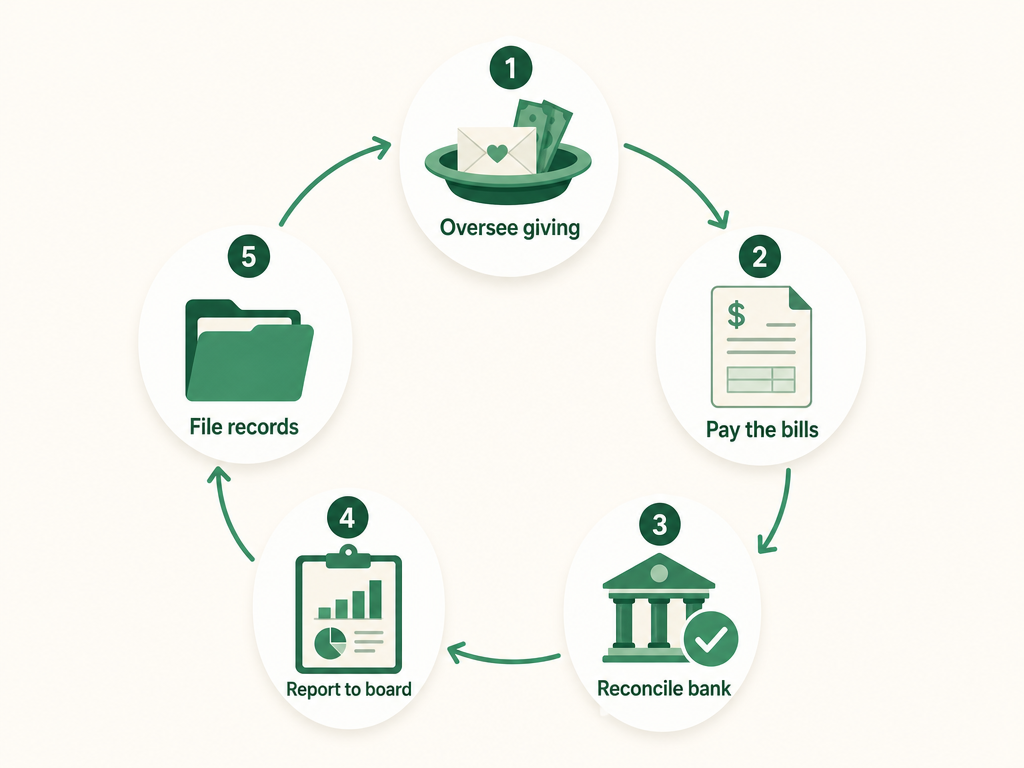
Most months, that loop is the whole job. The skill isn’t speed — it’s running it the same way every time so the books are always ready to be shown.
Why the treasurer shouldn’t be the only one touching the money
The church treasurer holds a fiduciary duty, which is a heavier standard than “be careful.” A fiduciary is legally and morally bound to put the organization’s interest ahead of their own and to handle its money with care, honesty, and full transparency. For a church that means one thing in practice: separating the work so no single person — including the treasurer — controls a transaction end to end.
Churches are unusually easy targets for fraud because they run on trust and often hand one trusted person the offering, the checkbook, and the bank login all at once. The fix is segregation of duties:
- Two unrelated people count the offering together and both sign the count sheet, before anyone is alone with the cash.
- The person who records the books is not the person who signs the checks, and ideally not the one who reconciles the bank either.
- A second signature or approval is required for payments over a set amount.
- Someone outside the treasurer’s seat reviews the monthly reconciliation — a finance committee member or a second officer who isn’t doing the recording.
Church-finance bodies like the ECFA treat this as baseline stewardship, not bureaucracy. Even a tiny church can split counting from recording. Once a year an independent set of eyes should look at the whole thing — that’s the job of a church audit, and a treasurer who keeps clean records makes it painless instead of dreaded.
Treasurer vs. bookkeeper vs. accountant, from the treasurer’s seat
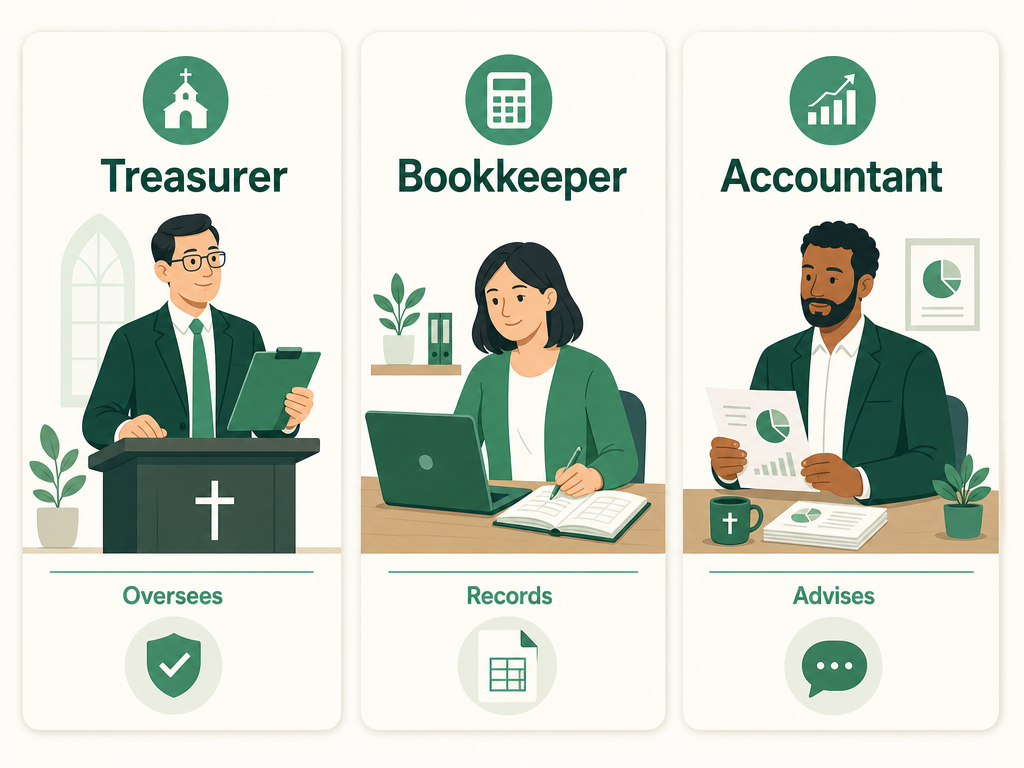
A church treasurer, a bookkeeper, and an accountant get blurred together, but from the treasurer’s chair the difference is clear: they sit at three different distances from the money. One oversees and answers for it, one records it, one interprets it.
| Role | What they do | Who they are |
|---|---|---|
| Treasurer | Oversees the finances, approves payments, reports to the board, answers to the congregation | An elected or appointed officer — usually a volunteer |
| Bookkeeper | Records contributions and expenses, reconciles the bank, runs the monthly cycle | Staff or volunteer doing the hands-on recording |
| Accountant | Builds the statements, advises on payroll and compliance, handles hard tax questions | A hired professional, in-house or outsourced |
In a small church one person often wears all three hats, which is exactly the situation segregation of duties warns against. As a church grows, the treasurer stays the accountable officer but hands the recording to a bookkeeper and brings in a church accountant for the higher-stakes calls. The treasurer never stops being the one who answers for the money — the others just take work off the treasurer’s desk.
The skills and qualities a good church treasurer needs
The best church treasurer is rarely the person with the most accounting credentials — it’s the person who is trustworthy, organized, and willing to be checked. The qualities that matter most:
- Integrity above everything. The treasurer handles money given in trust, so character outranks technical skill. Someone who welcomes oversight rather than resents it.
- Consistency. The job is a monthly loop; it rewards the person who does it on schedule, not the one who’s brilliant but does it twice a year.
- Attention to detail. Reconciling to the penny and coding gifts to the right fund take patience more than genius.
- Plain communication. The treasurer has to make the numbers clear to a board of non-accountants, so they can govern.
- Comfort with the tools. Basic spreadsheet or church-software fluency. Not a CPA’s depth — just enough to run the reports.
- Discretion. A treasurer sees who gives what and must never let that affect how members are treated.
Notice what’s not on the list: an accounting degree. A diligent volunteer with good software and a real review process runs a clean church treasury every week. The system, not the credential, is what makes it trustworthy.
Can a volunteer be the treasurer, and how software helps
A volunteer absolutely can serve as church treasurer — most do, and most churches are small enough that it works well. What makes it work isn’t heroics; it’s the right system around the volunteer. Accounting software built for churches does the heavy lifting that used to take an accounting background: it tracks each fund’s balance automatically, posts gifts to the right giver, walks you through reconciliation, and generates the board report and year-end giving statements with a few clicks.
That turns the treasurer’s job from “know accounting” into “run the process.” Purpose-built church packages handle fund accounting natively — keeping restricted gifts tied to their purpose without a spreadsheet of formulas a volunteer has to maintain. The treasurer still owns the oversight and the reporting; the software just removes the parts that used to require an expert. When a church grows past what one volunteer can manage on the side, that’s the signal to add a bookkeeper or weigh a paid professional — but the treasurer’s accountable role stays put.
What goes in the treasurer’s report to the board
The treasurer’s report is the monthly document the treasurer brings to the board or congregation — the main way the church sees that its money is being handled well. A good one is short, plain, and consistent. At a minimum it shows:
- Income and expenses for the month and year-to-date, against the budget.
- The balance in each fund — general, building, missions, benevolence — so restricted money is visibly intact.
- Cash on hand across the bank accounts, tied back to the reconciliations.
- Anything that needs the board’s attention — a fund running low, a category over budget, a large or unusual expense.
These are the same numbers that come out of the church financial statements — the statement of activities and the statement of financial position — trimmed down to what a board of non-accountants needs to make decisions. The discipline is consistency: the same format every month, so the board can read it at a glance and spot when something changes. A treasurer who hands the board a clear one-pager every month builds the kind of trust that makes the whole role easier.
FAQ
What is the role of a church treasurer? The church treasurer is the officer who oversees the church’s money and answers for it to the congregation and board. The role covers making sure giving is recorded and deposited, paying the bills, reconciling the bank, reporting to the board each month, helping build the budget, and issuing year-end giving statements. It’s oversight and accountability more than data entry, and the work is best spread so the treasurer isn’t the only one who touches the money.
Is church treasurer a paid position? In most churches it isn’t — the treasurer is an elected or appointed volunteer officer, the same as a board member. Larger churches sometimes pay a finance director or hire a bookkeeper to do the recording, but the treasurer role itself is usually unpaid. If a church does compensate the treasurer, the pay has to be reasonable and approved by the board, not set by the treasurer.
What is the difference between a church treasurer and a financial secretary? The two split the money so no one person controls it. The financial secretary handles the incoming side — counting and recording contributions and posting them to each giver’s record — while the treasurer handles the outgoing side, paying bills and managing the accounts, and reports to the board. Keeping the roles separate is a deliberate internal control: the person who records the gifts isn’t the person who writes the checks. Small churches that can’t fill both seats should at least separate counting from check-writing. The full breakdown is in treasurer vs. financial secretary.
Can the pastor’s wife be the church treasurer? She can in most churches, but it’s usually a bad idea, and not because of her. Putting the treasury in the hands of someone in the pastor’s household concentrates financial control inside one family and weakens the separation that protects everyone. If the pastor signs off on spending and a family member controls the books, there’s no independent check. Pick a treasurer outside the pastor’s household, or build in extra review if you can’t.
Who does the church treasurer report to? The treasurer reports to the board, finance committee, or the congregation, depending on how the church is governed — and the church bylaws usually spell out exactly who. That reporting line is part of the accountability: the treasurer manages the money, but a separate body reviews the reports and approves the budget, so authority never rests in one seat.
Should a church treasurer be bonded? Many churches do, and it’s worth considering. A fidelity bond — a form of insurance, often already part of a church’s insurance package as “employee dishonesty” coverage — reimburses the church if someone who handles its money steals it. Bonding doesn’t replace good controls (two-person offering counts, separating recording from check-signing, an outside review of the reconciliation), but it’s a sensible backstop when one volunteer touches a lot of cash, and it protects an honest treasurer too — insurance plus clean controls means suspicion never lands on one person. Check whether your existing church insurance already includes fidelity or employee-dishonesty coverage before buying a separate bond.
How long should a church treasurer serve? There’s no fixed rule, but most churches set a term of one to three years in the bylaws, with a renewal limit so the role rotates. Rotation isn’t a vote of no confidence — it’s a control. When the same person holds the checkbook for a decade, no one else knows how the books work and fresh eyes never review them. Even a treasurer who stays on should hand the reconciliation to a different reviewer periodically so the role is always checked.
Does a nonprofit need a treasurer? In most states, yes. Nonprofit corporation law and the organization’s own bylaws typically require a slate of officers — usually a president, a secretary, and a treasurer — and a church incorporated as a nonprofit is no exception. The treasurer is the officer who carries the board’s financial oversight, one piece of the board’s broader fiduciary responsibilities. Even where the law is silent, naming a treasurer in the bylaws is basic governance.
Is a church treasurer a fiduciary? Yes. A church treasurer holds money that belongs to the congregation, given in trust, which makes the role fiduciary — bound by a duty of care (handle the money competently and carefully) and a duty of loyalty (put the church’s interest ahead of your own). In plain terms, the treasurer has to account for every dollar and can never use church funds, or the access the role grants, for personal benefit. That standard is why the work is best split across several people rather than left to one.
Who should be the church treasurer? The right person is trustworthy, organized, and willing to be checked — character matters more than accounting credentials. Just as important is who it shouldn’t be: avoid anyone closely related to the bookkeeper, the check-signer, or the counters, because family ties inside the money chain quietly undo the separation of duties that protects the church. Pick someone outside the pastor’s household and outside the recording seat, so oversight stays independent.
What does a church financial secretary do? The financial secretary handles the incoming side of the money: counting the weekly offering, recording each gift to the right giver and fund, and tracking pledges and contributions. The treasurer handles the outgoing and oversight side — paying bills, reconciling, and reporting to the board. Splitting the two is deliberate separation of duties, so the person who records what comes in isn’t the same person who controls what goes out.
How do you resign as or replace a church treasurer? Plan a clean handoff rather than a sudden walk-away. The outgoing treasurer should reconcile the books current, gather every record — bank statements, deposit slips, invoices, approvals, and giving records — and pass them to the successor, ideally with a short overlap to answer questions. The board then needs to change the bank’s authorized signers and any online-banking access the same week, and minute the change in its records so the date of transfer is documented.
Vestrybooks gives a volunteer treasurer the fund accounting, reconciliation, and board-ready reports the role needs — without an accounting background. See how it works.
This article is general information for church treasurers, not professional tax or legal advice. For your church's situation, consult a qualified accountant or attorney.
Church accounting a volunteer can actually do.
Vestrybooks is church accounting + giving for the volunteer treasurer — fund tracking, one-click year-end statements, and online giving with $0 taken from every gift.
A real free plan · no credit card · your data stays yours