Blog · Bookkeeping & accounting
Do church treasurers get paid? (Usually not — here's why)
June 28, 2026 · By Benjamin Reinke

Short answer: No — the large majority of church treasurers are unpaid volunteers, especially in small and mid-sized churches. The treasurer is usually a board-elected lay officer, the same as any other board member, and the role is served, not hired. A church can pay a treasurer, and some larger churches do, but the moment money changes hands the question stops being “should we?” and becomes a compensation, tax, and oversight question: how much is reasonable, is the person an employee or a contractor, and who watches the person now being paid to watch the money.
Most church treasurers are volunteers
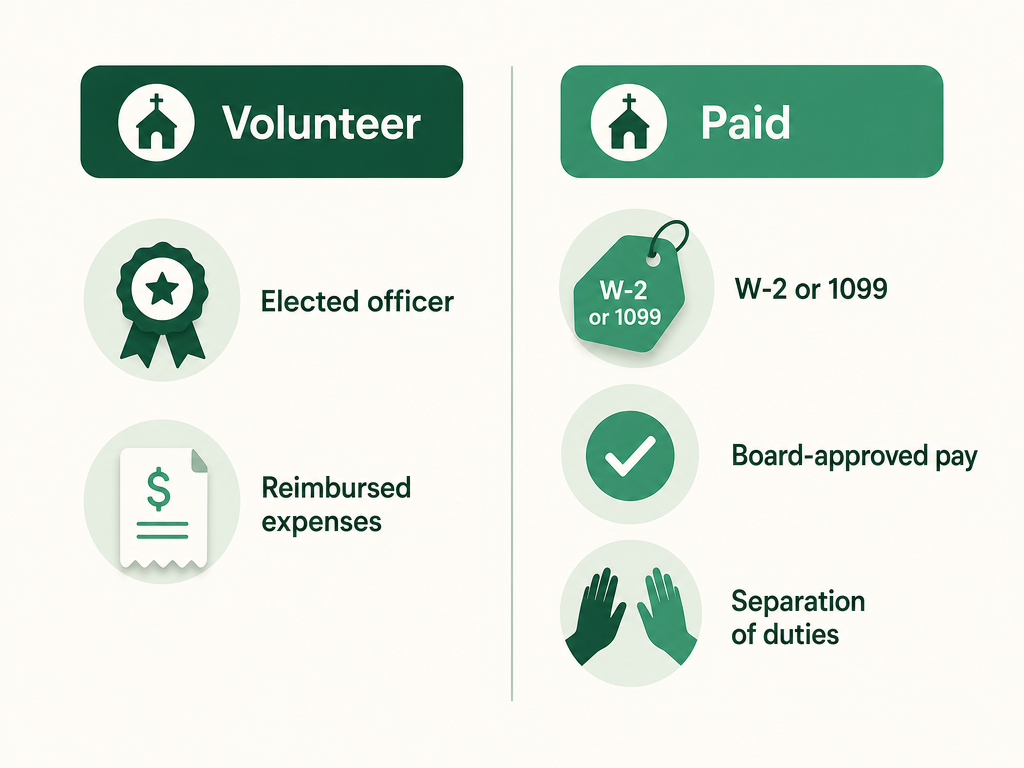
Church treasurers serve unpaid in most congregations because the role is one of governance and trust, not a job posting. The treasurer is typically a lay officer the congregation elects or the board appoints — a steward who answers for the church’s money to the people who gave it. That fiduciary character is the whole reason the seat exists, and it’s why churches fill it the way they fill any other board office: with a trusted member who volunteers, not a salaried hire.
Budgets push in the same direction. A small church running on a tight income can’t justify paying for oversight when a capable member will do it for free, and the day-to-day recording can sit inside ordinary church bookkeeping handled by a volunteer or a part-time bookkeeper. So the default — the way the role works in the large majority of churches — is an elected volunteer who owns the oversight and reporting without drawing a paycheck for it. The specifics of what that person actually does week to week are covered on the church treasurer role page; this page is about whether the seat comes with pay.
When a church pays its treasurer
A church pays its treasurer mainly when the role grows past what a volunteer can carry on the side. In a large congregation the finances are big enough — multiple funds, a real payroll, grants, restricted gifts — that the work becomes a part-time or full-time job, and at that scale the duties are often bundled into a paid finance director or business administrator position rather than left as a stand-alone elected office. Paying a person to run the money full-time is normal stewardship once the volume justifies it.
Whatever the church decides, the pay has to be set the right way. Compensation for a treasurer should be reasonable for the work and the local market, and it has to be approved by the board — never set by the treasurer for the treasurer. A board that votes the compensation, documents how it landed on the figure, and keeps the decision in its minutes protects both the church and the person being paid. The treasurer’s own signature should never appear on the decision that sets the treasurer’s salary.
If you pay a treasurer, it’s employment or contracting
Paying a treasurer turns a volunteer arrangement into a worker arrangement, and every paid worker is either an employee or an independent contractor. The distinction is not the church’s to assign by preference — the IRS decides it by looking at the facts. An employee gets a Form W-2 and has income and payroll taxes withheld; an independent contractor gets a Form 1099-NEC and handles their own taxes. Most treasurers who are paid look far more like employees than contractors, because the church directs the work.
The IRS draws the line with a common-law control test that weighs three categories of facts: behavioral control (does the church direct what the worker does and how), financial control (who controls the business side — pay method, expenses, tools), and the type of relationship (written contracts, benefits, permanence, and whether the work is core to the organization). There is no single deciding factor; you weigh the whole relationship (IRS: Independent contractor or employee?). A treasurer the church controls week to week, on an ongoing basis, doing work central to the organization, almost always lands on the employee side — which means W-2 payroll, not a 1099. How a church actually runs that is its own topic: see church payroll. (None of this is tax or legal advice — confirm a worker’s status with your own accountant.)
The oversight catch: paying the person who controls the money
Paying the treasurer sharpens an internal-control problem instead of solving it. The treasurer already oversees the church’s money; once that person is also being compensated, the church has a paid insider with influence over the funds — and that is exactly the situation segregation of duties exists to guard against. Pay does not buy a pass on controls. It raises the stakes for keeping them.
The rule is the same whether the treasurer is paid or volunteer: no single person should record transactions, approve payments, and reconcile the bank alone. Those duties get split so a transaction passes through more than one set of hands from offering plate to bank statement.
- Two unrelated people count the offering and both sign the count sheet.
- Whoever records the books does not also sign the checks, and ideally doesn’t reconcile the bank either.
- A second approval is required for payments over a set amount — dual control on money out.
- Someone outside the treasurer’s seat reviews the monthly reconciliation, paid treasurer or not.
A paid treasurer is not a reason to relax any of that. If anything, a salary is one more reason an independent reviewer should sign off on the reconciliation each month, so the person earning money from the church is never the only one who can see the whole picture.
Reimbursing a volunteer treasurer
Reimbursing a volunteer treasurer for real out-of-pocket costs is not pay, and done correctly it isn’t taxable. Under an accountable plan — where the treasurer documents an actual church-related expense with receipts and is paid back only for that documented amount — the reimbursement is a wash, not income, so it isn’t reported as wages (IRS Publication 463, Accountable Plans). Mileage to the bank, a box of offering envelopes, or accounting-software the treasurer bought for the church all qualify when the church has an accountable-plan policy and the treasurer turns in receipts.
A round-number “honorarium,” a year-end gift, or a flat monthly stipend with no receipts behind it is a different thing. Payments like that are compensation, not reimbursement, and are generally taxable to the person who receives them. The clean line is documentation: pay back a documented expense and it’s a reimbursement; hand over cash for the role itself and it’s pay. (As always, this is general information, not tax advice for your situation.)
FAQ
Do church treasurers get paid? Usually not. In most churches — especially small and mid-sized ones — the treasurer is an unpaid volunteer elected or appointed to the office, the same as any board member. Larger churches sometimes pay a finance director or business administrator who carries the treasurer’s duties, but the stand-alone treasurer role itself is most often a volunteer position.
Should a church treasurer be paid? It depends on the size of the job, not on principle. When the work is a few hours a month, a volunteer handles it fine and paying for it is hard to justify. When the finances grow into a real part-time or full-time workload, paying someone — and bundling the duties into a finance staff position — makes sense. Either way, any pay should be reasonable and approved by the board, never set by the treasurer.
Is a paid church treasurer an employee or contractor? Most often an employee. The IRS decides this by the facts, weighing how much the church controls the work, the financial arrangement, and the type of relationship. A treasurer the church directs on an ongoing basis, doing work core to the organization, generally meets the test for an employee — which means a W-2 and payroll, not a 1099. Confirm the classification with your accountant before you pay anyone.
Can a volunteer treasurer be reimbursed? Yes. Paying a volunteer back for documented, church-related out-of-pocket costs under an accountable plan — receipts in, exact amount out — is a reimbursement, not income, and isn’t taxable. A flat stipend or honorarium with no receipts behind it is treated as compensation and is generally taxable, so keep the two clearly separate.
Clean books and built-in dual control are what make a volunteer treasurer’s job doable — Vestrybooks handles the fund tracking, reconciliation, and board reports so an unpaid officer can run the role well. See how it works.
This article is general information for church treasurers, not professional tax or legal advice. For your church's situation, consult a qualified accountant or attorney.
Church accounting a volunteer can actually do.
Vestrybooks is church accounting + giving for the volunteer treasurer — fund tracking, one-click year-end statements, and online giving with $0 taken from every gift.
A real free plan · no credit card · your data stays yours