Blog · Church formation & governance
How to start a church the legal and financial way
June 27, 2026 · By Benjamin Reinke
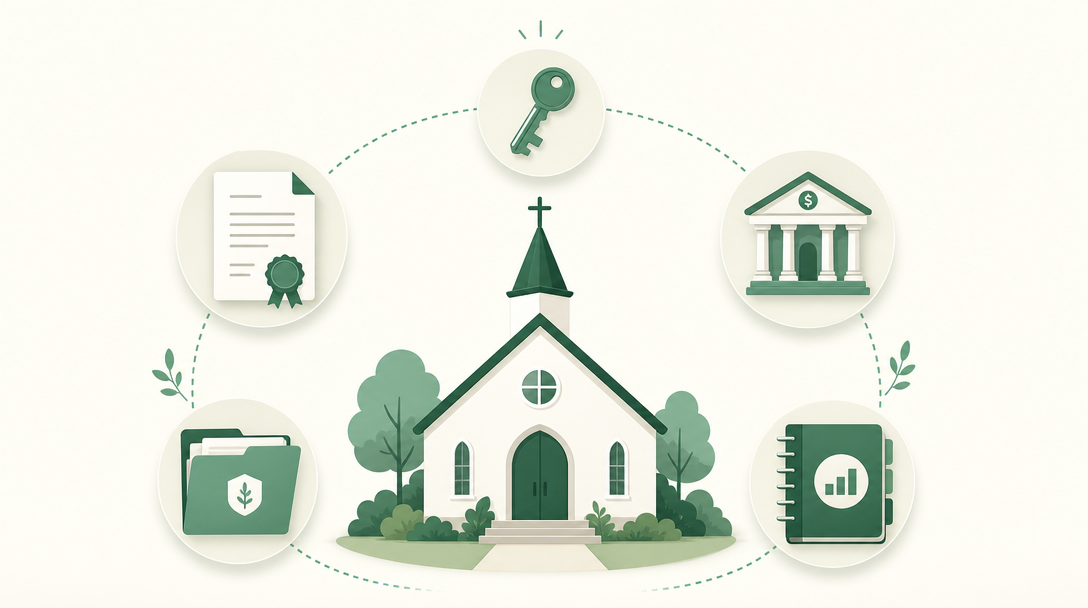
Short answer: Starting a church takes two things — a calling and a paper trail — and almost everyone underbuilds the second one. The legal and financial setup is a fixed checklist: form a legal entity (usually a nonprofit corporation) and incorporate in your state, get an EIN from the IRS, adopt bylaws, seat a board, decide whether to apply for a 501(c)(3) determination letter (a church is exempt automatically, but a letter is useful), open a bank account, set up bookkeeping on fund accounting, and put payroll, insurance, and basic compliance in place. None of it requires a lawyer on retainer, but skipping a step now turns into a mess later. This guide is the founder’s business-side checklist — not the vision side.
Vision is the start, but the setup is what this guide covers
Most “how to start a church” advice is about the calling — your mission, your core team, your launch Sunday. That matters, and it comes first. But it’s covered everywhere, and it’s not where new churches get stuck. They get stuck on the part nobody enjoys: the legal entity, the IRS paperwork, the bank account that won’t open without an EIN, the books that should have been set up in month one. The rest of this page is that practical scaffolding — the steps that make your church a real, fundable, compliant organization rather than a bank account in the founder’s name.
A quick framing before the steps: a church is a special kind of nonprofit. It follows the same formation path as starting any nonprofit, with a few breaks the IRS hands churches specifically. Keep that in mind — most of what’s true for nonprofits is true for you, plus a short list of exceptions.
The 9 steps to legally and financially start a church
Here is the whole sequence, in the order that actually works. Each step sets up the next — you can’t open a bank account without an EIN, and you can’t get an EIN cleanly without first deciding on your entity.
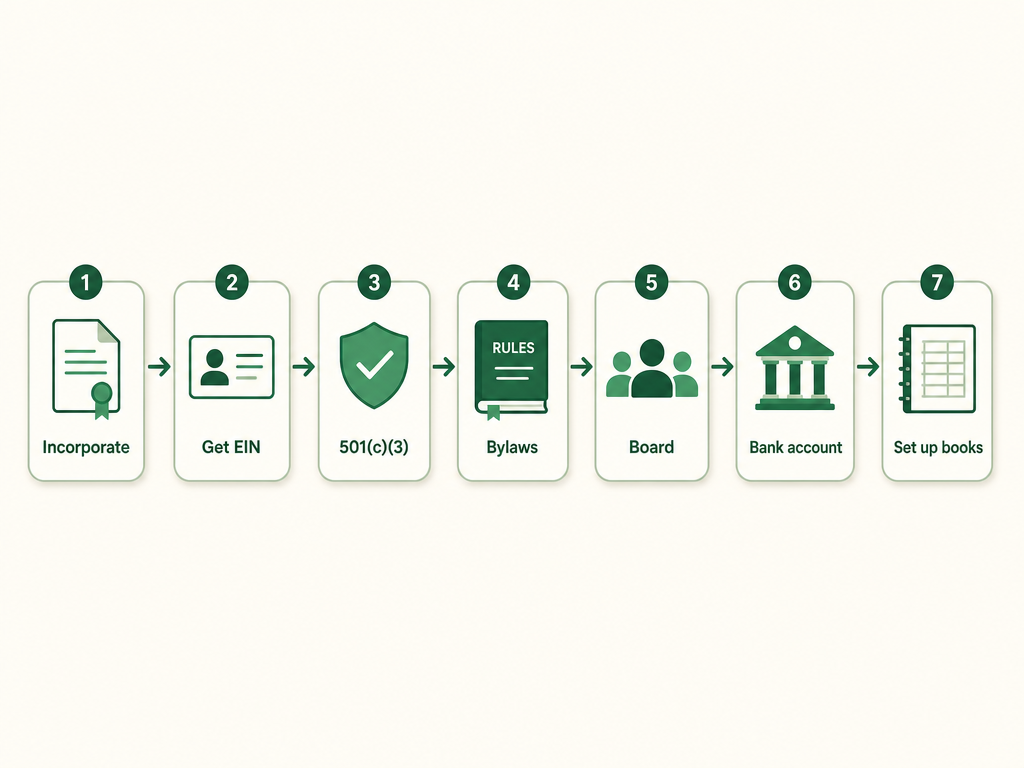
- Choose a legal structure and incorporate. Form a nonprofit corporation in your state — file articles of incorporation with the Secretary of State and pay the filing fee (roughly $30–$125 in most states).
- Get an EIN. Apply for a free Employer Identification Number from the IRS — it’s your church’s federal tax ID, needed before you can do almost anything financial.
- Adopt bylaws. Write and formally adopt the rules that govern how the church makes decisions, seats leaders, and handles money.
- Form a board. Seat at least three unrelated directors so the church is governed by a body, not one person.
- Decide on 501(c)(3) recognition. A church is automatically tax-exempt, but you can apply for an official determination letter if you want documentation.
- Open a bank account. Use the EIN and incorporation documents to open an account in the church’s name — never run money through a personal account.
- Set up bookkeeping. Start the books on fund accounting from day one, before the first offering comes in.
- Set up payroll. If you pay a pastor or staff, register for payroll and learn the clergy-tax rules, which are unusual.
- Get insurance and stay compliant. Buy liability coverage, keep your state registration current, and run the small recurring filings.
The sections below walk each step in detail. Read them in order the first time; after that, this page is a reference you’ll come back to.
Step 1 — Choose a legal structure and incorporate your church
Incorporating is the first real legal act of starting a church. Most churches form as a nonprofit corporation under their state’s law, because incorporation does two things money depends on: it makes the church a separate legal “person” that can hold property, sign contracts, and open accounts in its own name, and it gives the founders and board limited liability so the organization’s debts and lawsuits don’t land on them personally.
You incorporate by filing articles of incorporation with your state (usually the Secretary of State), naming the church, its purpose, its registered agent, and its initial directors. The filing fee runs about $30 to $125 depending on the state. Two clauses matter more than the rest: a 501(c)(3) purpose clause (organized exclusively for religious and charitable purposes) and a dissolution clause (if the church closes, assets go to another 501(c)(3), not to individuals). The IRS looks for both, so getting them right at incorporation saves a rewrite later. The full walkthrough is in articles of incorporation for a church.
A few churches operate unincorporated — that’s legal, but it leaves members and leaders personally exposed and makes banks and grant-makers nervous. For almost every new church, incorporating is worth the modest fee. For what incorporation actually means — and how it differs from tax-exempt status — see an incorporated church.
Step 2 — Get an EIN from the IRS
The Employer Identification Number is your church’s federal tax ID, and it’s the gate everything financial runs through. A bank won’t open a church account without one. You’ll need it to set up payroll, to issue contribution statements, and on most state forms. Getting an EIN is free and fast — apply directly on the IRS website and you get the number immediately. Do this right after you incorporate, using the church’s legal name from your articles.
One warning: only apply through the official IRS channel. Plenty of sites charge $50 to $300 to “obtain your EIN” — they’re just filling in the free federal form for you. There is no fee for an EIN, ever.
Step 3 — Write and adopt bylaws
Bylaws are the church’s internal rulebook — how decisions get made, how leaders are chosen and removed, how often the board meets, how money is approved, what happens in a dispute. Articles of incorporation make the church exist; bylaws make it governable. Without them, an honest disagreement about who decides what can split a young congregation.
Good church bylaws cover membership, the board’s size and terms, officer roles, meeting and quorum rules, a conflict-of-interest policy, financial controls (who can sign checks, spending limits), and amendment procedures. You don’t have to draft them from a blank page — start from a proven document and adapt it. A free church bylaws template gives you the standard structure, including the 501(c)(3) purpose and dissolution language the IRS expects. The board formally adopts the bylaws by vote, and that vote goes in your first meeting minutes.
Step 4 — Form a board of directors
A board is what makes a church an organization instead of one person’s project, and the IRS cares about it. Tax-exempt status assumes the church is governed by a body that holds leadership accountable and prevents any insider from profiting. Most states require at least three directors, and the IRS strongly prefers a majority who are unrelated — not the founder, the founder’s spouse, and the founder’s sibling.
The board’s real job at the start is oversight: approving the budget, reviewing the financials, setting the pastor’s compensation (and documenting that it’s reasonable — this protects your exempt status), and making sure no single person controls the money end to end. Seat the board early, keep minutes of every meeting, and have it formally approve the bylaws, the bank accounts, and the pastor’s pay. Those minutes are the evidence that the church is run properly. The board’s makeup and financial duties are covered in church board of trustees.
Step 5 — 501(c)(3) status, automatic exemption, and the determination letter
Tax-exempt status is the step where a church differs most from a generic nonprofit, and it’s where the most confusion lives. A church is automatically tax-exempt under 501(c)(3) the moment it meets the requirements — it does not have to file Form 1023 or get an IRS determination letter to be exempt, and it does not file the annual Form 990 that other nonprofits do (IRS Publication 1828). A regular charity has to apply and wait; a church is exempt by default.
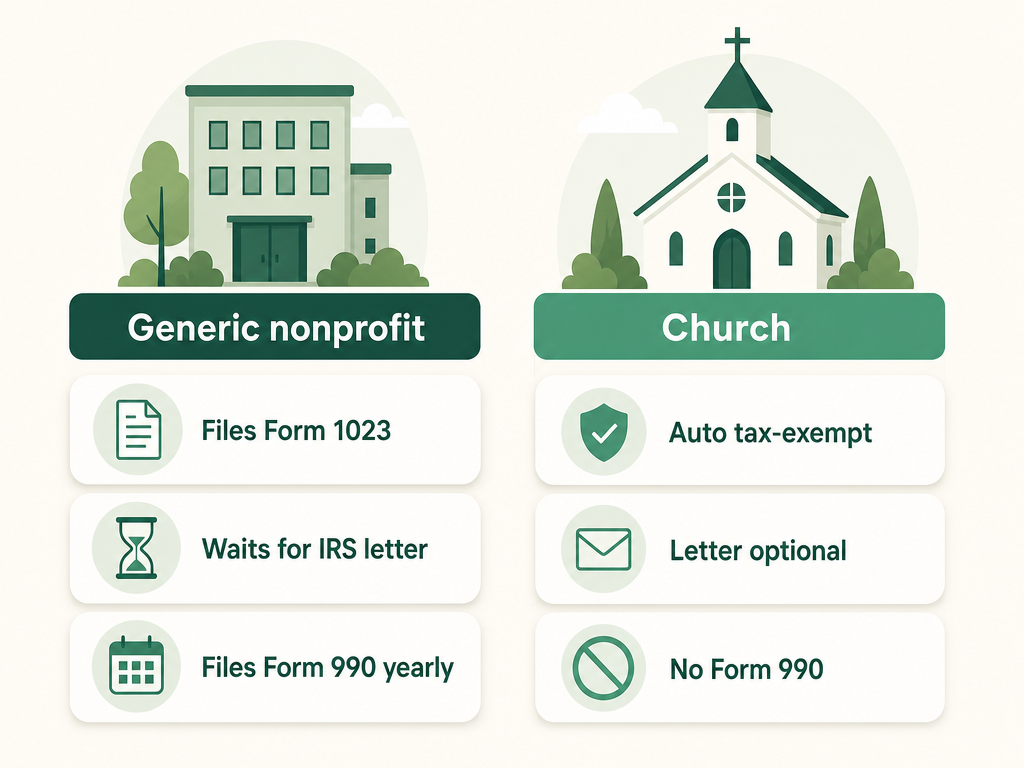
So why do many churches apply for the letter anyway? Because a formal determination letter is useful documentation, even though it grants no extra exemption:
- Donors and grant-makers sometimes want to see it before giving large or institutional gifts.
- Banks occasionally ask for it to open an account or waive fees.
- State and local exemptions (property tax, sales tax) often ask for federal recognition as proof.
Applying means filing Form 1023 (or the shorter 1023-EZ if you’re small and qualify) and paying the IRS user fee. It’s optional. Plenty of churches run for years exempt without one. Whether to apply is a judgment call — if you expect grants, large donors, or a property-tax exemption fight, the letter is worth it; if you’re a small congregation funded by your own members, you may not need it yet. Either way, the church is exempt. For the fuller picture of what a church does and doesn’t owe, see what taxes a church owes.
Step 6 — Open a church bank account
A dedicated bank account is the line between a church and a slush fund. Open one in the church’s legal name as soon as you have the EIN and incorporation papers — never route offerings through a founder’s personal account, even briefly. Commingling church and personal money is the single fastest way to lose donor trust, fail an audit, and endanger exempt status.
To open the account, most banks want your articles of incorporation, your EIN confirmation, your adopted bylaws, and a board resolution naming who can sign. Set up at least two authorized signers from the start, and require two signatures (or two-person approval) on payments over a threshold the board sets. That control costs nothing and stops most fraud before it starts.
Step 7 — Set up bookkeeping on fund accounting
Set the books up correctly before the first dollar arrives, because retrofitting accounting onto a year of messy transactions is miserable. Churches don’t keep books like a business does. A business tracks one bottom line — profit. A church holds money in trust for the people who gave it, and much of that money arrives tagged for a purpose: the building, missions, a family in need. So a church tracks money by purpose, using fund accounting — each fund (general, building, missions, benevolence) is its own self-contained set of books with its own running balance.
You’ll also need a chart of accounts (your list of income and expense categories) and a simple monthly routine: record giving by fund, enter bills, reconcile the bank, review the reports. The IRS doesn’t make a church file Form 990, but it does expect records that substantiate income and expenses (IRS Publication 1828) — and your donors need accurate giving records for their own taxes. The full hands-on routine is in the guide to church bookkeeping. Whether you use a spreadsheet, QuickBooks, or church-specific software, the setup decisions you make now shape every report you’ll ever run.
Step 8 — Set up payroll for clergy and staff
Payroll is where new churches make the most expensive mistakes, because clergy taxes are genuinely strange. The basics: if you pay a pastor or staff, you register for payroll, get state employer accounts, and withhold and remit taxes on schedule. But a minister sits in a tax category of their own — for federal income tax a pastor is usually an employee (paid on a W-2), yet for Social Security and Medicare they’re treated as self-employed and pay SECA tax themselves, so the church does not withhold FICA from a minister’s pay.
On top of that, an ordained minister can receive a housing allowance — a portion of pay designated in advance by the board that’s excluded from federal income tax (though still subject to SECA). Getting this wrong is common and costly. Designate the housing allowance in board minutes before the year starts, document reasonable compensation, and if you’re not sure how clergy payroll works, get a church-savvy bookkeeper or accountant to set it up once. After that it runs on rails.
Step 9 — Insurance, registrations, and ongoing compliance
A new church carries real risk the day it gathers people, so don’t skip insurance. At minimum, get general liability coverage; most churches also add property, directors-and-officers (D&O), and sexual-misconduct coverage. If you have employees, workers’ compensation is usually required by state law.
The recurring compliance work is light but real, and it varies by state:
| Task | Roughly how often | Notes |
|---|---|---|
| State nonprofit/annual report | Yearly or biennially | Keeps your incorporation in good standing |
| Charitable solicitation registration | Once + yearly renewal | Required in many states before you fundraise publicly |
| Payroll tax filings | Quarterly + year-end | Form 941, W-2s, plus state filings |
| Donor contribution statements | Yearly (by Jan 31) | Donors need these to deduct gifts of $250+ |
| Reasonable-compensation review | Yearly | Board documents that pastor/staff pay is reasonable |
None of this is hard once it’s on a calendar. The danger is forgetting — a lapsed state registration or a missed payroll filing creates penalties and headaches out of proportion to the task. Put every recurring item on a shared calendar with an owner, and review it at a board meeting once a year.
What starting a church actually costs
Starting a church on the legal and financial side is cheaper than most people expect — the real cost is time, not money. Here’s a realistic range of the hard costs to get legally formed:
| Item | Typical cost |
|---|---|
| State incorporation filing | $30–$125 |
| EIN | $0 (free from the IRS) |
| Bylaws (from a template) | $0 |
| 501(c)(3) determination (optional) | $275 (1023-EZ) or $600 (full 1023) |
| Bank account | $0–$25/mo, often free for nonprofits |
| Bookkeeping software | $0–$50/mo |
| Insurance | a few hundred dollars/year and up |
So the bare legal minimum — incorporate, EIN, bylaws, bank account, books — can run well under $200. Add the optional IRS letter and insurance and a small church is realistically a few hundred to around a thousand dollars to stand up properly. You can absolutely start a church with very little money; what you can’t do is skip the structure.
How to start a church in your state
The federal part of starting a church is the same everywhere — a church is automatically tax-exempt under 501(c)(3), and the EIN, bylaws, and board steps don’t change from state to state. What does change is the incorporation filing (which form, which agency, what fee), whether your state requires charitable-solicitation registration, and how a church claims state sales- and property-tax exemption. Those state-specific steps are where new churches get tripped up, so we cover them one state at a time:
- Starting a church in California
- Starting a church in Texas
- Starting a church in Florida
- Starting a church in New York
- Starting a church in Pennsylvania
- Starting a church in Illinois
- Starting a church in Ohio
- Starting a church in Georgia
- Starting a church in North Carolina
- Starting a church in Michigan
- Starting a church in Virginia
- Starting a church in Washington
- Starting a church in Arizona
- Starting a church in Massachusetts
- Starting a church in Tennessee
- Starting a church in Missouri
- Starting a church in Maryland
- Starting a church in Wisconsin
- Starting a church in Colorado
- Starting a church in Minnesota
- Starting a church in South Carolina
- Starting a church in Alabama
- Starting a church in Louisiana
- Starting a church in Kentucky
- Starting a church in Indiana
- Starting a church in Oregon
- Starting a church in New Jersey
- Starting a church in Oklahoma
- Starting a church in Connecticut
- Starting a church in Utah
- Starting a church in Iowa
- Starting a church in Nevada
- Starting a church in Arkansas
- Starting a church in Mississippi
- Starting a church in Kansas
- Starting a church in New Mexico
- Starting a church in Nebraska
- Starting a church in West Virginia
- Starting a church in Idaho
- Starting a church in Hawaii
- Starting a church in New Hampshire
- Starting a church in Maine
- Starting a church in Rhode Island
- Starting a church in Montana
- Starting a church in Delaware
- Starting a church in South Dakota
- Starting a church in North Dakota
- Starting a church in Alaska
- Starting a church in Vermont
- Starting a church in Wyoming
Every US state is covered — the federal steps above stay the same everywhere; it’s the state filing and tax-exemption details that vary.
FAQ
Can anyone start their own church? Yes. In the United States, anyone can start a church — there’s no government license or denominational permission required, and the First Amendment protects your right to form a religious organization. What you do need, to operate as a real and tax-exempt church, is the legal setup: a nonprofit corporation, an EIN, bylaws, a board, and books. The freedom to start one is unlimited; the structure to run one properly is a checklist.
How much does it cost to start a church? The legal and financial minimum is small — often under $200 to incorporate, get a free EIN, adopt bylaws from a template, and open a bank account. The optional IRS determination letter adds $275 (Form 1023-EZ) or $600 (full Form 1023), and insurance runs a few hundred dollars a year. A small church can be properly formed for a few hundred to about a thousand dollars; the bigger cost is the ongoing work of running it.
What is the 80% rule for churches? The “80% rule” isn’t a legal or IRS rule at all — it’s a church-growth observation about space. A sanctuary (or its parking lot) tends to feel full once it’s about 80% full, and that crowding quietly caps further growth, which is why growing churches add services or seats before they hit it. A separate “80/20 rule” notes that roughly 20% of members do about 80% of the giving and serving. Neither has anything to do with starting a church or keeping its tax-exempt status — they’re rules of thumb for ministry, not formation.
What does it take to start a church? Practically, it takes a legal entity (a nonprofit corporation), an EIN, adopted bylaws, a board of at least three mostly-unrelated directors, a bank account in the church’s name, and books set up on fund accounting — plus payroll if you have staff, insurance, and a short list of recurring state filings. A church is automatically tax-exempt, so the IRS determination letter is optional. The calling comes first, but this checklist is what turns it into an organization.
Should a church be incorporated? It isn’t legally required — a church can operate as an unincorporated association — but most churches incorporate, and for good reason. Incorporating makes the church a separate legal “person” that can hold property and sign contracts in its own name, and it gives the board and members limited liability so the organization’s debts and lawsuits don’t reach them personally. Banks, landlords, and grant-makers also expect to deal with an incorporated entity. For nearly every new church the modest filing fee is worth it.
Should a church be incorporated or an LLC? Almost always a nonprofit (religious) corporation, not an LLC. A nonprofit corporation is built to hold the 501(c)(3) purpose clause and the dissolution clause the IRS looks for — language that says the church exists for religious purposes and that, if it closes, its assets pass to another tax-exempt organization rather than to any individual. A standard LLC is designed for private ownership and profit distribution, which is the opposite of how a church is structured, so it’s a poor fit for tax-exempt status. The articles-of-incorporation-for-a-church guide on this site walks through exactly which clauses to include.
Does a church need to register with the state? In effect, yes — when you incorporate, you’re registering the church with your state, usually by filing articles of incorporation with the Secretary of State. That’s the step that creates the legal entity and keeps it in good standing through an annual or biennial report. Separately, many states require a charitable-solicitation registration before a church can publicly ask for donations, so check your state’s rules before you start fundraising.
Do churches have to register with the IRS? No. A church that meets the 501(c)(3) requirements is automatically tax-exempt and does not have to apply to the IRS or file Form 1023 to be recognized (IRS Publication 1828). Donors can deduct gifts to it even if it has never sought IRS recognition. Applying for an official determination letter is optional — useful documentation for banks, grant-makers, and large donors, but never a requirement for exemption, as explained in the are-churches-tax-exempt guide here.
How does a church apply for 501(c)(3) status, if it chooses to? Even though a church is already exempt, it can ask the IRS to confirm that in writing by filing Form 1023 (or the shorter Form 1023-EZ if it’s small and qualifies) and paying the user fee. The IRS reviews the application and, if approved, issues a determination letter the church can show donors, banks, and state agencies. The process is the same one any charity follows, walked through step by step in how to start a 501(c)(3).
Vestrybooks sets up a new church’s books on fund accounting from day one — funds, reconciliation, and the board reports — so the financial side is right before the first offering. See how it works.
This article is general information for church treasurers, not professional tax or legal advice. For your church's situation, consult a qualified accountant or attorney.
Church accounting a volunteer can actually do.
Vestrybooks is church accounting + giving for the volunteer treasurer — fund tracking, one-click year-end statements, and online giving with $0 taken from every gift.
A real free plan · no credit card · your data stays yours