Blog · Church formation & governance
How to start a church in New York
July 4, 2026 · By Benjamin Reinke
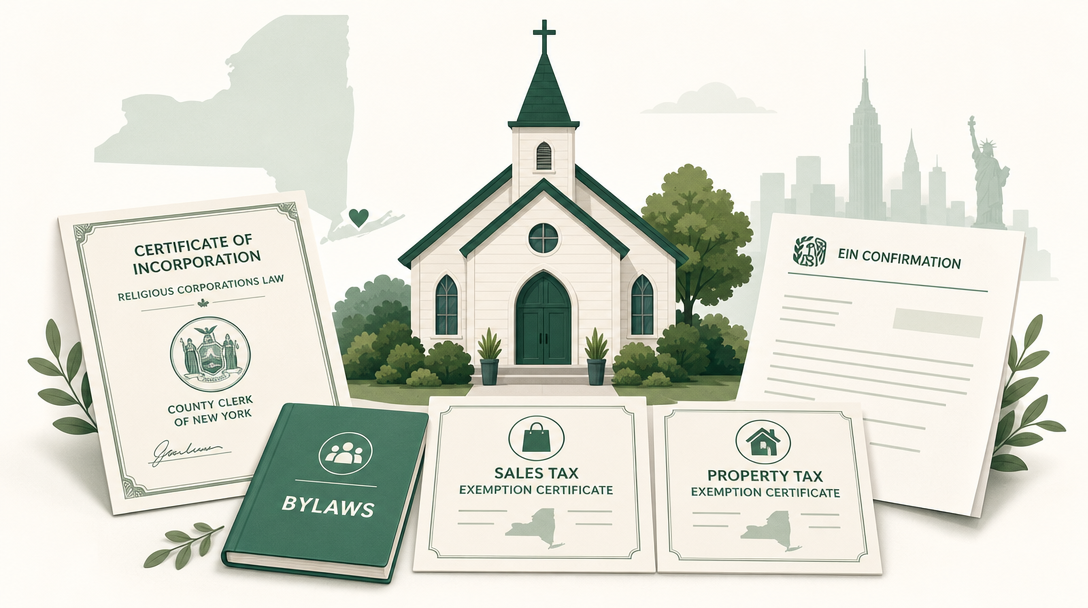
Short answer: To start a church in New York, you incorporate by filing a Certificate of Incorporation under the Religious Corporations Law (RCO) with the county clerk in the county where your place of worship sits, paying the $125 filing fee, then get a free EIN from the IRS, adopt bylaws, elect trustees, and open a bank account. A church is automatically tax-exempt under federal law, so the IRS determination letter is optional. The pieces that are genuinely New York-specific: churches file under the Religious Corporations Law — not the Not-for-Profit Corporation Law that ordinary nonprofits use — and the two state exemptions worth claiming are a sales tax exemption through the Department of Taxation and Finance (Form ST-119.2) and a property tax exemption under RPTL 420-a through your local assessor. One relief New York grants churches: houses of worship are exempt from the Attorney General’s charitable-registration requirement.
The federal formation steps are the same in every state — incorporate, EIN, bylaws, board, books. This guide covers those briefly and then spends its time on the New York pieces that carry the real value. For the full national walkthrough of each universal step, read how to start a church; below, the focus is what changes inside New York.
The formation steps that are the same anywhere
Starting a church in New York follows the standard church-formation checklist, and most of it is federal, not state-specific:
- Incorporate as a religious corporation (the New York-specific part — covered in detail below).
- Get an EIN — a free federal tax ID from the IRS, applied for directly at irs.gov. Never pay a third party for one; the EIN is always free.
- Adopt bylaws — the church’s internal rulebook for decisions, leadership, and money. Start from a proven document rather than a blank page; see church bylaws for what to include.
- Elect trustees — the governing board that holds the church’s property and oversees its affairs, so the church is run by a body rather than one person.
- Skip or pursue the 501(c)(3) letter — a church is automatically tax-exempt and does not have to file Form 1023, though many apply for the determination letter as documentation (IRS Publication 1828).
- Open a bank account in the church’s legal name using the EIN and formation documents.
- Set up the books on fund accounting from day one, before the first offering arrives.
Each of these is walked step by step in the national formation guide linked above. The rest of this page is the New York layer on top.
Incorporating a church in New York under the Religious Corporations Law
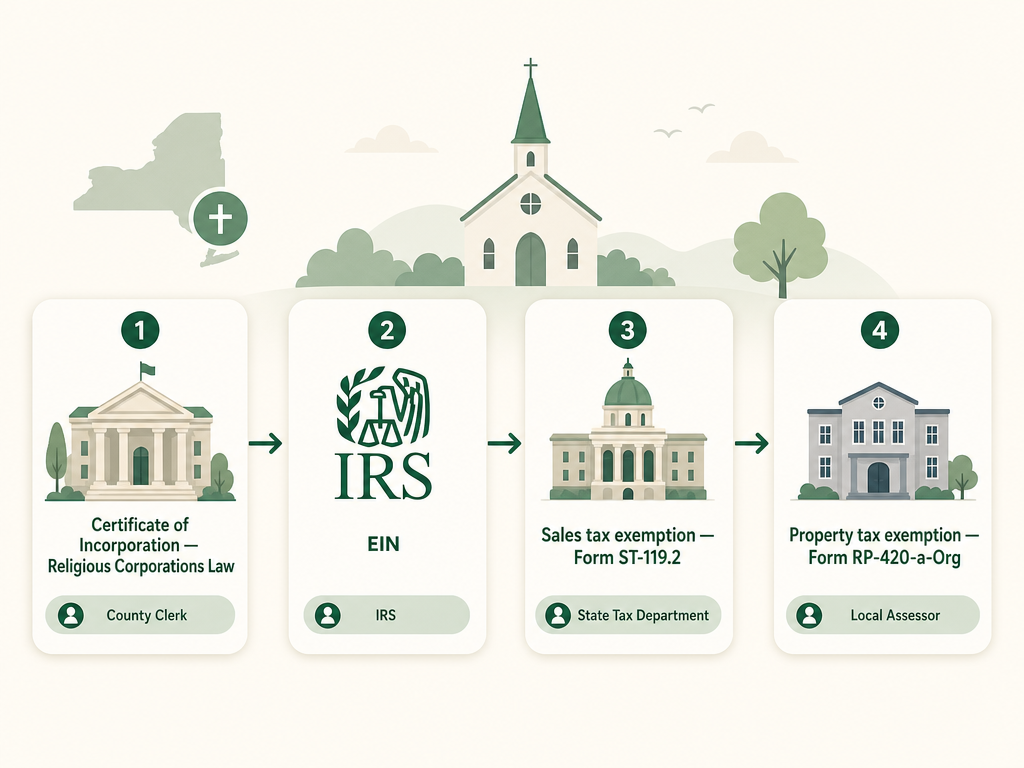
Here is where a New York church diverges from an ordinary nonprofit. A church does not incorporate under the Not-for-Profit Corporation Law (N-PCL) that other charities use. Instead, it forms as a religious corporation under New York’s Religious Corporations Law (RCO) by filing a Certificate of Incorporation — and it files that certificate with the county clerk in the county where the church’s principal office or place of worship is located, not with the Department of State in Albany. Only a church with no New York place of worship files with the Department of State instead (New York Business Express, religious corporation).
The filing fee is $125 as of 2026; confirm the current amount with your county clerk and the New York Business Express religious-corporation page, since fees change. The process starts with an incorporation meeting: under RCO §193, the presiding officer of the meeting and at least two other people present execute and acknowledge the Certificate of Incorporation, and the members elect the church’s trustees at that same meeting (N.Y. Religious Corporations Law §193). For an independent or “other denomination” church forming under Article 10, no court order or Attorney General sign-off is required to file — a genuine simplification compared with the multi-agency N-PCL path.
The Certificate names the church, its trustees, and the county where it worships. Two clauses do the heavy lifting for federal tax-exempt status and should go in from the start rather than as an amendment later:
- A 501(c)(3) purpose clause stating the church is organized exclusively for religious and charitable purposes.
- A dissolution clause stating that if the church closes, its assets pass to another 501(c)(3) organization, not to any individual.
The IRS looks for both, so getting the language right on the New York filing saves a rewrite. The full breakdown of what these documents need is in articles of incorporation for a church. Because the Religious Corporations Law is denomination-specific and the certificate is acknowledged like a deed, many New York churches have an attorney prepare it — the statute even recommends it.
Does a New York church register with the Attorney General to fundraise
Mostly no — and this is a real advantage for churches. New York generally requires charities that solicit contributions or hold charitable assets in the state to register with the Attorney General’s Charities Bureau (Form CHAR410) and file the annual CHAR500. But the law carves out an exemption for religious organizations: houses of worship and other charitable organizations run by religious organizations are exempt from registering with the Charities Bureau (New York Attorney General, charities registration).
That means an ordinary congregation taking offerings and asking members to give does not file the CHAR410 or the recurring CHAR500 that ordinary New York nonprofits must handle every year. It removes a whole agency — and an annual filing — from a church’s compliance calendar. If your church runs an affiliated entity that isn’t itself a house of worship, or you are unsure whether the exemption reaches a particular activity, you can claim the exemption when prompted in the Charities Bureau’s online registration and confirm the current rules on the Attorney General’s page. Note that “registering” still happens in one sense — filing the Certificate of Incorporation registers the church as a legal entity. What New York’s religious exemption skips is the separate fundraising registration.
Claiming the New York sales tax exemption for your church
A qualifying New York church can buy items for its exempt purposes free of state and local sales tax — but the exemption is not automatic. You apply to the New York Department of Taxation and Finance using Form ST-119.2, Application for an Exempt Organization Certificate. Once approved, the Tax Department issues Form ST-119, the Exempt Organization Certificate (which carries a six-digit New York exemption number) along with Form ST-119.1, the Exempt Purchase Certificate (New York Department of Taxation and Finance, exempt organizations). From then on, you present the ST-119.1 to vendors at the time of purchase and buy qualifying items without paying New York sales tax. There is no fee to apply.
A few things worth getting right. The exemption is prospective — purchases made before the ST-119 is issued are generally still taxable, so apply early rather than waiting until your first big equipment buy. The certificate covers what the church buys for its religious purposes; sales the church makes to the public can be a different question, and certain fundraising sales may still carry tax. Keep the ST-119 and ST-119.1 on file where staff and volunteers can find them, because the ST-119.1 is what actually stops the tax at the register.
Claiming the New York property tax exemption under RPTL 420-a
A New York church that owns its building can exempt that property from local real property tax under Real Property Tax Law §420-a, which wholly exempts property owned by a religious corporation and used exclusively for religious purposes (New York Department of Taxation and Finance, RPTL 420-a). This one runs through your local assessor, not the Tax Department or the county clerk.
Outside New York City, you apply with Form RP-420-a-Org, Application for Real Property Tax Exemption for Nonprofit Organizations, filing it with the assessor for the city or town where the property sits. Timing is the thing to watch: the application must be on file by the jurisdiction’s taxable status date — generally March 1 in most towns outside New York City, though it varies, so confirm the date with your assessor. New York City properties use different forms through the NYC Department of Finance. Once granted, a church generally does not reapply every year unless the assessor requests it or the church acquires new property. There is no fee to apply, but a church that owns real estate should treat the deadline as a hard calendar item — miss the taxable status date and the exemption waits a full year.
New York filing at a glance
The table below maps each New York step to its agency, form, and cost. Treat the fees as accurate as of 2026 and confirm with the listed agency, since New York fees change.
| What you’re doing | Agency | Form | Fee (as of 2026) |
|---|---|---|---|
| Incorporate the church | County clerk (RCO) | Certificate of Incorporation (Religious Corporations Law) | $125 (confirm with the clerk) |
| Get a federal tax ID | IRS | EIN application (online) | Free |
| 501(c)(3) recognition (optional) | IRS | Form 1023 or 1023-EZ | $600 / $275 user fee |
| Sales tax exemption | NY Dept of Taxation and Finance | Form ST-119.2 (issues ST-119) | No fee |
| Property tax exemption | Local assessor | Form RP-420-a-Org | No fee |
| Charitable-solicitation registration | NY Attorney General | Religious organizations exempt | — |
Setting up the books once the church exists in New York
Once the church is formed and the exemptions are filed, the work shifts from one-time paperwork to the monthly routine — and that routine is where churches actually fail or hold together. A church holds money in trust for the people who gave it, much of it tagged for a purpose (the building, missions, benevolence), so it tracks money by fund rather than as a single bottom line. Set the books up on fund accounting before the first offering, keep the giving records your donors need for their own taxes, and document that the trustees review the finances. None of the New York exemptions excuse a church from keeping clean records; the IRS still expects records that substantiate income and expenses (IRS Publication 1828).
FAQ
How much does it cost to start a church in New York? The required state cost is small. Filing the Certificate of Incorporation under the Religious Corporations Law with the county clerk costs $125 as of 2026, the EIN from the IRS is free, and the New York sales tax (Form ST-119.2) and property tax (Form RP-420-a-Org) exemptions carry no filing fee. So the bare legal minimum to form a New York church and claim its exemptions is roughly the $125 filing fee plus your time. Optional add-ons raise it: the IRS determination letter is $275 (Form 1023-EZ) or $600 (full Form 1023), attorney help with the certificate is common because the Religious Corporations Law is denomination-specific, and insurance runs a few hundred dollars a year.
Do you incorporate a New York church under the Not-for-Profit Corporation Law? No — that is the key New York quirk. Churches incorporate under the Religious Corporations Law (RCO), not the Not-for-Profit Corporation Law that ordinary nonprofits use. The Certificate of Incorporation is filed with the county clerk in the county where the church worships (a church with no New York place of worship files with the Department of State instead), and the members elect trustees at the incorporation meeting under RCO §193. For an independent church, no court or Attorney General approval is needed to file.
Does a New York church have to register with the Attorney General to fundraise? Generally no. New York exempts religious organizations — houses of worship and charities run by them — from the Charities Bureau registration that ordinary nonprofits must file (Form CHAR410) and from the annual CHAR500 (New York Attorney General, charities registration). An ordinary congregation taking offerings does not file a fundraising registration, which removes a whole agency and an annual report from the compliance calendar.
Do you need 501(c)(3) status to start a church in New York? No. A church is automatically tax-exempt under federal law and does not have to file Form 1023 or hold an IRS determination letter to be exempt (IRS Publication 1828). Many New York churches still apply for the determination letter as documentation for banks, grant-makers, and large donors, but it is optional — see are churches tax exempt for the fuller picture. You will generally want the federal recognition before applying for the sales tax exemption, since the Tax Department wants to see the church’s exempt basis.
Can I just start my own church in New York? Practically, anyone can start a church in New York — there is no state license or denominational permission required, and the First Amendment protects the right to form a religious organization. What you do need, to operate as a real and exempt church, is the structure: a religious corporation formed under the Religious Corporations Law, an EIN, adopted bylaws, elected trustees, a bank account in the church’s name, and books set up on fund accounting. The freedom to start one is unlimited; running one properly is a checklist.
This is general information, not tax or legal advice. New York’s Religious Corporations Law is denomination-specific and fees and deadlines change — consult a qualified attorney or accountant and confirm current requirements with the county clerk, the Department of Taxation and Finance, and your local assessor before filing.
Vestrybooks sets up a new New York church’s books on fund accounting from day one — funds, reconciliation, and the board reports — so the financial side is right before the first offering. See how it works.
This article is general information for church treasurers, not professional tax or legal advice. For your church's situation, consult a qualified accountant or attorney.
Church accounting a volunteer can actually do.
Vestrybooks is church accounting + giving for the volunteer treasurer — fund tracking, one-click year-end statements, and online giving with $0 taken from every gift.
A real free plan · no credit card · your data stays yours