Blog · Church formation & governance
How to start a church in Florida
June 28, 2026 · By Benjamin Reinke
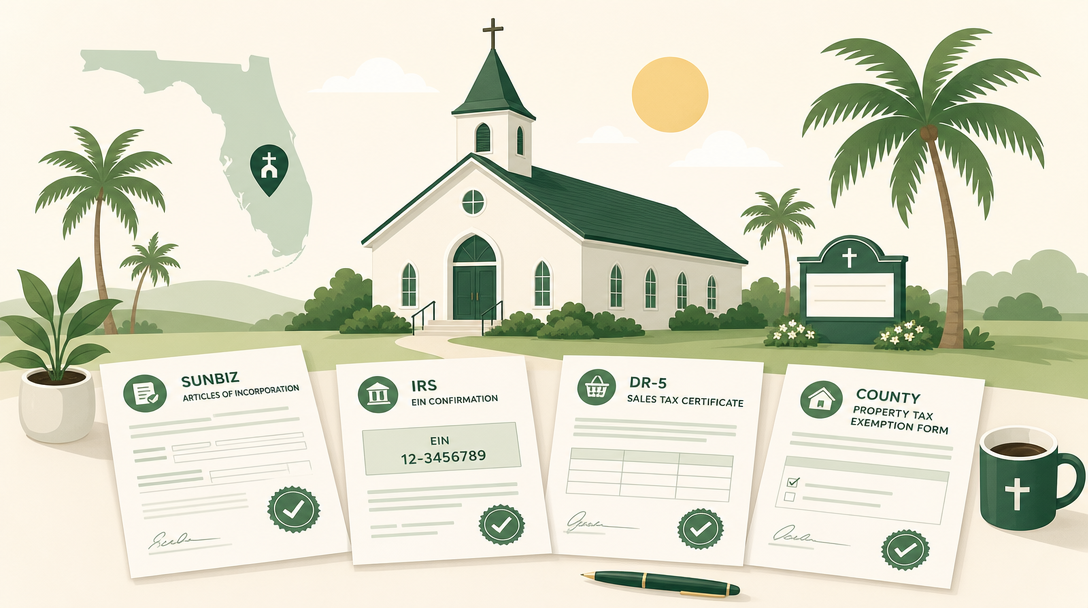
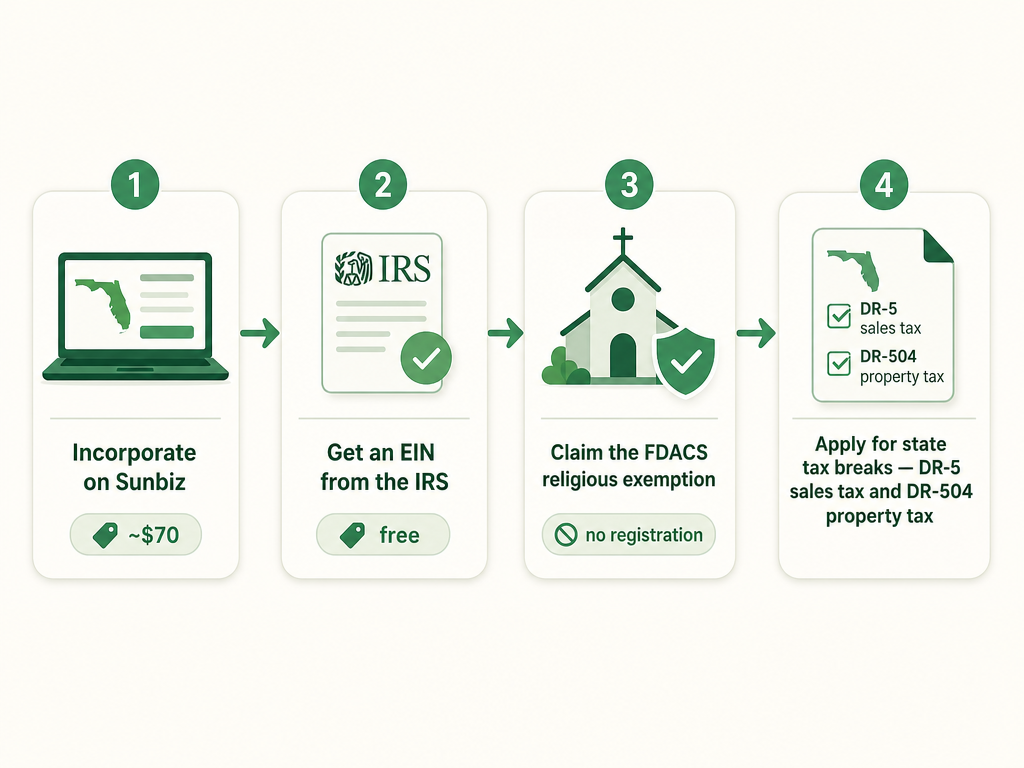
Short answer: To start a church in Florida, file Articles of Incorporation for a Florida Not For Profit Corporation with the Florida Division of Corporations (Sunbiz) — about $70 with the required registered agent — then get a free EIN from the IRS, adopt bylaws, and seat a board. A bona fide church is exempt from FDACS charitable-solicitation registration and is automatically tax-exempt under 501(c)(3), so no Form 1023 is required. To stop paying tax, apply to the Florida Department of Revenue for a sales tax Consumer’s Certificate of Exemption (Form DR-5) and to your county property appraiser for the religious property tax exemption (Form DR-504). Florida has no state personal income tax, which removes a step other states have.
Most of the work of starting a church is the same in every state: a legal entity, an EIN, bylaws, a board, and books set up correctly from day one. That universal checklist lives in the national guide to how to start a church — read it for the parts that don’t change. This page covers what is Florida-specific: where you file, what it costs on Sunbiz, the FDACS exemption that saves churches a registration, and the two state tax breaks you have to apply for by hand.
The universal church-formation steps, in brief
Every new church, in Florida or anywhere, walks the same core sequence. The national guide details each one; here is the short version so the Florida-specific steps below have a frame:
- Incorporate as a nonprofit corporation in your state.
- Get an EIN — a free federal tax ID from the IRS, needed before you can bank or hire.
- Adopt bylaws — the church’s internal rulebook for decisions, leaders, and money.
- Seat a board of at least three mostly-unrelated directors.
- Decide on a 501(c)(3) determination letter — optional for a church, which is exempt automatically.
- Open a bank account in the church’s legal name.
- Set up bookkeeping on fund accounting before the first offering.
Steps 2 through 7 are federal or universal and don’t change at the Florida line — the IRS EIN process, the bylaws, the board rules, and fund accounting are identical to the national walkthrough linked above. Step 1, incorporation, is where Florida has its own forms, its own fee, and its own filing office, and that is where this guide goes deep.
Incorporate your church on Sunbiz (Florida Division of Corporations)
Incorporating is the first state-level act of starting a Florida church. You form a Florida Not For Profit Corporation by filing Articles of Incorporation with the Florida Division of Corporations, the state office that runs the Sunbiz filing system under the Department of State. You can file online at sunbiz.org or mail a printed form with a check.
The base filing costs $35 for the Articles plus a required $35 registered agent designation — about $70 total (Florida Division of Corporations fee schedule). A certified copy ($8.75) and a certificate of status ($8.75) are optional add-ons, not required to form the church. Confirm the current figures on the official fee page before you pay, since the state can change them.
Your Articles must name the corporation, its principal address, a registered agent with a Florida street address who agrees to accept legal mail, the corporate purpose, and the initial officers or directors. Two clauses matter beyond Florida’s minimum: a 501(c)(3) purpose clause (organized exclusively for religious purposes) and a dissolution clause (assets pass to another tax-exempt organization if the church closes). Florida’s bare form doesn’t force these, but the IRS looks for both, so write them in now. The clause-by-clause walkthrough is in articles of incorporation for a church.
After incorporating, Florida requires an annual report every year between January 1 and May 1 to keep the corporation active — about $61.25 for a nonprofit (fee schedule). Miss it and the state can administratively dissolve the church, so put it on a calendar.
FDACS charitable-solicitation registration and the Florida church exemption
Florida normally requires any organization that asks the public for donations to register with the Florida Department of Agriculture and Consumer Services (FDACS) under the Solicitation of Contributions Act before fundraising. A church is the headline exception. Under Florida Statutes Chapter 496, a bona fide religious institution is exempt from the Act and does not have to register with FDACS to solicit contributions (Florida Statutes ch. 496).
The statute defines a religious institution broadly — a church, denominational organization, or established place of worship where nonprofit religious services are regularly held, including integral parts of a tax-exempt religious institution. If your church meets that definition, you skip the registration and the annual renewal that other Florida nonprofits carry. FDACS may ask exempt organizations to confirm their status, so keep your incorporation and exemption records handy, and verify the current process on the FDACS Solicitation of Contributions page since the agency can update how an exemption is claimed.
One caution: the exemption is for the church itself. A separate fundraising entity, or a related organization mostly supported by funds solicited outside your congregation, may not qualify and could still need to register.
Florida sales tax exemption for churches — Form DR-5
A Florida church can buy goods without paying state sales tax, but the exemption is not automatic — you apply for it. You request a Consumer’s Certificate of Exemption by filing Form DR-5 with the Florida Department of Revenue (DR-5 application and instructions). Religious institutions with an established physical place of worship qualify, and the certificate is valid for five years (Florida DOR — nonprofit sales and use tax).
Once approved, the church presents the certificate when buying for its exempt purposes so it isn’t charged sales tax. The exemption does not cover everything — Florida specifically excludes leasing or renting living or sleeping accommodations to others from the church’s exemption. The Department reviews and renews qualifying certificates on roughly a five-year cycle, often automatically for organizations already on file, so keep your contact information current with the DOR.
Florida levies no state personal income tax, and a 501(c)(3) is exempt from Florida’s corporate income tax as well (apart from any unrelated business income) — so beyond the sales and property tax applications below, a Florida church has fewer state tax filings than churches in income-tax states.
Florida property tax exemption for religious use — Form DR-504
Property a Florida church owns and uses for worship can be exempt from local property tax (ad valorem tax), but the exemption is granted by the county property appraiser, not the state, and you must apply. File Form DR-504, the application for an ad valorem tax exemption, with the property appraiser in the county where the property sits (Florida DOR Form DR-504).
The deadline is firm: the application is due between January 1 and March 1 of the year you want the exemption. Florida grants the exemption based on predominant use for religious purposes — the property has to actually be used for worship (or have documented steps underway to put it to that use, such as permits or construction). County appraisers commonly ask for your Articles of Incorporation, bylaws, financial statements, and a copy of your DR-5 sales tax certificate, so it pays to have those in hand. Because each county runs its own office, check your county property appraiser’s specific instructions before filing.
Florida church filing at a glance
| Step | Where you file | Form | Cost (verify) | Timing |
|---|---|---|---|---|
| Incorporate | Florida Division of Corporations (Sunbiz) | Articles of Incorporation, Florida Not For Profit Corporation | ~$70 ($35 + $35 registered agent) | Before anything else |
| Federal tax ID | IRS | EIN application (online) | $0 | Right after incorporating |
| Charitable solicitation | FDACS | Exemption — bona fide religious institutions are exempt from registration | $0 | Confirm exemption before fundraising |
| Sales tax exemption | Florida Department of Revenue | DR-5 (Consumer’s Certificate of Exemption) | $0 | Apply once incorporated; renews ~5 yrs |
| Property tax exemption | County property appraiser | DR-504 (ad valorem exemption) | $0 | File Jan 1 – Mar 1 |
| Stay active | Florida Division of Corporations (Sunbiz) | Annual report | ~$61.25 | Jan 1 – May 1 every year |
Figures are the published Florida amounts at the time of writing; always confirm on the official Sunbiz, DOR, FDACS, or county pages before you file.
How Florida church tax exemption fits the federal 501(c)(3) rule
Florida’s tax breaks sit on top of the federal rule that a church is automatically tax-exempt. A church that meets the 501(c)(3) requirements is exempt the moment it qualifies — it does not have to file IRS Form 1023 or receive a determination letter, and it does not file the annual Form 990 (IRS Publication 1828). The full federal picture is in the guide to whether churches are tax exempt.
Many Florida churches still apply for the IRS determination letter anyway, because the state exemptions can lean on it. The county property appraiser and the DOR may ask for evidence of your nonprofit and religious status, and a federal determination letter is clean proof. It’s optional for federal exemption, but if you expect a property tax exemption fight or large institutional donors, the letter earns its $275 (Form 1023-EZ) or $600 (full Form 1023) user fee.
FAQ
How much does it cost to start a church in Florida? The hard Florida cost to incorporate is about $70 — $35 for the Articles of Incorporation plus the required $35 registered agent designation, filed with the Division of Corporations on Sunbiz. The EIN is free, the FDACS exemption costs nothing for a bona fide church, and the DR-5 sales tax and DR-504 property tax applications carry no state fee. Budget for the optional IRS determination letter ($275 or $600) only if you want it. Add the yearly ~$61.25 annual report to keep the corporation active. Confirm each amount on the official page before paying.
Do you have to register a church with the state of Florida? Yes, in the sense that you register the corporation by filing Articles of Incorporation with the Florida Division of Corporations (Sunbiz) — that’s what creates the legal entity. But a bona fide church is exempt from the separate FDACS charitable-solicitation registration that other Florida nonprofits must complete before fundraising, under Florida Statutes Chapter 496. So you file once to incorporate, then keep the corporation active with an annual report, but you skip the FDACS solicitation registration.
Is a church automatically tax-exempt in Florida? For federal income tax, yes — a qualifying church is automatically a 501(c)(3) with no IRS application required (IRS Publication 1828). For Florida sales tax and property tax, no — those exemptions exist for churches but you have to apply, using Form DR-5 with the Department of Revenue and Form DR-504 with your county property appraiser. Florida charges no personal income tax, and 501(c)(3)s are exempt from its corporate income tax.
Can anyone start a church in Florida? Yes. Anyone can start a church in Florida — there’s no state license or denominational permission required, and the First Amendment protects the right to form a religious organization. To operate as a real, tax-exempt church, you still need the structure: a Florida nonprofit corporation, an EIN, bylaws, a board, and proper books. The freedom to start one is open; the setup to run one properly is a checklist.
How many members do you need to start a church in Florida? Florida sets no minimum congregation size to incorporate a Not For Profit Corporation, but it does require a board of directors, and most churches seat at least three directors to satisfy governance norms and IRS expectations. The IRS prefers a majority of directors who are unrelated, so the practical floor is three responsible people, not a set number of worshippers.
Vestrybooks sets up a new Florida church’s books on fund accounting from day one — funds, reconciliation, and board-ready reports — so the money side is right before the first offering. See how it works.
This article is general information for church treasurers, not professional tax or legal advice. For your church's situation, consult a qualified accountant or attorney.
Church accounting a volunteer can actually do.
Vestrybooks is church accounting + giving for the volunteer treasurer — fund tracking, one-click year-end statements, and online giving with $0 taken from every gift.
A real free plan · no credit card · your data stays yours