Blog · Church formation & governance
How to start a church in California the legal way
June 28, 2026 · By Benjamin Reinke
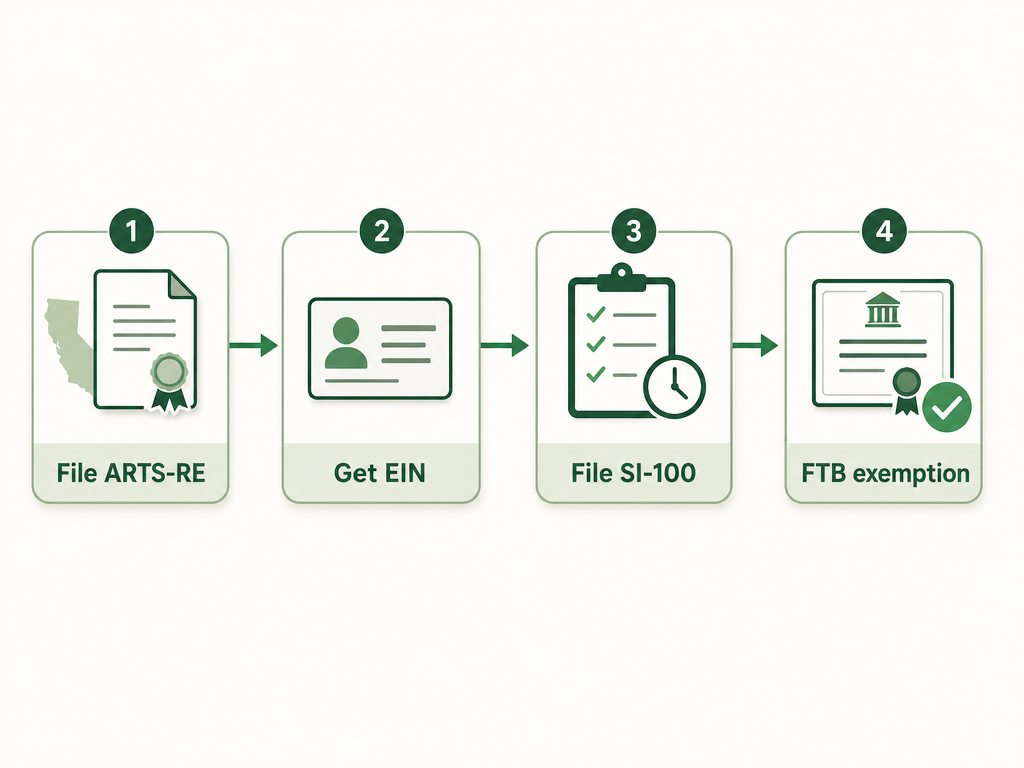
Short answer: To start a church in California, you form a nonprofit religious corporation by filing Form ARTS-RE (Articles of Incorporation of a Nonprofit Religious Corporation) with the California Secretary of State for a $30 filing fee, then get a free EIN from the IRS, adopt bylaws, and seat a board. After that, California’s church-specific steps are the part most guides skip: file a Statement of Information (Form SI-100) within 90 days, request a state income-tax exemption from the Franchise Tax Board (Form FTB 3500A), and claim the county property-tax exemption for your worship space. Churches are exempt from registering with the California Attorney General’s charity registry, but they are not exempt from California sales tax. The federal steps are the same as how to start a church anywhere; this guide covers what California adds on top.
The universal church-formation steps, in brief
The national checklist for starting any church is the same in California as everywhere else, so this guide keeps it short and sends you to the full walkthrough. In order, the federal and governance steps are:
- Choose a legal structure — almost always a nonprofit corporation, not an LLC.
- Incorporate — file articles with the state (in California, Form ARTS-RE; see below).
- Get an EIN — free and immediate from the IRS; never pay a third party for it.
- Adopt bylaws — the church’s internal rulebook, with a conflict-of-interest policy.
- Seat a board — at least three directors, a majority unrelated.
- Decide on a 501(c)(3) determination letter — a church is automatically exempt, so the letter is optional.
- Open a bank account, set up fund accounting, and put payroll and insurance in place.
Each of those is explained in detail in the national church-formation guide, with a separate deep-dive on writing the incorporation clauses. The rest of this page is the California-specific layer: the exact state forms, fees, agencies, and exemptions a California church deals with that a church in another state would not.
File Form ARTS-RE with the California Secretary of State
Incorporating a California church means filing Form ARTS-RE — Articles of Incorporation of a Nonprofit Religious Corporation with the California Secretary of State. California’s Corporations Code splits nonprofits into three types (public benefit, mutual benefit, and religious), and a church organized primarily for religious purposes uses the religious corporation form. The filing fee is $30 (California Secretary of State, business entities forms); the Secretary of State also charges a separate handling fee for documents dropped off in person, so confirm the current fee on the official form before you file.
Form ARTS-RE asks for the corporation’s name, its religious purpose, a registered agent for service of process (a person or registered corporate agent in California), and an initial street address. To stay eligible for 501(c)(3) status, the articles should include the IRS-required language — a religious purpose clause and a dissolution clause that sends remaining assets to another tax-exempt organization if the church closes. The general anatomy of those clauses is covered in articles of incorporation for a church; California simply puts them on the ARTS-RE form.
File the Statement of Information (Form SI-100) within 90 days
After the Secretary of State files your ARTS-RE, California requires a Statement of Information (Form SI-100) within 90 days of incorporating, and then every two years after that. The SI-100 lists the corporation’s officers, directors, principal address, and agent for service of process, so the state has a current record of who runs the church. Check the Secretary of State’s forms and fees page for the current SI-100 fee before filing. Missing the SI-100 is one of the most common California formation mistakes — a lapsed statement can lead to penalties and, eventually, suspension of the corporation, so put the biennial filing on a calendar the day you incorporate.
The IRS step is the same — a California church is automatically tax-exempt
A church in California gets the same federal break every church gets: it is automatically tax-exempt under 501(c)(3) and does not have to file Form 1023 or get an IRS determination letter to be exempt (IRS Publication 1828). Many California churches still apply for the determination letter, because California’s state and local exemptions (income, property) often ask for proof of federal recognition, and large donors or grant-makers sometimes want to see it. Whether a church is exempt without ever asking the IRS — and why the letter is still worth getting — is covered in are churches tax exempt. The decision is the same in California as anywhere; what changes is that California’s own agencies are the ones that want to see the federal letter.
Request a California Franchise Tax Board income-tax exemption (Form FTB 3500A)
Federal exemption does not automatically exempt a California church from California’s own franchise and income tax — that comes from the California Franchise Tax Board (FTB). A church that already has an IRS determination letter under Section 501(c)(3) can use the short Form FTB 3500A, Submission of Exemption Request, attaching a copy of the federal determination letter, to obtain California exemption under Revenue & Taxation Code Section 23701d (FTB Form 3500A instructions). A church without a federal letter uses the longer Form FTB 3500 instead. Because a church is exempt federally by default but may not have a letter in hand, this is one place the optional determination letter actually earns its keep — it gets you the one-page state process instead of the full application.
| California agency | What it handles |
|---|---|
| Secretary of State | Incorporation (Form ARTS-RE), Statement of Information (SI-100) |
| Internal Revenue Service | Federal 501(c)(3) exemption (automatic for churches; letter optional) |
| Franchise Tax Board | State income/franchise-tax exemption (Form FTB 3500A or 3500) |
| Attorney General — Registry of Charities | Charity registration (churches are exempt) |
| County assessor + Board of Equalization | Property-tax Church/Religious/Welfare Exemption |
| CDTFA | Sales and use tax (no general nonprofit exemption) |
Churches are exempt from the California Attorney General’s charity registration
Most California charities must register with the Attorney General’s Registry of Charities and Fundraisers (using Form CT-1) within 30 days of first receiving charitable assets, and file annual reports after that — but churches are carved out. The Attorney General’s own guidance states that entities “organized primarily as a hospital, educational institution, or religious organization are exempt from the registration and annual reporting requirements by law” (California Attorney General, initial registration). In practice, a church organized primarily for religious purposes does not file the CT-1 or the annual renewals that other nonprofits do. If your organization’s primary purpose is unclear, the Registry lets you request a written exemption determination — worth doing if the church also runs a large, separately significant program. This mirrors the federal pattern where churches get registration breaks other charities don’t.
Claim the California property-tax exemption for your worship space
California does not tax church property automatically — but a church has to claim the exemption with the county assessor, and the claim is annual. California offers three related property-tax exemptions for religious organizations, jointly overseen by the county assessor and the California State Board of Equalization (BOE, Church Exemption):
- Church Exemption — for property (owned, leased, or rented) used exclusively for religious worship. It must be claimed every year, and to get the full exemption for the lien date the claim is generally due by February 15.
- Religious Exemption (Form BOE-267-S) — for property owned by a religious organization and used for worship plus a religious school; once granted it generally continues without an annual refiling.
- Welfare Exemption — for property used for qualifying religious, charitable, hospital, or scientific purposes; the BOE decides whether the organization qualifies and the county assessor decides whether the specific property qualifies.
The right form depends on whether the church owns or leases and whether it runs a school, so confirm with your county assessor which exemption fits before the lien-date deadline. The general principle that churches don’t pay property tax on worship space — and the steps to keep it — is covered in do churches pay property taxes.
California does not exempt churches from sales tax
A California church still pays sales and use tax on most of what it buys, and generally collects it on most of what it sells. The California Department of Tax and Fee Administration (CDTFA) is explicit that there is no broad nonprofit carve-out: “there are no statutory exemptions from either the sales tax or the use tax merely because the user of the property purchased is engaged in charitable activities, is a nonprofit organization, or enjoys certain privileges under property tax statutes or income tax statutes” (CDTFA, Tax Guide for Nonprofit Organizations). A handful of narrow exemptions exist for specific charitable activities, but a church should assume it owes sales tax on purchases and that bake-sale or bookstore sales may be taxable. If your church sells goods regularly, you may need a CDTFA seller’s permit — check the CDTFA guide for your situation.
What it costs to start a church in California
The hard cost of forming a California church is modest — the real investment is time and ongoing compliance. Here is a realistic range of the California-specific costs to get legally formed:
| Item | Typical California cost |
|---|---|
| Articles of incorporation (Form ARTS-RE) | $30 (plus an in-person handling fee) |
| Statement of Information (SI-100) | a small filing fee, due within 90 days |
| EIN from the IRS | $0 (free) |
| FTB exemption (Form 3500A) | $0 to submit |
| 501(c)(3) determination letter (optional) | $275 (Form 1023-EZ) or $600 (full Form 1023) |
| County property-tax exemption claim | $0 to file |
So the bare California minimum to incorporate and get exempt — ARTS-RE, EIN, SI-100, FTB 3500A — runs only a little over the $30 filing fee. The optional IRS letter is the biggest single line, and it’s optional. Fees change, so verify every figure on the official Secretary of State, FTB, and IRS pages before you file; the numbers here are current estimates, not quotes.
FAQ
What is required to start a church in California? To start a church in California you need a nonprofit religious corporation (Form ARTS-RE filed with the Secretary of State for $30), an EIN from the IRS, adopted bylaws, a board of at least three mostly-unrelated directors, and a Statement of Information (SI-100) filed within 90 days. To be tax-exempt in California you also request a Franchise Tax Board exemption (Form FTB 3500A) and claim the county property-tax exemption for your worship space. A church is automatically federally tax-exempt, so the IRS determination letter is optional.
How much does it cost to start a church in California? The California incorporation fee is $30 to file Form ARTS-RE, plus a small Statement of Information fee within 90 days. The EIN and the FTB exemption submission are free. The only large optional cost is the IRS determination letter — $275 for Form 1023-EZ or $600 for the full Form 1023 — which a church is not required to get. A California church can be legally formed and exempt for well under a few hundred dollars, not counting insurance and a place to meet. Confirm current fees on the official .gov pages before filing.
Does a California church have to register with the Attorney General’s charity registry? No. The California Attorney General’s office states that organizations organized primarily as religious organizations are exempt from the Registry of Charities registration and annual reporting requirements by law, so a church does not file the CT-1 or the annual renewals that other California charities do (California Attorney General). If a church’s primary purpose is unclear, it can request a written exemption determination from the Registry.
Do churches pay sales tax in California? Yes, generally. California has no broad sales-tax exemption for nonprofits or religious organizations, so a church usually pays sales or use tax on what it buys and may owe sales tax on what it sells (CDTFA). A few narrow exemptions exist for specific charitable activities, but a California church should assume sales tax applies unless a specific exemption clearly fits.
Can I just start my own church in California? Yes. Anyone can start a church in California — there is no state license or denominational permission required, and the First Amendment protects forming a religious organization. To operate as a real, tax-exempt church, though, you still complete the legal setup: incorporate with Form ARTS-RE, get an EIN, adopt bylaws, seat a board, and claim the state and local exemptions. The freedom to start one is unlimited; the structure to run it properly is a checklist.
What is the 80% rule for churches? The “80% rule” is not a legal or tax rule and has nothing to do with starting a church in California. It is a church-growth rule of thumb: a sanctuary or its parking lot tends to feel full at about 80% capacity, and that crowding quietly caps growth, which is why growing churches add seats or services before they hit it. It doesn’t affect incorporation, exemption, or any California filing.
Vestrybooks sets up a new California church’s books on fund accounting from day one — funds, reconciliation, and the board reports — so the financial side is right before the first offering. See how it works.
This article is general information for church treasurers, not professional tax or legal advice. For your church's situation, consult a qualified accountant or attorney.
Church accounting a volunteer can actually do.
Vestrybooks is church accounting + giving for the volunteer treasurer — fund tracking, one-click year-end statements, and online giving with $0 taken from every gift.
A real free plan · no credit card · your data stays yours