Blog · Church formation & governance
How to start a church in Alaska
July 4, 2026 · By Benjamin Reinke
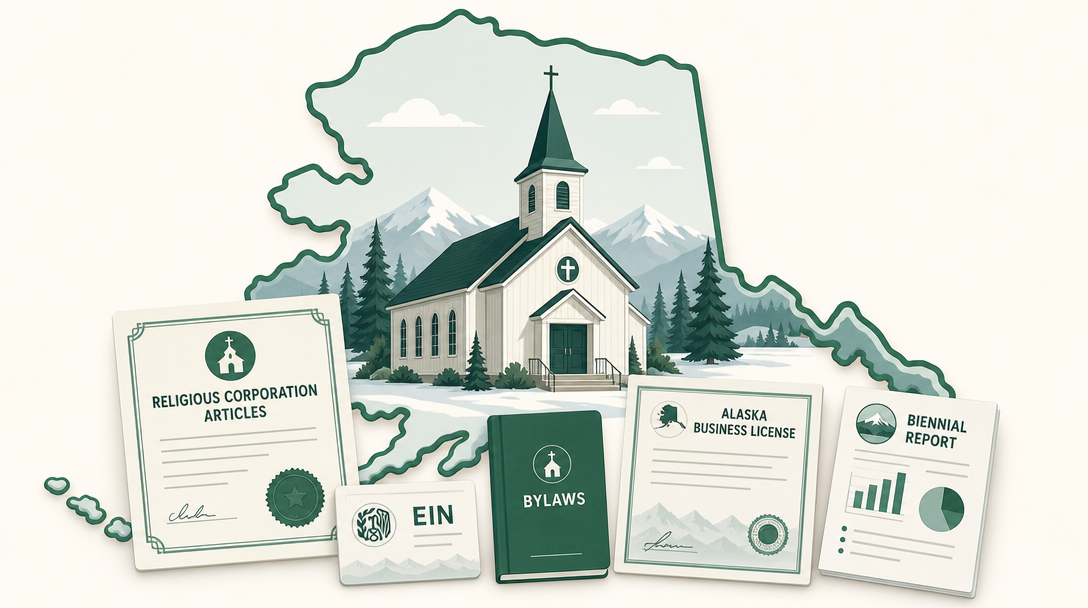
Short answer: To start a church in Alaska, you incorporate by filing Domestic Religious Corporation Articles of Incorporation (form 08-539) with the Alaska Department of Commerce, Community, and Economic Development (DCCED), Division of Corporations and paying the $50 filing fee, then get a free EIN from the IRS, adopt bylaws, and seat a board. A church is automatically tax-exempt under federal law, so the IRS determination letter is optional and there is no Form 990 to file. Alaska adds two state chores most guides miss: every entity needs an Alaska business license ($50 a year), and the corporation files a biennial report ($25) every two years to stay in good standing. One thing Alaska does not have makes the budget easier — there is no statewide sales tax — and a church that owns its building can claim a local property-tax exemption through its borough or city.
The federal formation steps — EIN, bylaws, board, books — are the same in every state. This guide covers those briefly and then spends its time on the Alaska pieces that carry the real value. For the full national walkthrough of each universal step, read how to start a church; below, the focus is what changes inside Alaska.
The formation steps that are the same anywhere
Starting a church in Alaska follows the standard church-formation checklist, and most of it is federal, not state-specific:
- Incorporate as a religious corporation (the Alaska-specific part — covered in detail below).
- Get an EIN — a free federal tax ID from the IRS, applied for directly at irs.gov. Never pay a third party for one; the EIN is always free.
- Adopt bylaws — the church’s internal rulebook for decisions, leadership, and money. Start from a proven document rather than a blank page; see church bylaws for what to include.
- Seat a board — Alaska requires at least three incorporators, so line up a real governing body of mostly-unrelated people rather than one person in charge of everything.
- Skip or pursue the 501(c)(3) letter — a church is automatically tax-exempt and does not have to file Form 1023, though many apply for the determination letter as documentation (IRS Publication 1828).
- Open a bank account in the church’s legal name using the EIN and formation documents.
- Set up the books on fund accounting from day one, before the first offering arrives.
Each of these is walked step by step in the national formation guide linked above. The rest of this page is the Alaska layer on top.
Incorporating a church in Alaska as a religious corporation
Alaska gives a church its own lane. Instead of filing the general nonprofit articles (which carry a $250 fee), a congregation files Domestic Religious Corporation Articles of Incorporation — form 08-539 with the DCCED, Division of Corporations, Business and Professional Licensing. The filing fee is $50 as of 2026, and the religious form is the right fit for a worshiping body (Alaska Division of Corporations, nonprofit and religious FAQs). Confirm the current fee on the Corporation Forms & Fees page, since fees change. You can file by mail or fax to the division in Juneau.
The Articles ask for the church’s name, its registered agent and registered office in Alaska, the religious purpose of the corporation, and the incorporators. Alaska requires at least three incorporators, so seat a board before you file rather than after. Two clauses belong in the Articles even though the state form does not force them, because the IRS looks for both if the church ever seeks a determination letter:
- A 501(c)(3) purpose clause stating the church is organized exclusively for religious and charitable purposes.
- A dissolution clause stating that if the church closes, its assets pass to another 501(c)(3) organization, not to any individual.
Getting that language right at formation saves an amendment later. The full breakdown of what these documents need is in articles of incorporation for a church.
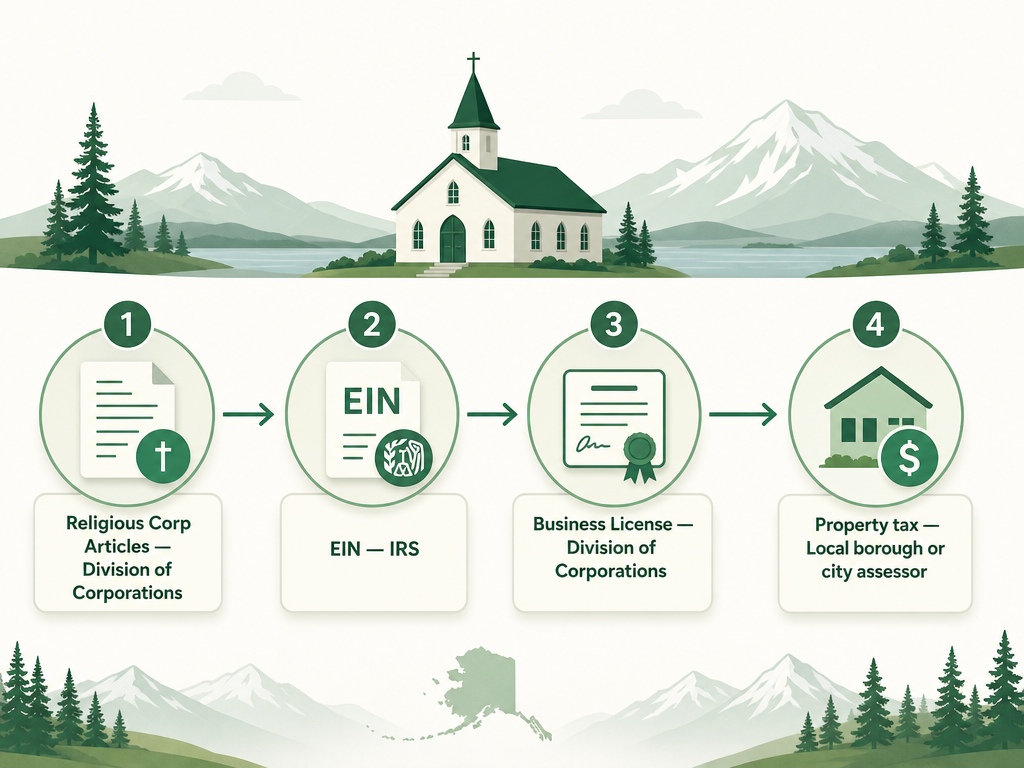
Incorporating is only half of the Alaska setup. The state treats organizations as businesses for licensing, so a new church also needs an Alaska business license, which runs $50 a year (Alaska Division of Corporations, business licensing fees). On top of that, the corporation files a biennial report — every two years — to stay in good standing; the report fee is $25 for a nonprofit or religious corporation, due by July 2 of the reporting year, and skipping it lets the state administratively dissolve the entity after six months (Alaska Division of Corporations, biennial reports). Put both the business license renewal and the biennial report on the calendar the day the church is formed.
Why an Alaska church skips Form 1023 and Form 990
Here is the part that saves a new congregation the most money and worry: under federal law a church is automatically a tax-exempt organization. It does not have to file IRS Form 1023 to be recognized, and it does not file the annual Form 990 that other charities file (IRS Publication 1828). That is a real difference from a general Alaska nonprofit, which must apply for 501(c)(3) status and does file a 990. A church is exempt the moment it operates as a church.
Many Alaska churches still choose to apply for the IRS determination letter — the official piece of paper that says “recognized 501(c)(3)” — because banks, grant-makers, and large donors sometimes ask to see it. That is a documentation choice, not a legal requirement, and it costs a $275 (Form 1023-EZ) or $600 (full Form 1023) user fee. The fuller picture of what automatic exemption does and does not cover is in are churches tax exempt. For most small congregations, the honest answer is that the federal side is short: get the EIN, keep clean records, and decide later whether the letter is worth it.
Alaska sales tax: no statewide tax, some local
Now the part that actually helps the budget: Alaska is one of a handful of states with no statewide sales tax. There is no general state sales-and-use tax for a church to register for, collect, or pay, which removes a whole category of paperwork that churches in most states have to track.
The nuance is local. Alaska law lets boroughs and cities levy their own sales tax by voter approval, and many do — well over a hundred municipalities, with rates that have ranged roughly from 1% to 7% (Alaska Office of the State Assessor, sales tax information). Whether your church owes local sales tax on what it buys, and whether a local exemption for religious organizations exists, depends entirely on the borough or city you operate in. So check with the local government rather than assuming the “no sales tax” headline covers you. On income tax, Alaska has no personal income tax and ties its corporate income tax to the federal code, so a church treated as exempt federally is generally exempt from Alaska corporate income tax too — confirm status with the Alaska Department of Revenue, Tax Division.
Claiming the Alaska property-tax exemption for church property
An Alaska church that owns its building can exempt that property from local property tax, and the exemption is written into state law: AS 29.45.030 makes property used exclusively for nonprofit religious purposes a required municipal exemption (Alaska property tax exemptions, Division of Community and Regional Affairs). The statute covers the sanctuary and its fixtures used for public worship, religious administrative offices, religious education, and the residence of a pastor, priest, rabbi, minister, or bishop of a recognized religious organization.
The catch is that the exemption is use-based and runs through your local assessor, not the state. Property from which the church earns income keeps the exemption only if that income comes solely from use by nonprofit religious, charitable, hospital, or educational groups. Because Alaska has organized and unorganized boroughs and independent cities, the application form, deadline, and any renewal cycle are set locally — the Mat-Su Borough, the Municipality of Anchorage, and the Fairbanks North Star Borough each run their own process. Contact the assessor’s office for the borough or city where the church owns property, file their religious or nonprofit exemption application, and confirm the annual deadline, since a missed deadline can cost a year of exemption.
Alaska filing at a glance
The table below maps each Alaska step to its agency, form, and cost. Treat the fees as accurate as of 2026 and confirm with the listed agency, since Alaska fees change.
| What you’re doing | Agency | Form | Fee (as of 2026) |
|---|---|---|---|
| Incorporate the church | DCCED, Division of Corporations | Domestic Religious Corporation Articles (08-539) | $50 (confirm) |
| Get a business license | DCCED, Division of Corporations | Alaska Business License | $50/yr |
| File the biennial report | DCCED, Division of Corporations | Biennial Report (every 2 years) | $25 |
| Get a federal tax ID | IRS | EIN application (online) | Free |
| 501(c)(3) recognition (optional) | IRS | Form 1023 or 1023-EZ | $600 / $275 user fee |
| Sales tax | No statewide tax | — | Local only (borough/city) |
| Property tax exemption | Local assessor (borough/city) | Local religious exemption application | No state fee |
Setting up the books once the church exists in Alaska
Once the church is formed and the exemptions are in motion, the work shifts from one-time paperwork to the monthly routine — and that routine is where churches either hold together or quietly fall apart. A church holds money in trust for the people who gave it, much of it tagged for a purpose (the building, missions, benevolence), so it tracks money by fund rather than as a single bottom line. Set the books on fund accounting before the first offering, keep the giving records your donors need for their own taxes, and document that the board reviews the finances. None of the Alaska exemptions excuse a church from keeping clean records; the IRS still expects records that substantiate income and expenses (IRS Publication 1828). The Alaska items to keep on the calendar are the business license renewal and the biennial report — letting either lapse can put the church out of good standing, and the biennial report in particular protects the corporation from administrative dissolution.
FAQ
How much does it cost to start a church in Alaska? The required state cost is low. Filing the Domestic Religious Corporation Articles (form 08-539) with the Division of Corporations costs $50 as of 2026, the Alaska business license is $50 a year, and the biennial report is $25 every two years. The EIN from the IRS is free, and the local property-tax exemption carries no state fee. So the bare legal minimum to form an Alaska church runs roughly $100 in the first year plus your time. The one optional add-on that costs real money is the IRS determination letter — $275 for Form 1023-EZ or $600 for the full Form 1023 — which a church can skip because it is automatically exempt.
Do you need 501(c)(3) status to start a church in Alaska? No. A church is automatically tax-exempt under federal law and does not have to file Form 1023 or hold an IRS determination letter to be exempt, and it does not file the annual Form 990 that other charities file (IRS Publication 1828). Many Alaska churches still apply for the determination letter as documentation for banks, grant-makers, and large donors, but it is optional.
Does an Alaska church have to worry about sales tax? There is no statewide sales tax in Alaska, so there is no state sales tax to register for or collect. The catch is that boroughs and cities can levy their own local sales tax by voter approval, and many do, with rates that have ranged from about 1% to 7% (Alaska Office of the State Assessor). Whether your church owes local sales tax, and whether a local religious exemption applies, depends on the specific municipality, so check with the local government where you meet.
Can I just start my own church in Alaska? Practically, anyone can start a church in Alaska — there is no state license or denominational permission required, and the First Amendment protects the right to form a religious organization. What you do need, to operate as a real and exempt church, is the structure: a religious corporation formed on form 08-539, an EIN, adopted bylaws, a board of at least three mostly-unrelated people, a business license, a bank account in the church’s name, and books set up on fund accounting. The freedom to start one is unlimited; running one properly is a checklist.
This is general information, not tax or legal advice. Alaska forms, fees, and local rules change, and every congregation’s situation is different — confirm the current requirements with the agencies linked above and consult a qualified attorney or accountant before you file.
Vestrybooks sets up a new Alaska church’s books on fund accounting from day one — funds, reconciliation, and the board reports — so the financial side is right before the first offering. See how it works.
This article is general information for church treasurers, not professional tax or legal advice. For your church's situation, consult a qualified accountant or attorney.
Church accounting a volunteer can actually do.
Vestrybooks is church accounting + giving for the volunteer treasurer — fund tracking, one-click year-end statements, and online giving with $0 taken from every gift.
A real free plan · no credit card · your data stays yours