Blog · Church formation & governance
How to start a church in Virginia
July 4, 2026 · By Benjamin Reinke
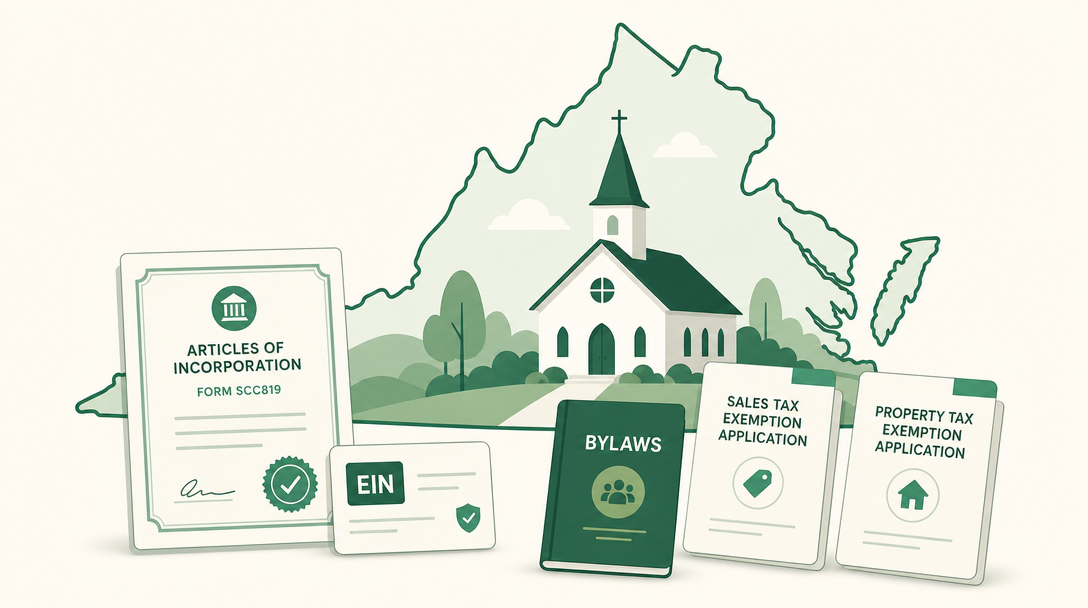
Short answer: To start a church in Virginia, you form a nonprofit corporation by filing Articles of Incorporation of a Virginia Nonstock Corporation — Form SCC819 with the Virginia State Corporation Commission (SCC), not the Secretary of State, and pay the $75 fee ($50 charter fee plus a $25 filing fee). Then get a free EIN from the IRS, adopt bylaws, seat a board, and open a bank account. A church is automatically tax-exempt under federal law, so the IRS determination letter is optional and there is no annual Form 990. The genuinely Virginia-specific parts are the SCC filing and two state exemptions worth claiming: a sales tax exemption through Virginia Tax’s Nonprofit Online system and a property tax exemption that Virginia grants churches by statute. And unlike an ordinary nonprofit, a church is excluded from Virginia’s charitable-solicitation registration, so it can take offerings without registering with VDACS first.
The federal formation steps are the same in every state — incorporate, EIN, bylaws, board, books. This guide covers those briefly and then spends its time on the Virginia pieces that carry the real value. For the full national walkthrough of each universal step, read how to start a church; below, the focus is what changes inside Virginia.
The formation steps that are the same anywhere
Starting a church in Virginia follows the standard church-formation checklist, and most of it is federal, not state-specific:
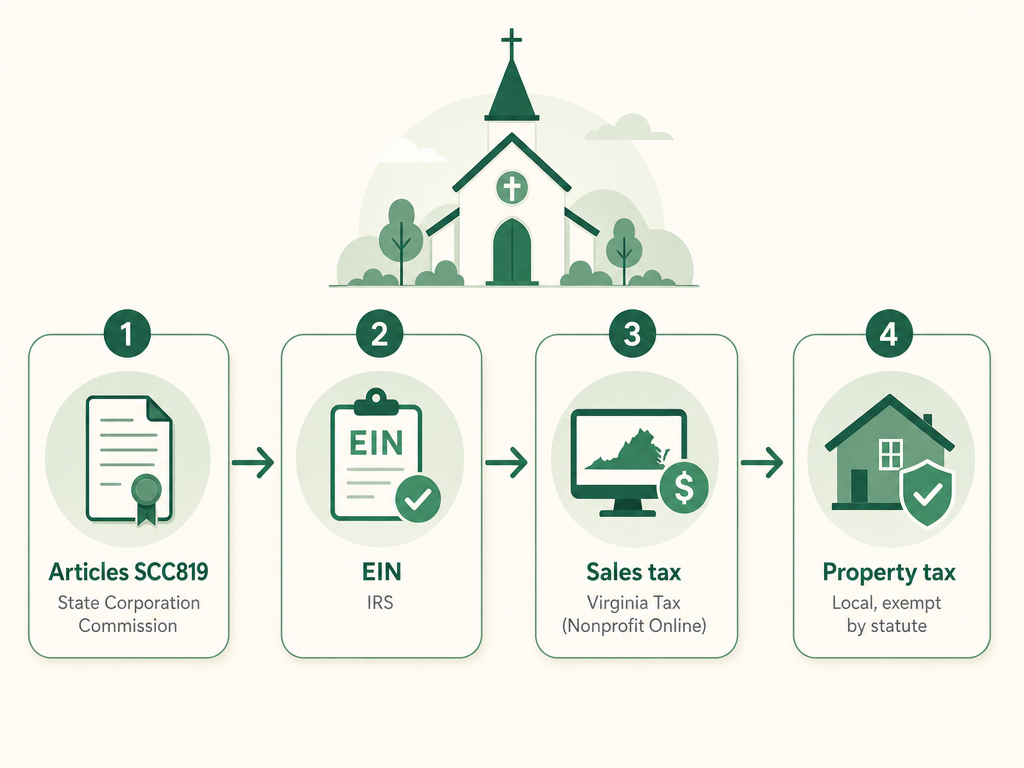
- Incorporate as a Virginia nonstock corporation (the Virginia-specific part — covered in detail below).
- Get an EIN — a free federal tax ID from the IRS, applied for directly at irs.gov. Never pay a third party for one; the EIN is always free.
- Adopt bylaws — the church’s internal rulebook for decisions, leadership, and money. Start from a proven document rather than a blank page; see church bylaws for what to include.
- Seat a board — at least three directors, ideally a majority unrelated, so the church is governed by a body rather than one person.
- Skip or pursue the 501(c)(3) letter — a church is automatically tax-exempt and does not have to file Form 1023, though many apply for the determination letter as documentation (IRS Publication 1828).
- Open a bank account in the church’s legal name using the EIN and formation documents.
- Set up the books on fund accounting from day one, before the first offering arrives.
Each of these is walked step by step in the national formation guide linked above. The rest of this page is the Virginia layer on top.
Incorporating a church in Virginia with Form SCC819
Virginia creates the church as a legal entity when you file Articles of Incorporation of a Virginia Nonstock Corporation — Form SCC819 with the Virginia State Corporation Commission. This is the point most people get wrong: Virginia does not use the Secretary of State for business filings the way many states do. Corporate registration runs through the SCC, and you file online through its Clerk’s Information System (CIS) or by mail to the Clerk’s Office in Richmond. A nonstock corporation is the structure Virginia uses for not-for-profit organizations — it can have members but no owners or shareholders, which fits a church exactly.
The total fee is $75 as of 2026, made up of a $50 charter fee under Code of Virginia § 13.1-815.1 plus a $25 filing fee under § 13.1-816; confirm the current amount with the Virginia State Corporation Commission, since fees change.
Form SCC819 asks for the church’s name, its registered agent and registered office in Virginia, and the structure of its board. The SCC’s pre-printed template covers the corporate basics, but the IRS looks for two clauses that the bare-minimum state form does not force you to include, so add them at formation rather than as an amendment later:
- A 501(c)(3) purpose clause stating the church is organized exclusively for religious and charitable purposes.
- A dissolution clause stating that if the church closes, its assets pass to another 501(c)(3) organization, not to any individual.
Getting that language into the articles up front saves a rewrite. The full breakdown of what these documents need is in articles of incorporation for a church. Virginia law sets a low floor on board size — a nonstock corporation’s board “shall consist of one or more individuals” under Code of Virginia § 13.1-855 — but three mostly-unrelated directors is the practical standard and the shape a bank or the IRS expects to see.
Does a Virginia church register with the state to fundraise
Here is a genuine break for churches, and a place where a church has it easier than an ordinary nonprofit. Virginia requires most charities to register with the Department of Agriculture and Consumer Services (VDACS) before they solicit any contributions — but a church is excluded from the definition of “charitable organization” under the Virginia Solicitation of Contributions Law. Under Code of Virginia § 57-60, a church, or a convention or association of churches, that is primarily operated for nonsecular purposes and does not pay net income to any individual is not the kind of organization that has to register to solicit.
In plain terms, a congregation taking offerings and asking its members and community to give does not file a fundraising registration with VDACS first. That removes a step — and an annual renewal fee — that a general nonprofit in Virginia has to handle before it fundraises. If your church runs a separate arm that is not really a church (a standalone foundation or a broad public-fundraising entity), look at that entity on its own terms, since it may not share the church exclusion. But the church itself does not register. You can confirm the current rules on the VDACS charitable solicitation registration page. Note that “registering” still happens in one sense — filing Form SCC819 registers the church as a legal entity with the SCC. What Virginia skips for churches is the separate fundraising registration.
Claiming the Virginia sales tax exemption for your church
A Virginia church can buy items free of state sales tax, but the exemption is not automatic — you apply to Virginia Tax through its Nonprofit Online system, which produces a retail sales-and-use tax certificate of exemption. Organizations that cannot apply online use Form NP-1 instead (Virginia Tax, nonprofit organizations). Once the certificate is issued, the church can buy qualifying tangible goods — equipment, supplies, and the like — without paying Virginia sales tax, and vendors will ask to see the certificate before they drop the tax.
One church-specific detail matters here. Virginia’s exemption normally keys off a federal 501(c)(3) determination letter, which a church may not have if it chose not to file Form 1023. Virginia Tax addresses that directly: a church that has not obtained an IRS determination letter can still apply by submitting a detailed financial statement for its prior accounting period in place of the letter, per the Form NP-1 instructions. So a new church that skipped the 1023 is not shut out of the Virginia sales tax exemption — it just documents its finances instead. Allow around 30 days for Virginia Tax to process the application, and keep the certificate on file once it is issued.
Claiming the Virginia property tax exemption for a church
Property tax is where Virginia treats churches best. Real property and personal property owned by a church and used exclusively for religious worship — or as the residence of its minister, plus adjacent land reasonably necessary to use it — is exempt from local property tax by classification under Code of Virginia § 58.1-3606. “By classification” is the key phrase: the exemption is granted by the statute itself, so a church does not have to win a special local ordinance or designation the way many other nonprofits must.
That said, the exemption is administered locally, so you still work with the commissioner of the revenue (or the assessor’s office) in the county or city where the church owns property, to have the parcel recognized and taken off the tax rolls. Bring your formation documents and be ready to show the property is used for worship. The scope has been read broadly — it reaches outdoor worship space and accessory uses whose dominant purpose supports worship — but the exclusive-use test still governs, so property the church rents out for unrelated commercial use can lose the break. Confirm the process and any local filing with your commissioner of the revenue, since each locality handles the paperwork its own way even though the exemption comes from state law.
Virginia filing at a glance
The table below maps each Virginia step to its agency, form, and cost. Treat the fees as accurate as of 2026 and confirm with the listed agency, since Virginia fees change.
| What you’re doing | Agency | Form | Fee (as of 2026) |
|---|---|---|---|
| Incorporate the church | Virginia State Corporation Commission | Articles — Form SCC819 | $75 ($50 charter + $25 filing) |
| Get a federal tax ID | IRS | EIN application (online) | Free |
| 501(c)(3) recognition (optional) | IRS | Form 1023 or 1023-EZ | $600 / $275 user fee |
| Sales tax exemption | Virginia Tax | Nonprofit Online (Form NP-1) | No fee |
| Property tax exemption | Local commissioner of the revenue | Local process; exempt by § 58.1-3606 | No state fee |
| Charitable-solicitation registration | — | Churches excluded under § 57-60 | — |
Setting up the books once the church exists in Virginia
Once the church is formed and the exemptions are filed, the work shifts from one-time paperwork to the monthly routine — and that routine is where churches actually fail or hold together. A church holds money in trust for the people who gave it, much of it tagged for a purpose (the building, missions, benevolence), so it tracks money by fund rather than as a single bottom line. Set the books up on fund accounting before the first offering, keep the giving records your donors need for their own taxes, and document that the board reviews the finances. None of the Virginia exemptions excuse a church from keeping clean records; the IRS still expects records that substantiate income and expenses (IRS Publication 1828).
FAQ
How much does it cost to start a church in Virginia? The required state cost is small. Filing Articles of Incorporation (Form SCC819) with the State Corporation Commission costs $75 as of 2026 — a $50 charter fee plus a $25 filing fee — the EIN from the IRS is free, and the Virginia sales tax exemption (Nonprofit Online / Form NP-1) and the church property tax exemption carry no state fee. Because a church is excluded from VDACS charitable-solicitation registration, there is no fundraising registration fee either. So the bare legal minimum to form a Virginia church and claim its exemptions is roughly the $75 filing fee plus your time. Optional add-ons raise it: the IRS determination letter is $275 (Form 1023-EZ) or $600 (full Form 1023), and insurance runs a few hundred dollars a year.
Do you file with the Secretary of State to start a church in Virginia? No — and this is the most common mix-up. Virginia routes business and nonprofit filings through the State Corporation Commission (SCC), not the Secretary of State. You incorporate the church by filing Form SCC819 with the SCC, online through its Clerk’s Information System or by mail to the Clerk’s Office in Richmond. Many other states use “Secretary of State” for this, so out-of-state templates and checklists point you to the wrong office in Virginia.
Does a Virginia church have to register with VDACS before it fundraises? No, in the ordinary case. A church, or a convention or association of churches, is excluded from the definition of “charitable organization” under Code of Virginia § 57-60, so it does not have to register with VDACS to solicit contributions the way a general nonprofit does. A congregation taking offerings and asking its members and community to give is not filing a fundraising registration first. A separate, non-church fundraising entity affiliated with the church should be checked on its own, since it may not share the exclusion.
Do you need 501(c)(3) status to start a church in Virginia? No. A church is automatically tax-exempt under federal law and does not have to file Form 1023 or hold an IRS determination letter to be exempt, and it does not file an annual Form 990 (IRS Publication 1828). A church can even claim the Virginia sales tax exemption without a federal letter — Virginia Tax lets a church submit a detailed prior-year financial statement in its place. Many Virginia churches still apply for the determination letter as documentation for banks, grant-makers, and large donors, but it is optional — see are churches tax exempt for the fuller picture.
Can I just start my own church in Virginia? Practically, anyone can start a church in Virginia — there is no state license or denominational permission required, and the First Amendment protects the right to form a religious organization. What you do need, to operate as a real and exempt church, is the structure: a nonstock corporation formed on Form SCC819 with the SCC, an EIN, adopted bylaws, a board of at least three mostly-unrelated directors, a bank account in the church’s name, and books set up on fund accounting. The freedom to start one is unlimited; running one properly is a checklist.
This is general information, not tax or legal advice. Virginia forms, fees, and rules change and are administered locally for property tax — confirm the current details with the SCC, Virginia Tax, and your commissioner of the revenue, or consult a qualified professional, before you file.
Vestrybooks sets up a new Virginia church’s books on fund accounting from day one — funds, reconciliation, and the board reports — so the financial side is right before the first offering. See how it works.
This article is general information for church treasurers, not professional tax or legal advice. For your church's situation, consult a qualified accountant or attorney.
Church accounting a volunteer can actually do.
Vestrybooks is church accounting + giving for the volunteer treasurer — fund tracking, one-click year-end statements, and online giving with $0 taken from every gift.
A real free plan · no credit card · your data stays yours