Blog · Church taxes
Do churches pay taxes? What's exempt, and what isn't
June 27, 2026 · By Benjamin Reinke
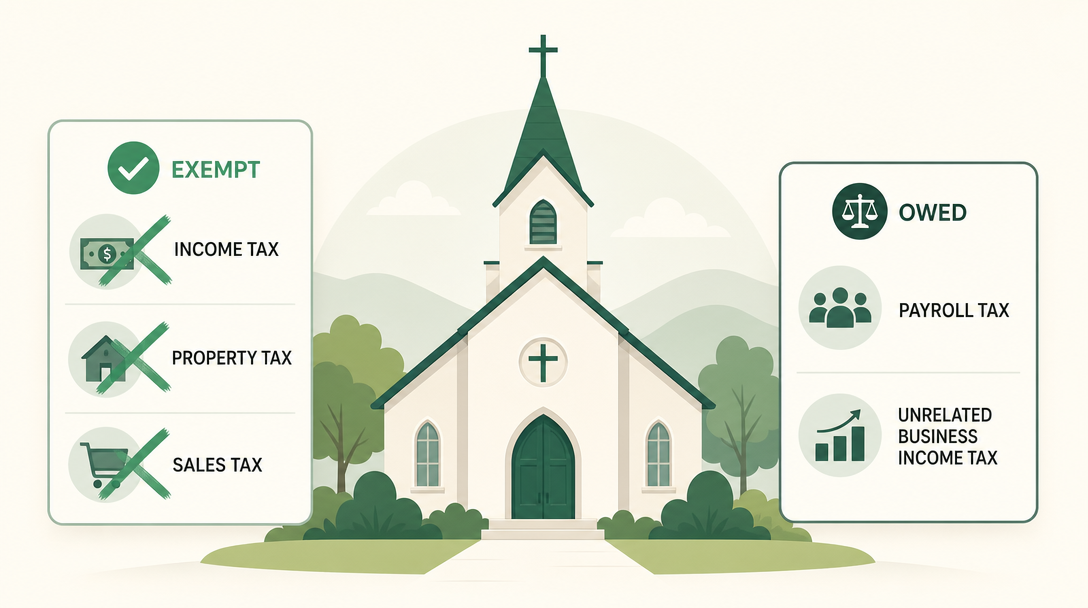
Short answer: Mostly no — but not entirely. A church is automatically exempt from federal income tax as a 501(c)(3), and usually exempt from property tax (on space used for ministry) and sales tax in many states. But “churches pay no taxes” is a myth: churches still pay payroll taxes on their non-minister staff, owe tax on unrelated business income, and their ministers pay self-employment tax on salary and housing. So a church pays fewer taxes than a business — not zero.
The taxes churches don’t pay
Three big exemptions cover most of a church’s money:
- Federal income tax. A church is a 501(c)(3) organization and is automatically tax-exempt — it doesn’t even have to apply to the IRS (IRS Publication 1828). Offerings and tithes aren’t taxed as income.
- Property tax. Most states exempt property used for religious purposes — the sanctuary, offices, classrooms — though it’s state-administered and not automatic (covered in do churches pay property taxes).
- Sales tax. Many states exempt churches from sales tax on purchases, usually with an exemption certificate — but this varies state to state, and a church may have to collect sales tax on what it sells (the full rundown is in do churches pay sales tax).
This is also why donors can deduct gifts: the church’s exempt status is what makes church donations tax deductible.
The taxes churches still pay
Here’s where the “churches don’t pay taxes” line breaks down:
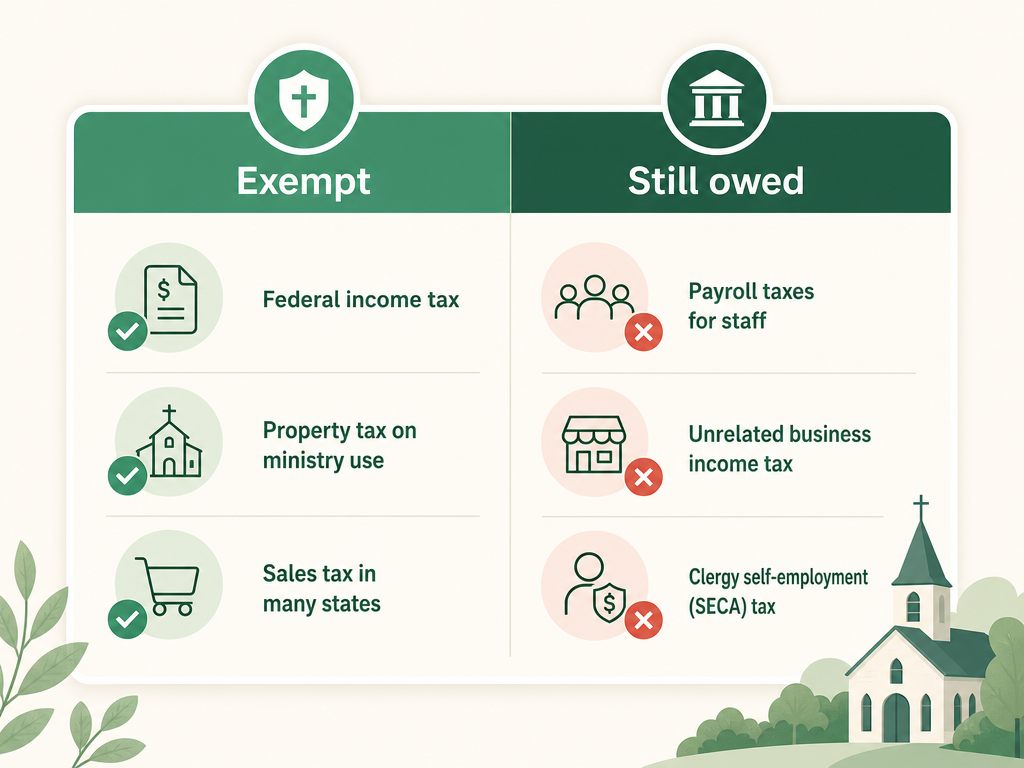
- Payroll taxes. For its non-minister employees — a secretary, a custodian, childcare staff — a church withholds income tax and handles Social Security and Medicare (FICA) like any employer.
- Unrelated business income tax (UBIT). If a church regularly runs a business unrelated to its religious mission — say, a parking lot open to the public for a fee — that income can be taxable (IRS Publication 598).
- Some property. Property not used for exempt purposes — a rental house, vacant land held for investment — can be taxable even when the sanctuary isn’t.
Beyond paying tax, a church carries reporting duties too: it has to issue 1099s to the contractors it pays $2,000 or more for services (the threshold for 2026 payments, up from $600), the same as any other organization, plus payroll forms for any employees — the full set is laid out in the guide to church tax forms. Exemption from income tax doesn’t exempt you from information reporting. The reverse comes up too — when a payer asks the church to fill out a nonprofit’s own W-9, certifying its name, EIN, and exempt status.
Do pastors pay taxes?
Yes — and this is the most misunderstood part. A minister pays federal income tax on their salary, and self-employment (SECA) tax on salary plus the housing allowance, because clergy have a “dual tax status”: employees for income tax, self-employed for Social Security. The housing allowance escapes income tax but not SECA — the trap covered in how the clergy housing allowance works. So “the pastor pays no taxes” is simply false.
Why churches are tax-exempt at all
Churches are exempt because they’re organized and operated exclusively for religious purposes under 501(c)(3) — the same category as other charities, with one privilege: churches are recognized automatically, without filing for a determination letter. What that exemption means, and the rules attached to it, are covered in are churches tax exempt. The exemption isn’t unconditional: a church can jeopardize it by campaigning for candidates or letting insiders profit — and the IRS can examine a church that crosses those lines, within the special limits that protect churches.
The “churches don’t pay taxes” myth
The viral version — “if churches paid taxes, we’d fix the deficit” — assumes churches would owe income tax on their full revenue like a for-profit. They wouldn’t: like all nonprofits, a church is taxed on profit from unrelated business, not on donations given for its mission. The honest summary is the one at the top: churches pay less tax than a business, not no tax.
Vestrybooks keeps a church’s payroll, giving, and fund records clean, so the lines between exempt and taxable activity are easy to see and report. See plans →
FAQ
Do churches pay federal income tax? No. A church is automatically a tax-exempt 501(c)(3), so its offerings and tithes aren’t taxed as income — but it does pay tax on income from an unrelated business.
Do churches pay payroll taxes? Yes, for non-minister employees — a church withholds income tax and handles Social Security and Medicare like any employer. Ministers are treated as self-employed for Social Security.
Do pastors pay taxes? Yes — income tax on their salary and self-employment (SECA) tax on salary plus housing allowance, unless they’ve formally opted out of Social Security.
Is it true churches pay no taxes? No. Churches are exempt from federal income tax and usually property and sales tax, but still pay payroll taxes, tax on unrelated business income, and their clergy owe SECA.
This is general information, not tax or legal advice — confirm your church’s situation with a qualified professional.
This article is general information for church treasurers, not professional tax or legal advice. For your church's situation, consult a qualified accountant or attorney.
Church accounting a volunteer can actually do.
Vestrybooks is church accounting + giving for the volunteer treasurer — fund tracking, one-click year-end statements, and online giving with $0 taken from every gift.
A real free plan · no credit card · your data stays yours