Blog · Church formation & governance
How to start a church in Alabama
July 4, 2026 · By Benjamin Reinke
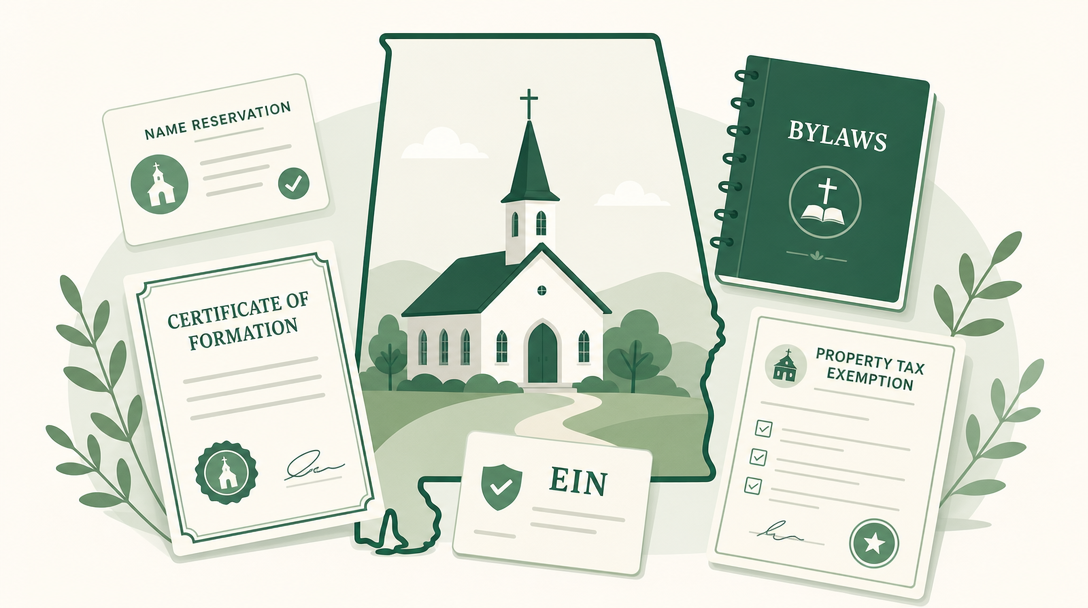
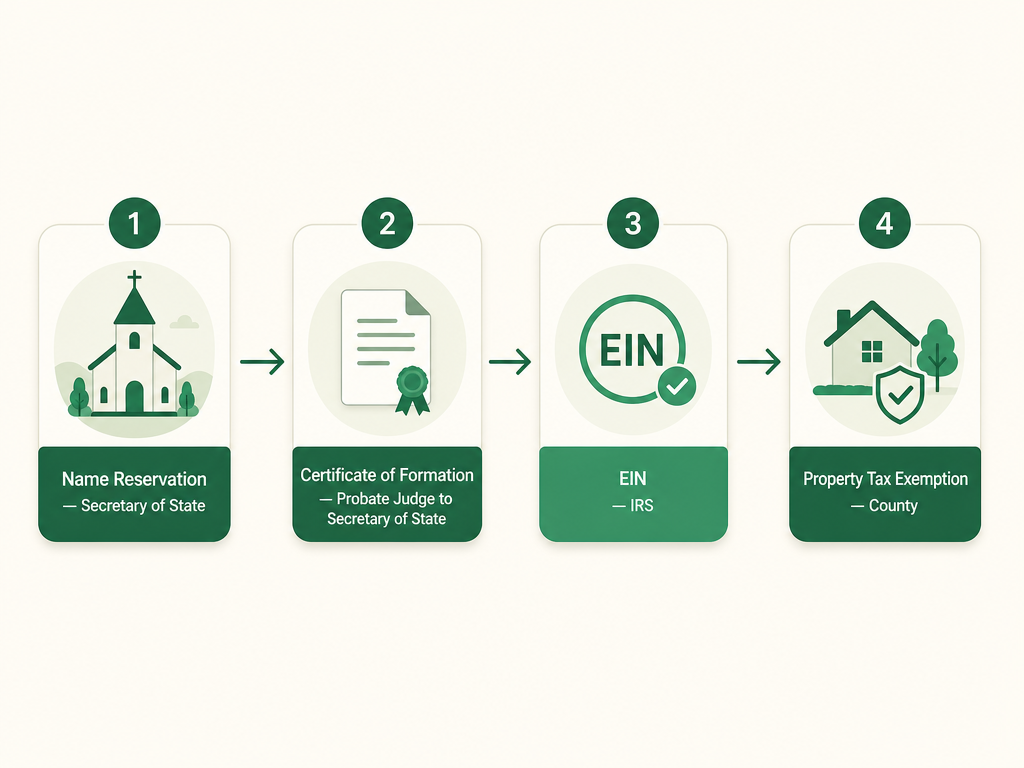
Short answer: To start a church in Alabama, you form a nonprofit corporation by reserving the name with the Alabama Secretary of State ($28 online), then filing the Domestic Nonprofit Corporation Certificate of Formation through the Probate Judge in your county, who records it and forwards it to the Secretary of State (a $100 Secretary of State fee plus a county probate fee). Then you get a free EIN, adopt bylaws, and seat a board. A church is automatically tax-exempt under federal law, so the IRS determination letter is optional and there is no annual Form 990. On the Alabama side, register to fundraise with the Attorney General is usually skipped — churches are exempt — and the property tax exemption runs through your county. One honest warning most guides bury: Alabama generally does not exempt church purchases from sales tax.
The federal formation steps are the same in every state — incorporate, EIN, bylaws, board, books. This guide covers those briefly and then spends its time on the Alabama pieces that carry the real weight. For the full national walkthrough of each universal step, read how to start a church; below, the focus is what changes inside Alabama.
The formation steps that are the same anywhere
Starting a church in Alabama follows the standard church-formation checklist, and most of it is federal, not state-specific:
- Incorporate as a nonprofit corporation (the Alabama-specific part — covered in detail below).
- Get an EIN — a free federal tax ID from the IRS, applied for directly at irs.gov. Never pay a third party for one; the EIN is always free.
- Adopt bylaws — the church’s internal rulebook for decisions, leadership, and money. Start from a proven document rather than a blank page; see church bylaws for what to include.
- Seat a board — at least three directors, ideally a majority unrelated, so the church is governed by a body rather than one person. Alabama sets the floor at three directors.
- Skip or pursue the 501(c)(3) letter — a church is automatically tax-exempt and does not have to file Form 1023, though many apply for the determination letter as documentation (IRS Publication 1828).
- Open a bank account in the church’s legal name using the EIN and formation documents.
- Set up the books on fund accounting from day one, before the first offering arrives.
Each of these is walked step by step in the national guide linked above. The rest of this page is the Alabama layer on top.
Incorporating a church in Alabama through the Probate Judge
Alabama routes nonprofit formation through the county courthouse, which surprises founders who expect to file straight with a Secretary of State. The church becomes a legal entity when you file the Domestic Nonprofit Corporation Certificate of Formation with the Probate Judge in the county where the church’s registered office sits. The probate office records it locally, then forwards a certified copy and the state fee to the Alabama Secretary of State, who indexes the filing (Alabama Secretary of State, domestic nonprofit certificate of formation).
A word on a common mix-up: Alabama did streamline corporate filings in the 2020s, and you may read that formations now go directly to the Secretary of State. That change reached for-profit corporations and LLCs — but the current nonprofit form still routes through the Probate Judge, so a new church files at the courthouse first. Always work from the live form on sos.alabama.gov rather than a summary.
Alabama also wants the name locked in before you file. You reserve the corporate name with the Secretary of State first, then attach the Name Reservation certificate to the Certificate of Formation — without it, the probate office will not record the filing. The name reservation runs $28 online as of 2026, the Secretary of State filing fee is $100, and the county probate office collects its own recording fee (call ahead to confirm the amount). Confirm each amount with the Alabama Secretary of State fee schedule and your county probate office before you write the checks, since fees change and counties set their own costs.
The Certificate of Formation asks for the church’s name, its registered agent and registered office in Alabama, the incorporators, the initial directors, and its purpose. Two clauses do the heavy lifting for tax-exempt status and should go in at formation rather than as an amendment later:
- A 501(c)(3) purpose clause stating the church is organized exclusively for religious and charitable purposes.
- A dissolution clause stating that if the church closes, its assets pass to another 501(c)(3) organization, not to any individual.
The IRS looks for both, so getting the language right on the Alabama filing saves a rewrite. The full breakdown of what these documents need is in articles of incorporation for a church. Alabama’s three-director floor is also the practical standard: the IRS treats a one- or two-person board as a red flag, so three mostly-unrelated directors is both the legal minimum and the sensible one.
Why a church can automatically skip Form 1023 and Form 990
Here is where a church diverges sharply from an ordinary nonprofit. An ordinary Alabama nonprofit must file IRS Form 1023 and receive a determination letter to become a 501(c)(3). A church does not: under federal law a church that meets the requirements is automatically tax-exempt and treated as a 501(c)(3) without applying, so Form 1023 is optional (IRS Publication 1828). Churches are also excused from the annual Form 990 information return other charities file every year — a real, ongoing savings in paperwork.
Many Alabama churches still file Form 1023 (or the streamlined 1023-EZ) and hold the IRS letter anyway, because banks, grant-makers, and large donors sometimes ask to see it and the letter removes any doubt about deductibility. That is a documentation decision, not a legal requirement. For the fuller picture of what “automatically exempt” does and doesn’t cover, read are churches tax exempt.
Does an Alabama church register with the Attorney General to fundraise
Alabama requires most charities to register with the Attorney General’s office before soliciting contributions from the public — but religious organizations are exempt from that registration (Alabama Attorney General, charitable organizations). A church taking offerings and asking its members to give does not file the Charitable Organization Registration Statement or pay the $25 fee that a general nonprofit does.
One nuance worth knowing: in Alabama several exemptions from charitable registration are not automatic — an organization has to claim them rather than simply assume them. For a plain congregation the religious exemption is clear, but if your church runs a separate fundraising arm or a related foundation that solicits the general public, check whether that entity has to register or file for its exemption before a public campaign.
Claiming the Alabama property tax exemption through your county
A church that owns its building can exempt that property from local property (ad valorem) tax, and in Alabama this runs through the county tax assessor or revenue commissioner where the property sits — not the Secretary of State or the Department of Revenue. Alabama law exempts property owned by religious organizations and used for religious worship, but the exemption is applied for and administered locally, so the office and paperwork differ from county to county.
Contact your county tax assessor or revenue commissioner soon after the church acquires or occupies property, ask for their religious-property exemption application, and file it for the tax year you want covered — bringing the recorded Certificate of Formation, the EIN, and proof of ownership and religious use. Because the process is county-run, confirm the current form and deadline with your local office; both are set at the county level.
Alabama sales tax and your church — the honest answer
Now the part most guides skip: Alabama generally does not give churches a sales tax exemption. The Alabama Department of Revenue is direct about it — in general, Alabama law does not provide a sales or use tax exemption to churches, and a church is required to pay sales or use tax on its purchases of tangible personal property (Alabama Department of Revenue, are churches exempt from sales and use taxes).
So budget as if your church pays sales tax on the equipment, supplies, and goods it buys — because in the ordinary case it does. Alabama grants sales-tax exemptions only to entities the legislature has named one by one in statute, and a qualifying named entity gets a Certificate of Exemption from the Department of Revenue rather than getting it automatically as a nonprofit. There is a narrow opening: certain church-affiliated educational facilities may qualify and can apply on form ST: EX-A1-SE for statutorily exempt entities (Alabama Department of Revenue, are any churches eligible for a certificate of exemption). For a plain congregation, plan on paying sales tax.
Alabama filing at a glance
The table below maps each step to its agency, form, and cost. Treat the fees as accurate as of 2026 and confirm with the listed agency, since Alabama fees change and county probate and property costs vary.
| What you’re doing | Agency | Form | Fee (as of 2026) |
|---|---|---|---|
| Reserve the church name | Alabama Secretary of State | Name Reservation | $28 online (confirm) |
| Incorporate the church | Probate Judge → Secretary of State | Domestic Nonprofit Certificate of Formation | $100 SoS + county probate fee |
| Get a federal tax ID | IRS | EIN application (online) | Free |
| 501(c)(3) recognition (optional) | IRS | Form 1023 or 1023-EZ | $600 / $275 user fee |
| Register to fundraise | Alabama Attorney General | Not required — churches exempt | — |
| Property tax exemption | County tax assessor / revenue commissioner | County religious-property application | No state fee |
| Sales tax on purchases | Alabama Dept. of Revenue | — | Generally taxable (no church exemption) |
Setting up the books once the church exists in Alabama
Once the church is formed and the property exemption is filed, the work shifts from one-time paperwork to the monthly routine — and that routine is where churches actually fail or hold together. A church holds money in trust for the people who gave it, much of it tagged for a purpose (the building, missions, benevolence), so it tracks money by fund rather than as a single bottom line. Set the books up on fund accounting before the first offering, keep the giving records your donors need for their own taxes, and document that the board reviews the finances. None of Alabama’s rules excuse a church from keeping clean records; the IRS still expects records that substantiate income and expenses.
FAQ
How much does it cost to start a church in Alabama? The required state cost is modest. Reserving the name runs about $28 online, the Secretary of State filing fee is $100, and the county probate office adds its own recording fee, so the Alabama paperwork typically lands around $150 to $200 plus your time. The EIN from the IRS is free, and because churches are exempt from Attorney General charitable registration, there is no fundraising fee. The one optional add-on is the IRS determination letter — $275 (Form 1023-EZ) or $600 (full Form 1023) — so a small Alabama church can be stood up properly for a couple hundred dollars beyond that letter.
Does an Alabama church file through the Probate Judge or the Secretary of State? Both, in sequence. You deliver the Domestic Nonprofit Certificate of Formation to the Probate Judge in the county where the registered office sits; the probate office records it and forwards a certified copy and the $100 state fee to the Secretary of State, who indexes it (Alabama Secretary of State, domestic nonprofit certificate of formation). Alabama moved for-profit corporations and LLCs to direct Secretary of State filing, which is why some guides say formations now skip the courthouse — but the current nonprofit form still routes through the Probate Judge, so a church files there first.
Do you need 501(c)(3) status to start a church in Alabama? No. A church is automatically tax-exempt under federal law and does not have to file Form 1023 or hold an IRS determination letter to be exempt, and it does not file the annual Form 990 that other charities file (IRS Publication 1828). Many Alabama churches still apply for the determination letter as documentation for banks, grant-makers, and large donors, but it is optional. Note that the exemption does not extend to Alabama sales tax, which churches generally still pay.
Can I just start my own church in Alabama? Practically, anyone can — there is no state license or denominational permission required, and the First Amendment protects the right to form a religious organization. What you do need, to operate as a real and exempt church, is the structure: a nonprofit corporation formed on the Certificate of Formation through the Probate Judge, an EIN, adopted bylaws, a board of at least three mostly-unrelated directors, a bank account in the church’s name, and books set up on fund accounting. The freedom to start one is unlimited; running one properly is a checklist.
This is general information, not tax or legal advice. Alabama forms, fees, and county procedures change — confirm the current requirements with the agency and a qualified professional before you file.
Vestrybooks sets up a new Alabama church’s books on fund accounting from day one — funds, reconciliation, and the board reports — so the financial side is right before the first offering. See how it works.
This article is general information for church treasurers, not professional tax or legal advice. For your church's situation, consult a qualified accountant or attorney.
Church accounting a volunteer can actually do.
Vestrybooks is church accounting + giving for the volunteer treasurer — fund tracking, one-click year-end statements, and online giving with $0 taken from every gift.
A real free plan · no credit card · your data stays yours