Blog · Nonprofit formation
How to start a 501(c)(3) and get IRS tax-exempt status
June 27, 2026 · By Benjamin Reinke
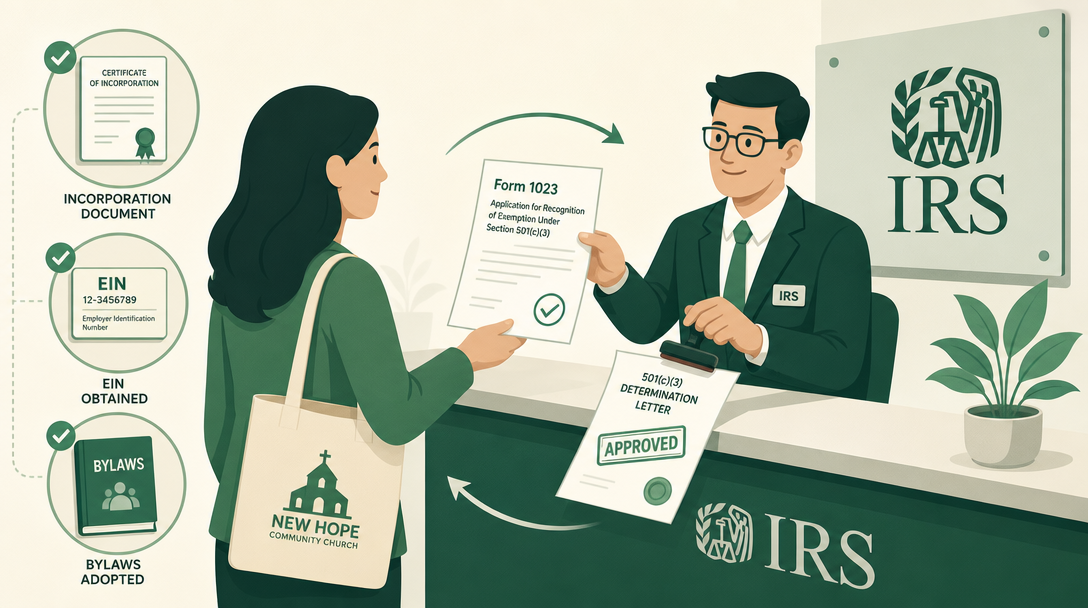
Short answer: “Starting a 501(c)(3)” really means getting the IRS to recognize your nonprofit corporation as tax-exempt under section 501(c)(3). You do that by filing Form 1023 (or the shorter Form 1023-EZ if you’re small enough to qualify), paying a user fee of $600 for the full form or $275 for the EZ, and waiting for a determination letter. But you can’t file until the organization already exists: you must be incorporated as a nonprofit, have an EIN, have bylaws, and have the right purpose and dissolution language in your articles. This page is about that one step — the tax-exemption application — not the whole formation checklist.
Where the 501(c)(3) step fits in starting a nonprofit
The 501(c)(3) application is one step inside a longer formation process, and it’s the step that trips people up because it’s the only one the IRS controls. The full sequence — incorporate, get an EIN, adopt bylaws, seat a board, apply for exemption, open a bank account, set up the books — is laid out in the guide to how to start a nonprofit. This page zooms in on step five: getting the federal tax exemption that turns a state-registered nonprofit into a real, deductible charity.
That distinction matters because the words get used loosely. People say “I want to start a 501(c)(3)” when they mean “I want to start a nonprofit and make it tax-exempt.” Those are two different acts. You become a nonprofit at the state level by incorporating. You become a 501(c)(3) at the federal level by applying to the IRS. The rest of this page is about the second act.
What 501(c)(3) status actually is
501(c)(3) is the section of the federal tax code that exempts certain nonprofits from federal income tax and lets their donors deduct gifts. To qualify, an organization has to be organized and operated exclusively for one of the exempt purposes the code lists — charitable, religious, educational, scientific, or literary — and none of its earnings can flow to private individuals. The IRS lays all of this out in Publication 557, the official guide to tax-exempt status.
In practice the IRS judges an applicant against two tests, and your application has to pass both:
- The organizational test looks at your governing documents. Your articles of incorporation must limit the organization to exempt purposes (the purpose clause) and must permanently dedicate its assets to another tax-exempt organization or government if it ever dissolves (the dissolution clause). If your articles say the wrong thing, you fail this test on paper — no matter how good your work is.
- The operational test looks at what you actually do. The organization has to operate primarily for its exempt purpose, with no substantial activity that isn’t in service of that mission, no campaigning for political candidates, and no insider getting an improper private benefit.
Get both right and you qualify. The application is mostly the IRS confirming that you do.
What you need in place before you apply for 501(c)(3) status
You cannot file for 501(c)(3) status with a good idea and nothing else. The IRS expects a real organization to already exist, and four things have to be done first.
- Incorporated as a nonprofit. You form a nonprofit corporation at the state level (usually with the Secretary of State) before you go to the IRS. The 1023 asks for your filed articles of incorporation; the 1023-EZ requires that you’re already a legally formed corporation, trust, or association.
- An EIN. Your nonprofit needs its own Employer Identification Number — the federal tax ID — before it can file. It’s free and immediate from the IRS, and the application form asks for it on the first page. Never pay a third-party site to “get” an EIN for you; there’s no fee for one.
- Bylaws. The full Form 1023 asks for your adopted bylaws and a conflict-of-interest policy. They’re the internal rules that show the IRS the organization is governed by a body, not run as one person’s project.
- A 501(c)(3)-compliant purpose and dissolution clause. This is the one people skip and regret. Your articles of incorporation must contain a purpose clause limiting the organization to exempt purposes and a dissolution clause sending assets to another 501(c)(3) on closure. Without both, the IRS will reject the application or make you amend your articles mid-review and refile them — which costs weeks.
If those four are in place, you’re ready to choose a form.
Form 1023 vs Form 1023-EZ — which 501(c)(3) application you file
There are two ways to apply for 501(c)(3) status, and which one you use comes down to size. Form 1023-EZ is the short, online-only application for small organizations. Form 1023 is the full version — longer, with schedules and narrative — required for everyone who doesn’t qualify for the EZ.
You’re eligible for Form 1023-EZ only if you project annual gross receipts of $50,000 or less in each of the next three years and have total assets of $250,000 or less. (Some organizations are barred from the EZ regardless of size — churches, schools, and hospitals among them.) Before you file the EZ, you must work through the Form 1023-EZ Eligibility Worksheet in the form’s instructions; if you answer “yes” to any question on it, you have to file the full 1023 instead. Verify your own eligibility on that worksheet — don’t guess from the dollar thresholds alone.
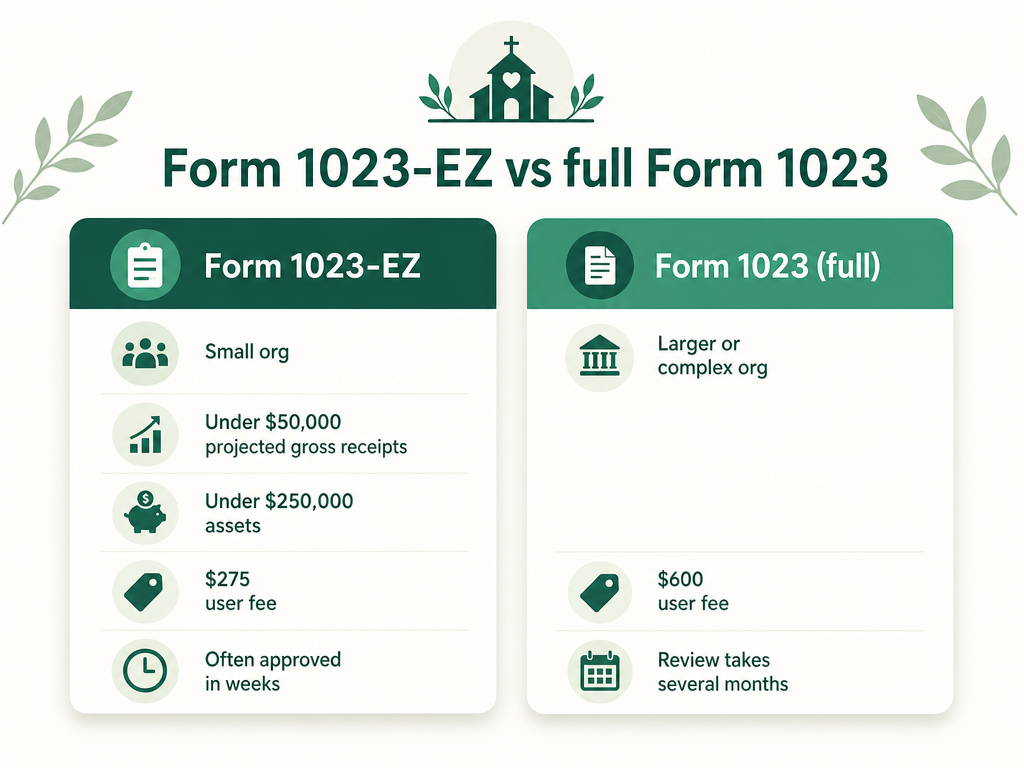
| Form 1023-EZ | Form 1023 (full) | |
|---|---|---|
| Who files it | Small orgs that pass the eligibility worksheet | Larger or more complex orgs; anyone barred from the EZ |
| Size limits | ≤ $50,000 projected annual gross receipts; ≤ $250,000 in assets | No limit |
| User fee | $275 | $600 |
| What you submit | A short online form, mostly attestations | Articles, bylaws, conflict-of-interest policy, activity narrative, financials, schedules |
| Typical review time | Often a few weeks | Commonly several months |
| Filed | Online at Pay.gov | Online at Pay.gov |
The fees and forms are described on the IRS Form 1023 page. One caution about the 1023-EZ: it’s fast because it’s mostly self-attestation, but attesting that your documents are compliant doesn’t make them compliant. Plenty of EZ-approved nonprofits later discover their articles never had a proper dissolution clause. Fix the documents first, then file.
The 501(c)(3) application process and timeline
The 501(c)(3) application runs through Pay.gov, where you create an account, complete the form, and pay the user fee online. Both Form 1023 and Form 1023-EZ are filed electronically — the IRS no longer accepts paper versions. Once you submit, the wait depends on which form you filed and how clean it is:
- Form 1023-EZ is often approved in a few weeks, sometimes faster, because there’s little for an agent to review.
- The full Form 1023 commonly takes several months, and longer if an agent has questions and sends your case to a reviewer.
When the IRS approves you, it issues a determination letter — the official document that says your organization is recognized as a 501(c)(3). Keep it. Banks, grant-makers, and state agencies will ask to see it. If you apply within 27 months of forming, the exemption is generally retroactive to your formation date, so donations from day one are deductible.
Common reasons a 501(c)(3) application is delayed or rejected
Most 501(c)(3) applications that stall or get rejected fail on avoidable, paperwork-level problems, not on the merits of the mission. The frequent ones:
- A missing or wrong dissolution or purpose clause in the articles of incorporation — the single most common reason the IRS pushes an application back. The organizational test is decided on this language.
- A vague activity narrative that doesn’t explain, concretely, what the organization does and how each activity serves an exempt purpose.
- Private-benefit or insider problems — a board controlled by one family, compensation that isn’t documented as reasonable, or the organization looking like it primarily benefits its founder.
- A purpose that isn’t actually exempt, or activities that lean too commercial or political.
- An incomplete application — a skipped schedule, a missing attachment, or filing the 1023-EZ when the eligibility worksheet said you couldn’t.
Almost all of these trace back to the prep work. An application built on clean articles, real bylaws, an unrelated board, and a clear narrative usually goes through without a fight.
Churches are automatically tax-exempt and don’t file for 501(c)(3)
Here’s the exception that changes everything for faith-based founders: a church is treated as a 501(c)(3) automatically, the moment it meets the requirements, without filing Form 1023 or receiving a determination letter. The application process described on this page is the path for a generic nonprofit. A qualifying church is exempt by default and doesn’t have to apply at all — and it doesn’t file the annual Form 990 either.
That doesn’t mean a church can’t apply. Many do, because a formal determination letter is useful documentation for banks, large donors, and state exemptions. But it’s optional. If you’re forming a religious organization, read why churches are automatically tax-exempt before you pay a single user fee — you may not owe one. For the church-specific version of the whole formation path, see how to start a church.
FAQ
How much does a 501(c)(3) cost to start? The IRS user fee is $275 for Form 1023-EZ and $600 for the full Form 1023. On top of that, state incorporation usually runs about $30 to $125, and an EIN is free. So the bare federal-plus-state cost of getting a small nonprofit recognized as a 501(c)(3) is often under $500. The bigger cost is time — the full 1023 review can take months.
What’s the difference between a nonprofit and a 501(c)(3)? A nonprofit is a state-level designation — you become one by incorporating as a nonprofit corporation in your state. A 501(c)(3) is a federal tax status the IRS grants on top of that, which exempts the organization from federal income tax and makes donations deductible. Every 501(c)(3) is a nonprofit, but a nonprofit isn’t a 501(c)(3) until the IRS recognizes it as one. You can operate as a nonprofit without 501(c)(3) status; you just don’t get the tax exemption or deductible donations.
How difficult is it to start a 501(c)(3)? The hard part isn’t the application itself — it’s getting the prerequisites right. If your articles of incorporation have a proper 501(c)(3) purpose clause and dissolution clause, you have an EIN and bylaws, and your board isn’t controlled by one family, the 1023-EZ can be straightforward and approved in weeks. The full Form 1023 is more work because of its schedules and activity narrative, but it’s paperwork, not law-school material. Most rejections come from sloppy documents, not difficult rules.
What is the 33% rule for nonprofits? The “33% rule” refers to the public support test that public charities must meet to avoid being classified as a private foundation. Broadly, a public charity needs to show that at least about one-third of its support comes from the general public or government sources, rather than from a small handful of donors. It’s a test you track over time after you’re recognized, not a hurdle in the initial 501(c)(3) application — but it’s why public charities pay attention to broadening their donor base.
Vestrybooks sets up a faith-based nonprofit’s books on fund accounting from day one — funds, reconciliation, and the board reports — so the financial side is right before the first donation. See how it works.
This is general information, not legal or tax advice — confirm your organization’s situation with a qualified professional.
This article is general information for church treasurers, not professional tax or legal advice. For your church's situation, consult a qualified accountant or attorney.
Nonprofit accounting, minus the headache.
Vestrybooks does fund accounting, donor tracking, and board-ready reports for churches and faith-based nonprofits.
A real free plan · no credit card · your data stays yours