Blog · Church formation & governance
What it means for a church to be incorporated
June 28, 2026 · By Benjamin Reinke
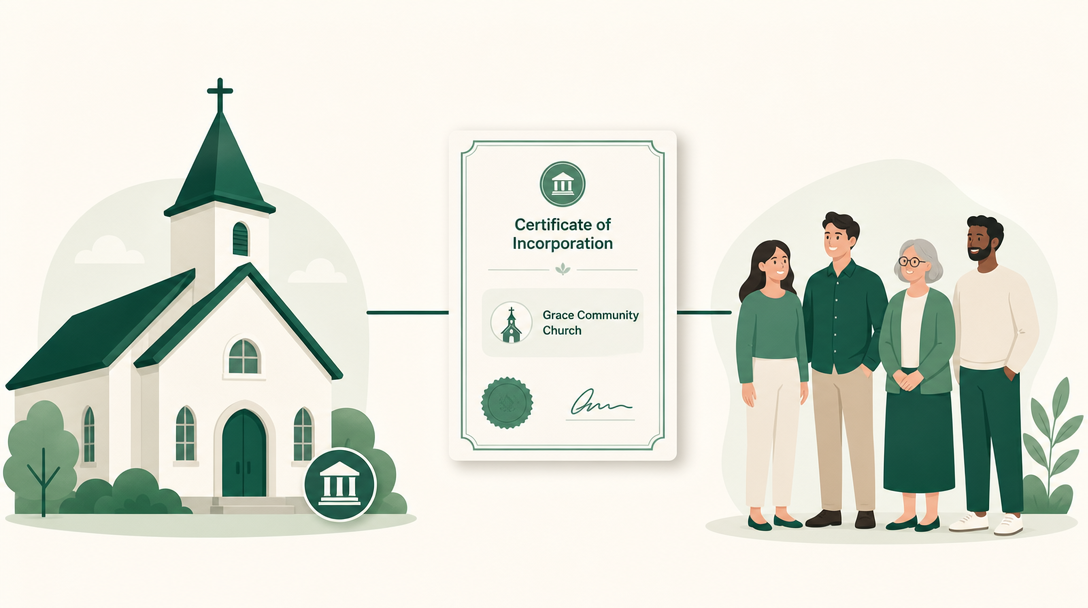
An incorporated church is a church that has been formed as a nonprofit corporation under its state’s law — a legal entity separate from the people who lead and attend it. Filing turns an informal group into a corporation that can hold property, sign contracts, and open a bank account in its own name, and it gives leaders and members limited liability so the church’s debts and lawsuits don’t land on them personally. One thing to get straight up front: being incorporated is not the same as being 501(c)(3) tax-exempt. Incorporation happens at the state level; tax exemption happens at the federal level, and a church can have one without the other. Most churches incorporate anyway, for liability protection and clean governance. This is general information, not legal advice — and it reflects the rules as of 2026, so confirm the specifics with your state or an attorney.
Incorporation is the first concrete legal act on the founding checklist. If you’re standing at the very beginning and want the whole sequence — entity, EIN, bylaws, board, bank account, books — start with how to start a church. This page zooms in on one piece of that checklist: what “incorporated” actually means, why churches choose it, and what it commits you to.
Incorporation vs. tax-exempt status: two different things
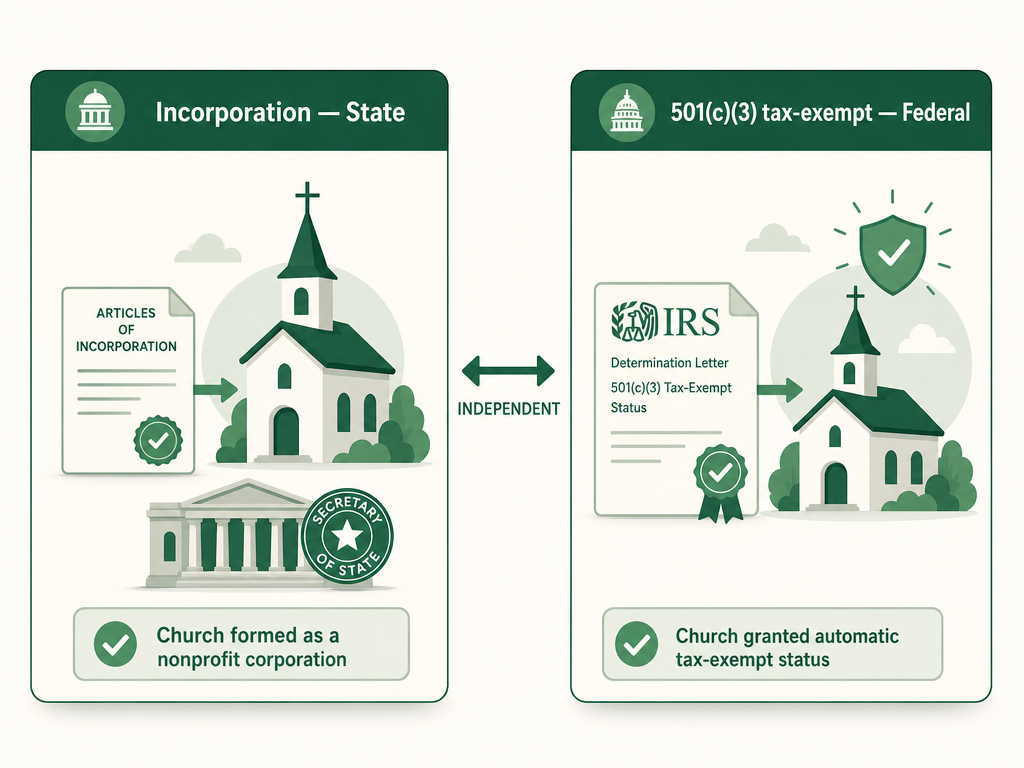
The single biggest source of confusion about an incorporated church is the assumption that incorporating is getting tax-exempt status. It isn’t. Picture two separate doors.
The first door is incorporation, and it’s a state matter. You walk through it by filing articles of incorporation with your Secretary of State, which creates a nonprofit corporation under your state’s law. That’s it — you’re now a legal entity. Incorporation says nothing about taxes.
The second door is 501(c)(3) tax-exempt status, and it’s a federal matter handled by the IRS. Here’s the part that surprises people: a church that meets the requirements of Section 501(c)(3) is automatically tax-exempt and is not required to apply for or obtain recognition from the IRS (IRS Publication 1828). The same publication confirms churches “may be legally organized in a variety of ways under state law, such as unincorporated associations, nonprofit corporations, corporations sole and charitable corporations” — which is the IRS plainly stating that how you’re organized under state law and whether you’re exempt federally are two different questions.
Because the two doors are independent, all of these combinations are real:
- Incorporated and tax-exempt — the common, recommended setup for an established church.
- Incorporated but without IRS recognition — a corporation that is still automatically exempt, it just never filed for a determination letter.
- Unincorporated and still tax-exempt — a church that never incorporated yet meets the 501(c)(3) requirements is exempt anyway.
So a church can be exempt without being incorporated, and incorporated without ever touching the IRS. For the full picture of why exemption is automatic and what the optional determination letter buys you, see are churches tax exempt.
Why a church incorporates
If exemption doesn’t require it, why do nearly all established churches incorporate? Because incorporation solves a stack of practical problems that an informal group can’t solve on its own.
Limited liability. This is the headline reason. Once a church is a corporation, it has a legal identity separate from its members, so the church’s debts and lawsuits are the corporation’s problem, not the personal problem of the pastor, the board, or the people in the pews. An injury claim or a broken contract lands on the entity. Members can still be held responsible for torts they personally commit, but not for the acts of others within the church — a protection that simply doesn’t exist for an informal association.
Perpetual existence. A corporation outlives the people who started it. Founders move on, boards turn over, pastors retire — and the church, as a legal entity, keeps going without missing a beat. The organization survives leadership changes instead of dissolving with them.
Clear title to property. A corporation can own real estate and other assets in its own name. That keeps the building and the bank balance attached to the church itself rather than to individual trustees who hold title personally — which gets messy fast when those individuals leave, die, or disagree.
Banking, contracts, loans, and grants. Banks want to see a state-filed entity before they open an account. Landlords and lenders want a corporation to sign the lease or the loan. Grant-makers want to deal with a recognizable organization. Incorporation is what lets the church do all of this in its own name instead of through a founder’s personal accounts.
Governance clarity. With articles of incorporation and bylaws on file, and state corporation law applying in the background, there’s a defined method for how the church makes decisions, seats leaders, and handles money. That structure prevents an honest disagreement from turning into a crisis over who actually has authority.
Incorporated vs. unincorporated church
The alternative to incorporating isn’t “nothing” — it’s an unincorporated association, which is the default legal status of any group of people who start meeting without filing anything. A church can legally operate this way. The catch is what an unincorporated association can’t do and what it exposes people to.
The traditional rule is that members of an unincorporated association can be personally liable for the acts of other members carried out in the course of the association’s activities. If someone is injured on church property and sues, the elders, the pastor, and even ordinary members can potentially be reached personally — their own assets on the line for something they didn’t do. Some states have softened this rule by statute, but a corporation’s liability protection is substantially stronger and far more reliable.
Property is the other sore spot. An unincorporated association has no separate legal existence, so in many states it can’t hold title to property, enter contracts, or sue and be sued in its own name. Churches that stay unincorporated typically have to designate individual trustees to hold the building in their personal names — an arrangement that creates confusion and dispute every time those people change. A handful of long-standing churches own land as an “unincorporated church,” but it’s the exception, and it’s not recommended.
| Incorporated church | Unincorporated church | |
|---|---|---|
| Legal status | Separate legal entity (a corporation) | No separate legal existence |
| Member liability | Limited — debts land on the entity | Members can be personally liable |
| Owns property | Yes, in the church’s own name | Usually through individual trustees |
| Signs contracts / opens accounts | Yes, as the corporation | Difficult; often done personally |
| Survives leadership changes | Yes — perpetual existence | Fragile, tied to individuals |
| State paperwork | Articles plus periodic reports | None to incorporate |
For almost every church, the modest cost of incorporating buys a large reduction in personal risk. The unincorporated route mainly makes sense for a tiny, short-lived, or transitional group — and even then, the exposure is real.
How a church incorporates
The mechanics are straightforward. A church incorporates by filing articles of incorporation with the state — usually the Secretary of State, sometimes a Division of Corporations. The articles are a short, public document naming the church, its registered agent and office, its incorporator, and (depending on the state) its initial directors. Filing fees commonly run in the $25 to $125 range, though they vary by state.
Two clauses inside the articles do double duty for the federal side: a 501(c)(3) purpose clause stating the church is organized exclusively for religious and charitable purposes, and a dissolution clause sending any leftover assets to another 501(c)(3) if the church closes. The IRS looks for both when it applies its organizational test, so getting them into the articles at filing time saves a rewrite later. A church should use its state’s nonprofit or religious corporation form rather than a generic business form, because the business forms don’t contain that language. The full walkthrough — every required clause, where to file, and what to keep — is in articles of incorporation for a church.
The obligations of an incorporated church
Incorporation isn’t free or maintenance-free. Becoming a corporation takes on a short list of ongoing duties, none of them heavy, but all of them real.
A filing fee. The one-time cost to file the articles, as noted above.
A registered agent. The church must name and keep a registered agent — a person or service at a physical in-state address who accepts legal documents and official mail on the church’s behalf. A founder can serve, or you can hire a commercial registered-agent service. If that agent’s address changes, the state needs to be told.
Annual or biennial reports. Most states require a nonprofit corporation to file a periodic report — typically every year or every two years — confirming the corporation’s name, registered office and agent, and its directors and officers. A nominal fee usually accompanies it. This report is what keeps the incorporation in good standing; let it lapse and the state can administratively dissolve the corporation, which quietly strips away the very liability protection you incorporated for.
Corporate formalities. Limited liability holds only as long as the church actually behaves like a corporation — adopting bylaws, seating a board, keeping minutes, and not commingling the church’s money with anyone’s personal funds. Honoring these formalities is what keeps the legal separation between the entity and its people intact.
Put the recurring report and registered-agent renewal on a shared calendar with an owner, and the maintenance burden of being incorporated comes down to a single short task once a year.
FAQ
Should a church be incorporated? For nearly every church, yes. Incorporation isn’t legally required — a church can operate as an unincorporated association — but it gives leaders and members limited liability, lets the church hold property and sign contracts in its own name, gives it perpetual existence, and is what banks, landlords, and grant-makers expect to deal with. The filing fee and the once-a-year report are small next to the personal risk an unincorporated church carries. The main exceptions are very small or short-lived groups, and even they take on real exposure by staying unincorporated.
Is an incorporated church automatically tax-exempt? A church doesn’t become tax-exempt because it incorporated — the two are separate. A church that meets the requirements of Section 501(c)(3) is automatically tax-exempt at the federal level whether or not it incorporated, and it doesn’t have to apply to the IRS to be recognized (IRS Publication 1828). Incorporating is a state act that creates a legal entity; exemption is a federal status. Most incorporated churches are also tax-exempt, but incorporation is not what grants the exemption.
What’s the difference between an incorporated and unincorporated church? An incorporated church is a separate legal entity — a corporation — so it can own property and sign contracts in its own name, and its debts and lawsuits stay with the entity rather than reaching members personally. An unincorporated church is just a group of people with no separate legal existence; in many states its members can be personally liable for the church’s obligations, and it usually can’t hold title to property except through individual trustees. Incorporation trades a small amount of paperwork for substantially stronger protection.
Does a church have to incorporate? No. Incorporation is optional, and a church that never incorporates can still be tax-exempt and can still receive deductible donations. But operating unincorporated leaves leaders and members personally exposed and makes property, banking, and contracts harder, which is why almost every established church incorporates. The decision is yours and your state’s — confirm the requirements and the trade-offs with an attorney before you choose.
Vestrybooks sets a newly incorporated church up on clean fund accounting from the first deposit — funds, reconciliation, and the board reports — so the financial side is documented from day one. See how it works.
This article is general information for church treasurers, not professional tax or legal advice. For your church's situation, consult a qualified accountant or attorney.
Church accounting a volunteer can actually do.
Vestrybooks is church accounting + giving for the volunteer treasurer — fund tracking, one-click year-end statements, and online giving with $0 taken from every gift.
A real free plan · no credit card · your data stays yours