Blog · Church formation & governance
Church bylaws explained for new and growing churches
June 27, 2026 · By Benjamin Reinke

Short answer: Church bylaws are the internal rulebook that says how a church governs itself — who holds authority, how members join and vote, how leaders are chosen and removed, and how decisions about money get made. Bylaws are not filed with the state the way articles of incorporation are; they live inside the church and can be amended by a congregational or board vote. A solid set covers the standard nonprofit articles every 501(c)(3) needs plus the church-specific ones a generic template skips — a statement of faith, membership, your form of government, the ordinances, and the IRS-required dissolution clause. Good bylaws also encode the financial controls that keep the church honest, which is the part most churches write too thin. This is the explainer; when you’re ready to draft, start from the downloadable church bylaws template.
What church bylaws actually do for a church
Church bylaws are the operating manual for how your church runs. Articles of incorporation create the church as a legal entity with the state; the bylaws say how that entity makes decisions day to day. They answer the questions that cause the fights — who can call a members’ meeting, what counts as a quorum, how many votes it takes to call or remove a pastor, who signs checks, who can change the bylaws themselves. When a church has no written answer to those questions, the loudest voice in the room usually wins, and that is where churches split.
Most well-run churches treat bylaws as the second document they adopt, right after they incorporate and before they open a bank account. Forming the church is a fixed sequence of legal and financial steps — see how to start a church for the full order of operations. Bylaws sit early in that sequence because almost everything downstream (the board’s authority, who controls the money, how you stay tax-exempt) flows from what the bylaws say.
Bylaws versus articles of incorporation
Church bylaws and articles of incorporation are two different documents that people constantly confuse. The articles are short, filed with your secretary of state, and create the legal corporation. The bylaws are longer, kept in the church’s own records, and govern how the corporation operates. You file the articles once and rarely touch them; you live in the bylaws and amend them as the church changes.
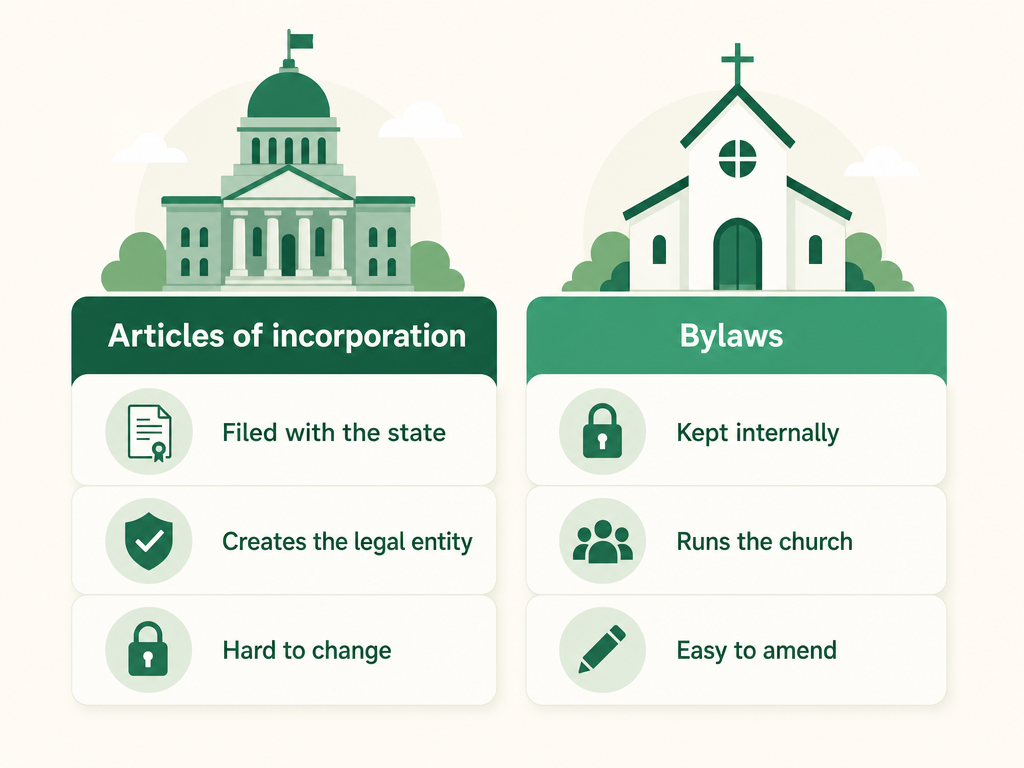
A practical rule: keep the articles lean and put almost everything operational in the bylaws. Anything in the articles is harder to change because amending them means another state filing. Anything in the bylaws you can amend with a vote. So the purpose clause and the dissolution clause the IRS requires usually appear in the articles (and are often restated in the bylaws), while the rules about meetings, voting, officers, and finances belong in the bylaws where you can adjust them as you grow.
The sections a complete set of church bylaws should include
Church bylaws are organized into numbered articles. A church needs the standard governance articles any nonprofit corporation uses, plus several church-specific ones a generic nonprofit template leaves out. Here is the full set, with what each article settles:
| Article | What it settles |
|---|---|
| Name & affiliation | The church’s legal name and its denomination (or independent status). |
| Purpose | The religious-purpose clause that supports 501(c)(3) status. |
| Statement of faith | What the church believes — the doctrinal anchor a nonprofit template skips. |
| Membership | How members join, what’s expected of them, voting rights, and discipline. |
| Church government (polity) | Who holds final authority: elder-led, congregational, or denominational. |
| Pastoral leadership | Calling, qualifications, ordination, compensation, and removal of the pastor. |
| Elders, deacons, officers | Roles, qualifications, and how each is selected and serves. |
| Board / trustees | The body that holds fiduciary and legal responsibility for the church. |
| Meetings | Members’ meetings, notice, quorum, and what vote each decision needs. |
| Ordinances | Baptism and the Lord’s Supper — who administers them and how often. |
| Finances & fiscal year | Treasurer’s duties, budget approval, controls, reporting, and year-end. |
| Conflict of interest | Disclosure and recusal rules that protect the church and its leaders. |
| Amendments | How the bylaws (and statement of faith) can be changed, and by what vote. |
| Dissolution | The IRS-required clause sending assets to another 501(c)(3) if the church closes. |
The statement of faith, the polity article, the ordinances, and the membership-and-discipline rules are the church-specific pieces. A boilerplate nonprofit template covers the corporate machinery but none of these, which is why a church should start from bylaws written for a church rather than retrofitting a generic one.
The polity article shapes the whole document
The church-government article is the one to settle first, because every other article reads differently depending on it. Whether your church is elder-led, congregational, or denominationally governed decides who calls the pastor, who approves the budget, and who can amend the bylaws. Pick your form of government, then make the articles on pastoral leadership, the board, and members’ meetings all line up with it. Bylaws that say the congregation approves the budget in one article and the elders approve it in another are how disputes start.
How church bylaws encode your financial controls
The finance article is where church bylaws stop being abstract and start protecting the offering. This is the section most churches write in two vague sentences, and it’s the one an auditor or a suspicious member reads first. Strong bylaws spell out the money rules so no single person can quietly control the church’s funds. Cover at least these:
- Treasurer’s powers and limits. Define what the treasurer may do alone and where a second approval kicks in — for example, any single payment over a set dollar amount needs a second signature or board sign-off.
- Separation of duties. State that the person who records the books is not the only person who handles cash or reconciles the bank. This is the single most effective fraud control a small organization has.
- Restricted and designated funds. Require that gifts given for a stated purpose are spent only on that purpose, and say who can release board-designated money. This keeps you out of the trap of spending the building fund on payroll.
- Budget approval. Name who proposes the annual budget and who must approve it, and require spending to track to that budget.
- Financial reporting. Require regular financial statements to the board — monthly or quarterly — so oversight isn’t optional or dependent on one person volunteering the numbers.
- Audit or review cadence. Commit the church to an independent review of the books on a set schedule (many churches do an annual internal audit, with an outside review at thresholds), so a second set of eyes always closes the year.
These rules belong in the bylaws because bylaws are durable — they outlast whoever currently holds the checkbook. Putting “the books are reviewed each January by someone other than the treasurer” in writing means the control survives a change in volunteers. Once the bylaws set the rules, the day-to-day discipline lives in your bookkeeping; our guide to church bookkeeping covers the monthly routine and the controls that put those bylaw provisions into practice.
The IRS clauses your church bylaws can’t skip
Church bylaws carry two clauses the IRS effectively requires of any 501(c)(3), and a church is a 501(c)(3) even though it’s automatically tax-exempt without filing. The first is the organizational requirement: the church’s purposes must be limited to exempt purposes, and its assets can’t benefit any private individual. The second is the dissolution clause: if the church ever closes, its remaining assets must go to another tax-exempt organization or to a government for a public purpose — never to members, officers, or pastors.
The IRS lays this out for churches in IRS Publication 1828, the Tax Guide for Churches and Religious Organizations, which describes the organizational and dissolution language exempt organizations are expected to carry. Get the purpose and dissolution wording close to the standard language and have it reviewed; this is the part of the bylaws where creativity costs you. For more on why churches get automatic exemption and what it requires, see are churches tax exempt.
Common mistakes churches make with their bylaws
Church bylaws fail in predictable ways, and most of the damage shows up years later during a conflict or an audit. The recurring mistakes:
- Writing them too detailed. Bylaws that name specific people, set a specific service time, or list this year’s committees have to be amended constantly. Keep operational specifics in policies, not bylaws.
- Contradicting the articles of incorporation. When the bylaws and the articles disagree, the articles usually win — and you may not notice until it matters. Read both together.
- A toothless finance article. “The treasurer shall keep the books” is not a control. Without separation of duties, spending limits, and a review cadence, the bylaws give a single person unchecked control of the money.
- No amendment procedure, or an impossible one. If the bylaws don’t say how to change them, you’re stuck; if they require a near-impossible supermajority, you’re stuck a different way. Set a workable, clearly stated bar.
- Copying a generic nonprofit template. A non-church template has no statement of faith, no polity choice, no membership-and-discipline article, and no ordinances — the heart of a church’s governance.
- Adopting them and never reviewing. Bylaws drift out of date as the church grows. Review them every few years, and any time you change polity, leadership structure, or how you handle money.
FAQ
What should be in church bylaws? Church bylaws should include the church’s name and affiliation, a religious-purpose clause, a statement of faith, membership rules, your form of government, pastoral leadership, the board and officers (including the treasurer’s duties), meetings and voting, the ordinances, a finance and fiscal-year article, conflict-of-interest rules, an amendment procedure, and an IRS-style dissolution clause. The finance article should spell out the treasurer’s limits, separation of duties, fund restrictions, reporting, and an audit cadence.
What should not be put in bylaws? Keep details that change often out of the bylaws — the names of current leaders, this year’s committees, specific service times, salary figures, and step-by-step procedures. Put those in separate policies or a procedures manual you can update without a bylaws vote. Bylaws should hold the durable rules; policies hold the specifics.
Are churches required to have bylaws? No federal law forces a church to adopt bylaws, but most state nonprofit corporation statutes expect an incorporated church to have them, and banks, lenders, and grantmakers routinely ask to see them. Practically, bylaws are required to function — they’re how the church proves who has authority to act and how decisions are made. Adopting them is one of the first governance steps after incorporating.
What is the 80/20 rule in churches? The 80/20 rule is the common observation that roughly 80% of a church’s giving and volunteer work comes from about 20% of its people. It’s a stewardship and engagement principle, not a legal rule, and it doesn’t belong in your bylaws. Bylaws govern authority and structure; the 80/20 pattern is something leaders watch when planning budgets and ministry, not something you write into your governing document.
Vestrybooks puts the financial controls your bylaws describe — fund restrictions, separation of duties, and board reporting — into the everyday books. See how it works.
This article is general information for church treasurers, not professional tax or legal advice. For your church's situation, consult a qualified accountant or attorney.
Church accounting a volunteer can actually do.
Vestrybooks is church accounting + giving for the volunteer treasurer — fund tracking, one-click year-end statements, and online giving with $0 taken from every gift.
A real free plan · no credit card · your data stays yours