Blog · Church formation & governance
How to start a church in Iowa
July 4, 2026 · By Benjamin Reinke
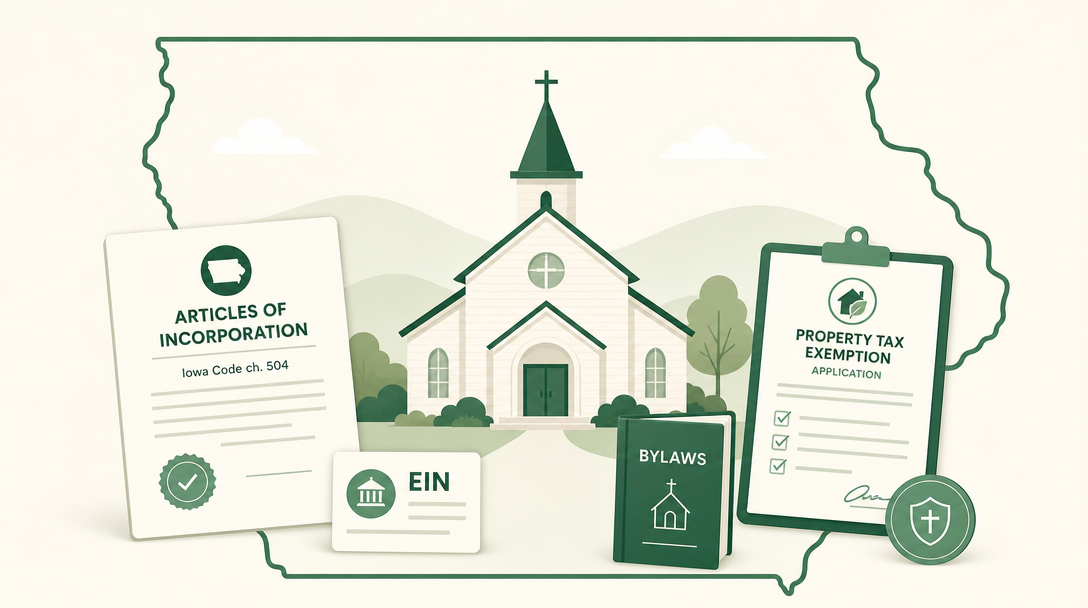
Short answer: To start a church in Iowa, you form a nonprofit corporation by filing Articles of Incorporation with the Iowa Secretary of State ($20 as of 2026), then get a free EIN from the IRS, adopt bylaws, seat a board, and open a bank account. A church is automatically tax-exempt under federal law, so the IRS determination letter is optional. The pieces that are genuinely Iowa-specific are the state filing, a free Biennial Report in odd-numbered years, and the property tax exemption for religious use, claimed through your city or county assessor. One honest warning most guides skip: Iowa generally does not exempt church purchases from sales tax, so budget as if what you buy is taxable.
The federal formation steps are the same in every state — incorporate, EIN, bylaws, board, books. This guide covers those briefly and then spends its time on the Iowa pieces that carry the real value. For the full national walkthrough of each universal step, read how to start a church; below, the focus is what changes inside Iowa.
The formation steps that are the same anywhere
Starting a church in Iowa follows the standard church-formation checklist, and most of it is federal, not state-specific:
- Incorporate as a nonprofit corporation (the Iowa-specific part — covered in detail below).
- Get an EIN — a free federal tax ID from the IRS, applied for directly at irs.gov. Never pay a third party for one; the EIN is always free.
- Adopt bylaws — the church’s internal rulebook for decisions, leadership, and money. Start from a proven document rather than a blank page; see church bylaws for what to include.
- Seat a board — at least three directors, ideally a majority unrelated, so the church is governed by a body rather than one person.
- Skip or pursue the 501(c)(3) letter — a church is automatically tax-exempt and does not have to file Form 1023, though many apply for the determination letter as documentation (IRS Publication 1828).
- Open a bank account in the church’s legal name using the EIN and formation documents.
- Set up the books on fund accounting from day one, before the first offering arrives.
Each of these is walked step by step in the national formation guide linked above. The rest of this page is the Iowa layer on top.
Incorporating a church in Iowa under chapter 504
Iowa creates the church as a legal entity when you file Articles of Incorporation with the Iowa Secretary of State. The filing fee is $20 as of 2026, the same whether you file online through the state’s Fast Track Filing system or by mail; confirm the current amount with the Iowa Secretary of State, since fees change.
One quirk separates Iowa from states like Texas or California: Iowa does not publish a fill-in-the-blank Articles of Incorporation form for nonprofits. The incorporator drafts the articles, and they must meet the requirements of Iowa Code chapter 504, the Revised Iowa Nonprofit Corporation Act. Under Iowa Code section 504.202, the articles must set forth a corporate name that meets the state’s naming rules, the registered office address and the name of the registered agent there, the name and address of each incorporator, whether the corporation will have members, and a provision on the distribution of assets on dissolution.
Because no template does this for you, the two clauses the IRS looks for are also yours to write in. Section 504.202 makes the purpose statement optional under state law, but a church should include both anyway:
- A 501(c)(3) purpose clause stating the church is organized exclusively for religious and charitable purposes.
- A dissolution clause stating that if the church closes, its assets pass to another 501(c)(3) organization, not to any individual.
Getting that language right at formation saves an amendment later, and it is the difference between articles that stand on their own and articles that would fail an IRS review if the church later applied for the determination letter. The full breakdown of what these documents need is in articles of incorporation for a church. On board size, Iowa law sets a low bar — a nonprofit corporation may have as few as one director under Iowa Code section 504.803 — but three mostly-unrelated directors is the practical standard, and a one-person board is a poor idea for a church holding other people’s money.
The free Iowa Biennial Report every church has to file
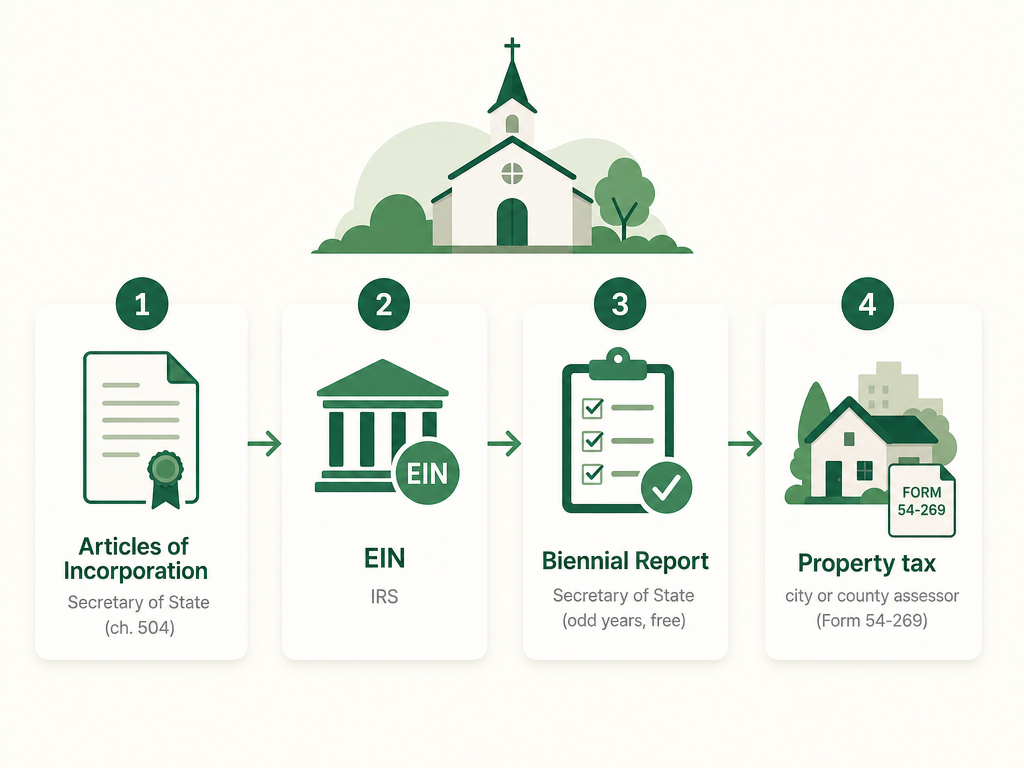
One ongoing item belongs on the church’s calendar from day one: every Iowa nonprofit corporation files a Biennial Report with the Secretary of State between January 1 and April 1 of each odd-numbered year, which keeps the entity in good standing. For nonprofit corporations the report carries no fee as of 2026 — a genuine break compared with for-profit entities — and it can be filed online, by mail, or in person.
Do not let it slide because it is free. If the church misses the report and does not file within 60 days of the due date, the Secretary of State can administratively dissolve the corporation, which unwinds the legal entity your whole structure sits on top of. Put the odd-year deadline on the treasurer’s recurring calendar.
Does an Iowa church register with the state to fundraise
No — not as a church. Iowa has no general charitable-solicitation registration requirement, so an Iowa church can begin taking offerings and asking members to give without first filing a state fundraising registration or paying a fee. That removes a step, and an annual renewal, that churches in many stricter states have to handle before they fundraise publicly.
The one narrow rule lives in Iowa Code chapter 13C, and it applies to professional commercial fund-raisers — outside people paid to solicit on an organization’s behalf — not to churches themselves. A bona fide salaried officer, employee, or volunteer of the church is explicitly not a professional commercial fund-raiser, so a congregation raising its own money through its own people falls outside that rule. Note that “registering” still happens in one sense: filing the Articles of Incorporation registers the church as a legal entity. What Iowa skips is the separate fundraising license.
Claiming the Iowa property tax exemption through your assessor
A church that owns its building can exempt that property from local property tax, but this one runs through your city or county assessor, not the Secretary of State or the Department of Revenue. You apply on Form 54-269, Application for Property Tax Exemption for Certain Nonprofit and Charitable Organizations, and the property has to be used solely for religious or charitable purposes — Iowa law caps the exemption at 320 acres and excludes any part of the property held or used for profit.
Timing matters. You file Form 54-269 with the assessor on or before February 1 of the assessment year you want the exemption for. Once the assessor grants it, the exemption carries forward to successive years without refiling, as long as the property’s use stays the same — you only reapply if the use changes or the church acquires new property. One honest point the assessors make plainly: holding an IRS 501(c)(3) letter does not by itself qualify property for the exemption; there must be actual religious or charitable use on top of the nonprofit status. The form and instructions are on the Iowa Department of Revenue tax credits and exemptions page, and the office that receives it is your local assessor.
Iowa sales tax and your church — the honest answer
Here is the part most state guides bury: Iowa generally does not give churches a blanket sales tax exemption on their purchases. A federal 501(c)(3) letter exempts a church from income tax, not sales tax, and the two are not the same thing. The Iowa Department of Revenue is blunt about it — nonprofit entities, churches, and religious organizations are not automatically exempt from paying Iowa sales tax on their taxable purchases, even though they are exempt from income tax, and a church is treated the same as any other buyer at the register (Iowa Department of Revenue, tax issues for nonprofit entities).
So a typical Iowa church pays sales tax on the equipment, supplies, and goods it buys. The exemptions that exist are specific rather than broad — purchases for resale, and purchases by Iowa private nonprofit educational institutions for educational use — and each turns on its own facts. There is a helpful flip side on the sales a church makes: proceeds from a church’s fundraising activities are exempt to the extent they are spent on religious, educational, or charitable purposes. But on the buying side, plan the budget as if your purchases are taxable. This is where a plain-language guide earns its keep: are churches tax exempt walks through why “tax-exempt” means income tax, not every tax, so a new church is not blindsided at the checkout.
Iowa filing at a glance
The table below maps each Iowa step to its agency, document, and cost. Treat the fees as accurate as of 2026 and confirm with the listed agency, since Iowa fees change.
| What you’re doing | Agency | Document | Fee (as of 2026) |
|---|---|---|---|
| Incorporate the church | Iowa Secretary of State | Articles of Incorporation (drafted to Iowa Code ch. 504) | $20 (confirm) |
| File the Biennial Report | Iowa Secretary of State | Biennial Report (odd years, Jan 1 – Apr 1) | No fee |
| Get a federal tax ID | IRS | EIN application (online) | Free |
| 501(c)(3) recognition (optional) | IRS | Form 1023 or 1023-EZ | $600 / $275 user fee |
| Property tax exemption | City or county assessor | Form 54-269 (by Feb 1) | No fee |
| Charitable-solicitation registration | — | Not required for ordinary churches | — |
| Sales tax on purchases | Iowa Department of Revenue | — | Generally taxable (no blanket exemption) |
Setting up the books once the church exists in Iowa
Once the church is formed and the property exemption is filed, the work shifts from one-time paperwork to the monthly routine — and that routine is where churches actually fail or hold together. A church holds money in trust for the people who gave it, much of it tagged for a purpose (the building, missions, benevolence), so it tracks money by fund rather than as a single bottom line. Set the books up on fund accounting before the first offering, keep the giving records your donors need for their own taxes, and document that the board reviews the finances. None of Iowa’s rules excuse a church from keeping clean records; the IRS still expects records that substantiate income and expenses (IRS Publication 1828). Keep the free Biennial Report in odd-numbered years on the same calendar, since letting it lapse can dissolve the corporation the exemptions sit on.
FAQ
How much does it cost to start a church in Iowa? The required state cost is small. Filing the Articles of Incorporation with the Iowa Secretary of State costs $20 as of 2026, the EIN from the IRS is free, the Biennial Report carries no fee, and the property tax exemption (Form 54-269) has no filing fee. So the bare legal minimum to form an Iowa church and claim its property exemption is roughly the $20 filing fee plus your time. Optional add-ons raise it: the IRS determination letter is $275 (Form 1023-EZ) or $600 (full Form 1023), and insurance runs a few hundred dollars a year. A small Iowa church can realistically be stood up properly for well under a few hundred dollars beyond the optional federal letter.
Does an Iowa church have to register with the state? Yes and no. The church registers as a legal entity when it files Articles of Incorporation with the Secretary of State to incorporate as a nonprofit corporation under chapter 504 — that is what creates the entity, and the odd-year Biennial Report keeps it in good standing. But Iowa does not require a separate charitable-solicitation registration before a church fundraises, unlike many states. Ordinary churches taking offerings and asking members to give do not file a fundraising registration; the only registration rule reaches professional commercial fund-raisers under Iowa Code chapter 13C, not the church’s own people.
Does Iowa give churches a sales tax exemption? Generally no. Iowa churches usually pay sales tax on their purchases, because a 501(c)(3) letter exempts you from income tax, not sales tax, and the Department of Revenue treats a church like any other buyer at the register (Iowa Department of Revenue, nonprofit entities). The exemptions that exist are narrow — purchases for resale and educational purchases by nonprofit schools — so budget as if your purchases are taxable. The brighter spot is on the selling side: proceeds from church fundraising are exempt to the extent they go to religious purposes.
Do you need 501(c)(3) status to start a church in Iowa? No. A church is automatically tax-exempt under federal law and does not have to file Form 1023 or hold an IRS determination letter to be exempt (IRS Publication 1828). It does not need the federal letter to claim the Iowa property tax exemption either, which turns on the property’s religious use rather than on a 501(c)(3) determination. Many Iowa churches still apply for the letter as documentation for banks, grant-makers, and large donors, but it is optional.
Can I just start my own church in Iowa? Practically, anyone can start a church in Iowa — there is no state license or denominational permission required, and the First Amendment protects the right to form a religious organization. What you do need, to operate as a real and exempt church, is the structure: a nonprofit corporation formed under chapter 504, an EIN, adopted bylaws, a board of at least three mostly-unrelated directors, a bank account in the church’s name, and books set up on fund accounting. The freedom to start one is unlimited; running one properly is a checklist.
This is general information, not tax or legal advice. Iowa fees, forms, and deadlines change, and every church’s situation is different — confirm the current requirements with the listed agencies and consult a qualified professional before you file.
Vestrybooks sets up a new Iowa church’s books on fund accounting from day one — funds, reconciliation, and the board reports — so the financial side is right before the first offering. See how it works.
This article is general information for church treasurers, not professional tax or legal advice. For your church's situation, consult a qualified accountant or attorney.
Church accounting a volunteer can actually do.
Vestrybooks is church accounting + giving for the volunteer treasurer — fund tracking, one-click year-end statements, and online giving with $0 taken from every gift.
A real free plan · no credit card · your data stays yours