Blog · Church formation & governance
How to start a church in Kentucky
July 4, 2026 · By Benjamin Reinke
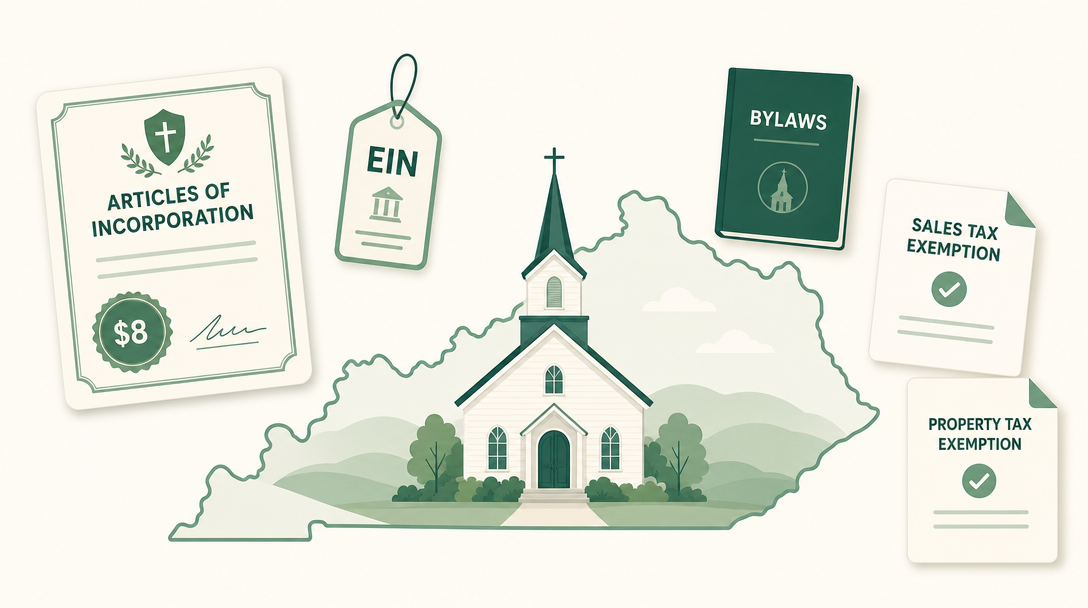
Short answer: To start a church in Kentucky, you form a nonprofit corporation by filing Articles of Incorporation for a Non-Profit Corporation with the Kentucky Secretary of State — and the fee is genuinely tiny, $8 as of 2026 — then record a stamped copy with the county clerk, get a free EIN from the IRS, adopt bylaws, and seat a board of at least three directors. A church is automatically tax-exempt under federal law, so the IRS determination letter (Form 1023) is optional and there is no annual Form 990. The pieces that are truly Kentucky-specific are the state filing, the county-clerk recording step, and two exemptions worth claiming: a sales tax exemption through the Department of Revenue (Form 51A125) and a property tax exemption through your county Property Valuation Administrator (Form 62A023).
The federal formation steps are the same in every state — incorporate, EIN, bylaws, board, books. This guide covers those briefly and then spends its time on the Kentucky pieces that carry the real value. For the full national walkthrough of each universal step, read how to start a church; below, the focus is what changes inside Kentucky.
The formation steps that are the same anywhere
Starting a church in Kentucky follows the standard church-formation checklist, and most of it is federal, not state-specific:
- Incorporate as a nonprofit corporation (the Kentucky-specific part — covered in detail below).
- Get an EIN — a free federal tax ID from the IRS, applied for directly at irs.gov. Never pay a third party for one; the EIN is always free.
- Adopt bylaws — the church’s internal rulebook for decisions, leadership, and money. Start from a proven document rather than a blank page; see church bylaws for what to include.
- Seat a board — Kentucky requires at least three directors, ideally a majority unrelated, so the church is governed by a body rather than one person.
- Skip or pursue the 501(c)(3) letter — a church is automatically tax-exempt and does not have to file Form 1023, though many apply for the determination letter as documentation (IRS Publication 1828).
- Open a bank account in the church’s legal name using the EIN and formation documents.
- Set up the books on fund accounting from day one, before the first offering arrives.
Each of these is walked step by step in the national formation guide linked above. The rest of this page is the Kentucky layer on top.
Incorporating a church in Kentucky with the Articles of Incorporation
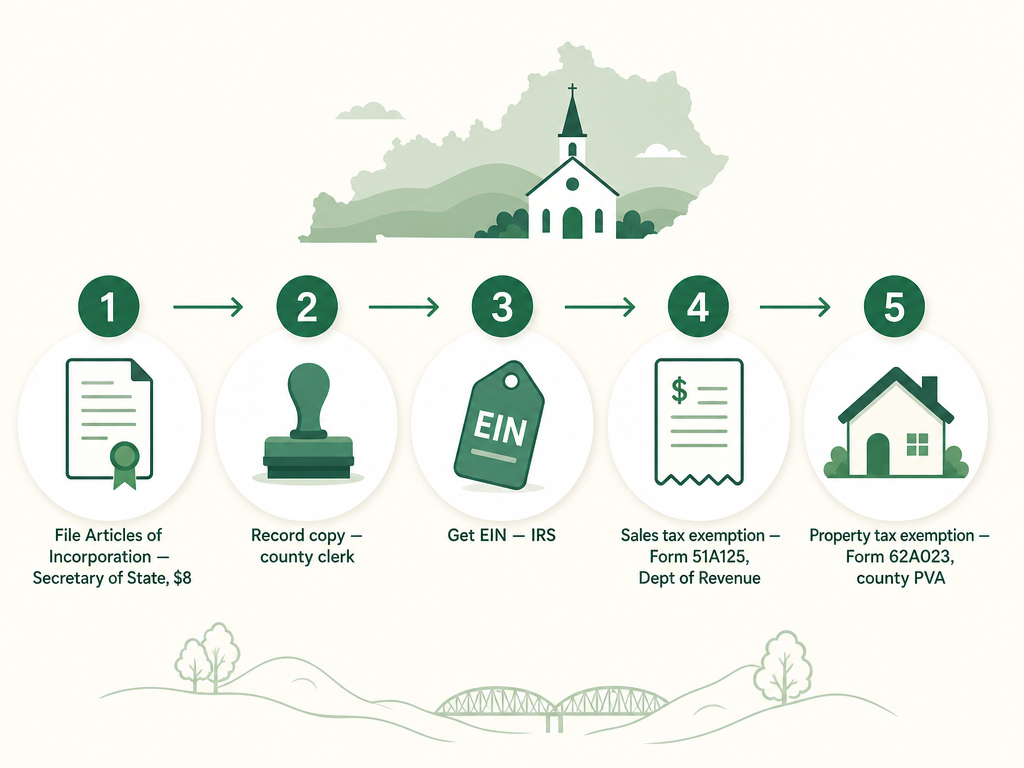
In Kentucky, you create the church as a legal entity by filing Articles of Incorporation for a Non-Profit Corporation with the Kentucky Secretary of State. The filing fee is $8 as of 2026 — one of the lowest incorporation fees in the country, and yes, that figure is correct — so cost is not the barrier here. Confirm the current amount with the Kentucky Secretary of State fee schedule, since fees change; the official non-profit Articles form states the $8 fee on its face. You can file online through the state’s business One Stop portal, by mail to Frankfort, or in person.
The Articles ask for the church’s name, its purpose, the registered agent and registered office in Kentucky (a street address, not a P.O. box), the principal office address, and the names and addresses of the directors and incorporators. Two clauses do the heavy lifting for tax-exempt status, and you should put them in at formation rather than amend later:
- A 501(c)(3) purpose clause stating the church is organized exclusively for religious and charitable purposes within the meaning of section 501(c)(3).
- A dissolution clause stating that if the church closes, its assets pass to another 501(c)(3) organization or a government entity, not to any individual.
The IRS looks for both, so getting the language right on the Kentucky filing saves a rewrite. The full breakdown of what these documents need is in articles of incorporation for a church. On board size, Kentucky sets a hard floor under Chapter 273 of the Kentucky Revised Statutes, which governs religious, charitable, and educational nonstock, nonprofit corporations: recruit at least three directors before you file.
Recording the Articles with your Kentucky county clerk
Kentucky adds one step most states do not, and it is easy to miss: after the Secretary of State accepts and stamps your Articles, you record a copy with the county clerk in the county where the church keeps its registered office. Under the state’s business-entity filing law, one exact or conformed copy stamped “filed” by the Secretary of State goes to the county clerk of that county. In practice, you download the stamped Articles from the Secretary of State’s online organization search after they are filed, then take that copy to your county clerk to record.
This is a leftover of Kentucky’s older two-step process, when religious and charitable corporations were both filed with the state and recorded locally. The Secretary of State filing is what actually creates the corporation today, but the county recording is still on the checklist, so budget a small local recording fee and a short trip to the courthouse. Confirm the recording fee and any local requirements with your own county clerk, since they vary by county.
Does a Kentucky church register with the state to fundraise
Kentucky requires most charities that solicit the public for donations to register with the Attorney General first — but a church soliciting funds for religious purposes is typically exempt from that requirement. The registration rule is tied to organizations that must file an IRS Form 990, and a church does not file a Form 990 at all, so the ordinary congregation taking offerings and asking its members to give generally does not file a fundraising registration.
That said, the exemption follows the church’s activity, not just its label. If the church spins up a separate charitable arm or solicits the general public for non-religious purposes, the registration question can come back. When in doubt, confirm your status with the Kentucky Attorney General’s charitable organization registration page before you launch a public campaign. Note that “registering” still happens in one sense — filing the Articles registers the church as a legal entity with the state. What most churches skip is the separate fundraising registration.
Claiming the Kentucky sales tax exemption for your church
A Kentucky church can buy items for its ministry free of state sales and use tax, but the exemption is not automatic — you apply to the Kentucky Department of Revenue using Form 51A125, the Application for Purchase Exemption Sales and Use Tax. Kentucky, unlike a number of states, grants a real sales-and-use-tax exemption to qualifying religious, charitable, and educational organizations, so this is worth the paperwork.
With the application you attach a copy of your Articles of Incorporation and a detailed schedule of receipts and disbursements; a church that has an IRS determination letter includes it, but a church that has chosen not to file Form 1023 can still apply on its religious-organization basis. If the Department approves it, the church receives an authorization letter with a Purchase Exemption ID, which lets it buy tangible personal property, digital property, and services for its exempt function without paying sales tax to the supplier. There is no fee to apply, and the application goes to the Division of Sales and Use Tax in Frankfort (Kentucky Department of Revenue, Form 51A125). One limit to know up front: the exemption covers what the church buys for its exempt function, not items it buys for unrelated purposes, and if the church makes taxable sales to the public it may still owe sales tax on those.
Claiming the Kentucky property tax exemption through the county PVA
A Kentucky church that owns its building can exempt that property from local property tax, and the authority is unusually strong here: Section 170 of the Kentucky Constitution exempts real property owned and occupied by, and personal property owned by, institutions of religion. The exemption is not filed with the state, though — it runs through your county Property Valuation Administrator (PVA), the local official who assesses property.
You apply with Form 62A023, the Application for Exemption from Property Taxation, filing it with the PVA in each county where the church owns property. The form asks the church to describe its purpose, activities, and finances so the PVA can decide whether the property qualifies. Two details matter: the real estate must be both owned and occupied by the church to qualify, and the burden of proof is on the church to show it meets the exemption. The personal-property side is broad — the exemption reaches motor vehicles, office equipment, and furniture held in the church’s name. Get the current form and any local deadline from your county PVA or the Kentucky Department of Revenue property tax exemptions page before you file.
Kentucky filing at a glance
The table below maps each Kentucky step to its agency, form, and cost. Treat the fees as accurate as of 2026 and confirm with the listed agency, since state fees change.
| What you’re doing | Agency | Form | Fee (as of 2026) |
|---|---|---|---|
| Incorporate the church | Kentucky Secretary of State | Articles of Incorporation (Non-Profit) | $8 (confirm with the SoS) |
| Record the Articles locally | County clerk | Stamped copy from the SoS | Small local recording fee |
| Get a federal tax ID | IRS | EIN application (online) | Free |
| 501(c)(3) recognition (optional) | IRS | Form 1023 or 1023-EZ | $600 / $275 user fee |
| Sales tax exemption | Kentucky Department of Revenue | Form 51A125 | No fee |
| Property tax exemption | County PVA | Form 62A023 | No fee |
| Annual report | Kentucky Secretary of State | Annual report (by June 30) | $15 |
Setting up the books once the church exists in Kentucky
Once the church is formed, recorded, and the exemptions are filed, the work shifts from one-time paperwork to the monthly routine — and that routine is where churches actually fail or hold together. A church holds money in trust for the people who gave it, much of it tagged for a purpose (the building, missions, benevolence), so it tracks money by fund rather than as a single bottom line. Set the books up on fund accounting before the first offering, keep the giving records your donors need for their own taxes, and document that the board reviews the finances. None of the Kentucky exemptions excuse a church from keeping clean records; the IRS still expects records that substantiate income and expenses (IRS Publication 1828). The one recurring state date to keep on the calendar is the annual report to the Secretary of State, due by June 30 each year — miss it and the state can administratively dissolve the corporation.
FAQ
How much does it cost to start a church in Kentucky? The required state cost is unusually low. Filing the Articles of Incorporation with the Kentucky Secretary of State costs just $8 as of 2026, plus a small county-clerk recording fee, the EIN from the IRS is free, and the sales tax (Form 51A125) and property tax (Form 62A023) exemptions carry no filing fee. So the bare legal minimum to form a Kentucky church and claim its exemptions is roughly $8 plus a modest local recording fee and your time, with a $15 annual report due each June 30 after that. Optional add-ons raise it: the IRS determination letter is $275 (Form 1023-EZ) or $600 (full Form 1023), and insurance runs a few hundred dollars a year. A small Kentucky church can realistically be stood up properly for well under a few hundred dollars beyond the optional federal letter.
Does a Kentucky church register with the state? Yes and no. The church registers as a legal entity when it files its Articles of Incorporation with the Secretary of State and records a stamped copy with the county clerk — that is what creates the entity and keeps it in good standing. But Kentucky does not require an ordinary church to file the separate charitable-solicitation registration with the Attorney General that general nonprofits face, because the registration rule is tied to organizations that file a Form 990, and a church soliciting for religious purposes is typically exempt.
Do you need 501(c)(3) status to start a church in Kentucky? No. A church is automatically tax-exempt under federal law and does not have to file Form 1023 or hold an IRS determination letter to be exempt (IRS Publication 1828). It also does not file an annual Form 990. It can still apply for the Kentucky sales tax exemption on its religious-organization basis without a federal letter. Many Kentucky churches apply for the determination letter anyway, as documentation for banks, grant-makers, and large donors, but it is optional — see are churches tax exempt for the fuller picture.
Can I just start my own church in Kentucky? Practically, anyone can start a church in Kentucky — there is no state license or denominational permission required, and the First Amendment protects the right to form a religious organization. What you do need, to operate as a real and exempt church, is the structure: a nonprofit corporation formed on the Articles of Incorporation, a stamped copy recorded with your county clerk, an EIN, adopted bylaws, a board of at least three mostly-unrelated directors, a bank account in the church’s name, and books set up on fund accounting. The freedom to start one is unlimited; running one properly is a checklist.
This is general information, not tax or legal advice. Kentucky forms, fees, and filing rules change — confirm the current requirements with the Kentucky Secretary of State, the Department of Revenue, your county clerk, and your county PVA, and consult a qualified professional before you file.
Vestrybooks sets up a new Kentucky church’s books on fund accounting from day one — funds, reconciliation, and the board reports — so the financial side is right before the first offering. See how it works.
This article is general information for church treasurers, not professional tax or legal advice. For your church's situation, consult a qualified accountant or attorney.
Church accounting a volunteer can actually do.
Vestrybooks is church accounting + giving for the volunteer treasurer — fund tracking, one-click year-end statements, and online giving with $0 taken from every gift.
A real free plan · no credit card · your data stays yours