Blog · Church formation & governance
How to start a church in Nebraska
July 4, 2026 · By Benjamin Reinke
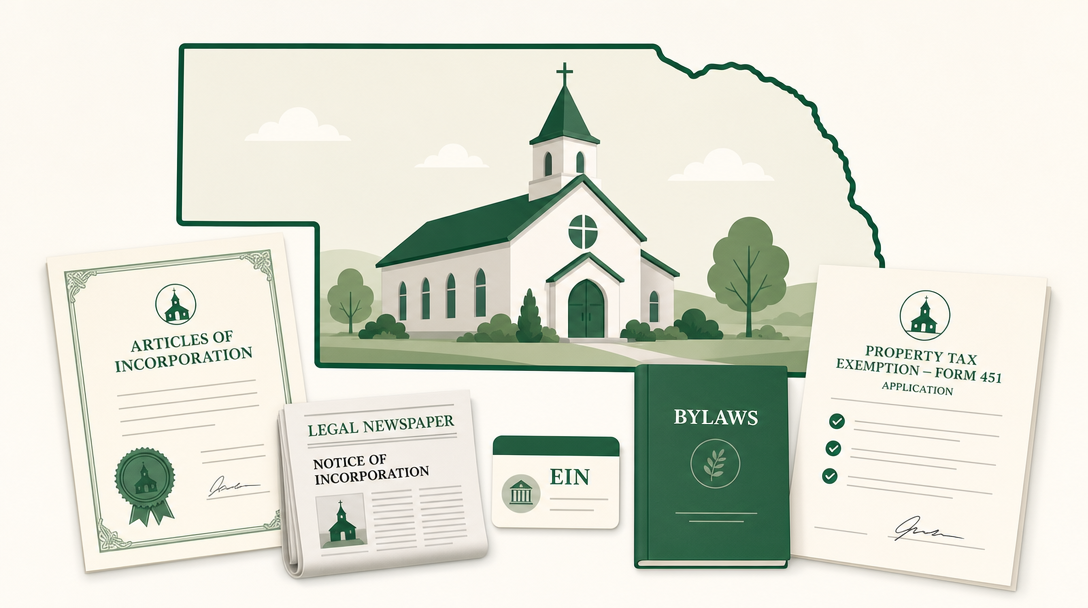
Short answer: To start a church in Nebraska, you form a nonprofit corporation by filing Articles of Incorporation with the Nebraska Secretary of State ($25 online or $30 in office as of 2026), then get a free EIN from the IRS, adopt bylaws, and seat a board. Nebraska adds a step most states dropped long ago: you must publish a notice of incorporation in a legal newspaper for three successive weeks and file proof of that publication with the Secretary of State. A church is automatically tax-exempt under federal law, so the IRS determination letter is optional and there is no annual Form 990. The Nebraska-specific pieces worth handling early are the publication rule and two exemptions — a property tax exemption through your county assessor (Form 451) and, unlike an ordinary nonprofit, a sales tax exemption a church can actually claim (Form 4).
The federal formation steps are the same in every state — incorporate, EIN, bylaws, board, books. This guide covers those briefly and then spends its time on the Nebraska pieces that carry the real value. For the full national walkthrough of each universal step, read how to start a church; below, the focus is what changes inside Nebraska.
The formation steps that are the same anywhere
Starting a church in Nebraska follows the standard church-formation checklist, and most of it is federal, not state-specific:
- Incorporate as a nonprofit corporation (the Nebraska-specific part — covered in detail below).
- Get an EIN — a free federal tax ID from the IRS, applied for directly at irs.gov. Never pay a third party for one; the EIN is always free.
- Adopt bylaws — the church’s internal rulebook for decisions, leadership, and money. Start from a proven document rather than a blank page; see church bylaws for what to include.
- Seat a board — at least three directors, ideally a majority unrelated, so the church is governed by a body rather than one person.
- Skip or pursue the 501(c)(3) letter — a church is automatically tax-exempt and does not have to file Form 1023, though many apply for the determination letter as documentation (IRS Publication 1828).
- Open a bank account in the church’s legal name using the EIN and formation documents.
- Set up the books on fund accounting from day one, before the first offering arrives.
Each of these is walked step by step in the national formation guide linked above. The rest of this page is the Nebraska layer on top.
Incorporating a church in Nebraska
Nebraska creates the church as a legal entity when you file Articles of Incorporation under the Nebraska Nonprofit Corporation Act with the Nebraska Secretary of State. The filing fee is $25 to file online or $30 in office as of 2026; confirm the current amount with the Nebraska Secretary of State, since fees change. You can file electronically through the state’s corporate filing portal or submit the document in person in Lincoln. When you form the church, you name it a religious corporation in the Articles — Nebraska classifies nonprofit corporations as public benefit, mutual benefit, or religious, and a church is the religious type.
The Articles ask for the church’s name, that religious-corporation classification, its registered agent and registered office in Nebraska, the name and address of each incorporator, and whether the corporation will have members. Two clauses matter for the IRS later, so build them in at formation rather than amending afterward:
- A 501(c)(3) purpose clause stating the church is organized exclusively for religious and charitable purposes.
- A dissolution clause stating that if the church closes, its assets pass to another 501(c)(3) organization, not to any individual.
The IRS looks for both, so getting the language right on the Nebraska filing saves a rewrite. The full breakdown of what these documents need is in articles of incorporation for a church. On board size, Nebraska requires a nonprofit corporation’s board to have three or more directors, which happens to line up with what the IRS wants anyway — three mostly-unrelated directors signals real governance.
Nebraska’s newspaper publication requirement for a new church
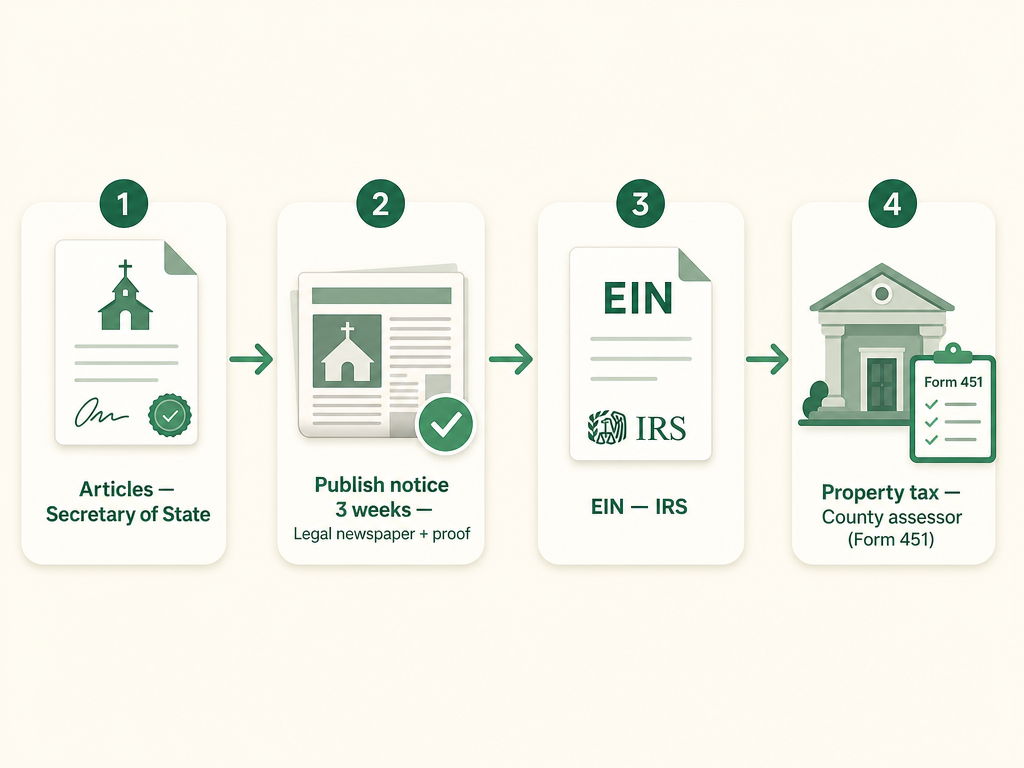
Here is the step that surprises almost everyone, because most states dropped it decades ago: Nebraska requires a brand-new nonprofit corporation — including a church — to publish a notice of incorporation before its founding is fully settled. The notice runs for three successive weeks in a legal newspaper of general circulation in the county where the corporation’s principal office sits, or, if it has none in the state, the county of its registered office (Nebraska Revised Statute 21-19,173).
The published notice has to show specific facts: the corporate name, that the church is a religious corporation, the street address of the initial registered office and the name of the initial registered agent, the name and street address of each incorporator, and whether the corporation will have members. The newspaper handles the running and then supplies an affidavit; you file that proof of publication with the Secretary of State to close out the requirement.
Budget a little time and money for this. Publication costs vary by paper and county — small papers can run roughly $40 to $200 depending on rates and the notice length — so confirm the price with a legal newspaper in your county before you file, since there is no flat statewide figure. Skipping the step leaves the incorporation technically incomplete, though Nebraska law lets a late publication followed by filed proof cure the gap. Treat it as a real to-do on your formation checklist, not an optional formality.
Claiming the Nebraska property tax exemption through your county
A Nebraska church that owns its building can exempt that property from local property tax, but the exemption is not automatic and it does not run through the Secretary of State. You apply with Form 451, the Exemption Application, filing it with the county assessor in the county where the property sits (Nebraska Department of Revenue, Form 451). The property has to be owned by the church, used exclusively for religious purposes, and not used for financial gain — the assessor applies a specific test before granting it.
Timing matters here. You file Form 451 on or before December 31 immediately preceding the year you want the exemption for. In the first year and in every fourth year after, you file the full Form 451 with the accompanying questionnaire; in the in-between years the exemption generally carries forward without a fresh application unless the assessor asks or the church acquires new property. If a church buys and converts property to religious use between January 1 and July 1, it can still file by July 1 for that year. Miss December 31 and there is a narrow late window through June 30 with a waiver request to the county board of equalization — but plan on the December 31 deadline. Confirm the current form and deadline with your county assessor before filing.
Nebraska sales tax and your church
Now the honest part most guides get wrong for churches — but in Nebraska it cuts in the church’s favor. Nebraska does not give nonprofits a blanket sales tax exemption; a plain 501(c) designation does not make purchases exempt, and most community nonprofits pay sales tax on what they buy. The exempt list is narrow and statutory. A church, though, sits squarely on that list: an organization created exclusively for religious purposes is one of the specifically named categories that can be exempt from Nebraska sales and use tax (Nebraska Department of Revenue, REG-1-091, Religious Organizations).
The exemption is not automatic, and this is the catch. The church must apply on Form 4, the Nebraska Exemption Application for Sales and Use Tax, and affirmatively show it is organized and operated exclusively for religious purposes — a bare restatement of the charter will not do; you attach the bylaws and the articles of incorporation (Nebraska Department of Revenue, Form 4). Once approved, the Department issues a Nebraska Exempt Organization Certificate of Exemption with an exemption number (05-XXXXXXX), and the church presents a Form 13 exempt sale certificate to sellers to buy tax-free. There is no filing fee for Form 4. One limit to know: the exemption covers the church’s own purchases, so the church has to make and pay for the purchase itself — a member buying something to donate cannot use the church’s exemption. So a Nebraska church gets sales tax relief that a typical nonprofit does not, but only after it files Form 4 and holds the certificate.
Nebraska filing at a glance
The table below maps each Nebraska step to its agency, form, and cost. Treat the fees as accurate as of 2026 and confirm with the listed agency, since Nebraska fees change.
| What you’re doing | Agency | Form | Fee (as of 2026) |
|---|---|---|---|
| Incorporate the church | Nebraska Secretary of State | Articles of Incorporation (religious corporation) | $25 online / $30 in office (confirm) |
| Publish notice of incorporation | Legal newspaper in your county | Notice + proof of publication | Varies by paper (confirm locally) |
| File proof of publication | Nebraska Secretary of State | Affidavit of publication | $25 online / $30 in office |
| Get a federal tax ID | IRS | EIN application (online) | Free |
| 501(c)(3) recognition (optional) | IRS | Form 1023 or 1023-EZ | $600 / $275 user fee |
| Property tax exemption | County assessor | Form 451 | No fee |
| Sales tax exemption | Nebraska Department of Revenue | Form 4 (religious) | No fee |
| Charitable-solicitation registration | None statewide | — | No general registration |
Setting up the books once the church exists in Nebraska
Once the church is formed, the notice is published, and the exemptions are filed, the work shifts from one-time paperwork to the monthly routine — and that routine is where churches actually fail or hold together. A church holds money in trust for the people who gave it, much of it tagged for a purpose (the building, missions, benevolence), so it tracks money by fund rather than as a single bottom line. Set the books up on fund accounting before the first offering, keep the giving records your donors need for their own taxes, and document that the board reviews the finances. None of the Nebraska exemptions excuse a church from keeping clean records; the IRS still expects records that substantiate income and expenses (IRS Publication 1828). One Nebraska calendar item to keep: the Secretary of State requires nonprofit corporations to file a biennial report, and letting it lapse can push the corporation toward delinquent or dissolved status, so put the due date where you will see it.
FAQ
How much does it cost to start a church in Nebraska? The required state cost is modest. Filing Articles of Incorporation runs $25 online or $30 in office as of 2026, plus the newspaper publication for the notice of incorporation, which varies by paper and county and often lands somewhere around $40 to $200. The EIN from the IRS is free, and the property tax (Form 451) and sales tax (Form 4) exemptions carry no filing fee. There is no statewide charitable-registration fee either. Optional add-ons raise it: the IRS determination letter is $275 (Form 1023-EZ) or $600 (full Form 1023). Realistically, a small Nebraska church can be stood up properly for a few hundred dollars, most of it the publication cost and any optional federal letter.
Does Nebraska really require a newspaper notice for a new church? Yes. Nebraska is one of the few states that still requires it, and a church is not exempt. A new nonprofit corporation must publish a notice of incorporation for three successive weeks in a legal newspaper of general circulation in the county of its principal or registered office, then file proof of publication with the Secretary of State (Nebraska Revised Statute 21-19,173). The newspaper supplies the affidavit after the notice runs; you file it to complete the incorporation.
Do you need 501(c)(3) status to start a church in Nebraska? No. A church is automatically tax-exempt under federal law and does not have to file Form 1023 or hold an IRS determination letter to be exempt, and it does not file an annual Form 990 (IRS Publication 1828). Many Nebraska churches still apply for the determination letter as documentation for banks, grant-makers, and large donors, but it is optional — see are churches tax exempt for the fuller picture.
Are a Nebraska church’s purchases exempt from sales tax? They can be, but only after you apply. Nebraska does not exempt nonprofits broadly, yet an organization created exclusively for religious purposes is on the narrow list that qualifies. The church files Form 4 with the Department of Revenue, proves it operates exclusively for religious purposes, and, once approved, receives a Certificate of Exemption it uses to buy tax-free (Nebraska Department of Revenue, REG-1-091). Until the certificate is in hand, budget as if purchases are taxable.
Can I just start my own church in Nebraska? Practically, anyone can start a church in Nebraska — there is no state license or denominational permission required, and the First Amendment protects the right to form a religious organization. What you do need, to operate as a real and exempt church, is the structure: a nonprofit corporation formed as a religious corporation, the notice published for three weeks with proof filed, an EIN, adopted bylaws, a board of at least three mostly-unrelated directors, a bank account in the church’s name, and books set up on fund accounting. The freedom to start one is unlimited; running one properly is a checklist.
This is general information, not tax or legal advice. Nebraska forms, fees, and deadlines change — confirm the current details with the Nebraska Secretary of State, the Department of Revenue, and your county assessor, and consult a qualified professional for your situation.
Vestrybooks sets up a new Nebraska church’s books on fund accounting from day one — funds, reconciliation, and the board reports — so the financial side is right before the first offering. See how it works.
This article is general information for church treasurers, not professional tax or legal advice. For your church's situation, consult a qualified accountant or attorney.
Church accounting a volunteer can actually do.
Vestrybooks is church accounting + giving for the volunteer treasurer — fund tracking, one-click year-end statements, and online giving with $0 taken from every gift.
A real free plan · no credit card · your data stays yours