Blog · Church formation & governance
What a church board of trustees does and how it guards the money
June 27, 2026 · By Benjamin Reinke

A church board of trustees is the group of people legally responsible for governing a church and overseeing its money and property. The board sets policy, approves the budget, reviews the financial statements, and holds a fiduciary duty to act in the church’s best interest rather than anyone’s personal gain. The titles change with the church’s polity — trustees, elders, deacons, directors, or a vestry — but the core job is the same: somebody other than the person spending the money has to watch the money.
What a church board of trustees is, and who sits on it
A church board of trustees is the body that carries the church’s legal and financial responsibility. When a church incorporates as a nonprofit, state law requires a board of directors, and most churches give that board a name drawn from their tradition. The board is usually elected by the congregation or appointed under the bylaws, meets on a regular schedule, and keeps written minutes of what it decides.
The word “trustee” is doing real work here. A trustee holds something in trust for someone else — in this case, the congregation’s gifts and the church’s buildings. That framing is the whole reason the role exists, and it’s why the board’s financial duties matter more than its title.
Trustees vs. elders, deacons, and directors — it’s mostly polity
The label a church puts on its board depends on its polity, the system it uses to govern itself. The duties overlap heavily; the names don’t.
| Term | Common tradition | Typical focus |
|---|---|---|
| Board of trustees | Methodist, many Baptist, congregational | Property, legal, and financial oversight |
| Elders | Presbyterian, many non-denominational | Spiritual leadership and doctrine, often with governance |
| Deacons | Baptist, many congregational | Service, care, and practical operations |
| Board of directors | The legal term in incorporation papers | Whatever the bylaws assign — the corporate board |
| Vestry | Episcopal / Anglican | The lay governing body, including finances |
The key thing to understand: whatever your church calls them, the people named in your incorporation documents are your legal board of directors, and they carry the fiduciary duties below — even if your bylaws call them elders or a vestry. Some larger churches split the work, giving spiritual oversight to elders and money-and-buildings oversight to a separate board of trustees. That’s a structure choice, not a rule. If you’re still forming the church, how to start a church walks through where the board fits in the incorporation and 501(c)(3) steps.
The fiduciary duties every church board carries
A church board’s authority comes bundled with three legal duties that courts apply to any nonprofit board. Board members are personally expected to meet them.
- Duty of care — show up, stay informed, and make decisions a reasonably prudent person would. Read the financials before you approve them; don’t rubber-stamp.
- Duty of loyalty — put the church’s interest ahead of your own. This is the source of the conflict-of-interest rules below.
- Duty of obedience — keep the church inside its stated religious purpose and follow its own bylaws and the law.
These aren’t abstractions. They’re the standard a member, a donor, or a court would measure the board against if money went missing or a deal looked self-serving.
The board’s financial oversight role — where most of the work is
A church board’s most consequential job is financial oversight, and it’s the part boards most often neglect. Oversight doesn’t mean doing the bookkeeping; it means making sure the bookkeeping is honest and the money is controlled. A board meeting that does this well covers a short, repeatable list.
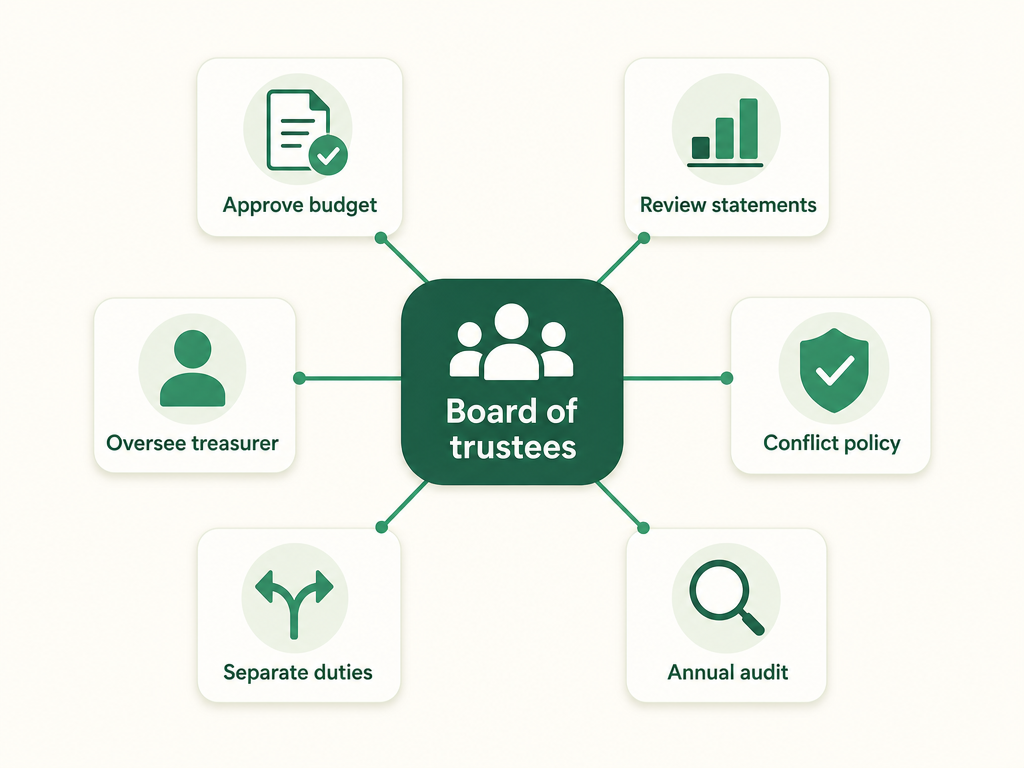
- Approve the annual budget. The board adopts the spending plan and holds staff to it. A church budget the board never voted on isn’t really the church’s plan.
- Review the financial statements regularly. Monthly or quarterly, the board reads the statement of activities and the balances and asks questions. Reviewing the church financial statements is how a board catches a problem while it’s small.
- Oversee the treasurer. The treasurer keeps the books and reports to the board; the board does not hand the treasurer unchecked control. The board reviews what the treasurer reports and confirms it against the bank.
- Enforce a conflict-of-interest policy. When a vote touches a board member’s family, business, or pay, that member discloses it and steps out of the decision.
- Require segregation of duties. The person who counts the offering, the person who records it, and the person who reconciles the bank should not all be the same person. One individual controlling the money from start to finish is the single most common setup behind church embezzlement.
- Commission an annual review or audit. Once a year, someone independent checks the books. For most churches an internal church audit by a few uninvolved members is enough; larger budgets may warrant an outside CPA.
That last group of controls — separation of duties, a real review, no single point of control — is the heart of the board’s value. The board’s signature on the budget means little if one person can still move money with nobody watching.
Board composition for 501(c)(3) — size, independence, and no insider profit
A church board’s makeup directly affects the church’s tax-exempt status, so it’s worth getting right. The IRS doesn’t set a hard headcount for churches, but its guidance and practice point to a board that is small enough to function and independent enough to be trusted.
- Have at least three voting members. Three is the practical floor most states and the IRS expect; many churches run five to nine. An odd number avoids tied votes.
- Keep the board mostly unrelated. A board stacked with one family or one person’s business partners can’t provide independent oversight. The IRS scrutinizes boards where related parties or paid staff hold a majority, because such a board can’t credibly check the people it’s supposed to check.
- Watch where the paid pastor sits. A pastor often serves on the board, which is fine, but the board can’t be a majority of paid staff and their relatives, and a board member must never vote on their own compensation.
The reason behind all of this is private inurement — the rule that none of a 501(c)(3)‘s earnings may benefit an insider beyond reasonable pay. An independent board is the church’s defense against it. The IRS lays this out in IRS Publication 1828, the tax guide for churches, which warns that a church serving private interests rather than public ones risks losing its exemption.
How a board’s oversight protects the church’s tax-exempt status
A church board protects the church’s 501(c)(3) status mainly by keeping the church clean on the two issues that get exemptions revoked: private inurement and self-dealing. The connection between board oversight and tax status is direct.
- An independent board that approves pay and contracts at arm’s length is the documentation that compensation was reasonable — the defense against an inurement claim.
- A conflict-of-interest policy that’s actually enforced shows the IRS the church guards against insiders steering money to themselves.
- Clean, reviewed books mean the church can show where every dollar went if it’s ever asked, which is what keeps an exemption defensible.
Exempt status is a standing the church has to maintain, not a one-time award (the broader picture is in are churches tax exempt). The board is the body responsible for maintaining it.
What the Bible says about trustees, briefly
The Bible doesn’t use the word “trustee” — it’s a modern legal term that comes from nonprofit and corporate law, not Scripture. What the New Testament does describe are leaders entrusted with care of the community and its resources: the early church appointed trustworthy people to handle the daily distribution of food and funds (Acts 6:1-6), and Paul required overseers to be above reproach and “not greedy for money” (1 Timothy 3). The principle behind a board of trustees — that those who handle a community’s money must be trustworthy and accountable — is thoroughly biblical, even if the title isn’t.
FAQ
What does the Bible say about trustees in the church? The Bible doesn’t use the word “trustee,” which is a modern legal term. It does describe leaders entrusted with the community’s resources — the church appointing trustworthy people to handle the distribution of funds in Acts 6, and Paul requiring overseers to be above reproach and not greedy for money in 1 Timothy 3. The accountability behind the trustee role is biblical even though the title isn’t.
What are the duties of the board of trustees in a church? A church board of trustees governs the church, oversees its property, and carries its financial responsibility — approving the budget, reviewing the financial statements, overseeing the treasurer, enforcing a conflict-of-interest policy, requiring that no one person controls the money, and arranging an annual review or audit. Underneath those tasks sit the fiduciary duties of care, loyalty, and obedience.
How many members should be on a church board? At least three voting members, which is the practical floor the IRS and most states expect, with many churches choosing five to nine. Use an odd number to avoid ties, and keep the board mostly unrelated and not a majority of paid staff, so it can provide real, independent oversight.
What are the four duties of a trustee? For a church board, the duties are most often grouped as the three fiduciary duties — care (stay informed and act prudently), loyalty (put the church first), and obedience (follow the law and the church’s purpose) — applied to four practical jobs: governing the church, safeguarding its property, overseeing its finances, and protecting its tax-exempt status.
A church board can only oversee money it can actually see. Vestrybooks gives the board view-only access to live, reconciled books, so oversight is real instead of a report taken on faith. See how it works.
This is general information, not legal or tax advice — confirm your church’s situation with a qualified professional.
This article is general information for church treasurers, not professional tax or legal advice. For your church's situation, consult a qualified accountant or attorney.
Church accounting a volunteer can actually do.
Vestrybooks is church accounting + giving for the volunteer treasurer — fund tracking, one-click year-end statements, and online giving with $0 taken from every gift.
A real free plan · no credit card · your data stays yours