Blog · Nonprofit formation
How to start a nonprofit the legal and financial way
June 27, 2026 · By Benjamin Reinke
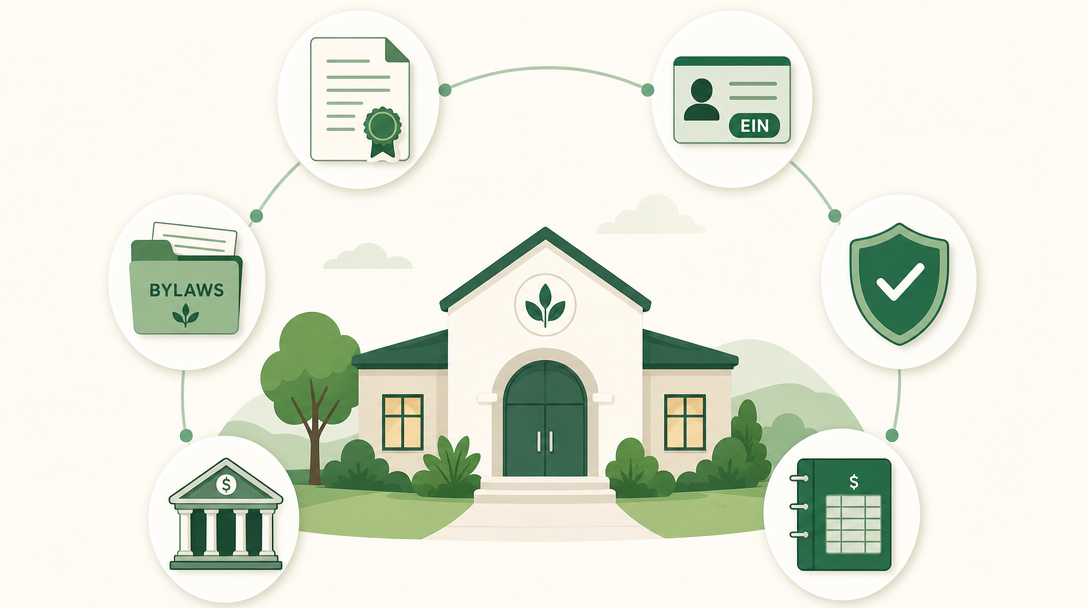
Short answer: Starting a nonprofit is a fixed sequence of legal and financial steps, and the cause that inspired you is only the first of them. You pick a structure and incorporate in your state (file articles of incorporation), get a free EIN from the IRS, apply for 501(c)(3) tax-exempt status with Form 1023 or 1023-EZ, adopt bylaws, seat a board of at least three mostly-unrelated directors, open a bank account in the nonprofit’s name, set up the books on fund accounting, and then keep up with a short list of annual filings like the Form 990. None of it requires a lawyer on retainer, but skipping a step now becomes a problem later. This is the founder’s business-side checklist, not the mission-statement workshop.
The mission comes first, but this guide is the setup nobody walks you through
Most “how to start a nonprofit” advice is about the cause — your mission and vision, the community you want to serve, your first fundraiser. That part matters and it comes first, but it’s covered everywhere, and it’s not where new nonprofits stall. They stall on the unglamorous part: the legal entity, the IRS application that takes months, the bank account that won’t open without an EIN, the books that should have been started in month one. The rest of this page is that scaffolding — the steps that turn a good intention into a real, fundable, tax-exempt organization instead of a donation jar in the founder’s name. Many founders line up the cause, programs, and funding model in a nonprofit business plan before the paperwork begins.
One framing before the steps. A nonprofit and a church follow nearly the same formation path, because a church is a special kind of nonprofit. The difference shows up almost entirely at the tax-exemption step, where churches get a few breaks the IRS hands them specifically. If you’re forming a faith-based organization, read this page for the shared mechanics, then see how to start a church for the church-specific shortcuts.
The 8 steps to legally and financially start a nonprofit
Here is the whole sequence, in the order that actually works. Each step feeds the next — you can’t open a bank account without an EIN, you can’t get an EIN cleanly without deciding on your entity first, and the IRS won’t grant 501(c)(3) status without your articles, bylaws, and a board already in place.
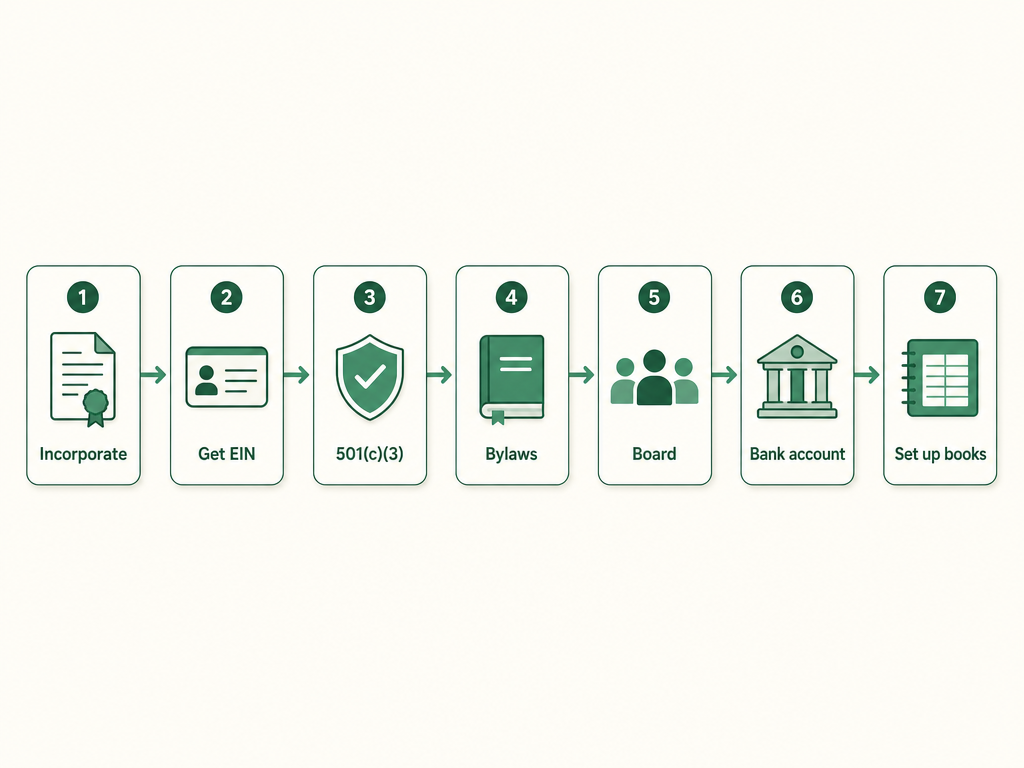
- Choose a structure and incorporate. Form a nonprofit corporation in your state — file articles of incorporation with the Secretary of State and pay the filing fee (roughly $30–$125 in most states).
- Get an EIN. Apply for a free Employer Identification Number from the IRS — your nonprofit’s federal tax ID, needed before you can do almost anything financial.
- Adopt bylaws. Write and formally adopt the rules that govern how the nonprofit makes decisions, seats leaders, and handles money.
- Form a board of directors. Seat at least three mostly-unrelated directors so the organization is governed by a body, not one person.
- Apply for 501(c)(3) tax-exempt status. File Form 1023 (or the shorter 1023-EZ if you qualify) and pay the IRS user fee to get your determination letter.
- Open a bank account. Use the EIN and incorporation documents to open an account in the nonprofit’s name — never run donations through a personal account.
- Set up bookkeeping. Start the books on fund accounting from day one, before the first donation arrives.
- Stay compliant. File the annual Form 990, keep your state registration current, and renew your charitable-solicitation registration.
The sections below walk each step in detail. Read them in order the first time; after that, this page is a reference to come back to.
Step 1 — Choose a structure and incorporate your nonprofit
Incorporating is the first real legal act of starting a nonprofit. Almost every charity forms as a nonprofit corporation under its state’s law, because incorporation does two things money depends on: it makes the organization a separate legal “person” that can hold property, sign contracts, and open accounts in its own name, and it gives the founders and board limited liability, so the organization’s debts and lawsuits don’t land on them personally.
You incorporate by filing articles of incorporation with your state (usually the Secretary of State), naming the nonprofit, its charitable purpose, its registered agent, and its initial directors. The filing fee runs about $30 to $125 depending on the state. Two clauses matter more than the rest, because the IRS reads them later when it decides on your exemption: a 501(c)(3) purpose clause (organized exclusively for charitable, educational, or religious purposes) and a dissolution clause (if the nonprofit closes, its assets go to another 501(c)(3), not to any individual). Getting both right at incorporation saves a rewrite during the 1023 review. The deep dive on drafting and filing your nonprofit articles of incorporation — every required clause and how to submit them to the state — is its own guide.
A handful of organizations operate unincorporated as a nonprofit association. That’s legal, but it leaves members and leaders personally exposed and makes banks and grant-makers nervous. For almost every new nonprofit, incorporating is worth the modest fee.
Step 2 — Get an EIN from the IRS
The Employer Identification Number is your nonprofit’s federal tax ID, and it’s the gate everything financial runs through. A bank won’t open a nonprofit account without one. You need it on the 501(c)(3) application, on payroll forms, and on most state registrations. Getting an EIN is free and immediate — apply directly on the IRS website using your nonprofit’s legal name from the articles, and the number is issued on the spot. Do this right after you incorporate.
One warning: only apply through the official IRS channel. Plenty of sites charge $50 to $300 to “obtain your EIN” — they’re just retyping the free federal form for you. There is no fee for an EIN, ever.
Step 3 — Write and adopt bylaws
Bylaws are the nonprofit’s internal rulebook — how decisions get made, how directors are elected and removed, how often the board meets, how money is approved, what happens in a dispute. Articles of incorporation make the organization exist; bylaws make it governable. The IRS also asks for them: a complete Form 1023 includes your adopted bylaws and a conflict-of-interest policy.
Good bylaws cover membership (if any), the board’s size and terms, officer roles, meeting and quorum rules, a conflict-of-interest policy, financial controls (who can sign checks, spending limits), and amendment procedures. You don’t have to draft them from a blank page — start from a proven template and adapt it, making sure the 501(c)(3) purpose and dissolution language matches your articles. The board formally adopts the bylaws by vote, and that vote goes in your first meeting minutes. What goes in nonprofit bylaws — section by section — gets a full guide of its own; for now, treat them as a step you finish before you file the 1023.
Step 4 — Form a board of directors
A board is what makes a nonprofit an organization instead of one person’s project, and the IRS treats it as central. Tax-exempt status assumes the nonprofit is governed by a body that holds leadership accountable and prevents any insider from profiting. Most states require at least three directors, and the IRS strongly prefers a majority who are unrelated — not the founder, the founder’s spouse, and the founder’s sibling. A board stacked with one family can’t credibly check the people it’s supposed to check.
The board’s real job at the start is oversight: approving the budget, reviewing the financials, hiring and setting the pay of the executive director (and documenting that the pay is reasonable, which protects your exempt status), and making sure no single person controls the money end to end. The fuller picture of what a board is and does is in what a nonprofit board does. Seat the board early, keep minutes of every meeting, and have it formally approve the bylaws and the bank accounts. Those minutes are the evidence that the nonprofit is run properly — and the IRS asks about board composition on the 1023.
Step 5 — Apply for 501(c)(3) tax-exempt status with Form 1023
Tax-exempt status is the step that separates a nonprofit from a hobby, and it’s the one that takes real time. Unlike a church — which is exempt automatically — most nonprofits must apply to the IRS and receive a determination letter before they’re recognized as 501(c)(3) and before donors can deduct their gifts. You apply on one of two forms:
- Form 1023-EZ — the streamlined application for small organizations that expect under $50,000 in annual gross receipts and have under $250,000 in assets. The user fee is $275, and it’s often approved in a few weeks.
- Form 1023 (the full version) — required for larger or more complex organizations. The user fee is $600, and review commonly takes several months.
The details of the application, the eligibility worksheet, and the schedules live on the IRS Form 1023 page, and the IRS walks through what qualifies an organization for exemption in IRS Publication 557. You’ll attach your articles, bylaws, a conflict-of-interest policy, a narrative of your activities, and a budget — which is exactly why steps 1 through 4 come first. The full walkthrough of how to start a 501(c)(3) — the eligibility worksheet, the schedules, and what gets applications delayed — is its own guide; this is the short version.
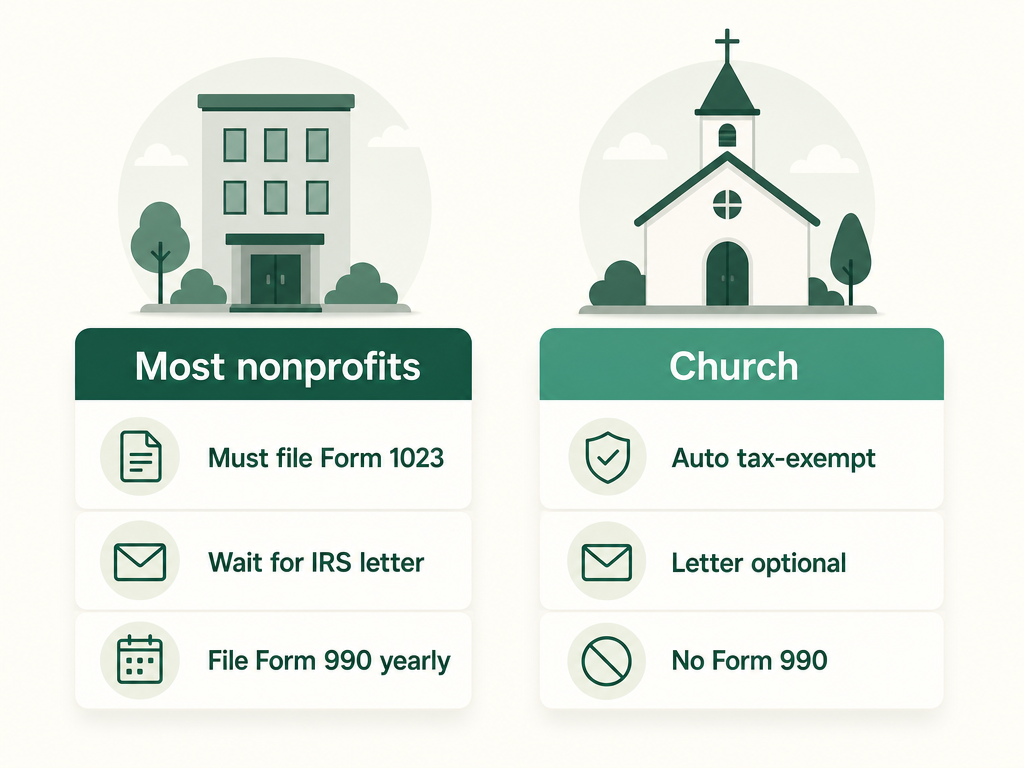
Here is the one place faith-based founders get to take a shortcut. A church is treated as automatically tax-exempt under 501(c)(3) the moment it meets the requirements — it does not have to file Form 1023 or get a determination letter, and it does not file the annual Form 990. (Most churches still apply for the letter as useful documentation for banks and grant-makers, but they aren’t required to.) If you’re forming a religious organization, the rule that churches are automatically tax-exempt is the single biggest way your path differs from the one on this page.
Step 6 — Open a nonprofit bank account
A dedicated bank account is the line between a nonprofit and a slush fund. Open one in the organization’s legal name as soon as you have the EIN and incorporation papers — never route donations through a founder’s personal account, even briefly. Commingling personal and organizational money is the fastest way to lose donor trust, fail an audit, and put your exempt status at risk.
To open the account, most banks want your articles of incorporation, your EIN confirmation, your adopted bylaws, and a board resolution naming who can sign. Set up at least two authorized signers from the start, and require two-person approval on payments above a threshold the board sets. That control costs nothing and stops most fraud before it starts.
Step 7 — Set up bookkeeping on fund accounting
Set the books up correctly before the first dollar arrives, because retrofitting accounting onto a year of messy transactions is miserable. Nonprofits don’t keep books the way a business does. A business tracks one bottom line — profit. A nonprofit holds money in trust for the people and grant-makers who gave it, and much of that money arrives restricted for a specific purpose: a program, a building, a scholarship. So a nonprofit tracks money by purpose, using fund accounting — each fund is its own self-contained set of books with its own running balance, so a grant restricted to one program never quietly pays for something else.
You’ll also need a chart of accounts (your list of income and expense categories) and a simple monthly routine: record donations and grants by fund, enter bills, reconcile the bank, review the reports. The full hands-on routine is in the guide to nonprofit bookkeeping. The setup decisions you make now shape every report you’ll ever run — including the Form 990 you’ll file at year-end.
Step 8 — File Form 990, renew registrations, and stay compliant
A 501(c)(3) carries a light but real recurring workload, and the headline item is the Form 990. Most tax-exempt nonprofits file a 990 every year — it reports finances and governance to the IRS and is public, so donors and watchdogs can read it. The version you file scales with your size: the 990-N (a short e-postcard) for the smallest organizations, the 990-EZ in the middle, and the full 990 for larger ones. Miss it three years in a row and the IRS automatically revokes your exempt status, which is a painful thing to undo.
The rest of the recurring work varies by state:
| Task | Roughly how often | Notes |
|---|---|---|
| Form 990 / 990-EZ / 990-N | Yearly | Required for most 501(c)(3)s; three misses revokes exemption |
| State nonprofit annual report | Yearly or biennially | Keeps your incorporation in good standing |
| Charitable solicitation registration | Once + yearly renewal | Required in many states before you fundraise publicly |
| State tax-exemption renewals | Varies | Sales- and property-tax exemptions often need their own filings |
| Reasonable-compensation review | Yearly | Board documents that staff pay is reasonable |
None of this is hard once it’s on a calendar. The danger is forgetting — a lapsed registration or a missed 990 creates penalties out of proportion to the task. Put every recurring item on a shared calendar with an owner, and review it at a board meeting once a year.
What starting a nonprofit actually costs
Starting a nonprofit on the legal and financial side is cheaper than most people expect — the real cost is time, not money, since the 501(c)(3) review can take weeks to months. Here’s a realistic range of the hard costs to get formed and recognized:
| Item | Typical cost |
|---|---|
| State incorporation filing | $30–$125 |
| EIN | $0 (free from the IRS) |
| Bylaws (from a template) | $0 |
| 501(c)(3) application | $275 (Form 1023-EZ) or $600 (full Form 1023) |
| Bank account | $0–$25/mo, often free for nonprofits |
| Bookkeeping software | $0–$50/mo |
| State charitable registration | $0–$100+, varies by state |
So the bare path to a recognized 501(c)(3) — incorporate, EIN, bylaws, the 1023-EZ, a bank account, and books — can run under $500 for a small organization. You can absolutely start a nonprofit with very little money; what you can’t do is skip the structure and still be a real, deductible charity.
How to start a nonprofit in your state
The federal core of starting a nonprofit is the same everywhere — the EIN, the Form 1023 for 501(c)(3) status, the bylaws, and the board don’t change from state to state. What does change is the incorporation filing (which form, which agency, what fee), whether your state requires charitable-solicitation registration before you fundraise, and how a nonprofit claims state income, franchise, and sales-tax exemption. Those state-specific steps are where new nonprofits stall, so we cover them one state at a time:
- Starting a nonprofit in California
- Starting a nonprofit in Texas
- Starting a nonprofit in Florida
- Starting a nonprofit in Michigan
- Starting a nonprofit in Ohio
- Starting a nonprofit in Illinois
- Starting a nonprofit in Arizona
- Starting a nonprofit in Maryland
- Starting a nonprofit in Virginia
- Starting a nonprofit in New Jersey
- Starting a nonprofit in Georgia
- Starting a nonprofit in Alabama
- Starting a nonprofit in Indiana
- Starting a nonprofit in Missouri
- Starting a nonprofit in Oregon
- Starting a nonprofit in Washington
- Starting a nonprofit in Colorado
- Starting a nonprofit in New York
- Starting a nonprofit in Louisiana
- Starting a nonprofit in Oklahoma
- Starting a nonprofit in Tennessee
- Starting a nonprofit in Wisconsin
- Starting a nonprofit in Kentucky
- Starting a nonprofit in Nevada
- Starting a nonprofit in Arkansas
- Starting a nonprofit in Hawaii
- Starting a nonprofit in Mississippi
- Starting a nonprofit in Utah
- Starting a nonprofit in North Carolina
- Starting a nonprofit in Iowa
- Starting a nonprofit in New Mexico
- Starting a nonprofit in Delaware
- Starting a nonprofit in Idaho
- Starting a nonprofit in Kansas
- Starting a nonprofit in Maine
- Starting a nonprofit in Massachusetts
- Starting a nonprofit in South Carolina
- Starting a nonprofit in Pennsylvania
- Starting a nonprofit in Nebraska
- Starting a nonprofit in Minnesota
- Starting a nonprofit in Montana
- Starting a nonprofit in Rhode Island
- Starting a nonprofit in Wyoming
- Starting a nonprofit in Alaska
- Starting a nonprofit in Connecticut
- Starting a nonprofit in New Hampshire
- Starting a nonprofit in North Dakota
- Starting a nonprofit in South Dakota
- Starting a nonprofit in Vermont
- Starting a nonprofit in West Virginia
More states are on the way. Wherever you are, the federal steps above stay the same — it’s the state incorporation, charitable registration, and tax-exemption details that vary.
FAQ
How do I start a nonprofit with no money? You can start a nonprofit on a shoestring, because the unavoidable costs are small: the EIN is free, bylaws can come from a template for free, and the 1023-EZ application is $275 (the full 1023 is $600). State incorporation runs roughly $30 to $125. That puts a recognized 501(c)(3) within reach for a few hundred dollars total. To bring even that down, recruit a volunteer board, lean on free state resources and nonprofit-support centers, and hold off on paid help until the organization has revenue. What you can’t skip is the structure — the entity, the EIN, the 501(c)(3) filing, and basic books.
How much money do I need to start a nonprofit? The legal and financial minimum is small — often under $500 to incorporate, get a free EIN, adopt bylaws from a template, file the 1023-EZ, and open a bank account. The full Form 1023 raises the application fee to $600, and some states add a charitable-registration fee. A small nonprofit can be properly formed and recognized for a few hundred dollars; the bigger investment is the time the 501(c)(3) review takes and the ongoing work of running the organization.
Can I get paid if I start a nonprofit? Yes — a nonprofit can pay its founder a salary for actual work, such as serving as the executive director, and that’s completely legal. The rule is that the pay must be reasonable for the role and approved by the board through a documented process, not set by the founder alone. What you cannot do is treat the nonprofit’s surplus as personal profit or pay yourself out of proportion to the work — that’s the private inurement problem that can cost the organization its exemption. Reasonable pay for real work is fine; pocketing the proceeds is not.
What is the 80/20 rule for nonprofits? The “80/20 rule” for nonprofits is a rule of thumb, not a law: roughly 80% of an organization’s donations tend to come from about 20% of its donors. It’s a fundraising observation that argues for paying close attention to your major-gift relationships, not a formation or tax requirement. (It’s sometimes confused with overhead or program-spending ratios, but those are separate guidelines about how much of a budget goes to the mission versus administration.) The 80/20 rule has nothing to do with how you start a nonprofit or keep its 501(c)(3) status.
Vestrybooks sets up a faith-based nonprofit’s books on fund accounting from day one — funds, reconciliation, and the board reports — so the financial side is right before the first donation. See how it works.
This is general information, not legal or tax advice — confirm your organization’s situation with a qualified professional.
This article is general information for church treasurers, not professional tax or legal advice. For your church's situation, consult a qualified accountant or attorney.
Nonprofit accounting, minus the headache.
Vestrybooks does fund accounting, donor tracking, and board-ready reports for churches and faith-based nonprofits.
A real free plan · no credit card · your data stays yours