Blog · Church taxes
Are churches tax exempt?
June 27, 2026 · By Benjamin Reinke
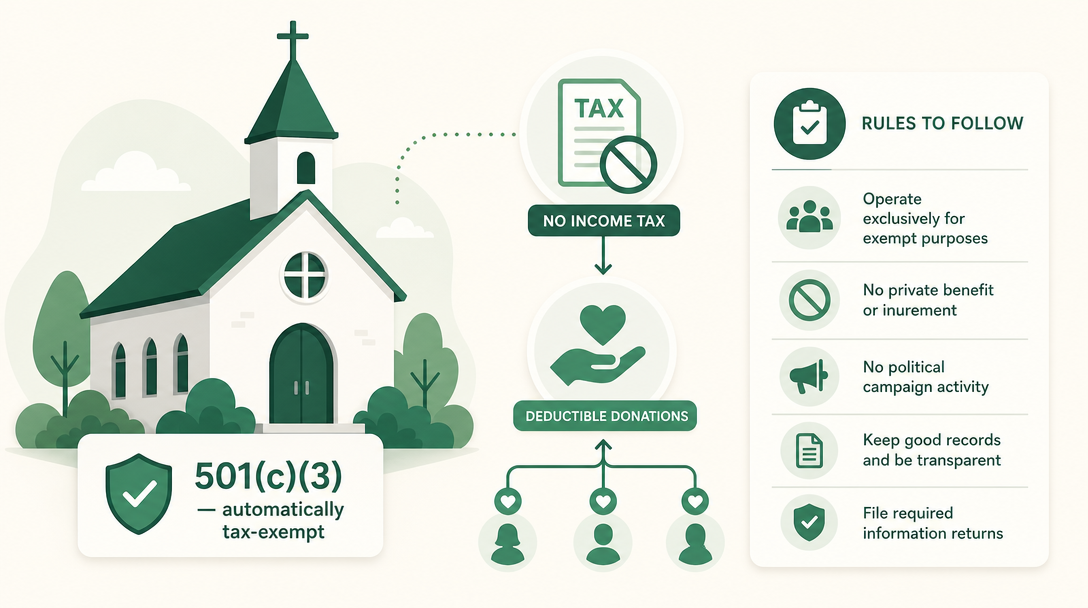
Short answer: Yes. A church is a 501(c)(3) organization and is automatically tax-exempt — uniquely, it doesn’t even have to apply to the IRS for recognition. Tax-exempt means the church pays no federal income tax on its offerings, and donors can claim a deduction for their gifts. The status comes with rules, though: a church can’t campaign for political candidates, can’t let insiders profit, and still owes tax on unrelated business income.
What “tax exempt” means for a church
For a church, tax-exempt status has two practical effects: the church itself owes no federal income tax on the donations and offerings it receives, and the gifts people give are tax-deductible to those donors. It’s the same 501(c)(3) status other charities hold — exempt because the organization is operated exclusively for religious (charitable) purposes, with no part of its earnings going to private individuals (IRS Publication 1828). It does not mean a church pays no taxes at all — see do churches pay taxes for the full picture.
The church exception: exempt automatically, no application
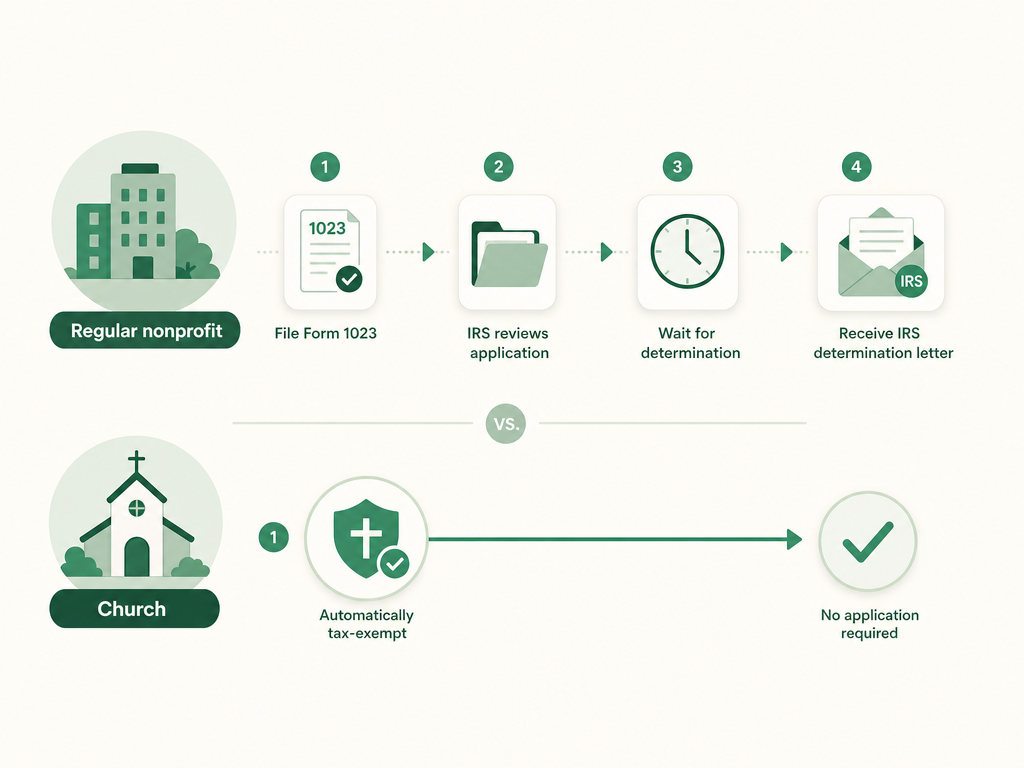
Here’s what makes churches unusual. Most nonprofits have to apply to the IRS (file Form 1023) and receive a determination letter to be tax-exempt. Churches don’t — they are considered tax-exempt automatically as soon as they meet the requirements, with no application required.
Should a church still apply for a determination letter?
Applying is optional, and many churches do it anyway. A formal IRS determination letter doesn’t grant any extra exemption, but it gives the church official documentation — useful for reassuring donors, satisfying a grant-maker or bank, or claiming state and local exemptions that ask for it. Plenty of churches operate exempt without one; whether to apply is a judgment call.
The strings attached
Tax-exempt status isn’t unconditional. To keep it, a church must stay inside the 501(c)(3) rules:
- No political campaigning. A 501(c)(3) — including a church — can’t endorse or oppose candidates for public office.
- No private inurement. The church’s money can’t be used to enrich insiders (a pastor, a board member) beyond reasonable compensation.
- Unrelated business income is still taxable. Run a business unrelated to the mission, and that income can be taxed even though offerings aren’t.
Cross those lines seriously enough and a church can lose its exemption — which is why clean records and reasonable-compensation documentation matter. Sound governing documents help, too: a free church bylaws template — or the general nonprofit version — includes the 501(c)(3) purpose and dissolution clauses the IRS looks for.
Exempt from income tax — but not everything
“Tax exempt” specifically means federal income tax. A church is usually also exempt from property tax on ministry-used real estate (do churches pay property taxes) and from sales tax in many states, but those are separate, state-administered exemptions with their own rules. And the church’s people still pay their own taxes — a minister owes income tax and self-employment (SECA) tax on salary and housing.
Vestrybooks keeps a church’s books and compensation records clean and provable, so the things that protect exempt status — reasonable pay, no inurement, clear funds — are always documented. See plans →
FAQ
What does it mean if a church is tax exempt? The church pays no federal income tax on its offerings, and donors can deduct their gifts. It’s 501(c)(3) status, held because the church operates exclusively for religious purposes.
Do churches have to apply for 501(c)(3) status? No. Unlike other nonprofits, churches are automatically tax-exempt without filing Form 1023 — though some apply for a determination letter for documentation.
Can a church lose its tax-exempt status? Yes — by campaigning for political candidates, letting insiders profit (private inurement), or otherwise breaking the 501(c)(3) rules.
Are churches exempt from sales tax? Often, but it’s state-administered and varies — many states exempt church purchases with an exemption certificate, while some don’t.
Does a church need a 501(c)(3)? No — a qualifying church is already exempt automatically, so it doesn’t need to apply or hold a formal 501(c)(3) determination letter. Many churches still get one anyway, because the letter is useful documentation for banks, grant-makers, and state exemptions that ask for proof. Whether to apply is a judgment call (501(c)(3) determination letter).
Can a church be tax-exempt without a 501(c)(3)? Yes. A church that meets the requirements is treated as exempt automatically, without applying — so it can be fully tax-exempt even with no determination letter on file. The exemption itself is separate from the IRS recognizing it in writing; the letter documents the status, it doesn’t create it (IRS Publication 1828).
Is every church automatically a 501(c)(3)? Only churches that actually meet the 501(c)(3) requirements are treated as exempt automatically. The organization must be organized and operated exclusively for exempt purposes, allow no part of its earnings to benefit insiders, and stay out of political campaigning. A church that doesn’t meet those tests isn’t exempt just because it calls itself a church.
Can a church be a 501(c)(4) instead of a 501(c)(3)? In theory, but it almost never makes sense, and churches are virtually always 501(c)(3). A 501(c)(4) is a social-welfare organization that can lobby more freely — but donations to it are not tax-deductible, which is a major drawback for a congregation that relies on deductible offerings.
How do you check whether a church is a 501(c)(3)? Use the IRS Tax Exempt Organization Search. Keep in mind many exempt churches won’t appear there, because they never applied for a determination letter and so aren’t in the database — absence from the list doesn’t mean a church isn’t exempt (looking up a nonprofit’s 990).
This is general information, not tax or legal advice — confirm your church’s situation with a qualified professional.
This article is general information for church treasurers, not professional tax or legal advice. For your church's situation, consult a qualified accountant or attorney.
Church accounting a volunteer can actually do.
Vestrybooks is church accounting + giving for the volunteer treasurer — fund tracking, one-click year-end statements, and online giving with $0 taken from every gift.
A real free plan · no credit card · your data stays yours