Blog · Nonprofit board & governance
What a nonprofit board of directors is and what it actually does
June 27, 2026 · By Benjamin Reinke

A nonprofit board of directors is the group of people legally responsible for governing a nonprofit — setting its direction, overseeing its money, and hiring and supervising the person who runs it. Every 501(c)(3) is required to have one, because a nonprofit is a corporation with no owners, and the board is the body the public and the IRS hold accountable for the mission. Board members usually serve as unpaid volunteers and owe the organization a fiduciary duty to act in its interest rather than their own. Unlike a corporate board, they answer to a mission and the public, not to shareholders chasing profit.
This page is the overview. Each major piece below — what directors do, what positions a board fills, whether they get paid, and what the IRS requires of a 501(c)(3) board — is a topic deep enough to have its own guide, and we link out to those as we go.
What a nonprofit board of directors is, and why every 501(c)(3) has one
A nonprofit board of directors is the governing body of a nonprofit corporation — the people in whom the law vests ultimate responsibility for the organization. When you incorporate a nonprofit under state law, the state requires a board of directors before it will grant corporate status, and the IRS requires one before it will grant 501(c)(3) exemption. So a board isn’t optional or a nice-to-have. A nonprofit literally cannot exist without one.
The reason traces back to a single fact: a nonprofit has no owners. A business has shareholders who own it and can sell it; a nonprofit’s assets belong to its charitable purpose, and no individual can own or cash out a nonprofit. That creates a gap — somebody has to stand in for the absent owners and make sure the organization stays true to its mission and handles its money honestly. The board fills that gap. Directors hold the organization in trust for the public, which is why their core obligation is called a fiduciary duty.
A board is also where authority sits collectively, not individually. A single director, even the chair, has no power to act alone; the board acts as a body, by vote, and records its decisions in meeting minutes. That structure is the whole point — it spreads control so no one person runs the organization unchecked.
A nonprofit board vs. a for-profit board of directors
A nonprofit board and a corporate board share a name and a basic shape, but they answer to different people for different reasons. The contrast is the fastest way to understand what a nonprofit board is.
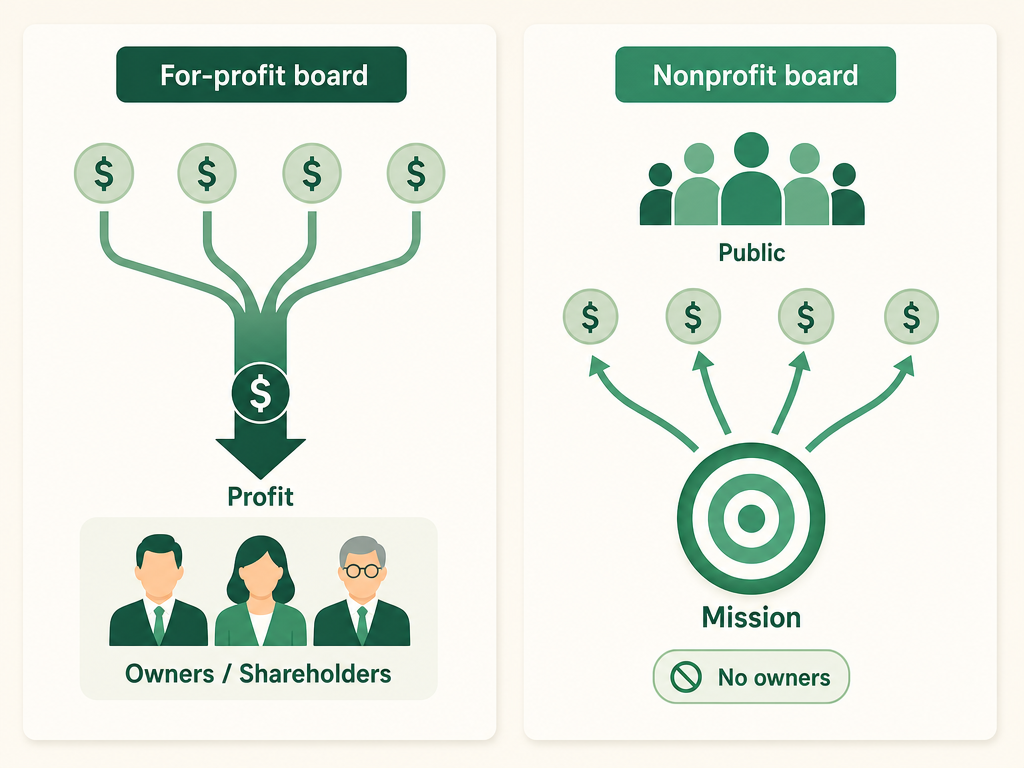
| Nonprofit board | For-profit board | |
|---|---|---|
| Who owns the organization | No one — assets belong to the mission | Shareholders who own and can sell it |
| What success means | Advancing the mission | Returning a profit to owners |
| Who the board answers to | The public, donors, the IRS | The shareholders |
| Are members paid | Usually unpaid volunteers | Almost always paid |
| The core duty | Fiduciary duty to the mission and public | Fiduciary duty to maximize shareholder value |
| Where the money can go | Back into the mission — no private profit | Distributed to owners as dividends |
That last row carries the most legal weight. A nonprofit’s earnings can’t be paid out to insiders the way a company pays dividends — a rule the IRS calls private inurement. The board is the body responsible for making sure it never happens.
What a nonprofit board of directors does — the four core jobs
A nonprofit board’s work, stripped down, is four jobs. Everything a board does in a given meeting maps back to one of them.
- Govern. The board sets policy, adopts the bylaws, and makes the decisions that bind the organization — the actions only the board can take. It works through votes recorded in minutes, not through any one member’s say-so.
- Set direction. The board owns the mission and the strategy. It decides what the organization is for, approves long-range plans, and keeps the work pointed at the charitable purpose the nonprofit was granted exemption to pursue.
- Oversee the finances. The board approves the annual budget, reviews the financial statements on a regular schedule, and makes sure controls exist so the money is handled honestly. Oversight doesn’t mean doing the bookkeeping — it means making sure the bookkeeping is honest, the way a watchful board reviews nonprofit bookkeeping rather than performing it.
- Hire and oversee the executive director. The board hires, supervises, sets the pay of, and if necessary fires the one employee who runs the organization day to day. The board does not run programs itself; it holds the executive director accountable for running them.
These four jobs break down into a longer list of board roles and responsibilities — the specific tasks a board carries out across a year — which is its own topic worth a closer look.
Board vs. staff — the board governs, the staff runs
A nonprofit board and a nonprofit’s staff do different things, and confusing the two is the most common governance mistake a young organization makes. The line is simple: the board governs; the staff runs the organization.
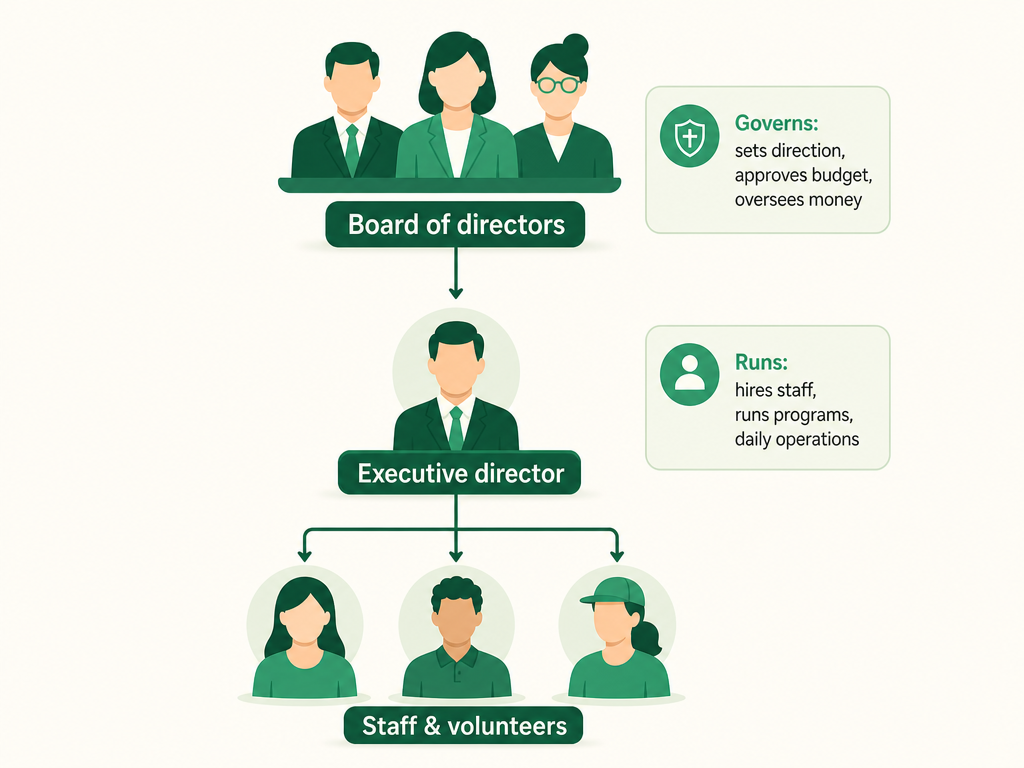
The board’s job is direction and oversight: set the mission, approve the budget, hire the executive director, and watch the money. The executive director’s job is execution: hire and manage the rest of the staff, run the programs, and handle daily operations. The board supervises exactly one employee — the executive director — and works through that person rather than around them. A board that starts directing individual staff or signing off on routine purchases has crossed the line from governing into managing, and it usually means the executive director isn’t being allowed to do the job the board hired them for.
This is also why most boards meet only a handful of times a year. Governance is periodic — approve, review, decide, oversee — while running the organization is continuous. The two roles fit together precisely because they don’t overlap.
The fiduciary duties every nonprofit director owes
Every nonprofit director carries three legal duties that courts apply to any nonprofit board. They aren’t suggestions — they’re the standard a regulator, a donor, or a judge would measure a director against if something went wrong.
- Duty of care. Show up, stay informed, and make the decisions a reasonably prudent person would. Read the financials before approving them; don’t rubber-stamp what staff puts in front of you.
- Duty of loyalty. Put the organization’s interest ahead of your own. This is the source of conflict-of-interest rules — a director who stands to gain from a decision discloses it and steps out of the vote.
- Duty of obedience. Keep the organization inside its stated charitable purpose, and follow its own bylaws and the law.
Underneath these sits the rule that gives them teeth. A 501(c)(3)‘s earnings can’t benefit insiders beyond reasonable pay, and a board that fails to guard against that puts the exemption itself at risk. The IRS spells this out in IRS Publication 1828, which warns that an organization serving private interests rather than public ones risks losing its tax-exempt status. An independent board enforcing these duties is the organization’s main defense against that outcome.
How a nonprofit board is structured — officers and positions
A nonprofit board fills a small set of officer positions that state law and the bylaws define, even when the rest of the board serves without a title. Most boards have at minimum a chair (or president), a treasurer, and a secretary, with other directors serving as voting members.
- Board chair / president — runs the meetings, sets the agenda, and is usually the board’s point of contact with the executive director.
- Treasurer — leads the board’s financial oversight, presents the financials, and works with whoever keeps the books.
- Secretary — keeps the minutes and the official records, and makes sure the organization follows its own bylaws.
- Directors at large — the remaining voting members who bring judgment, expertise, and an outside check to the board’s decisions.
Boards also do much of their work in committees — a finance or audit committee, a governance committee, and so on. The full breakdown of board positions, who does what, and how committees fit is a topic of its own.
Do nonprofit board members get paid?
Nonprofit board members are usually unpaid — the overwhelming majority of directors serve as volunteers, and that’s the norm the IRS and donors expect. Nonprofits may reimburse directors for actual expenses like travel, and a small number of large organizations pay modest compensation for board service, but a board where members draw real money from the organization invites scrutiny, because it cuts against the volunteer-stewardship model and edges toward the private-benefit problem the rules exist to prevent. Whether board members get paid — including the rare cases where pay is allowed and how it’s documented — is a question worth its own answer.
What the IRS requires of a 501(c)(3) board of directors
A 501(c)(3)‘s board has to meet a handful of requirements for the organization to get and keep its exemption. The headline ones:
- At least three directors. The IRS expects a minimum of three, and most states agree. A one- or two-person board can’t provide the independent oversight the structure is meant to create.
- A majority of unrelated, independent members. A board stacked with one family or one person’s business partners can’t credibly check the people it’s supposed to check, and the IRS scrutinizes boards where related parties or paid staff hold a majority.
- No private inurement. None of the organization’s earnings may flow to insiders beyond reasonable compensation, and no director may vote on their own pay.
- A real role in governance. The board must actually meet, decide, and keep records — a board that exists only on paper is a red flag.
These 501(c)(3) board requirements run deep enough to warrant a guide of their own. The same standards that protect a nonprofit’s exemption are what a board’s financial oversight is built to satisfy — an independent board with clean, reviewed books is the documentation that the organization served its mission and not someone’s private interest.
How church boards fit — trustees, elders, and a vestry
Church boards are a faith-based variant of the nonprofit board, with different names for the same legal role. A church that incorporates is a nonprofit, so it has a board of directors in the eyes of the law — but most churches call that board something drawn from their tradition: a board of trustees, a body of elders, a vestry, or a session. The titles change with the church’s polity; the fiduciary duties don’t. Whatever a congregation calls its board, the people named in its incorporation papers carry the same duties of care, loyalty, and obedience as any other nonprofit director.
Churches do get a few breaks general nonprofits don’t — they’re automatically tax-exempt without applying, and they don’t file a Form 990 — but their boards govern under the same rules. If you run or serve a congregation, the church board of trustees guide is this page written for churches, and whether churches are tax-exempt covers the 501(c)(3) side of the faith-based picture.
FAQ
What is a board for a nonprofit? A board for a nonprofit is the group of people legally responsible for governing the organization — setting its mission and direction, overseeing its finances, and hiring and supervising the executive director who runs it. Because a nonprofit has no owners, the board stands in for them and answers to the public and the IRS for how the organization is run. Every 501(c)(3) is required to have one.
Who holds the most power in a nonprofit? The board of directors holds the most power in a nonprofit, but it holds it collectively, not as individuals. The board acts as a body, by vote, and no single member — not even the chair — can act alone. Day-to-day authority is delegated to the executive director, who runs the organization, but the executive director answers to the board, and the board can hire or remove that person. So ultimate authority sits with the board acting together.
What does it mean to be a director of a nonprofit? Being a director of a nonprofit means serving as a voting member of its governing board, with a legal fiduciary duty to act in the organization’s interest rather than your own. A director helps set direction, approves the budget, reviews the financials, and shares responsibility for hiring and overseeing the executive director. Most directors are unpaid volunteers, and each carries the duties of care, loyalty, and obedience.
What is the role of a board of directors? The role of a nonprofit board of directors is to govern the organization: set its mission and strategy, oversee its finances, hire and supervise the executive director, and make sure the organization follows the law and stays true to its charitable purpose. The board governs and oversees; the staff, led by the executive director, runs the organization day to day.
A board can only oversee money it can actually see. Vestrybooks gives the board view-only access to live, reconciled books, so financial oversight is real instead of a report taken on faith. See how it works.
This is general information, not legal or tax advice — confirm your organization’s situation with a qualified professional.
This article is general information for church treasurers, not professional tax or legal advice. For your church's situation, consult a qualified accountant or attorney.
Nonprofit accounting, minus the headache.
Vestrybooks does fund accounting, donor tracking, and board-ready reports for churches and faith-based nonprofits.
A real free plan · no credit card · your data stays yours