Blog · Nonprofit formation
How to start a nonprofit in Vermont
June 28, 2026 · By Benjamin Reinke
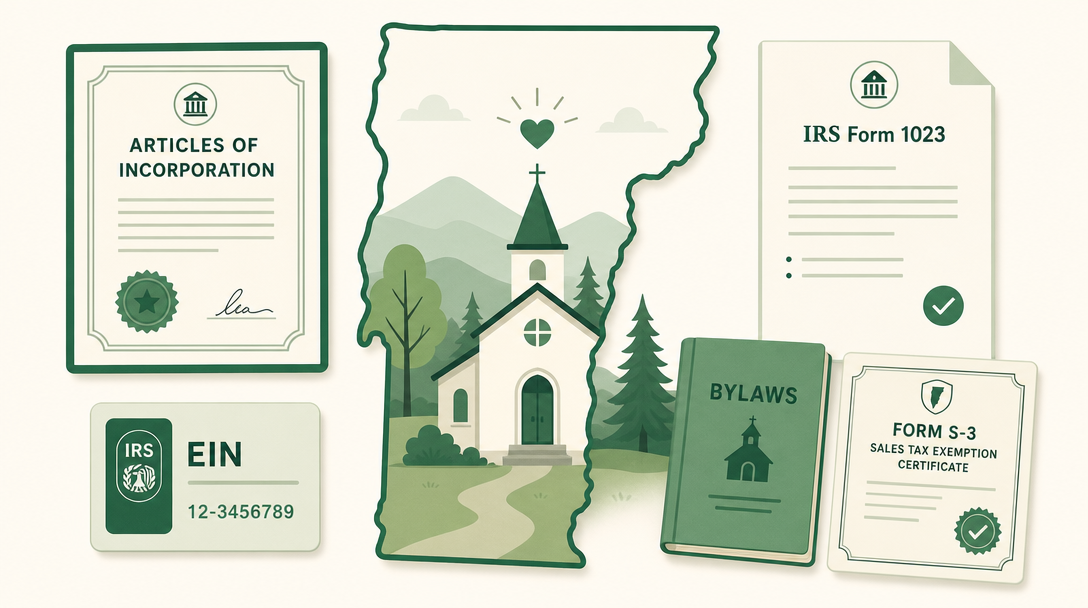
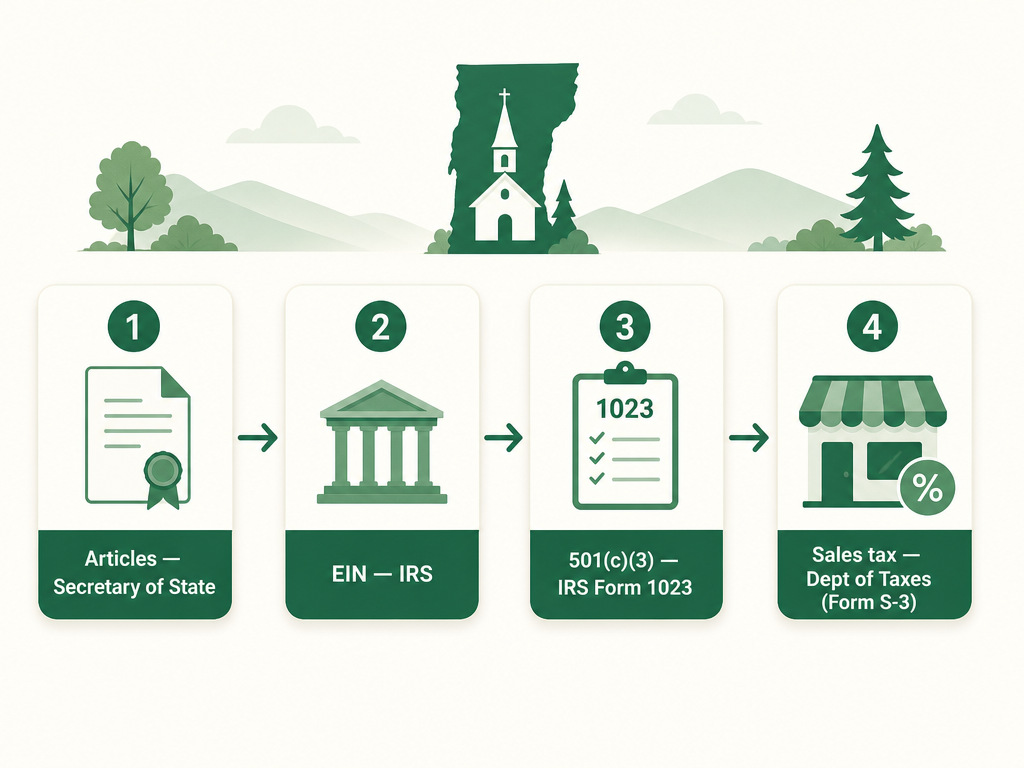
Short answer: To start a nonprofit in Vermont, you incorporate by filing Articles of Incorporation of a Vermont Nonprofit Corporation with the Vermont Secretary of State, Corporations Division ($155 as of 2026), get a free EIN from the IRS, adopt bylaws, and seat a board of at least three directors — Vermont law sets that floor. Then comes the part people miss: a nonprofit is not automatically tax-exempt, so you file IRS Form 1023 (or 1023-EZ) to become a 501(c)(3). On the Vermont side, the state keeps things lighter than most: there is no general charitable-solicitation registration for the charity itself — only paid fundraisers register with the Attorney General — so you do not file an annual fundraising registration the way California or many states demand. You will file a biennial report with the Secretary of State to keep the corporation in good standing, and to skip sales tax on purchases you register for a Vermont Business Tax Account and use Form S-3 with the Department of Taxes.
The federal core — EIN, bylaws, board, and the 501(c)(3) application — is the same in every state. For the full national walkthrough, read how to start a nonprofit; this page focuses on the Vermont layer stacked on top of it, where the state-specific forms, fees, and agencies actually live.
The formation steps that are the same anywhere
Forming a nonprofit in Vermont follows the standard checklist, and most of it is federal rather than state-specific:
- Incorporate as a Vermont nonprofit corporation (the Vermont-specific part — covered in detail below).
- Get an EIN — a free federal tax ID from the IRS, applied for directly at irs.gov. Never pay a third party for one; the EIN is always free.
- Adopt bylaws — the organization’s internal rulebook for decisions, leadership, and money. Start from a proven document rather than a blank page; see nonprofit bylaws for what to include.
- Seat a board of directors who govern the organization, set policy, and hold it accountable.
- Apply for 501(c)(3) with Form 1023 — this is the step that turns a nonprofit corporation into a tax-exempt charity. Unlike a church, an ordinary nonprofit is not automatically exempt; you must file IRS Form 1023 (or the streamlined Form 1023-EZ if you qualify) and receive a determination letter (IRS, applying for 501(c)(3) status). The full path is in how to start a 501(c)(3).
- Open a bank account in the nonprofit’s legal name using the EIN and formation documents.
- Set up the books on fund accounting from day one, before the first grant or donation arrives.
Each of these is walked step by step in the national formation guide linked above. The rest of this page is the Vermont layer on top.
Incorporating a nonprofit in Vermont
Vermont creates the nonprofit as a legal entity when you file Articles of Incorporation of a Vermont Nonprofit Corporation with the Vermont Secretary of State, Corporations Division. The filing fee is $155 as of 2026; confirm the current amount with the Vermont Secretary of State fee schedule, since fees change. Most filers register online through the state’s business portal, which usually processes in about a business day; paper filings take longer.
The Articles form asks for the nonprofit’s name, its registered agent in Vermont, whether it is a public benefit or mutual benefit corporation, and a business description. The state’s form lets you tick that the organization is a 501(c)(3) charitable entity, but the IRS still wants two clauses spelled out in your governing documents, and you should make sure they are present rather than assume the checkbox covers them:
- A 501(c)(3) purpose clause stating the organization is formed exclusively for charitable, religious, educational, or other exempt purposes.
- A dissolution clause stating that if the nonprofit closes, its assets pass to another 501(c)(3) organization, not to any individual.
Getting that language right at formation saves an amendment later. The full breakdown of what these documents need is in articles of incorporation. On board size, Vermont is stricter than some states: a nonprofit corporation’s board of directors must consist of three or more individuals, and the number can never drop below three, under 11B V.S.A. § 8.03. There is no one-director shortcut here, which is just as well — the IRS treats a tiny board as a red flag on the 1023 anyway.
One follow-up the state requires of every nonprofit corporation: a biennial report filed with the Secretary of State every two years to keep your officers, address, and registered agent current on the public record. The report is $35 if any officer, director, or employee was compensated in the prior calendar year, and $0 if none were, per the Vermont Secretary of State fee schedule. Let it lapse and the state can administratively terminate the corporation.
Charitable registration in Vermont
Here is where Vermont surprises people who have formed nonprofits in other states: Vermont does not require general charitable-solicitation registration for the charity itself. A nonprofit asking the public for donations in Vermont does not file an initial registration form or an annual renewal with the state the way charities must in California, New York, and most other states. That is the verified current position, not a temporary lapse — Vermont has long regulated fundraising through the conduct of paid fundraisers rather than a charity registry.
What Vermont does regulate is paid fundraisers. Under Vermont’s Charitable Solicitations Law, 9 V.S.A. § 2471 et seq., a paid fundraiser soliciting on behalf of a charity must file a notice of solicitation with the Attorney General’s Office before each campaign, post a $20,000 bond, file a post-campaign financial report, and make specific disclosures when asking for money (Vermont Attorney General, charities and paid fundraisers). If your nonprofit runs its own appeals with staff and volunteers, none of that applies to you. The obligation lands on the professional solicitor you hire, not on the charity.
A word of caution rather than complacency: this is the one area where states change their minds, and bills to add a charity registry surface periodically. Before you launch a fundraising campaign, confirm the current rule with the Vermont Attorney General’s charities page. And remember that the lighter Vermont rule says nothing about other states — the moment you solicit donors who live elsewhere, those states’ registration laws can reach you.
Claiming the Vermont sales tax exemption (Form S-3)
Vermont does give qualifying 501(c)(3) nonprofits a real break on sales tax, and the mechanism is specific. Only federally designated 501(c)(3) organizations are normally exempt from Vermont Sales Tax on the taxable items they buy — a nonprofit that holds, say, 501(c)(4) status does not get this exemption (Vermont Department of Taxes, sales and use tax for nonprofits).
The process runs in two parts. First, register for a Vermont Business Tax Account with the Vermont Department of Taxes; you cannot use the exemption until that account exists. Then, for each qualifying purchase, complete Form S-3, Vermont Sales Tax Exemption Certificate for Resale and Exempt Organizations, and present it to the seller at the time of purchase. The certificate goes to the vendor, not to the Department — there is no exemption application you mail in to the state and wait on. The seller keeps the form on file and does not charge you sales tax. If you buy from an out-of-state vendor who does not collect Vermont tax, watch for use tax, which can apply to untaxed taxable purchases. Confirm the current procedure and form with the Vermont Department of Taxes before you rely on it.
On income tax, the picture is straightforward: Vermont follows the federal IRS exemption designations, so a nonprofit that holds a 501(c)(3) determination letter is generally exempt from Vermont corporate income tax on its exempt-purpose activity. Vermont does not impose a standing minimum franchise tax on exempt nonprofits the way California’s $800 minimum hits unexempted corporations. The catch most groups forget is unrelated business income — money the nonprofit earns from a regular trade or business unrelated to its mission can still be taxable at both the federal and Vermont levels.
Vermont filing at a glance
The table below maps each step to its agency, form, and cost. Treat the fees as accurate as of 2026 and confirm with the listed agency, since Vermont fees change.
| What you’re doing | Agency | Form | Fee (as of 2026) |
|---|---|---|---|
| Incorporate the nonprofit | Vermont Secretary of State | Articles of Incorporation (Nonprofit) | $155 (confirm) |
| Keep the corporation current | Vermont Secretary of State | Biennial report (every two years) | $35 / $0 |
| Get a federal tax ID | IRS | EIN application (online) | Free |
| Apply for 501(c)(3) status | IRS | Form 1023 or 1023-EZ | $600 / $275 user fee |
| Register to fundraise | None for the charity | Paid fundraisers file with the AG | No charity filing |
| Claim sales tax exemption | Vermont Department of Taxes | Form S-3 (given to the seller) | No fee |
| State income tax | Vermont Department of Taxes | Follows federal 501(c)(3) | Exempt (except UBIT) |
Setting up the books once the nonprofit exists in Vermont
Once the entity is formed and the exemption certificate is in hand, the work shifts from one-time paperwork to the monthly routine — and that routine is where nonprofits either hold together or quietly fall apart. A nonprofit holds money in trust for the people and purposes it serves, much of it restricted by donors or grant terms, so it tracks money by fund rather than as a single bottom line. Set the books on fund accounting before the first grant lands, keep the giving records donors need, and document that the board reviews the finances; the discipline is covered in nonprofit accounting. The Vermont date to keep on your calendar is the biennial report — that two-year filing to the Secretary of State is what keeps the corporation in good standing, and letting it slide can put the entity at risk of administrative termination.
FAQ
How much does it cost to start a nonprofit in Vermont? The required state cost is small. Filing the Articles of Incorporation with the Secretary of State costs $155 as of 2026, and the biennial report that follows is $35 or $0 depending on whether anyone was compensated. There is no charitable-registration fee for the nonprofit itself, and the Form S-3 sales tax exemption has no fee. The bigger line item is federal: the IRS charges a $275 user fee for Form 1023-EZ or $600 for the full Form 1023, which is what actually makes you a 501(c)(3). Realistically, a small Vermont nonprofit can be stood up properly for a few hundred dollars once you include the federal exemption application.
Does a Vermont nonprofit have to register to solicit donations? Generally no. Vermont does not require the charity itself to register before soliciting donations within the state; the state instead regulates paid fundraisers, who file a notice of solicitation with the Attorney General and post a bond before each campaign (Vermont Attorney General, charities and paid fundraisers). Confirm this is still current before a campaign, and note that other states where your donors live may require their own registration.
How many board members does a Vermont nonprofit need? At least three. Vermont law requires a nonprofit corporation’s board of directors to consist of three or more individuals, and the number can never be reduced below three, under 11B V.S.A. § 8.03. A board of at least three mostly-unrelated directors also signals real governance and smooths the 501(c)(3) application, so one person cannot stand up a Vermont nonprofit alone — you need to recruit a board first.
How long does it take to start a nonprofit in Vermont? The Vermont incorporation itself is quick — online filings with the Secretary of State often process in around a business day, with paper filings taking longer. The slow part is federal: the IRS can take anywhere from about a month (Form 1023-EZ) to many months (full Form 1023) to issue the 501(c)(3) determination letter, which is what you need before claiming the sales tax exemption. Plan for the state entity to exist within days but the full tax-exempt status to take several months end to end.
Vestrybooks sets up a new Vermont nonprofit’s books on fund accounting from day one — funds, reconciliation, and the board reports — so the financial side is right before the first grant arrives. See how it works.
More state guides: Maine · New Hampshire · Massachusetts · Rhode Island · Connecticut
This article is general information for church treasurers, not professional tax or legal advice. For your church's situation, consult a qualified accountant or attorney.
Nonprofit accounting, minus the headache.
Vestrybooks does fund accounting, donor tracking, and board-ready reports for churches and faith-based nonprofits.
A real free plan · no credit card · your data stays yours