Blog · Nonprofit formation
How to start a nonprofit in New Jersey
June 28, 2026 · By Benjamin Reinke
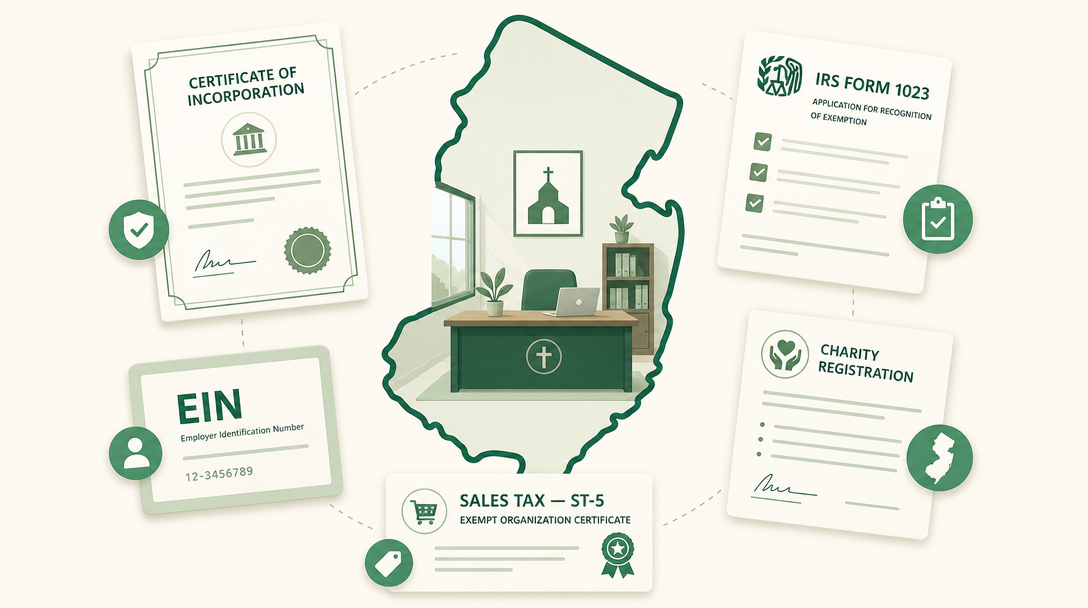
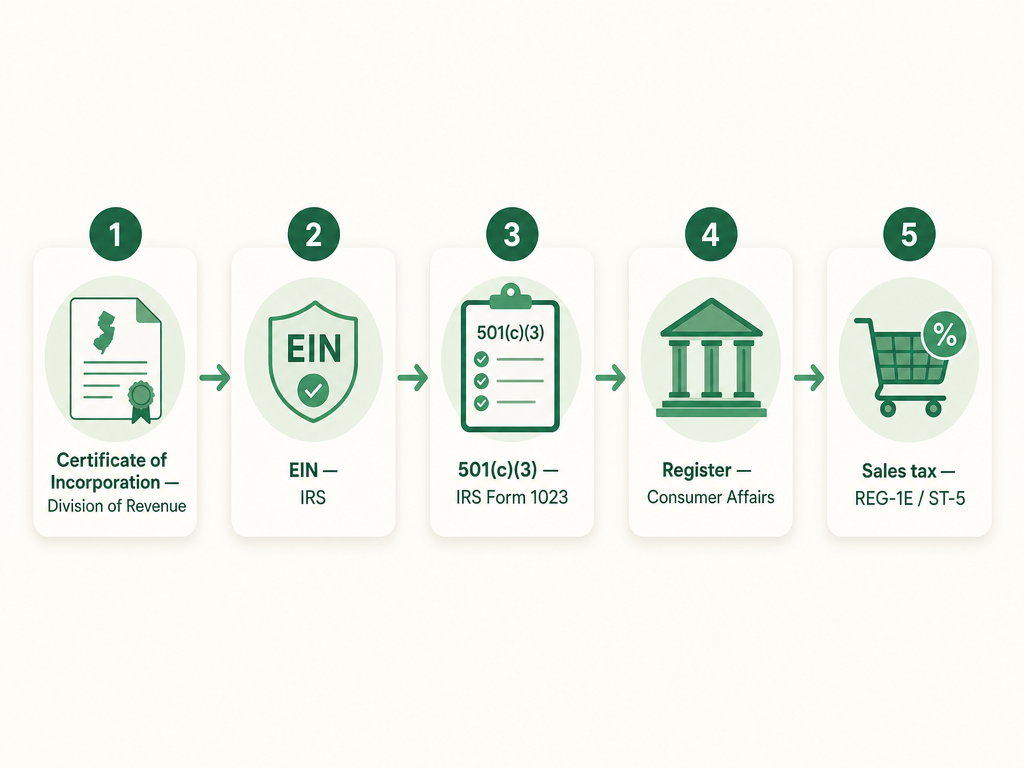
Short answer: To start a nonprofit in New Jersey, you incorporate by filing a Certificate of Incorporation (the Public Records Filing for New Business Entity) with the New Jersey Division of Revenue and Enterprise Services ($75 as of 2026), get a free EIN from the IRS, adopt bylaws, and seat a board of at least three trustees. Then comes the part people miss: a nonprofit is not automatically tax-exempt, so you file IRS Form 1023 (or 1023-EZ) to become a 501(c)(3). On the New Jersey side, you complete a separate business registration (Form NJ-REG), register with the Division of Consumer Affairs, Charities Registration Section before you fundraise (Form CRI-200 or CRI-150I), and apply for the state sales tax exemption with Form REG-1E to receive an ST-5 Exempt Organization Certificate. Get the ST-5 and qualifying purchases for your exempt purposes are free of New Jersey sales tax.
The federal core — EIN, bylaws, board, and the 501(c)(3) application — is the same in every state. For the full national walkthrough, read how to start a nonprofit; this page focuses on the New Jersey layer stacked on top of it, where the state-specific forms, fees, and agencies actually live.
The formation steps that are the same anywhere
Forming a nonprofit in New Jersey follows the standard checklist, and most of it is federal rather than state-specific:
- Incorporate as a nonprofit corporation (the New Jersey-specific part — covered in detail below).
- Get an EIN — a free federal tax ID from the IRS, applied for directly at irs.gov. Never pay a third party for one; the EIN is always free.
- Adopt bylaws — the organization’s internal rulebook for decisions, leadership, and money. Start from a proven document rather than a blank page; see nonprofit bylaws for what to include.
- Seat a board of trustees who govern the organization, set policy, and hold it accountable.
- Apply for 501(c)(3) with Form 1023 — this is the step that turns a nonprofit corporation into a tax-exempt charity. Unlike a church, an ordinary nonprofit is not automatically exempt; you must file IRS Form 1023 (or the streamlined Form 1023-EZ if you qualify) and receive a determination letter (IRS, applying for 501(c)(3) status). The full path is in how to start a 501(c)(3).
- Open a bank account in the nonprofit’s legal name using the EIN and formation documents.
- Set up the books on fund accounting from day one, before the first grant or donation arrives.
Each of these is walked step by step in the national formation guide linked above. The rest of this page is the New Jersey layer on top.
Incorporating a nonprofit in New Jersey
New Jersey creates the nonprofit as a legal entity when you file a Certificate of Incorporation with the Division of Revenue and Enterprise Services, part of the Department of the Treasury. Most founders file the Public Records Filing for New Business Entity, the state’s combined form for new corporations. The filing fee for a domestic nonprofit corporation is $75 as of 2026; confirm the current amount with the New Jersey Division of Revenue, since fees change. You can file online through the state’s business portal or by mail.
The certificate asks for the nonprofit’s name, its registered agent and office in New Jersey, the names of its incorporators and initial trustees, and a statement of purpose. New Jersey’s Nonprofit Corporation Act sets the board floor here: under N.J.S.A. 15A:6-2, “the number of trustees of a corporation shall be not less than three,” so plan on recruiting at least three trustees before you file. Two clauses belong in the certificate from the start, because the IRS will look for them on your Form 1023:
- A 501(c)(3) purpose clause stating the organization is formed exclusively for charitable, religious, educational, or other exempt purposes.
- A dissolution clause stating that if the nonprofit closes, its assets pass to another 501(c)(3) organization, not to any individual (NJ Department of State, starting a nonprofit).
Getting that language right at formation saves an amendment later. The full breakdown of what these documents need is in articles of incorporation. One follow-up the state requires of every new entity: after the certificate is filed, you complete a separate business registration using Form NJ-REG, the tax and employer registration that connects the nonprofit to the Division of Taxation. NJ-REG is what later lets the organization obtain a Business Registration Certificate and apply for the sales tax exemption described below, so treat it as part of the formation, not an afterthought.
Registering to fundraise in New Jersey
Here is the step that trips up nonprofits coming from a church background, where it usually does not apply: New Jersey requires most charities to register with the Division of Consumer Affairs, Charities Registration Section before they solicit donations from the public. A church taking offerings can often skip this; a general nonprofit asking the public for money cannot.
Which form you file depends on how much you raise. Organizations with gross contributions of $25,000 or less in the fiscal year file the short form, CRI-200, which carries a $30 registration fee. Organizations above that threshold — or any that use a paid professional fundraiser — file the long form, CRI-150I, whose fee is tiered by gross contributions: $60 for $25,001 to $100,000, $150 for $100,001 to $500,000, and $250 for more than $500,000 (NJ Division of Consumer Affairs, charities forms). Confirm the current fee schedule with Consumer Affairs before filing, since the tiers have been revised.
Registration is not one-and-done. Each year you renew — the short-form filers re-file the CRI-200, and long-form filers file the CRI-300R renewal — generally within six months after the close of your fiscal year, and a late filing adds a $25 late fee. New Jersey now lets the smallest organizations choose: a charity raising $10,000 or less a year may decide whether to register, but it must register within 30 days of crossing that threshold (NJ Division of Consumer Affairs, charities forms). Treat the registration as required the moment you start asking the public for money at any real scale.
Claiming the New Jersey sales tax exemption (ST-5)
Good news that sets New Jersey apart from some states: a qualifying 501(c)(3) can buy free of New Jersey sales and use tax. The exemption is not automatic, though — it runs through a separate application to the Division of Taxation.
You apply with Form REG-1E, Application for ST-5 Exempt Organization Certificate, and there is no fee to file it. Once the Division of Taxation approves the application, it issues the organization an ST-5 Exempt Organization Certificate, and you give vendors a copy at the point of sale. The ST-5 covers purchases and rentals of goods, equipment and motor vehicles, plus services, meals, admissions and hotel occupancies, as long as they are directly related to the organization’s exempt purposes and paid with organization funds (NJ Division of Taxation, ST-5 exempt organizations). Two practical catches worth knowing: energy purchases are not covered, and an item paid for with personal funds does not qualify even if the organization later reimburses the buyer — the payment must come from the nonprofit’s own account. Allow about three weeks for the Division of Taxation to process a complete REG-1E and issue the certificate.
New Jersey filing at a glance
The table below maps each step to its agency, form, and cost. Treat the fees as accurate as of 2026 and confirm with the listed agency, since New Jersey fees change.
| What you’re doing | Agency | Form | Fee (as of 2026) |
|---|---|---|---|
| Incorporate the nonprofit | NJ Division of Revenue | Certificate of Incorporation (Public Records Filing) | $75 (confirm) |
| Register the entity for tax | NJ Division of Revenue / Taxation | Form NJ-REG | No fee |
| Get a federal tax ID | IRS | EIN application (online) | Free |
| Apply for 501(c)(3) status | IRS | Form 1023 or 1023-EZ | $600 / $275 user fee |
| Register to fundraise | NJ Division of Consumer Affairs | Form CRI-200 or CRI-150I | $30 / $60–$250 tiered |
| Claim sales tax exemption | NJ Division of Taxation | Form REG-1E (issues ST-5) | No fee |
Setting up the books once the nonprofit exists in New Jersey
Once the entity is formed and the exemptions are filed, the work shifts from one-time paperwork to the monthly routine — and that routine is where nonprofits either hold together or quietly fall apart. A nonprofit holds money in trust for the people and purposes it serves, much of it restricted by donors or grant terms, so it tracks money by fund rather than as a single bottom line. Set the books on fund accounting before the first grant lands, keep the giving records donors need, and document that the board reviews the finances; the discipline is covered in nonprofit accounting. The New Jersey angle to keep on your calendar is the charities renewal — that annual filing to the Division of Consumer Affairs is what keeps your fundraising registration current, and letting it lapse can put the registration into delinquent status.
FAQ
How much does it cost to start a nonprofit in New Jersey? The required state cost is modest. Filing the Certificate of Incorporation with the Division of Revenue costs $75 as of 2026, the NJ-REG business registration has no fee, and the Division of Consumer Affairs charitable registration starts at $30 for the short-form CRI-200 (more for larger organizations on the CRI-150I). The state sales tax exemption form (REG-1E) is also free. So the New Jersey paperwork runs roughly $105 plus your time. The bigger line item is federal: the IRS charges a $275 user fee for Form 1023-EZ or $600 for the full Form 1023, which is what actually makes you a 501(c)(3). A small New Jersey nonprofit can be stood up properly for a few hundred dollars once you include the federal exemption application.
Do you have to register a nonprofit with New Jersey to fundraise? Yes, in most cases. New Jersey requires charities that solicit donations from the public to register with the Division of Consumer Affairs, Charities Registration Section, using Form CRI-200 or CRI-150I depending on how much they raise, and to renew each year (NJ Division of Consumer Affairs, charities forms). The smallest organizations — those raising $10,000 or less a year — may choose whether to register, but must do so within 30 days of crossing that threshold. This registration is separate from incorporating with the Division of Revenue and separate from your IRS 501(c)(3) application; skipping it can put your organization out of compliance before you have raised much at all.
How long does it take to start a nonprofit in New Jersey? The New Jersey incorporation itself is relatively quick — online filings with the Division of Revenue are processed fast, and the ST-5 sales tax certificate takes about three weeks after a complete REG-1E. The slow part is federal: the IRS can take anywhere from about a month (Form 1023-EZ) to many months (full Form 1023) to issue the 501(c)(3) determination letter. Plan for the state entity to exist within a week or two but the full tax-exempt status to take several months end to end.
Can one person start a nonprofit in New Jersey? Not on their own board. New Jersey’s Nonprofit Corporation Act requires a minimum of three trustees under N.J.S.A. 15A:6-2, so a single-person board does not meet the legal floor — and the IRS scrutinizes thinly governed nonprofits on the Form 1023 anyway. One person can start the process and drive it, but you will need to recruit at least two more trustees before you incorporate and apply for tax-exempt status.
Vestrybooks sets up a new New Jersey nonprofit’s books on fund accounting from day one — funds, reconciliation, and the board reports — so the financial side is right before the first grant arrives. See how it works.
More state guides: New York · Pennsylvania · Delaware · Maryland
This article is general information for church treasurers, not professional tax or legal advice. For your church's situation, consult a qualified accountant or attorney.
Nonprofit accounting, minus the headache.
Vestrybooks does fund accounting, donor tracking, and board-ready reports for churches and faith-based nonprofits.
A real free plan · no credit card · your data stays yours