Blog · Nonprofit formation
What a 501(c)(3) determination letter is and how to get one
June 27, 2026 · By Benjamin Reinke
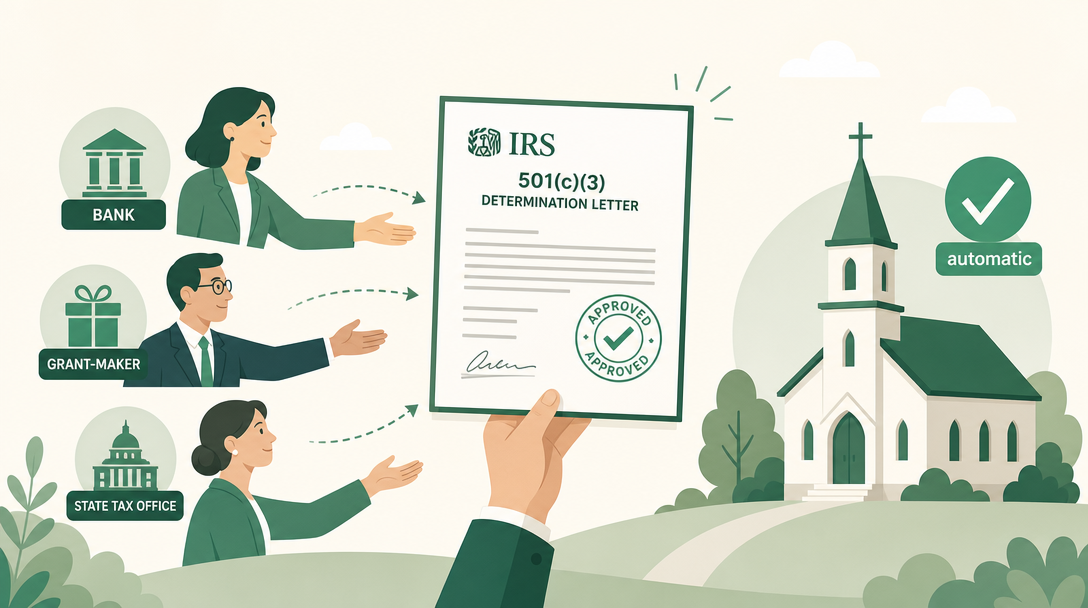
Short answer: A 501(c)(3) determination letter is the official IRS letter that recognizes your organization as tax-exempt under section 501(c)(3). The IRS issues it after it approves your application for exemption — Form 1023 or the shorter Form 1023-EZ. The letter is your proof of exempt status: banks, grant-makers, and state tax offices ask to see it. One big exception runs through everything below — a church is automatically tax-exempt and never has to apply, so many churches have no determination letter at all, and that’s fine.
What a 501(c)(3) determination letter is
A 501(c)(3) determination letter is the document the IRS sends an organization once it agrees the organization qualifies as tax-exempt under section 501(c)(3) of the tax code. The letter states that the IRS has “determined” the organization is exempt from federal income tax and, for a public charity, that contributions to it are deductible by donors. It also notes the organization’s public-charity classification and the effective date of the exemption — usually the formation date, if the application was filed in time.
You don’t draft or buy this letter. The IRS produces it as the outcome of reviewing an application for recognition of exemption. That application is Form 1023 (the full version) or Form 1023-EZ (the streamlined version for small organizations), both described on the IRS about-Form-1023 page. No approved application, no letter. The letter is the last step of a longer formation sequence laid out in how to start a nonprofit — incorporate, get an EIN, adopt bylaws, then file — and the application itself is covered in how to start a 501(c)(3). This page is about the letter that process produces and what you do with it afterward.
What a 501(c)(3) determination letter is for
The determination letter exists to be shown to other people who need proof that your exemption is real. It’s the single document that answers “are you actually a 501(c)(3)?” with an IRS signature behind it. The usual moments it comes up:
- Opening a bank account. Most banks ask for the determination letter (plus your EIN and articles) before they’ll open a nonprofit account in the organization’s name.
- Applying for grants. Many foundations and grant-makers require a copy of the determination letter as part of the application — it’s how they confirm gifts to you are deductible and that you’re an eligible grantee.
- Claiming state and local exemptions. State income-tax, sales-tax, and property-tax exemptions are separate from the federal one, and many state forms ask you to attach the federal determination letter as the starting point.
- Reassuring donors. Larger donors, and donor-advised funds, often want to see the letter before making a significant gift.
The letter doesn’t grant any of those benefits by itself — your exempt status does that. It’s the portable proof of that status.
Churches are automatically tax-exempt and often have no determination letter
Here is the part faith-based organizations need to understand, because it reverses the usual rule. A church is treated as tax-exempt under 501(c)(3) automatically, the moment it meets the requirements, without filing Form 1023 and without receiving a determination letter. Unlike a typical nonprofit, a qualifying church does not have to apply to the IRS for recognition at all. This is the same point covered in are churches tax exempt, and it has a direct consequence: a church can be fully, legally exempt and still have no determination letter in its files.
That isn’t a problem. A church with no letter has lost nothing — its exemption never depended on one. So if you’re a church treasurer who can’t find a determination letter, the first question isn’t “where did it go,” it’s “did we ever apply?” Many churches never did.
Plenty of churches do apply anyway, on purpose. A determination letter is convenient documentation — it saves arguments with banks, satisfies grant-makers who ask for one, and supports state exemption claims. Applying is optional, not required. If your church chose to file Form 1023 and was approved, you have a letter to keep track of; if it didn’t, there’s nothing to track down. (Churches also don’t file the annual Form 990 — see Form 990 for who does.)
How to get a copy of a lost 501(c)(3) determination letter
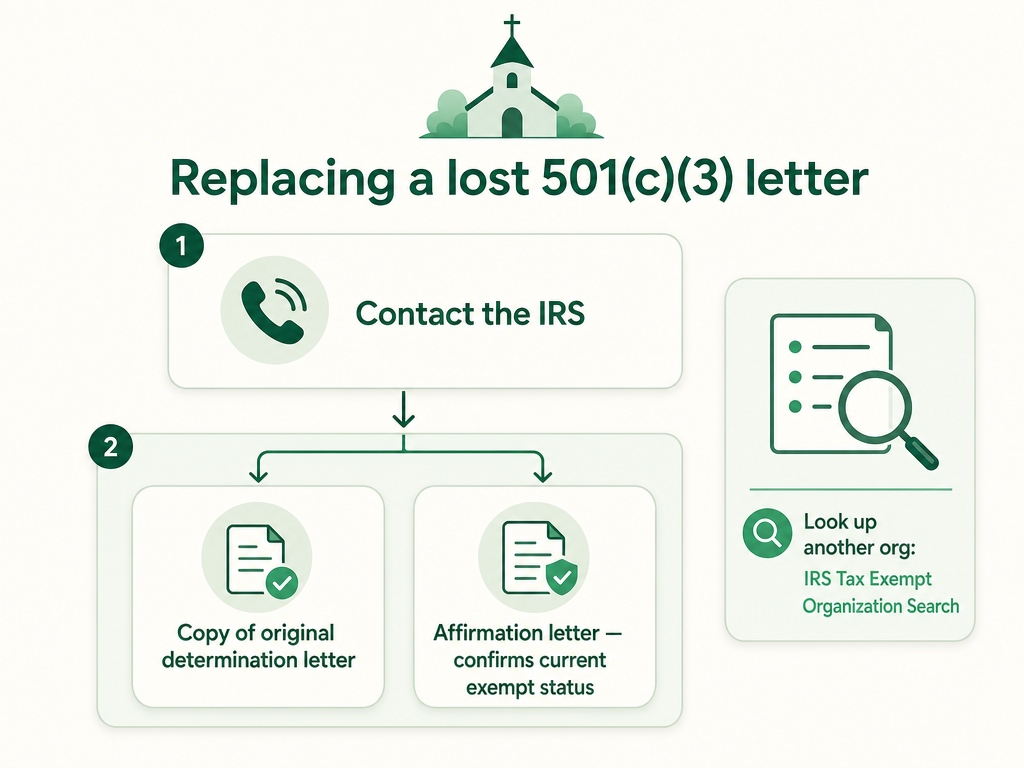
If your organization did receive a determination letter and you’ve lost it, you don’t reapply — you ask the IRS for a copy, and there are two things it can send.
| What you need | How to get it |
|---|---|
| A copy of a letter issued Jan. 1, 2014 or later | Download it yourself from the IRS Tax Exempt Organization Search — the IRS posts these letters online. |
| A copy of a letter issued before 2014 | Request it from the IRS by filing Form 4506-B, the request for a copy of an exempt organization’s application or letter. |
| An affirmation letter (current exempt status) | Also request it with Form 4506-B. An affirmation letter is the IRS letter confirming your organization’s current exempt status; the IRS says it “serves the same purpose for grantors and contributors as a copy of the original determination letter.” |
The affirmation letter is the practical fix when the original can’t be found or pre-dates the online archive. It restates that the organization is currently recognized as exempt, which is usually all a bank or grant-maker actually needs. If you’ve already submitted a request and it’s been more than 60 days, the IRS says to call Customer Account Services at 877-829-5500 to check the status.
How to look up another organization’s 501(c)(3) status and letter
To verify a different organization — a charity you want to donate to, a grantee, a vendor you’re vetting — use the IRS Tax Exempt Organization Search (TEOS). It’s the free, official lookup at irs.gov, and it searches five IRS data sets, including the list of organizations eligible to receive tax-deductible contributions, the auto-revocation list of organizations that lost their status, posted Form 990 filings, and copies of determination letters dated on or after January 1, 2014. For the full walkthrough of TEOS, ProPublica, and Candid, see how to look up a nonprofit’s 990.
So TEOS does two jobs at once. It tells you whether an organization is currently recognized as exempt and eligible for deductible gifts, and — for letters issued in 2014 or later — it lets you view and download the actual determination letter as a PDF. For a letter older than that, the search will confirm status but won’t have the document image; the organization itself would have to request a pre-2014 copy with Form 4506-B. Verifying status this way is the standard due-diligence step before granting to or partnering with another nonprofit.
FAQ
How do I get a copy of my 501(c)(3) determination letter? If your letter was issued on or after January 1, 2014, download it yourself from the IRS Tax Exempt Organization Search. If it’s older than that, request a copy from the IRS by filing Form 4506-B. You can also use Form 4506-B to request an affirmation letter, which confirms your current exempt status and works the same way for banks and grant-makers. After 60 days with no response, call the IRS at 877-829-5500.
What is a 501(c)(3) determination letter? It’s the official IRS letter recognizing an organization as tax-exempt under section 501(c)(3). The IRS issues it after approving an application for exemption (Form 1023 or 1023-EZ), and it serves as proof of exempt status for banks, grant-makers, and state agencies.
How long does it take to get an IRS 501(c)(3) determination letter? For a new applicant, it depends on the form. Form 1023-EZ is often approved in a few weeks; the full Form 1023 commonly takes several months. If you’re just requesting a copy of an existing letter, downloading it from the Tax Exempt Organization Search is instant, while a Form 4506-B request is processed by mail or email and takes longer.
What does a 501(c)(3) determination letter look like? It’s a short IRS letter on official letterhead addressed to the organization. It states that the IRS has determined the organization is exempt under section 501(c)(3), gives the public-charity classification and the effective date of exemption, and explains filing requirements. The IRS posts real examples through its Tax Exempt Organization Search.
Does a church need a 501(c)(3) determination letter? No. A church is automatically tax-exempt under 501(c)(3) without applying, so it isn’t required to have a determination letter and many don’t. A church can apply for one voluntarily if it wants the documentation, but its exempt status doesn’t depend on it.
Vestrybooks keeps a church or nonprofit’s books, donor records, and compensation documentation clean from day one — so the paper trail behind your exempt status is always in order. See how it works.
This is general information, not legal or tax advice — confirm your organization’s situation with a qualified professional.
This article is general information for church treasurers, not professional tax or legal advice. For your church's situation, consult a qualified accountant or attorney.
Nonprofit accounting, minus the headache.
Vestrybooks does fund accounting, donor tracking, and board-ready reports for churches and faith-based nonprofits.
A real free plan · no credit card · your data stays yours