Blog · Nonprofit formation
How to start a nonprofit in Louisiana
June 28, 2026 · By Benjamin Reinke
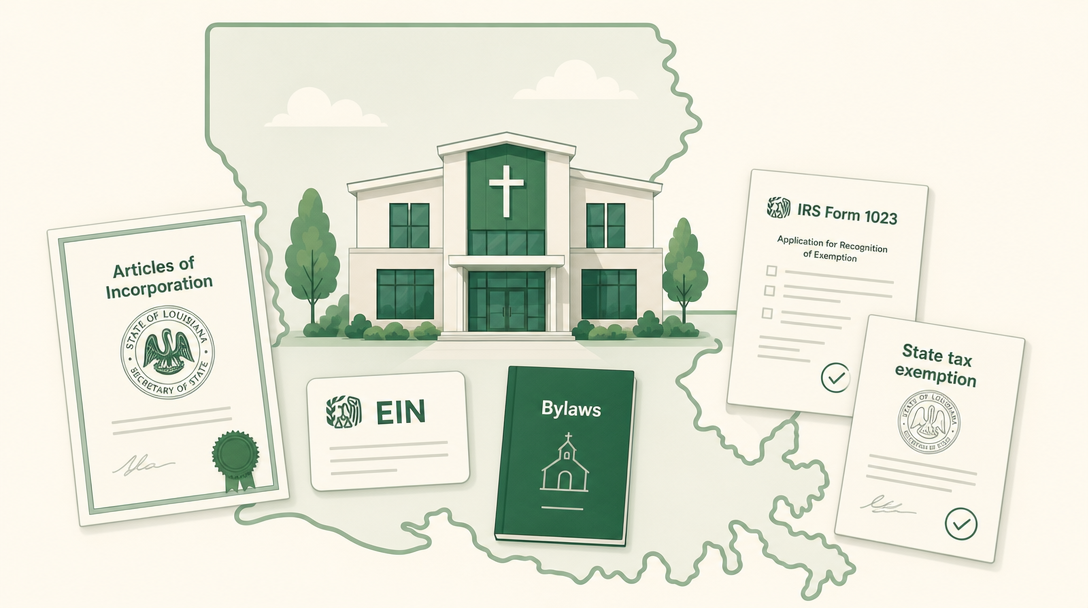
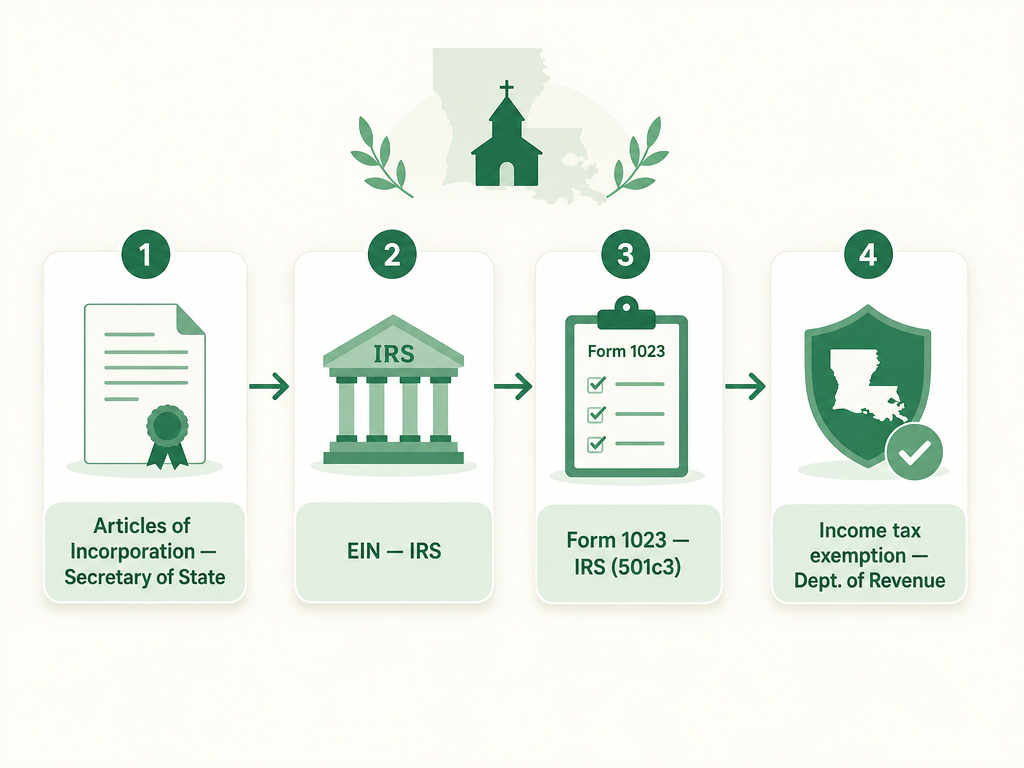
Short answer: To start a nonprofit in Louisiana, you incorporate by filing Articles of Incorporation with the Louisiana Secretary of State ($75 as of 2026), and you put the registered office, registered agent, and initial directors right inside those Articles — Louisiana folds the old “initial report” into the incorporation filing. Then get a free EIN from the IRS, adopt bylaws, and seat a board of at least three directors. The step people skip: a nonprofit is not automatically tax-exempt, so you must file IRS Form 1023 (or 1023-EZ) to become a 501(c)(3). On the Louisiana side, two facts surprise founders — the state has no broad charitable-solicitation registration for ordinary charities (only paid professional solicitors register with the Department of Justice), and Louisiana generally does not exempt a nonprofit’s purchases from sales tax. Louisiana does exempt approved 501(c)(3)s from state corporate income and franchise tax, but you apply for that separately.
Most of nonprofit formation is federal and identical in every state — incorporate, EIN, bylaws, board, and the 501(c)(3) application. For the full national walkthrough of each step, read how to start a nonprofit; this page covers the universal core briefly and then spends its time on the Louisiana layer, where the state-specific forms, fees, and agencies actually live.
The formation steps that are the same anywhere
Forming a nonprofit in Louisiana follows the standard checklist, and most of it is federal rather than state-specific:
- Incorporate as a nonprofit corporation (the Louisiana-specific part — covered in detail below).
- Get an EIN — a free federal tax ID from the IRS, applied for directly at irs.gov. Never pay a third party for one; the EIN is always free.
- Adopt bylaws — the organization’s internal rulebook for decisions, leadership, and money. Start from a proven document rather than a blank page; see nonprofit bylaws for what to include.
- Seat a board of directors who govern the organization, set policy, and hold it accountable. Louisiana requires at least three.
- Apply for 501(c)(3) with Form 1023 — this is the step that turns a nonprofit corporation into a tax-exempt charity. Unlike a church, an ordinary nonprofit is not automatically exempt; you must file IRS Form 1023 (or the streamlined Form 1023-EZ if you qualify) and receive a determination letter (IRS, applying for 501(c)(3) status). The full path is in how to start a 501(c)(3).
- Open a bank account in the nonprofit’s legal name using the EIN and formation documents.
- Set up the books on fund accounting from day one, before the first grant or donation arrives.
Each of these is walked step by step in the national formation guide linked above. The 501(c)(3) application is genuinely required here — there is no automatic exemption for an ordinary nonprofit the way there is for a church. The rest of this page is the Louisiana layer on top of that federal core.
Incorporating a nonprofit in Louisiana
Louisiana creates the nonprofit as a legal entity when you file Articles of Incorporation for a nonprofit corporation with the Louisiana Secretary of State. The filing fee is $75 as of 2026; confirm the current amount with the Louisiana Secretary of State, since fees change. You can file online through the state’s GeauxBiz portal or by mail to the Commercial Division in Baton Rouge.
Worth knowing if you read older guides: Louisiana used to require a separate initial report filed alongside the Articles, but the state no longer demands a standalone initial report. The information that report used to carry — the nonprofit’s registered office, its registered agent for service of process in Louisiana, and the initial directors — now goes directly into the Articles of Incorporation, so the practical effect is one combined filing rather than two. The Articles also need the two clauses the IRS will look for, and the smart move is to draft them in from the start rather than amend later:
- A 501(c)(3) purpose clause stating the organization is formed exclusively for charitable, religious, educational, or other exempt purposes within the meaning of section 501(c)(3).
- A dissolution clause stating that if the nonprofit closes, its assets pass to another 501(c)(3) organization or a government entity, not to any individual.
Getting that language right at formation saves a rejected 1023 and a rewrite. The full breakdown of what these documents need is in articles of incorporation. On board size, Louisiana law sets a clear floor: a nonprofit corporation is managed by a board of not less than three natural persons, except that a corporation with fewer than three members needs only as many directors as it has members (La. R.S. 12:224, board of directors). Three unrelated directors is also the practical standard the IRS expects, and it treats a one-person board as a red flag on the 1023.
Charitable solicitation in Louisiana
Here is the step that trips up nonprofits coming from other states, where a separate fundraising license is the norm: Louisiana has no broad charitable-solicitation registration that ordinary charities must file before asking the public for money. A volunteer-run nonprofit raising donations through its own board, staff, and members does not register with the state to solicit. That removes a registration — and an annual renewal — that nonprofits in many other states have to handle before they fundraise.
What Louisiana regulates instead is the professional solicitor — a paid, third-party fundraiser hired to solicit on a charity’s behalf. A professional solicitor must register with the Consumer Protection Section of the Louisiana Department of Justice at least ten days before soliciting, pay a $150 registration fee, and, if it will hold contributions, post a $25,000 surety bond; the registration is good for one year and renews annually (La. R.S. 51:1901.1, registration of professional solicitors). A salaried officer or employee of the charity is not a professional solicitor, and someone who solicits on a purely voluntary basis is not either. So the rule lands on the paid outside fundraiser, not on the charity that does its own asking. Confirm the current fee and bond amounts with the Department of Justice before you hire any outside fundraiser, since the schedule can change. The honest summary: most new Louisiana nonprofits never file a state fundraising registration — but if you contract a paid solicitor, that solicitor registers and bonds before a single ask.
Louisiana sales tax and your nonprofit
Now the honest answer most state guides skip: Louisiana generally does not give nonprofits a blanket sales tax exemption on their purchases. A 501(c)(3) letter exempts the organization from federal income tax, but it does not buy you a sales-tax break — Louisiana’s own Department of Revenue states plainly that “non-profit organizations are not generally exempt from sales tax on purchases in Louisiana” and that the exemption a charity does get “applies to income tax for the corporation” (Louisiana Department of Revenue, sales-tax exemption FAQ). So a typical Louisiana nonprofit pays state and local sales tax on the equipment, supplies, and goods it buys, the same as a for-profit would.
The exceptions are narrow and specific. Certain named categories of organization have their own carve-outs, and a nonprofit running fundraising events can apply for a limited exemption on parking fees, admissions, and sales of goods at those events using Form R-1048 — but the application must be approved before the event (the Department asks for it at least 30 days ahead), and buying the items you plan to resell is still taxable (Louisiana Department of Revenue, Form R-1048 nonprofit exemption). Budget as if your purchases are taxable, then check whether a specific exemption actually fits your activities before you rely on it.
The brighter side of the tax picture is income and franchise tax. A 501(c)(3) is exempt from Louisiana corporate income tax, and many nonprofits also qualify to be exempt from the state’s corporation franchise tax under La. R.S. 47:608 — but that franchise-tax exemption is not automatic on the federal letter; you confirm eligibility by filing Form R-4310 with the Department of Revenue. Treat the income and franchise exemption as a separate step you complete after the IRS determination arrives, not as something that turns on by itself.
Louisiana filing at a glance
The table below maps each step to its agency, form, and cost. Treat the fees as accurate as of 2026 and confirm with the listed agency, since Louisiana fees change.
| What you’re doing | Agency | Form | Fee (as of 2026) |
|---|---|---|---|
| Incorporate the nonprofit | Louisiana Secretary of State | Articles of Incorporation (registered agent and directors included) | $75 (confirm) |
| Get a federal tax ID | IRS | EIN application (online) | Free |
| Apply for 501(c)(3) status | IRS | Form 1023 or 1023-EZ | $600 / $275 user fee |
| Charitable-solicitation registration | — | Not required for ordinary charities | — |
| Professional (paid) solicitor | LA Department of Justice | Solicitor registration + bond | $150 + $25,000 bond |
| Income / franchise tax exemption | LA Department of Revenue | Form R-4310 (franchise) | No fee |
| Sales tax on purchases | LA Department of Revenue | — | Generally taxable (no blanket exemption) |
Setting up the books once the nonprofit exists in Louisiana
Once the entity is formed and the exemptions are filed, the work shifts from one-time paperwork to the monthly routine — and that routine is where nonprofits either hold together or quietly fall apart. A nonprofit holds money in trust for the people and funders who gave it, much of it restricted to a purpose (a program, a grant, a capital campaign), so it tracks money by fund rather than as a single bottom line. Set the books on fund accounting before the first grant lands, keep the donor and grant records you will need for the IRS Form 990 each year, and document that the board reviews the finances; the discipline is covered in nonprofit accounting. None of the Louisiana steps excuse a nonprofit from clean records — the 990 is public, and the state corporate filings assume an entity that knows its own numbers. The Louisiana item to keep on your calendar is the annual report to the Secretary of State, due each year by your incorporation anniversary; letting it lapse can put the corporation out of good standing.
FAQ
How much does it cost to start a nonprofit in Louisiana? The required state cost is modest. Filing Articles of Incorporation with the Louisiana Secretary of State costs $75 as of 2026, the EIN from the IRS is free, and there is no broad state fundraising registration to pay for. The real expense is federal: the IRS charges a $275 user fee for Form 1023-EZ or $600 for the full Form 1023, which is what actually makes you a 501(c)(3). The state corporate income and franchise tax exemption (Form R-4310) carries no fee. Realistically, a small Louisiana nonprofit that qualifies for the EZ form can be stood up properly for around $350 plus your time, with a larger organization on the full Form 1023 closer to $675.
Does a Louisiana nonprofit have to register to fundraise? For most nonprofits, no. Louisiana does not require ordinary charities — those raising money through their own board, staff, members, and volunteers — to file a state charitable-solicitation registration before asking the public for donations. What Louisiana regulates is the paid professional solicitor: a third-party fundraiser hired to solicit must register with the Louisiana Department of Justice at least ten days in advance, pay a $150 fee, and post a $25,000 bond if it holds contributions (La. R.S. 51:1901.1). So a charity doing its own asking generally files nothing to fundraise; the registration follows the paid outside solicitor.
Are Louisiana nonprofits exempt from sales tax? Generally not on their purchases. A Louisiana nonprofit usually pays state and local sales tax on the goods, equipment, and supplies it buys, because the Department of Revenue does not grant a blanket sales-tax exemption to 501(c)(3) organizations. The exemptions that exist are narrow — certain named organization types and a limited fundraising-event exemption you apply for in advance on Form R-1048. The exemption a nonprofit reliably gets is from state corporate income tax (and, for many, franchise tax), not from sales tax on what it buys.
Can one person start a nonprofit in Louisiana? One person can do the work of forming the nonprofit, but the entity cannot be governed by one person. Louisiana requires a nonprofit corporation to have a board of at least three directors, with a narrow exception only when the corporation has fewer than three members (La. R.S. 12:224). A common pattern is for a founder to recruit three or more directors — ideally a majority unrelated to each other — adopt bylaws, and then file the Articles. The IRS also scrutinizes single-director nonprofits on the 1023, so a real board is part of getting tax-exempt status, not an afterthought.
Vestrybooks sets up a new Louisiana nonprofit’s books on fund accounting from day one — funds, grant tracking, reconciliation, and the board reports — so the financial side is right before the first grant arrives. See how it works.
More state guides: Alabama · Mississippi · Tennessee · Kentucky · Arkansas
This article is general information for church treasurers, not professional tax or legal advice. For your church's situation, consult a qualified accountant or attorney.
Nonprofit accounting, minus the headache.
Vestrybooks does fund accounting, donor tracking, and board-ready reports for churches and faith-based nonprofits.
A real free plan · no credit card · your data stays yours