Blog · Nonprofit formation
Articles of incorporation for a nonprofit, explained
June 27, 2026 · By Benjamin Reinke
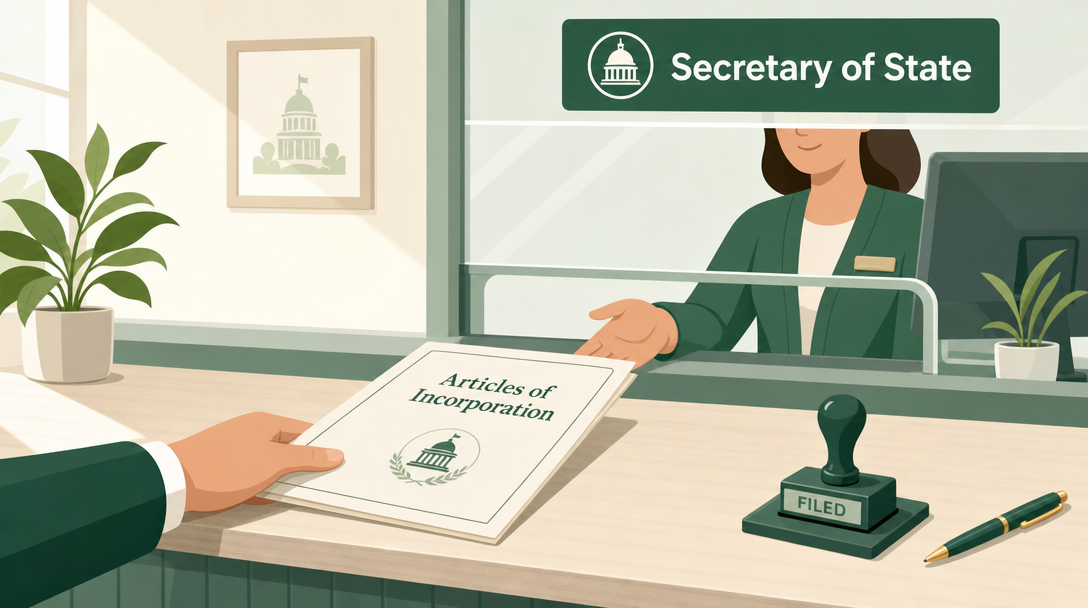
Articles of incorporation are the short document you file with the state to turn an idea into a legal nonprofit corporation. Filing them is the moment the organization becomes a real entity that can hold property, sign contracts, hire people, and open a bank account in its own name. The articles are public and state-filed — not to be confused with bylaws, which are the longer internal rulebook the nonprofit keeps to itself. To later qualify for 501(c)(3) tax exemption, the articles must contain two clauses the IRS requires: a purpose clause limiting the nonprofit to exempt purposes, and a dissolution clause sending leftover assets to another 501(c)(3).
Why a nonprofit files articles of incorporation with the state
A nonprofit files articles of incorporation to exist as a nonprofit corporation under state law. Until that document is filed and accepted, the group is just a handful of people with a mission — and legally, those people can be personally on the hook for the group’s debts, contracts, and liabilities. Incorporating draws a line between the organization and the individuals running it, so a lawsuit or an unpaid bill lands on the corporation, not on a founder’s personal bank account.
Incorporation also turns on the everyday machinery a nonprofit needs. Banks ask for a state-filed entity before opening an account. Funders and grant-makers want to give to a corporation, not an informal club. And the IRS expects a recognizable legal form before it will grant 501(c)(3) recognition. Incorporating is one of the first concrete steps on the founding checklist — see how to start a nonprofit for the full sequence from entity to EIN to exemption.
Incorporating isn’t the only legal form a nonprofit can take — some operate as unincorporated associations or charitable trusts — but the nonprofit corporation is by far the most common, and the easiest to take 501(c)(3) because state nonprofit forms are built around the IRS clauses.
Articles of incorporation vs. bylaws for a nonprofit
Articles of incorporation and bylaws are two separate documents that people constantly confuse. The articles create the corporation and are filed with the state; the bylaws run the corporation and stay inside the organization.
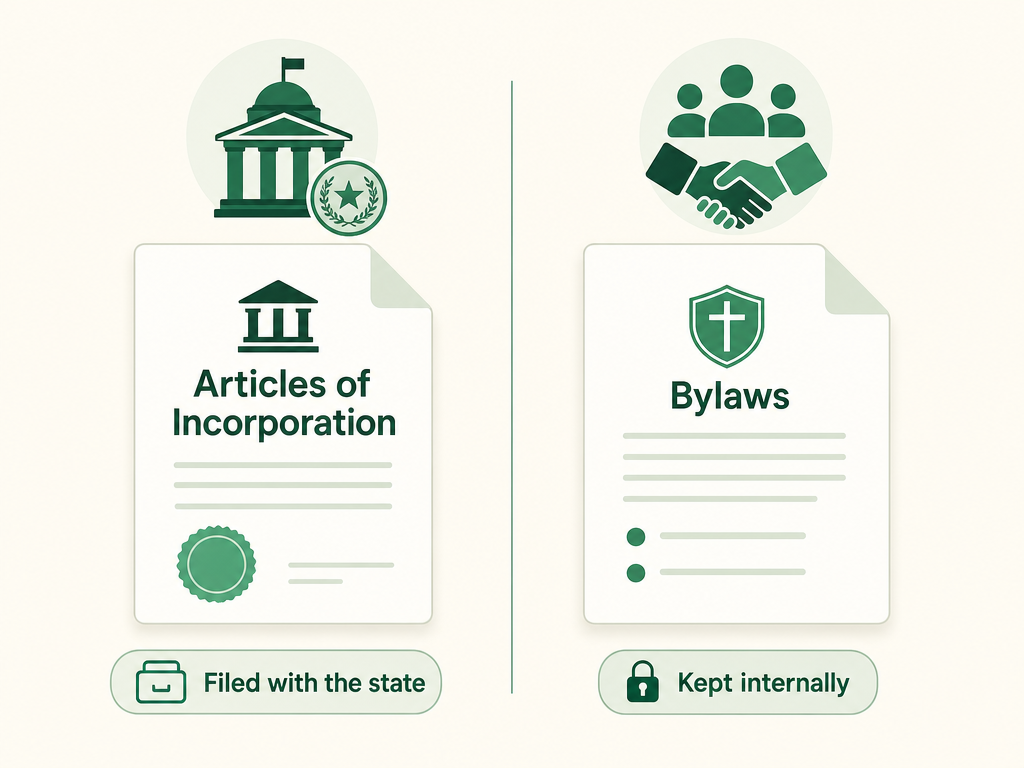
The split matters in practice:
| Articles of incorporation | Bylaws | |
|---|---|---|
| Purpose | Create the legal entity | Govern day-to-day operations |
| Filed with the state? | Yes — Secretary of State | No — kept internally |
| Public record? | Yes | No |
| Length | Usually 1–2 pages | Often 5–20 pages |
| Typical contents | Name, registered agent, purpose, dissolution | Board elections, officers, meetings, voting, quorum |
| How to change it | File an amendment with the state | Vote per the bylaws’ own rules |
Both documents work together. A nonprofit adopts bylaws separately, usually at its first board meeting; you can start from a free nonprofit bylaws template and tailor it to your board structure. The articles are the deed that brings the corporation into being; the bylaws are the operating manual once it exists.
The clauses your nonprofit articles of incorporation must include
Articles of incorporation are short, but every line earns its place — especially the two clauses the IRS demands for tax exemption. State filing forms vary, yet a 501(c)(3)-bound nonprofit’s articles generally need these provisions:
- Corporate name. The exact legal name of the nonprofit (e.g., “Riverside Food Relief, Inc.”). It must be distinguishable from entities already registered in your state; nearly every Secretary of State site has a free name-availability search.
- Registered agent and registered office. A person or company at a physical in-state address who accepts legal papers and official mail for the nonprofit. A founder can serve, or you can hire a commercial registered-agent service for a yearly fee.
- Incorporator(s). The person (or people) who signs and submits the articles. The incorporator doesn’t have to stay on as an officer or board member afterward.
- Purpose clause (501(c)(3)-compliant). A statement that the organization is organized exclusively for charitable, educational, religious, or scientific purposes within the meaning of Section 501(c)(3). This is one half of the IRS “organizational test.”
- Dissolution clause. A statement that if the nonprofit dissolves, its remaining assets go to another 501(c)(3) organization (or to a government for a public purpose) — never to members, directors, or officers. This is the other half of the organizational test.
- Initial directors (sometimes). Some states want the first board listed in the articles; others leave the board entirely to the bylaws.
The two provisions that trip nonprofits up are the purpose and dissolution language. Generic incorporation forms — the ones meant for a regular business — don’t include them, so a founder who files a stock or for-profit form ends up with articles the IRS will reject. The fix is to use your state’s nonprofit articles form and add the exact 501(c)(3) wording.
The IRS organizational test, in plain terms
The IRS “organizational test” is the rule that a 501(c)(3)‘s founding document — for a corporation, that’s the articles of incorporation — must limit the organization to exempt purposes on paper, not just in practice. Two specific clauses satisfy it:
- The purpose clause must restrict the nonprofit’s activities to exempt (charitable, educational, religious, scientific) purposes. A catch-all like “this corporation may engage in any lawful activity” is too broad and fails the test on its own.
- The dissolution clause must permanently dedicate the assets to an exempt purpose — meaning if the nonprofit closes, what’s left goes to another 501(c)(3), not back to the people who founded or ran it.
Both clauses must live in the articles, not only the bylaws, because the IRS reads the state-filed founding document when it applies the organizational test. The IRS lays out this requirement, with sample purpose and dissolution language you can copy, in IRS Publication 557, its guide to tax-exempt status. Match your wording to that publication and you’ve cleared the organizational test before you ever file Form 1023.
How and where to file articles of incorporation for a nonprofit
Articles of incorporation are filed with your state’s Secretary of State (in a handful of states, a Division of Corporations or a similar agency). The outline is the same everywhere, even though forms and fees differ:
- Pick the right form. Use your state’s nonprofit (sometimes “nonstock” or “not-for-profit”) articles — not the for-profit form, which lacks the 501(c)(3) clauses.
- Run a name check. Confirm the nonprofit’s name is available on the Secretary of State’s business search before you commit to it.
- Fill in the required clauses. Name, registered agent and office, incorporator, plus the 501(c)(3) purpose and dissolution language.
- File and pay the fee. Most states let you file online; nonprofit filing fees commonly run $25–$125, though a few states are higher or lower.
- Keep the stamped copy. The state returns a stamped or certified copy — that’s your proof of incorporation, and you’ll need it to get an EIN and open a bank account.
State requirements are not identical, so always read your own Secretary of State’s instructions before filing. The clauses above are close to universal, but the exact form, wording, and fee belong to your state. A church follows this same path with a few faith-specific touches — see articles of incorporation for a church if that’s your situation.
What comes after a nonprofit files its articles of incorporation
Filing the articles is step one, not the finish line. Once the state accepts them, a new nonprofit typically:
- Adopts bylaws and holds an organizational board meeting to elect officers and set basic policies.
- Gets an EIN (the federal tax ID) from the IRS — free, and required before a bank account or payroll.
- Opens a bank account in the corporation’s name, using the stamped articles and the EIN.
- Applies for 501(c)(3) status by filing Form 1023 (or the streamlined 1023-EZ) with the IRS — this is the step where those purpose and dissolution clauses get tested.
- Sets up bookkeeping on fund accounting from the first deposit, so restricted grants and the operating fund are tracked separately from day one.
Get the articles right and the rest of the founding checklist falls into place on solid ground. Sloppy or missing clauses, on the other hand, surface months later as a rejected exemption application — exactly when a young nonprofit can least afford the delay.
Vestrybooks sets a newly incorporated nonprofit up on clean fund accounting from the first deposit, so grants, restricted gifts, and spending are documented from day one. See plans →
FAQ
Does a nonprofit need articles of incorporation? A nonprofit needs articles of incorporation if it wants to operate as a nonprofit corporation — and most do, because that’s the structure banks, funders, and the IRS expect. You can run a small group as an unincorporated association without filing, but you lose the liability protection of a corporation and make 501(c)(3) recognition harder. Incorporating is the standard first move.
How do you write articles of incorporation for a nonprofit? Start from your state’s nonprofit articles form and fill in the corporate name, registered agent and office, incorporator, a 501(c)(3) purpose clause, and a dissolution clause sending assets to another 501(c)(3). Match the purpose and dissolution wording to IRS Publication 557, then file with your Secretary of State and keep the stamped copy.
What are articles of incorporation for-profit? Articles of incorporation for a for-profit company are the same kind of state filing — they create the corporation — but they describe ownership through stock and shareholders and skip the 501(c)(3) purpose and dissolution clauses. That’s why you can’t use a for-profit form for a nonprofit: it lacks the language the IRS organizational test requires.
Where can I find an organization’s articles of incorporation? Because articles of incorporation are public record, you can usually find them through the Secretary of State’s online business search in the state where the nonprofit incorporated. Many states show the filing and let you order or download a certified copy for a small fee. The nonprofit’s own files and its IRS Form 1023 application also contain a copy.
This is general information, not tax or legal advice — confirm your situation and your state’s filing rules with a qualified professional.
This article is general information for church treasurers, not professional tax or legal advice. For your church's situation, consult a qualified accountant or attorney.
Nonprofit accounting, minus the headache.
Vestrybooks does fund accounting, donor tracking, and board-ready reports for churches and faith-based nonprofits.
A real free plan · no credit card · your data stays yours