Blog · Nonprofit formation
How to write a nonprofit business plan
July 4, 2026 · By Benjamin Reinke
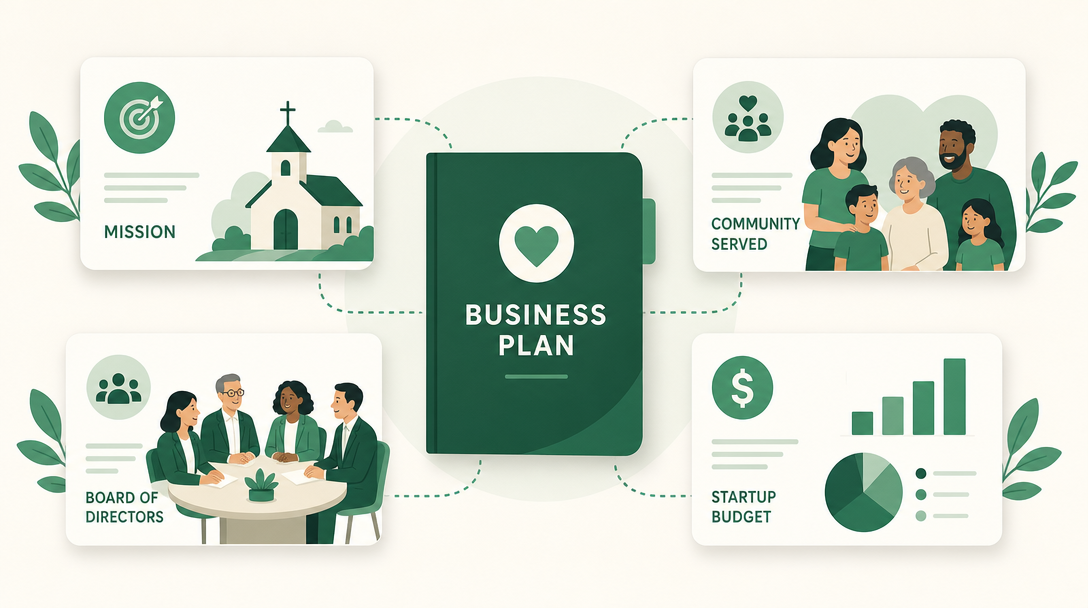
Short answer: A nonprofit business plan is the written document that explains how your organization will do good work and stay solvent doing it — your mission, the problem you solve, the programs you’ll run, who leads the work, how you’ll reach people, and, above all, a realistic budget showing where the money comes from and where it goes. It’s the story you tell grant-makers and major donors, the shared understanding your board aligns around, and the backbone of the activities-and-finances narrative the IRS asks for on Form 1023. Unlike a for-profit plan, it’s built around a mission and a funding mix of donations, grants, and earned revenue — not profit for owners. Write it before or while you incorporate, and let its budget become your actual books, set up on fund accounting so restricted money is tracked from the first dollar.
What a nonprofit business plan is and why it matters
A nonprofit business plan is a written narrative that answers a simple pair of questions the National Council of Nonprofits frames as the heart of any plan: what problem are we trying to solve, and who will get us there, by when, and with what resources? It ties your mission to a set of programs and to a budget that proves the mission can be paid for. The National Council of Nonprofits guide to business planning describes it as the story of how the organization will operate given its activities, its revenue, its expenses, and the changes it will face over time.
It matters for four concrete reasons, and none of them is bureaucratic box-checking:
- Funders read it first. Foundations, major donors, and grant-makers want to see that you’ve thought past the good intention — that there’s a plan, a budget, and a board behind the cause. A credible plan is often what gets you the first meeting.
- It aligns your board. A board of directors that approved a plan is a board that agrees on what the organization is for and what it will cost. Without one, every meeting relitigates the mission.
- It feeds the IRS narrative. Your 501(c)(3) application asks for a description of your activities and a projected budget. The work you do writing a business plan is most of that application already done — see how to start a 501(c)(3) for what the Form 1023 narrative and budget actually require.
- It keeps you solvent. The plan forces you to confront whether you’re over-reliant on a single funder and whether the everyday cost of keeping the lights on is actually covered. That’s the difference between a nonprofit that lasts and one that runs out of cash in year two.
A business plan is not the same as the legal formation checklist. Incorporating, getting an EIN, seating a board, and filing for tax exemption are their own sequence, walked step by step in how to start a nonprofit. This page is about the document — the plan you write before or alongside those steps that makes the whole thing fundable.
How a nonprofit business plan differs from a for-profit one
The structure looks similar — both have an executive summary, a description of what you do, and financials — but three things underneath are genuinely different, and getting them wrong is the most common way a first-time founder writes the wrong plan.
- Mission over profit. A for-profit plan exists to show the business will make money for its owners or investors. A nonprofit plan exists to show the organization can sustain its mission financially — success is measured in outcomes (meals delivered, students graduated, people housed), not margin. There are no owners and no profit to distribute; any surplus goes back into the work.
- The funding model is a mix, not a sale. A business sells a product to customers. A nonprofit funds its work through a blend of individual donations, grants, corporate sponsorships, program fees or earned revenue, government contracts, and events. Your plan has to name each source and be honest about which are reliable and which are hopeful — the plan’s job is partly to prove you’re not standing on one leg.
- A board governs, not owners. A nonprofit answers to a board of directors and, ultimately, to the public and its donors — not to shareholders. Your plan describes governance and oversight, because that’s what makes the organization accountable and what the IRS and funders look for.
Keep those three differences in front of you as you draft, and the rest of the plan writes itself in the right key.
A nonprofit business plan outline you can copy
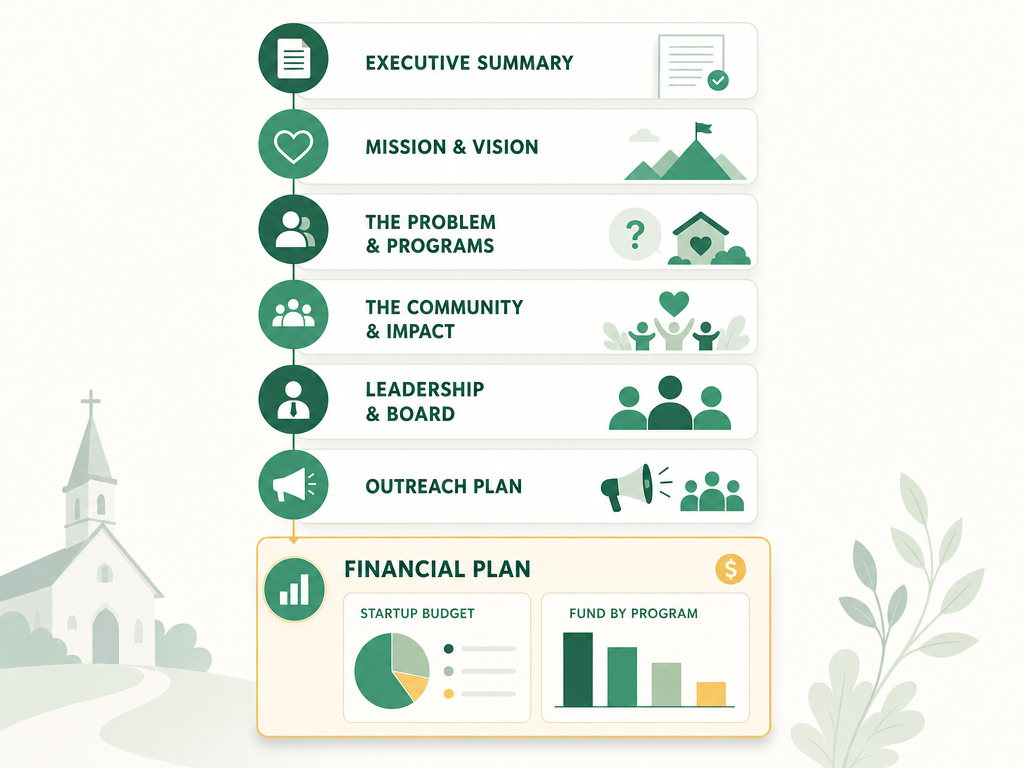
Here’s the whole structure in one place. Copy it into a document and fill in each heading — most complete nonprofit plans run 8 to 15 pages, with the financial plan and appendix carrying the weight.
- Executive summary — one page, written last: mission, the need, your programs, leadership, and the top-line budget.
- Mission and vision — what you exist to do, and the world you’re working toward.
- The problem and your programs — the need you’re addressing and the specific programs that address it.
- Target community and impact — who you serve, how many, and the outcomes you’ll measure.
- Leadership and board — the people running the work and the board governing it.
- Marketing and outreach plan — how the people you serve and the people who fund you will find you.
- Financial plan — startup budget, first-year operating budget by program, funding sources, and how you’ll track restricted funds.
- Appendix — articles of incorporation, bylaws, board bios, letters of support, and detailed budget tables.
The sections below walk each one.
Executive summary: write it last, put it first
The executive summary is a one-page snapshot of the entire plan — mission, the problem, your programs, who leads, and the headline numbers from your budget. It sits at the front because it’s the only page some funders read in full, but you write it last, once the rest of the plan has told you what it actually says. Keep it to a page. If a grant officer can read this one page and understand what you do, who you help, what it costs, and why you’ll succeed, it’s doing its job.
Mission and vision: the anchor everything hangs on
State your mission in a sentence or two: who you serve, what you do for them, and to what end. Add a vision — the changed world you’re working toward — if it clarifies the mission. This section is short but load-bearing, because every later section is judged against it. A budget that pours most of its money into program work says the same thing your mission does; a budget that doesn’t reveals a plan that hasn’t been thought through. Write the mission plainly enough that a volunteer, a donor, and a board member would each describe your work the same way.
The problem and your programs: the need, then the response
Name the problem before you name your solution. Funders give to needs, not to organizations, so describe the specific gap you exist to close — with real local detail, not a national statistic that could apply anywhere. Then lay out your programs: the concrete activities that address that need. For each program, say what it does, who runs it, and roughly what it costs, because those program costs become the backbone of your operating budget later. Two or three well-defined programs beat a vague promise to help everyone.
Target community and impact: who you serve and how you’ll measure it
Describe the community you serve in specifics — geography, demographics, how many people, what they need. Then commit to how you’ll measure impact: the outcomes that tell you the programs worked. Nonprofits are held to their mission, so define success in numbers you can actually track — people served, nights of shelter provided, students who graduated — and say how you’ll collect them. This is also where a funder decides whether your goals are ambitious and honest, or vague and unfalsifiable. Pick outcomes you’d be willing to report on a year from now.
Leadership and board: who does the work and who oversees it
This section covers two groups. Leadership is the staff or founder doing the day-to-day work — name them, their relevant experience, and the roles you still need to fill. The board of directors is the governing body that holds leadership accountable, approves the budget, and protects the mission. Most states require at least three directors, and the IRS strongly prefers a majority who are unrelated. Funders read this section to answer one question: can these people actually pull it off? A short, honest bio for each, plus a clear note on the gaps you’re recruiting to fill, does more than an inflated org chart.
Marketing and outreach plan: how people find you
A nonprofit has two audiences to reach, and your outreach plan should address both: the people you serve, who need to know your programs exist, and the people who fund you — donors, grant-makers, sponsors. Sketch how you’ll reach each: the channels (word of mouth, a website, community partners, events), your first-year fundraising approach, and how you’ll tell your story. This doesn’t need to be a full marketing strategy at the plan stage, but it does need to show you’ve thought about how the money and the people arrive, not just how you’ll spend and serve.
The financial plan: where a business plan becomes real books
This is the section funders and the IRS read hardest, and the one this guide dwells on, because a nonprofit plan lives or dies on whether the mission is actually paid for. The financial plan has four parts, and each one turns directly into a decision about your books.
1. A realistic startup budget. The one-time cost to get off the ground: incorporation and filing fees, the 501(c)(3) application fee ($275 for Form 1023-EZ, $600 for the full Form 1023), initial supplies or equipment, a website, insurance, and any deposit to open a bank account. A small nonprofit can be properly formed for a few hundred dollars, but name every line so nothing surprises you in month one.
2. A first-year operating budget by program. The recurring cost of running the work, organized by the programs you defined earlier plus your management and fundraising costs. Building the budget program by program is the discipline that separates a plan from a wish — it forces you to price each activity and to see which programs are cheap to run and which are expensive. The full method for forecasting revenue conservatively and planning expenses by function is in the guide to nonprofit budgeting; the plan is where that budget first takes shape.
3. Funding sources. List every source you expect — individual donations, grants, sponsorships, program fees, events — and be honest about which are committed and which are hopeful. A plan that names four or five sources reassures funders that you won’t collapse if one dries up. A plan that leans entirely on a single grant is a risk they can see from across the room.
4. How you’ll track restricted funds from day one. This is the part most first-year plans skip and later regret. Much of a nonprofit’s money arrives restricted — a grant that can only pay for one program, a donation given for a specific purpose. You are legally obligated to spend that money only as the giver directed, which means your books have to keep each restricted pot separate from general operating money from the very first deposit. The mechanics of restricted versus unrestricted money — and why commingling them is the mistake that costs nonprofits donor trust and clean audits — are laid out in the guide to nonprofit fund accounting and restricted funds. Decide in the plan that you’ll track this way, and you’ve made the single most important bookkeeping decision before a dollar arrives.
That last point is the bridge from plan to reality. The budget you write here isn’t a document that sits in a drawer — it’s the first draft of your actual books. If your plan already breaks money out by program and flags which funds are restricted, then setting up your accounting is a matter of translating the plan into funds, not reinventing it. Set the books up on fund accounting at launch, and every restricted grant or gift stays walled off in its own fund automatically, so a dollar given for the food pantry never quietly pays the electric bill. Get that right on day one and you’ll never have to untangle a year of commingled transactions to file your first Form 990.
FAQ
Does a nonprofit need a business plan? No law requires a business plan the way one requires articles of incorporation or a 501(c)(3) application, but in practice you need one to succeed. Grant-makers and major donors expect to see a plan before they fund you, your board needs one to agree on direction, and the activities-and-budget narrative the IRS asks for on Form 1023 is largely the same work. A nonprofit that skips the plan tends to discover the gaps — an unfunded program, an over-reliance on one grant — after the money is already committed. Writing the plan is how you find those gaps while they’re still cheap to fix.
What goes in a nonprofit business plan? A complete plan has an executive summary, a mission and vision, a description of the problem and your programs, the community you serve and the impact you’ll measure, your leadership and board, a marketing and outreach plan, and a financial plan — a startup budget, a first-year operating budget by program, your funding sources, and how you’ll track restricted funds. An appendix holds the supporting documents: articles of incorporation, bylaws, board bios, and detailed budget tables. The financial plan carries the most weight, because it’s where you prove the mission can actually be paid for.
How is a nonprofit business plan different from a for-profit one? Three differences matter most. A nonprofit plan is built around a mission and measured in outcomes, not around profit for owners. Its funding model is a mix of donations, grants, sponsorships, and earned revenue rather than sales to customers. And it answers to a board of directors and the public rather than to shareholders. The section headings look similar, but a nonprofit plan that reads like a for-profit one — chasing revenue growth with no mission or governance story — misses what funders and the IRS are actually looking for.
How long should a nonprofit business plan be? Most nonprofit business plans run about 8 to 15 pages, plus an appendix for supporting documents and detailed budget tables. Length isn’t the point — completeness and honesty are. A tight plan that clearly answers what problem you solve, who you serve, who leads, and how the money works beats a padded one every time. Write the financial plan in full and keep the narrative sections plain.
When should you write the business plan — before or after incorporating? Write it before or while you incorporate. The plan clarifies your mission and programs, which shape the purpose clause in your articles of incorporation, and its budget becomes the projected-finances section of your 501(c)(3) application. Doing the plan first means you’re not writing that IRS narrative from scratch later, and it means your first conversations with potential board members and funders have something concrete behind them.
Your business plan’s budget is only useful if it becomes real books. Vestrybooks sets a new nonprofit up on fund accounting from day one — so restricted grants and gifts are tracked from the first dollar, and your year-end reports and Form 990 come out clean. See how it works.
This is general information, not legal or tax advice — confirm your organization’s situation with a qualified professional.
This article is general information for church treasurers, not professional tax or legal advice. For your church's situation, consult a qualified accountant or attorney.
Nonprofit accounting, minus the headache.
Vestrybooks does fund accounting, donor tracking, and board-ready reports for churches and faith-based nonprofits.
A real free plan · no credit card · your data stays yours