Blog · Nonprofit tax filing
IRS Form 990, the annual return most nonprofits file
June 27, 2026 · By Benjamin Reinke
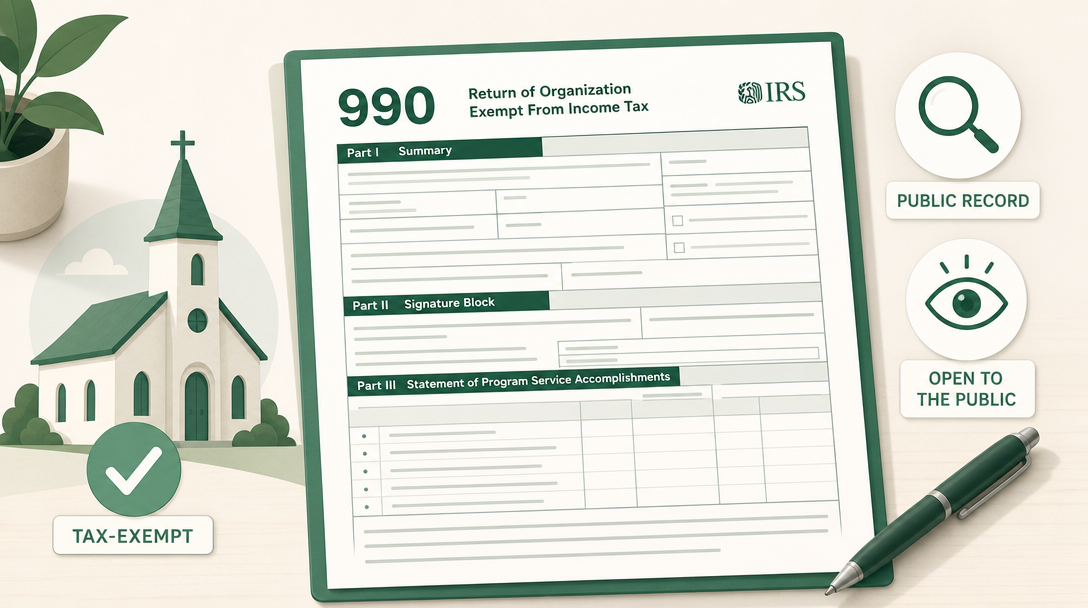
Short answer: IRS Form 990 is the annual information return that most tax-exempt nonprofits file with the IRS to report their finances, governance, and programs. It is not a tax bill — exempt organizations usually owe no income tax — but it is a required filing, and it’s public record that donors, charity watchdogs, and rating sites can read. There are three versions sorted by size: the 990-N (e-Postcard) for small organizations with gross receipts normally $50,000 or less, the 990-EZ for mid-size groups, and the full Form 990 for larger ones. Churches don’t file at all — they’re exempt from the requirement. And any organization that skips its filing for three years running loses its tax-exempt status automatically.
What IRS Form 990 is and why it’s public
IRS Form 990 is the annual return a 501(c)(3) and most other tax-exempt organizations use to report to the IRS what they took in, what they spent, who runs them, and what they did during the year. The form’s official name is the Return of Organization Exempt From Income Tax (see the IRS about Form 990 page). Calling it a “return” trips people up, because a tax-exempt nonprofit generally pays no income tax — the 990 is an information return, not a check to the Treasury. It exists so the public and the government can see that an organization granted tax-exempt status is actually being run as a charity.
The 990 is open to public inspection, and that’s the part that matters most for trust. Anyone can pull a nonprofit’s 990 — donors deciding whether to give, journalists, grantmakers, and rating sites like Charity Navigator and Candid that build their scores partly from 990 data. So the form isn’t just a compliance chore; it’s a public statement about how the organization handles money. That’s a different job from a nonprofit annual report, which is the friendly, donor-facing booklet a nonprofit chooses to publish. The 990 is the required filing for the IRS; the annual report is the optional story for donors. Same underlying books, two different audiences.
The three versions of Form 990, by organization size
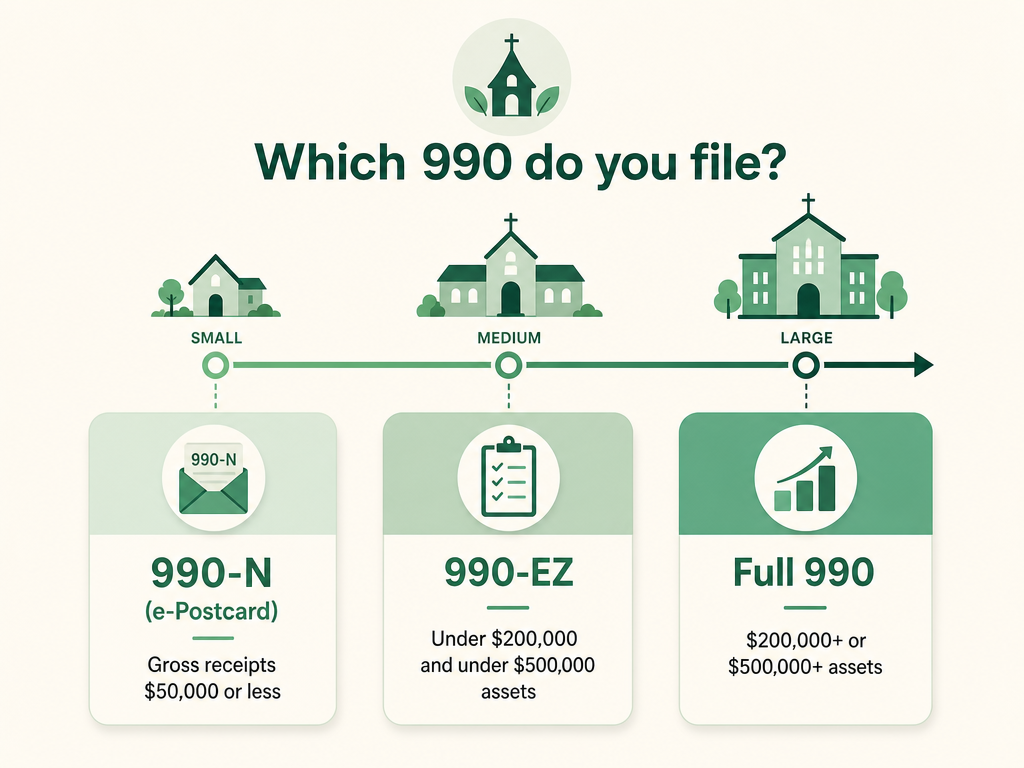
The Form 990 you file depends on how big the organization is, measured by gross receipts and total assets. The IRS sets three thresholds, and an organization can always choose to file a longer version than required (a small group may file the full 990 voluntarily), but never a shorter one.
| Form | Who files it | Size thresholds |
|---|---|---|
| 990-N (e-Postcard) | Small organizations | Gross receipts normally $50,000 or less |
| 990-EZ | Mid-size organizations | Gross receipts under $200,000 and total assets under $500,000 |
| Full Form 990 | Larger organizations | Gross receipts $200,000 or more, or total assets $500,000 or more |
| 990-PF | Private foundations | Every private foundation, regardless of size |
The logic on the two larger forms is worth reading slowly. The 990-EZ needs both numbers under the line — gross receipts under $200,000 and assets under $500,000. The full 990 kicks in if either number crosses its line — receipts at $200,000 or more, or assets at $500,000 or more. So a small charity that took in only $80,000 but is sitting on a $600,000 building files the full 990, because the asset side alone pushes it over. The thresholds come straight from the IRS — see its about Form 990-EZ page and the 990-N (e-Postcard) page.
Form 990-N, the e-Postcard for small organizations
Form 990-N is an eight-question electronic notice — the “e-Postcard” — for organizations whose gross receipts are normally $50,000 or less. There’s no paper version and nothing to mail; it’s filed online directly with the IRS, and it asks only for confirming details (legal name, EIN, address, principal officer, and that the organization is still under the threshold). “Normally $50,000 or less” has its own averaging rules for new and young organizations, but for an established small nonprofit it means an average of $50,000 or less over the prior three years. The e-Postcard is the floor of the requirement — even the smallest active nonprofit has to file something, and this is it.
Form 990-PF, the form private foundations always file
Form 990-PF is the version every private foundation files, no matter how small. A private foundation — typically a charity funded by one family, individual, or company rather than the general public — reports on Form 990-PF regardless of its receipts or assets, so the size thresholds above don’t apply to it. If an organization is classified as a private foundation, it files the 990-PF; if it’s a public charity, it uses the size-based 990, 990-EZ, or 990-N.
Each Form 990 version and rule, in depth
Each form and deadline rule has its own guide that goes deeper than the summary here:
- Form 990-N (the e-Postcard) — the eight-question filing for the smallest nonprofits
- Form 990-EZ — the short form for mid-size organizations
- How to file Form 990 — a step-by-step filing walkthrough
- Form 990 deadline and extension — due dates and the Form 8868 extension
- Form 990 late-filing penalties — what filing late, or not at all, costs
When Form 990 is due and how to get an extension
Form 990 is due on the 15th day of the 5th month after the organization’s fiscal year ends. For the common calendar-year nonprofit (books closing December 31), that’s May 15 of the following year. A fiscal year ending June 30 makes the return due November 15. The deadline is the same across the 990, 990-EZ, and 990-N.
If you need more time, file Form 8868 (Application for Extension of Time To File an Exempt Organization Return) by the due date — it grants an automatic six-month extension, no explanation required. For a calendar-year filer, that moves the deadline from May 15 to November 15. One catch worth knowing: the 990-N e-Postcard can’t be extended with Form 8868, but because it’s so short, that’s rarely a problem. Missing the deadline can mean IRS penalties for the 990 and 990-EZ, and missing it repeatedly leads somewhere worse, covered below.
Why churches don’t file Form 990
Churches do not file Form 990 at all — and this is the single most important point for anyone running a church’s books. A church, an integrated auxiliary of a church, and a convention or association of churches are exempt from the filing requirement entirely, under the same rules that make a church automatically tax-exempt without ever applying to the IRS. The IRS states this directly: these organizations are not required to file an annual return or notice. Most other 501(c)(3)s — charities, foundations, ministries that aren’t churches — must file; a church does not.
That exemption carries a quiet consequence. Because a church usually files nothing public with the IRS, its 990 isn’t out there for donors to read — which means the church’s own church financial statements and its report to the congregation become the only regular public accounting it does. The 990 normally forces a layer of transparency; a church has to supply that transparency on its own. (Church-affiliated organizations that aren’t themselves churches — a separately incorporated school or a parachurch nonprofit — often do have to file, so don’t assume the exemption covers everything in the orbit of a church. For the full picture of why the exemption exists, see are churches tax exempt.)
Miss three years and the IRS revokes your status automatically
The hardest rule in the 990 world is automatic revocation: an organization that fails to file its required 990, 990-EZ, or 990-N for three consecutive years loses its tax-exempt status automatically. There’s no warning letter and no IRS judgment call — by law, the exemption is revoked on the due date of the third missed return. The IRS then publishes the organization on its Auto-Revocation List, and the practical fallout is real: the organization can owe income tax, and donations to it stop being deductible until the status is restored.
This is exactly why the e-Postcard exists. Tiny all-volunteer nonprofits used to fly under the radar with no filing at all; now even a $5,000-a-year group must file the 990-N, and three skipped years revokes it just the same. (Churches, again, are the exception — because they’re not required to file, they’re not subject to automatic revocation for failing to file.)
Getting tax-exempt status back after revocation
Reinstatement after automatic revocation means applying for tax-exempt status again — re-filing Form 1023 (or Form 1024 for non-501(c)(3) groups), paying the user fee, and asking the IRS to recognize the exemption once more. The IRS offers a few reinstatement procedures, and the smoothest one is the streamlined relief for small organizations: a group that was eligible to file the 990-N or 990-EZ can be reinstated retroactively to its revocation date — closing the taxable gap — if it applies within 15 months and includes the missed returns. Larger organizations face a more involved path and must show reasonable cause for the missed filings to get the gap erased. The lesson is the cheaper one: filing a five-minute e-Postcard on time every year is far easier than buying your exemption back.
Vestrybooks keeps a church’s money-in-and-out clean and by-fund all year, so the figures behind your financial statements and your report to the congregation are always one click away — even though your church never files a 990. See plans →
FAQ
What is IRS Form 990 used for? Form 990 is the annual information return tax-exempt nonprofits file with the IRS to report their finances, governance, and activities. It shows the public and the government that an organization with tax-exempt status is being run as a genuine charity. It’s an information return, not a tax bill — most exempt organizations owe no income tax.
Who has to file Form 990? Most tax-exempt organizations, including 501(c)(3) public charities, must file a version of the 990 every year. Which version depends on size: 990-N for gross receipts normally $50,000 or less, 990-EZ for under $200,000 in receipts and under $500,000 in assets, and the full 990 above either line. Private foundations file Form 990-PF. Churches are exempt and file nothing.
Do churches have to file Form 990? No. Churches, their integrated auxiliaries, and conventions or associations of churches are exempt from filing Form 990 entirely. Because they aren’t required to file, they also aren’t subject to the automatic revocation that hits other nonprofits after three missed years.
When is Form 990 due? Form 990 is due on the 15th day of the 5th month after the organization’s fiscal year ends — May 15 for a calendar-year nonprofit. Filing Form 8868 by that date grants an automatic six-month extension, moving a calendar-year deadline to November 15.
What happens if a nonprofit doesn’t file Form 990 for three years? The IRS automatically revokes the organization’s tax-exempt status. The revocation is automatic on the third year’s due date, with no warning. To get the exemption back, the organization must reapply with Form 1023 or 1024; small organizations that qualified for the 990-N or 990-EZ can often be reinstated retroactively if they apply within 15 months.
This is general information, not tax or legal advice — confirm your organization’s filing requirements with a qualified professional.
This article is general information for church treasurers, not professional tax or legal advice. For your church's situation, consult a qualified accountant or attorney.
Nonprofit accounting, minus the headache.
Vestrybooks does fund accounting, donor tracking, and board-ready reports for churches and faith-based nonprofits.
A real free plan · no credit card · your data stays yours