Blog · Financial reporting
The nonprofit cash flow statement, explained
June 27, 2026 · By Benjamin Reinke
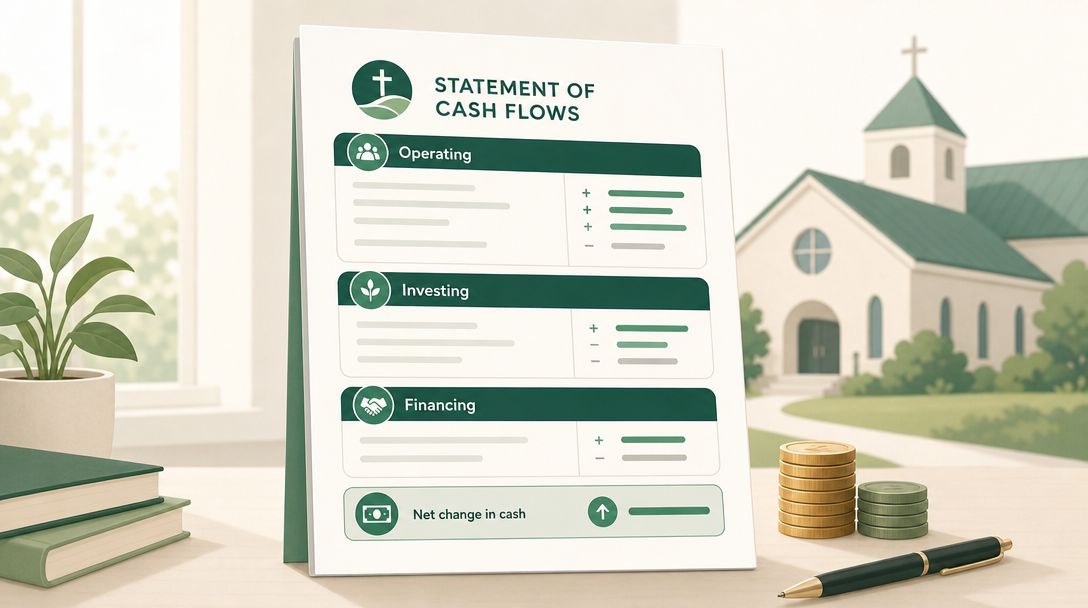
Short answer: A nonprofit cash flow statement — formally the statement of cash flows — is the report that shows how much actual cash moved in and out of an organization over a period, sorted into three sections: operating, investing, and financing. It answers a question the statement of activities can’t: not “did we come out ahead on paper?” but “did the bank balance actually go up or down, and why?” It’s one of the four statements in a full set under FASB’s nonprofit standard, and most organizations need it once they report on the accrual basis or get audited.
What a nonprofit cash flow statement shows
A nonprofit cash flow statement reconciles the change in cash from the start of a period to the end of it, and explains every dollar of that change by source. The statement of activities can show a healthy surplus while the checking account drains — a $50,000 restricted grant counts as revenue the day it’s pledged, but the cash might not arrive for months, and a payroll run leaves on the accrual books as an expense even if the bank already cleared it. The cash flow statement strips all of that timing out and tracks the money itself.
That’s the core reason a nonprofit keeps both reports. The statement of activities tells you whether revenue beat expenses on an accrual basis; the cash flow statement tells you whether you can make payroll on the 15th. A growing organization can post a surplus and still run out of cash, and only this statement catches it early — it’s the liquidity check on your nonprofit budget.
The three sections of a nonprofit cash flow statement
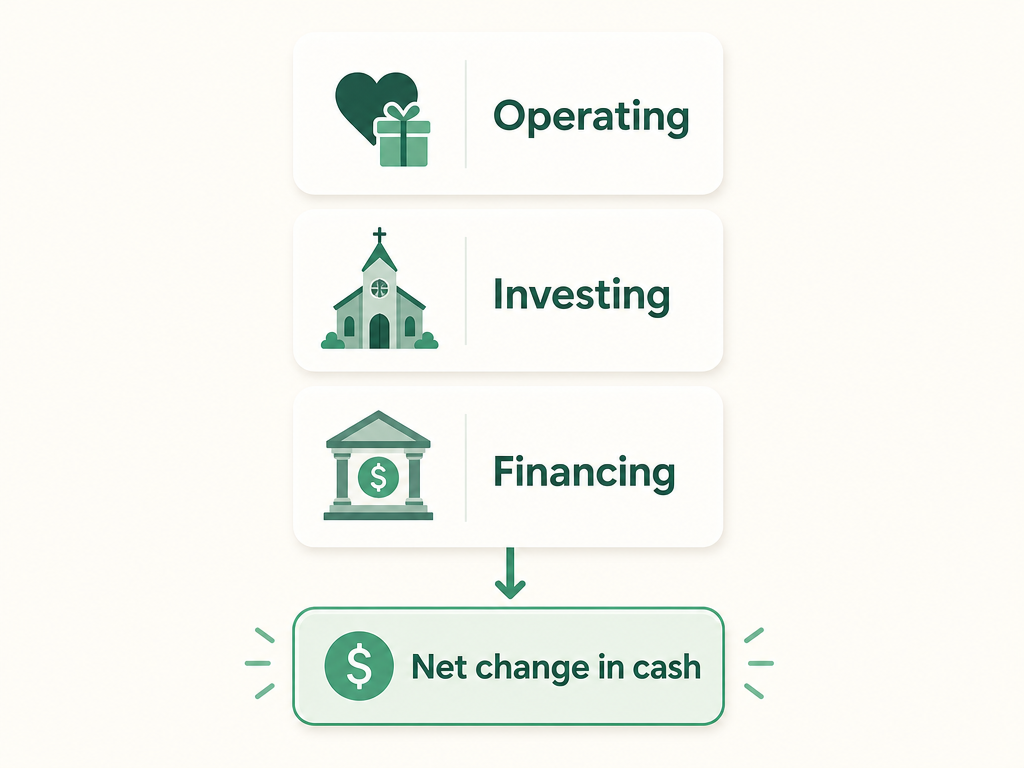
A nonprofit cash flow statement splits every cash movement into three buckets, defined the same way for nonprofits and businesses under FASB ASC 230. The three sections add up to the net increase or decrease in cash for the period.
| Section | What’s in it |
|---|---|
| Operating activities | Cash from the day-to-day mission — unrestricted donations, program fees, and grants received, minus cash paid to staff and vendors. The biggest section for most nonprofits. |
| Investing activities | Cash tied to long-term assets — buying or selling equipment and property, and purchasing or redeeming investments. |
| Financing activities | Cash from borrowing and repaying loans, plus donor-restricted gifts earmarked for endowment or long-term purposes (a nonprofit-specific twist). |
The split matters because the sections aren’t equal in health. Positive operating cash flow means the mission funds itself; a balance propped up only by new loans (financing) or by selling assets (investing) is a warning the operating side can’t sustain the organization.
Direct method vs. indirect method for the operating section
A nonprofit cash flow statement can present its operating section two ways, and only the operating section differs — investing and financing look identical either way.
| Method | How the operating section works | In practice |
|---|---|---|
| Direct method | Lists actual cash categories — cash received from donors, cash paid to employees, cash paid to vendors. | Easier for a board to read; FASB prefers it but few organizations use it. |
| Indirect method | Starts with the change in net assets, then adds back non-cash items (depreciation) and adjusts for timing (changes in receivables and payables). | More common, because it falls out of the accrual books with less rework. |
Both methods land on the exact same net cash figure — they only differ in how the operating section gets there. If you choose the direct method, FASB no longer requires the indirect reconciliation alongside it, which removed one reason organizations stuck with indirect.
Restricted cash on the nonprofit cash flow statement
Restricted cash is the wrinkle that trips up nonprofits and never shows up in a business cash flow statement. A donor gives $100,000 for a new building. That cash sits in the bank, so it counts toward the organization’s cash balance — but it isn’t free to spend on rent or salaries. Read the bank balance alone and the nonprofit looks flush; in reality most of it is spoken for.
The cash flow statement handles this in two places. The donor-restricted gift earmarked for a long-term purpose like an endowment is reported in financing activities, not operating, so it doesn’t inflate the picture of how the mission funds itself. And the beginning and ending cash totals the statement reconciles to must include restricted cash, with the restricted portion disclosed — so a reader sees both the full balance and the slice that isn’t available. This is the cash side of the same restriction split that runs through fund accounting; the statement reports the cash version of money a donor has already committed.
When a nonprofit actually needs a cash flow statement
A nonprofit needs a statement of cash flows whenever it produces a full set of GAAP financial statements — which is the case for any audited organization, most grant applications that ask for audited financials, and many bank loans. For those, the cash flow statement is mandatory alongside the other three reports; it’s one of the four nonprofit financial statements a complete set includes.
A very small, cash-basis nonprofit is a different story. If an organization records every transaction when money changes hands, its books already are a record of cash movements, so a formal accrual-style cash flow statement adds little — the statement of activities and a simple cash-on-hand figure tell most of the story. The IRS doesn’t dictate the format of internal statements either; tax-exempt reporting runs through the Form 990 series (see IRS Publication 557), which isn’t the same as the GAAP statements. The practical rule: the smaller and more cash-based you are, the less you need it; the moment an audit or a serious funder enters the picture, it’s required.
For a church specifically, the same logic applies — it’s one of the standard church financial statements, and the cash flow statement matters most once a church takes on a mortgage, runs on accrual, or sits for an audit. A tiny congregation tracking offerings on a cash basis can usually get by without a formal one.
Vestrybooks builds these statements from a church’s everyday entries automatically, with restricted cash already separated from what’s free to spend. See plans →
FAQ
What are the three sections of a nonprofit cash flow statement? Operating activities (cash from the day-to-day mission), investing activities (buying or selling long-term assets and investments), and financing activities (borrowing, loan repayment, and donor-restricted gifts for long-term purposes). The three add up to the net change in cash for the period.
What’s the difference between a statement of cash flows and a statement of activities? The statement of activities reports revenue and expenses on an accrual basis and ends in the change in net assets, so it can show a surplus before the cash arrives. The cash flow statement tracks only actual cash moving in and out, so it tells you whether the bank balance went up or down. A nonprofit needs both because one can look healthy while the other warns of a cash crunch.
Direct or indirect method — which should a nonprofit use? Both reach the same net cash figure and differ only in the operating section. FASB prefers the direct method because it’s easier to read, but the indirect method is more common because it falls out of the accrual books with less work. Either is acceptable.
Do small nonprofits have to prepare a cash flow statement? Only when producing a full set of GAAP statements — which audits, many grant applications, and bank loans require. A small cash-basis nonprofit whose books already track cash movement can usually skip a formal one until an audit or funder calls for it.
This is general information, not accounting or legal advice — confirm your organization’s requirements with a qualified professional.
This article is general information for church treasurers, not professional tax or legal advice. For your church's situation, consult a qualified accountant or attorney.
Church accounting a volunteer can actually do.
Vestrybooks is church accounting + giving for the volunteer treasurer — fund tracking, one-click year-end statements, and online giving with $0 taken from every gift.
A real free plan · no credit card · your data stays yours