Blog · Financial reporting
The statement of functional expenses, explained
June 28, 2026 · By Benjamin Reinke

Short answer: A nonprofit statement of functional expenses is a report — usually a matrix — that breaks every dollar a nonprofit spent into two views at once: by natural category (salaries, rent, utilities, supplies) down the side, and by function (program services, management and general, and fundraising) across the top. FASB’s nonprofit standard, ASC 958, requires nonprofits to report expenses by both nature and function, and this statement is where the program-expense ratio that donors and watchdogs judge you on comes from. It’s one of the four core nonprofit financial statements.
What a statement of functional expenses shows
The statement of functional expenses answers a question the other statements can’t: of everything we spent, how much actually reached the mission? It takes the same total expenses reported on the nonprofit statement of activities and lays them out in a grid. Read it one way (a row) and you see a natural cost — say, salaries — split across the three functions. Read it the other way (a column) and you see everything that one function consumed.
Most nonprofits present it as a table. Natural categories run down the left; the three functional columns run across the top; a total column on the right ties back to total expenses on the statement of activities.
| Natural category | Program services | Management & general | Fundraising | Total |
|---|---|---|---|---|
| Salaries & wages | $180,000 | $40,000 | $30,000 | $250,000 |
| Rent & occupancy | $36,000 | $9,000 | $5,000 | $50,000 |
| Supplies | $14,000 | $3,000 | $3,000 | $20,000 |
| Professional fees | $2,000 | $12,000 | $1,000 | $15,000 |
| Total expenses | $232,000 | $64,000 | $39,000 | $335,000 |
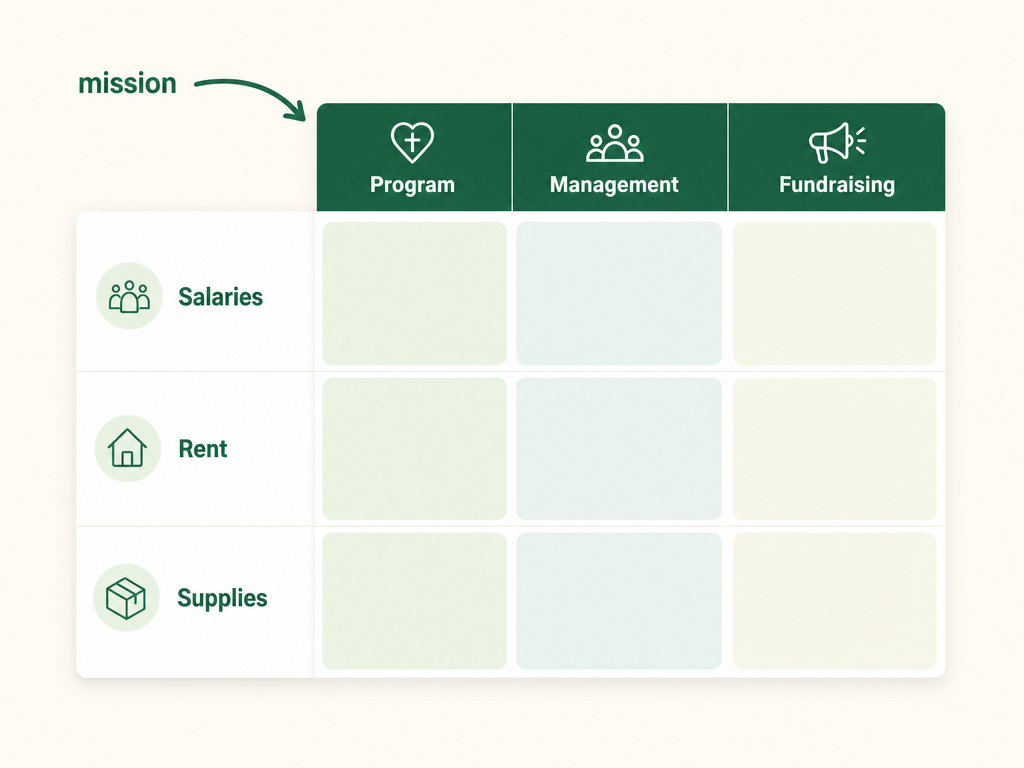
Natural expenses vs. functional expenses
Natural expenses describe what you bought — the line items a bookkeeper already records: salaries, rent, insurance, software, postage. Functional expenses describe why you spent it — which of your activities the money served. The statement of functional expenses is the only report that shows both at the same time, which is exactly what makes the matrix format useful: a single rent payment appears once as a natural cost and then gets divided across the functions that used the space.
The three functional expense categories
ASC 958 sorts every expense into one of three functions. Defining them clearly is the heart of the statement, because the split drives the ratios donors look at.
- Program services — the direct cost of the activities that carry out the mission. For a food bank, the meals; for a school, the classrooms; for a church, ministry, worship, and outreach. This is the column donors want to see large.
- Management and general — the cost of running the organization as a whole: executive oversight, accounting and the annual audit, board governance, general office and HR. Necessary, but not the mission itself.
- Fundraising — the cost of raising contributions: the development staff, the donor mailings, the gala, grant writing. This is what it costs to bring the money in.
Management and general plus fundraising together are often called overhead or supporting services. The smaller they are relative to program, the higher your program-expense ratio.
Why FASB ASC 958 requires reporting expenses by nature and function
Reporting expenses by both nature and function isn’t optional for a nonprofit — it’s a requirement of FASB’s not-for-profit standard, ASC 958. A nonprofit can satisfy it in the statement of activities, in a separate statement of functional expenses, or in the notes, but the functional breakdown has to appear somewhere in the audited statements. Most organizations of any size present the full matrix, because it’s the clearest way to show the split and because it lines up with the Form 990.
The reason this matters beyond compliance: the matrix is where the program-expense ratio comes from — program spending divided by total spending. In the example above, $232,000 of $335,000 is roughly 69% to program. Charity raters publish that figure, grantmakers ask for it, and donors compare it across the organizations they support. The statement of functional expenses is the document that makes the number defensible.
How nonprofits allocate shared costs across functions
Some costs sit cleanly in one function — a program director’s salary is program, a fundraiser’s salary is fundraising. But many costs are shared, and a multi-program nonprofit has to allocate them across functions using a reasonable, consistent basis. The allocation is where judgment enters, and where an auditor will push.
- Salaries of people who wear several hats — allocate by a time study or timesheet estimate of hours spent on each function.
- Rent, utilities, depreciation — allocate by square footage used for each function, or by headcount.
- Insurance, IT, general supplies — allocate by headcount, by direct program costs, or another rational driver.
The key rules: pick a basis that actually reflects how the cost was used, document it, and apply it consistently year to year. Pushing too much overhead into the program column to inflate the ratio is a common — and risky — way nonprofits get the statement wrong.
The Form 990 connection — Part IX functional expenses
If your nonprofit files an IRS Form 990, the statement of functional expenses isn’t just a financial-statement exercise — it’s also the form. Part IX of the 990, “Statement of Functional Expenses,” is the same matrix: natural categories down the rows, with columns for total, program services, management and general, and fundraising. The IRS’s about-Form-990 page describes the return that carries it. Because the 990 is public, the functional split you report there is visible to anyone — donors, journalists, and watchdogs pull it straight from your filing. The numbers on your audited statement of functional expenses and your 990 Part IX should match.
Do churches use a statement of functional expenses?
Churches sit in a different spot than most nonprofits. Churches are exempt from filing Form 990, so most small churches never fill out Part IX and use the statement of functional expenses less than a typical 501(c)(3) does. But it doesn’t disappear. Any church that gets an audit will produce one, because ASC 958 applies to churches the same as other nonprofits. Larger churches use it voluntarily to show members and leadership how giving translates into ministry versus administration — the same program, admin, and fundraising lens behind healthy church budget percentages. It’s one of the church financial statements, even if it’s the one churches lean on least.
How the statement of functional expenses differs from the statement of activities
The statement of activities is the nonprofit income statement — revenue and support, minus expenses, ending in the change in net assets. The statement of functional expenses takes only the expense line from that report and expands it into the full nature-by-function matrix. The activities statement tells you whether you ran a surplus or deficit; the functional-expenses statement tells you where the spending went. They share a number — total expenses — and a purpose: showing how much of every dollar reached the mission. For the complete set, see the nonprofit financial statements guide.
FAQ
What is an example of a function of expense? Program services is a function. So is management and general, and so is fundraising. A function describes why money was spent — which activity it served — as opposed to a natural category like salaries or rent, which describes what was bought.
Is a statement of functional expenses required? Reporting expenses by both nature and function is required of nonprofits under FASB ASC 958, but the full standalone statement is one of three acceptable formats — you can also present the breakdown in the statement of activities or in the notes. Churches are exempt from filing Form 990, so they use it less, though any audited church will produce one.
What is the statement of functional expenses on a 990? It’s Part IX of IRS Form 990. Part IX lays out the organization’s expenses in a matrix — natural categories by row, with columns for total, program services, management and general, and fundraising — the same structure as the audited statement. Because the 990 is public, those figures are visible to donors and watchdogs.
What is a nonprofit statement of functional expenses template? A template is a blank matrix: natural expense categories listed down the left (salaries, rent, supplies, professional fees, depreciation), three function columns across the top (program, management & general, fundraising), and a total column. You fill in each cell, allocating shared costs by a consistent basis, and the column totals give you the functional split.
Vestrybooks tracks every expense by fund and function as you go, so the statement of functional expenses — and the program-versus-overhead split behind it — comes straight from your books. See how it works.
This is general information, not accounting or legal advice — confirm your organization’s requirements with a qualified professional.
This article is general information for church treasurers, not professional tax or legal advice. For your church's situation, consult a qualified accountant or attorney.
Church accounting a volunteer can actually do.
Vestrybooks is church accounting + giving for the volunteer treasurer — fund tracking, one-click year-end statements, and online giving with $0 taken from every gift.
A real free plan · no credit card · your data stays yours