Blog · Financial reporting
What a nonprofit annual report is and how to make one
June 27, 2026 · By Benjamin Reinke
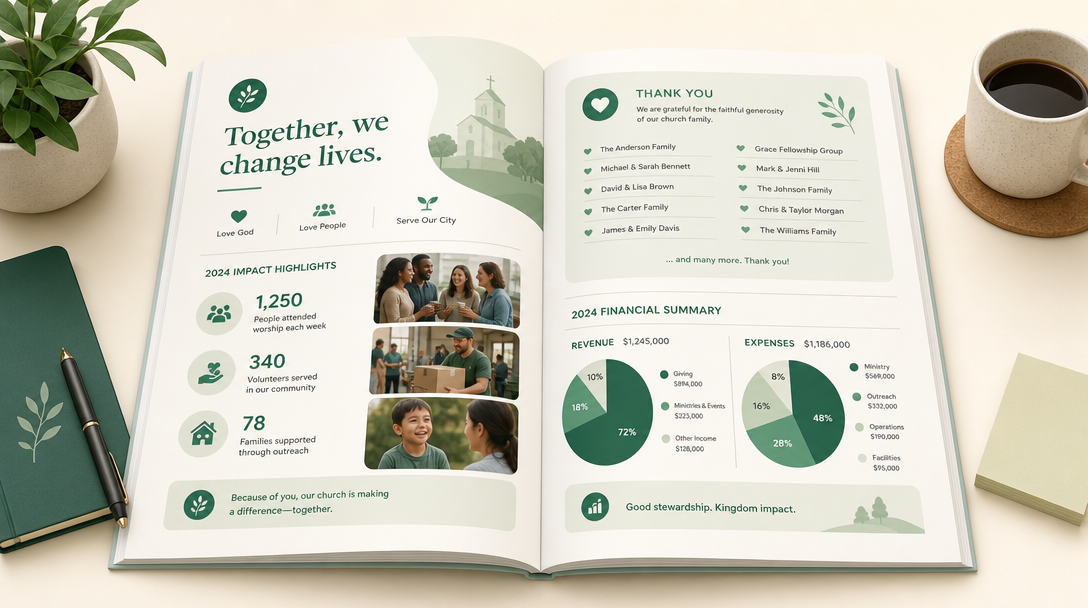
Short answer: A nonprofit annual report is the public document a nonprofit publishes once a year to show donors, the community, and the public what it did with their money and what it accomplished. It pairs mission and impact (the stories and outcomes) with a plain-English financial summary (revenue, expenses, and what’s left). It is not the same thing as IRS Form 990 — the 990 is the required tax filing for the government, while the annual report is the optional, donor-facing story. Most nonprofits are not legally required to publish one, but nearly every healthy organization does, because it’s how you keep donors giving.
What a nonprofit annual report is and who reads it
A nonprofit annual report is a yearly summary an organization writes for the people outside its walls — donors, members, grantmakers, volunteers, the press, and anyone deciding whether to trust it with a gift. The report answers two questions a donor actually cares about: did my money do something real, and can I see the numbers? It leads with the mission and the year’s wins (people served, programs run, milestones hit), then backs that up with a short financial summary so the impact doesn’t read as empty marketing.
The audience is the key thing to keep straight. The annual report is built for humans who give, so it’s readable, visual, and proud. That’s the opposite of an audited financial statement or a tax form, which are built for accountants and regulators. Same underlying numbers, completely different job.
Nonprofit annual report vs. Form 990 — the difference that trips people up
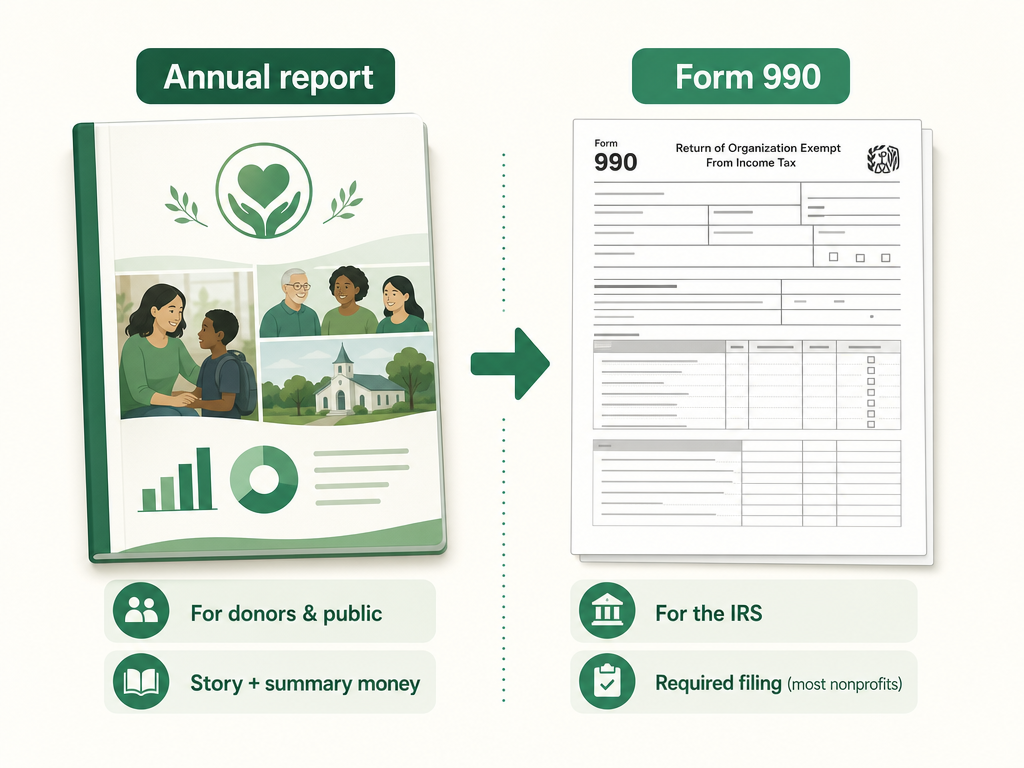
The most common mix-up is treating the annual report and Form 990 as the same document. They’re not. The 990 is the information return most tax-exempt nonprofits must file with the IRS every year — a standardized, public-record tax form (see the IRS about Form 990 page). The annual report is the storytelling-plus-summary document the nonprofit chooses to publish for its donors. One is compliance; the other is communication.
| Nonprofit annual report | IRS Form 990 | |
|---|---|---|
| Who it’s for | Donors, members, the public | The IRS (and public record) |
| Purpose | Show impact, build trust, thank donors | Report finances and governance to the government |
| Required? | Generally no — best practice | Yes for most 501(c)(3)s (churches are exempt) |
| Format | Free-form: photos, stories, charts | A fixed government form |
| Numbers shown | A friendly summary | Detailed, line-by-line |
They feed each other in practice. The financial summary in your annual report is drawn from the same books that produce your 990 and your formal nonprofit financial statements — so if the bookkeeping is clean, both come together quickly.
What to include in a nonprofit annual report
A strong nonprofit annual report covers a predictable set of sections. You don’t need all of them, and you should never bury the mission under finance, but most good reports hit these:
- A mission reminder and a letter from leadership — one short opening from the executive director or board chair that frames the year.
- Impact and outcomes — the heart of it. Real numbers tied to your mission: people served, meals delivered, students graduated, acres restored. Pair each with a short story or photo so the figure means something.
- A financial summary — total revenue (by source: donations, grants, earned income), expenses by function (program, management/admin, fundraising), the change in net assets, and a few headline figures like total raised or program-spending ratio. Keep it to a page; link to the full statements for anyone who wants detail.
- Donor thank-yous — a named list of supporters (with permission), or at least a heartfelt acknowledgment. This is the social proof that earns the next gift.
- Leadership and board — your board of directors, key staff, and partners, which signals oversight and credibility.
- Looking ahead — what next year’s goals and needs are, with a clear way to give or get involved.
The financial summary is where nonprofits either build trust or quietly lose it. Show expenses by function so a reader can see how much went to the actual programs versus overhead — that program-vs-admin split comes straight from your nonprofit statement of activities. Round the numbers, use a chart, and don’t hide a hard year; donors forgive honesty far faster than spin.
Annual report vs. impact report — are they the same?
An impact report is the close cousin of the annual report, and the two overlap heavily. The difference is emphasis. An impact report is almost entirely about outcomes — the change you created — and may skip detailed finances. An annual report is the fuller picture: impact plus a financial summary, governance, and the year’s operations. Many small nonprofits publish one combined document and call it either name. If you only have the budget for one, make it the annual report, since the financial summary is what serious donors and grantmakers look for.
Is a nonprofit required to publish an annual report?
A nonprofit is generally not legally required to publish a public annual report. There’s no federal rule that says a 501(c)(3) must produce the glossy donor-facing document. What is required for most exempt organizations is the annual Form 990 filing with the IRS — and 990 filers must make that return available to the public on request.
Two wrinkles to know:
- State filings use the same words. Many states require nonprofits to file an “annual report” or annual registration with the Secretary of State or charity regulator to stay in good standing. That state filing is a compliance form, not the donor publication — same name, different thing. Check your state’s requirements.
- Grantmakers and watchdogs effectively expect one. Foundations, large donors, and rating sites increasingly look for a published report. So while no law forces it, the practical answer is that any nonprofit raising real money should publish one.
How to make a nonprofit annual report — a simple process
Making a nonprofit annual report is mostly gathering things you already have and shaping them for a non-accountant reader. A workable process:
- Pull the numbers first. Close out the year’s books and produce your financial summary — revenue by source, expenses by function, change in net assets. Everything else builds around clean figures.
- Pick the story. Choose three to five impact highlights that prove the mission moved. Find one human story and one strong photo for each.
- Draft the sections. Leadership letter, impact, financial summary, thank-yous, board, looking ahead. Keep it tight — a short, honest report beats a long, vague one.
- Design it for skimmers. Big headline numbers, charts over tables, lots of white space and photos. Most readers skim; reward them.
- Review and publish. Have a board member and a second reader check the facts and the math, then publish it — usually a PDF on your site plus a short email or printed version for key donors.
You don’t need a 30-page booklet. A clean two-to-four-page report, published reliably every year, does the job.
A church’s annual report to the congregation
For a church, the annual report is the same idea pointed inward: a yearly report to the congregation rather than to outside donors. It typically goes out before or at the annual meeting and covers the year’s ministry highlights, attendance and membership, staff and leadership changes, and a financial summary — money in, money out, and where the fund balances stand. Because churches are exempt from filing Form 990, the congregational annual report is often a church’s only regular public accounting, which makes it matter even more for trust.
The financial half of a church’s report is built from the same records as its formal church financial statements — the summary in the report is just those numbers translated into plain language for members. If your bookkeeping is in order through the year, the annual report is a summary exercise, not a scramble.
Vestrybooks builds your financial summary straight from everyday entries — money in and out, by fund — so the numbers for your annual report are always one click away, with restricted and unrestricted funds already separated. See plans →
FAQ
What is the annual report of a nonprofit organization? A nonprofit annual report is the yearly public document an organization publishes to show donors and the community its mission impact and a summary of its finances — revenue, expenses, and outcomes — for the year. It’s a communication and trust-building tool, not a tax filing.
Is an annual report the same as a 990? No. Form 990 is the required tax return most nonprofits file with the IRS; the annual report is the optional, donor-facing document a nonprofit publishes to tell its story and summarize its finances. They use the same underlying numbers but serve different audiences.
Does a nonprofit have to file an annual report? Most nonprofits aren’t legally required to publish a public annual report, though it’s standard best practice. Many states do require a separate “annual report” filing with the Secretary of State to keep the organization in good standing, and most exempt nonprofits must file Form 990 with the IRS.
What is needed in an annual report for a nonprofit? A leadership letter, the year’s impact and outcomes, a financial summary (revenue, expenses by function, change in net assets), donor thank-yous, the board and leadership, and a look at the year ahead with a way to give.
This is general information, not accounting or legal advice — confirm your organization’s requirements with a qualified professional.
This article is general information for church treasurers, not professional tax or legal advice. For your church's situation, consult a qualified accountant or attorney.
Church accounting a volunteer can actually do.
Vestrybooks is church accounting + giving for the volunteer treasurer — fund tracking, one-click year-end statements, and online giving with $0 taken from every gift.
A real free plan · no credit card · your data stays yours