Blog · Financial reporting
Nonprofit financial statements — the four reports and who needs them
June 27, 2026 · By Benjamin Reinke
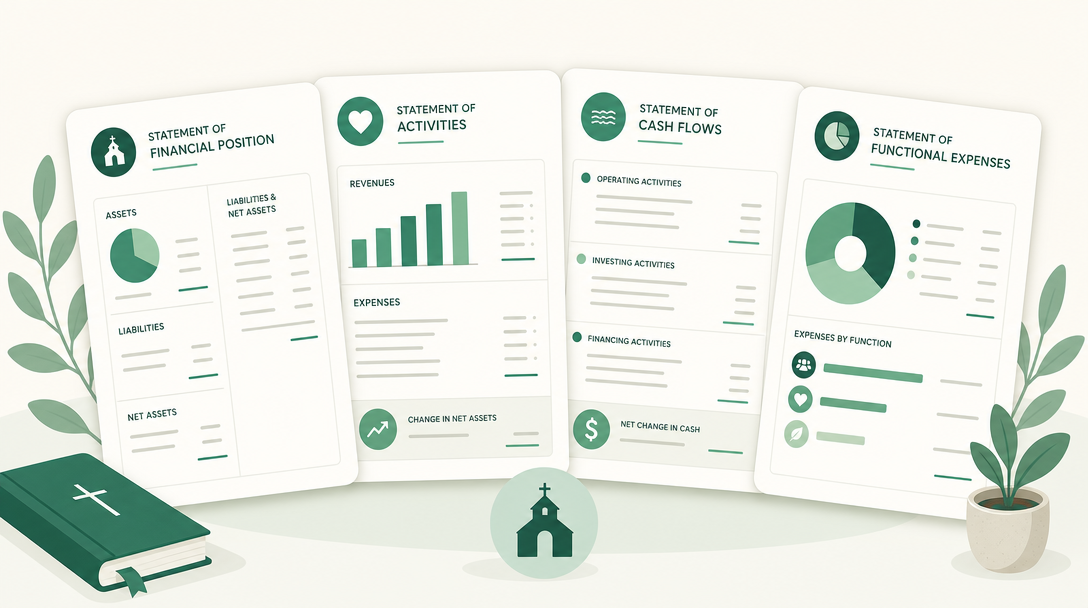
Short answer: A nonprofit’s financial statements are four reports defined by nonprofit accounting standards: the statement of financial position (the balance sheet), the statement of activities (the income statement / “P&L” equivalent), the statement of cash flows, and the statement of functional expenses. They report net assets — split by donor restriction — instead of profit or owner’s equity. Most 501(c)(3)s produce them for their board, donors, and grantmakers; whether you must file them depends on your IRS return.
What nonprofit financial statements are
Nonprofit financial statements summarize where an organization’s money stands and how it moved, following FASB’s nonprofit standard (ASC 958) rather than the profit-and-loss format a business uses. The defining difference: a nonprofit has no owners and no profit motive, so its statements end in the change in net assets, and those net assets are reported in two buckets — with and without donor restrictions — so readers can see what’s free to use versus committed to a purpose.
The four nonprofit financial statements
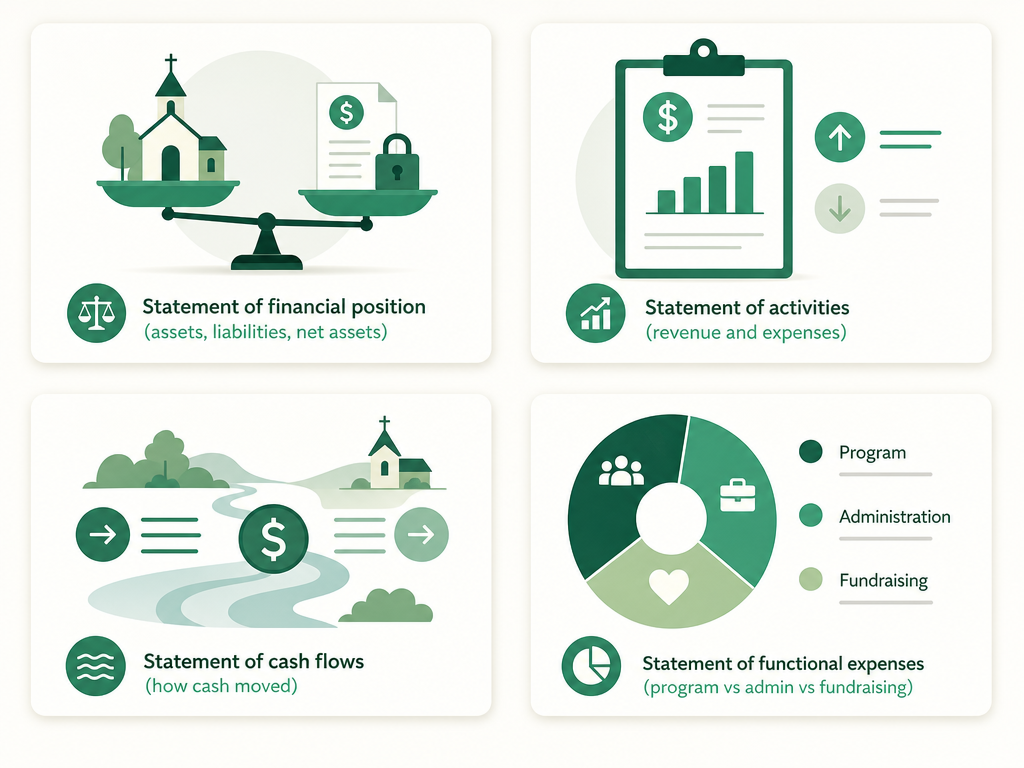
| Statement | What it shows |
|---|---|
| Statement of financial position (balance sheet) | Assets, liabilities, and net assets at a point in time |
| Statement of activities (the income statement) | Revenue, expenses, and the change in net assets over a period |
| Statement of cash flows | How cash moved through operating, investing, financing |
| Statement of functional expenses (the functional-expense statement) | Spending split by function — program, management, fundraising |
For a church, these are exactly the church financial statements — the statement of financial position and the statement of activities are the two most churches rely on.
What is a nonprofit’s “P&L” called?
A nonprofit doesn’t call it a profit-and-loss statement, because there’s no profit. The equivalent is the statement of activities — it reports revenue and expenses over a period and ends in the change in net assets instead of net income.
Does a 501(c)(3) have to provide financial statements?
Filing requirements depend on the organization. Most 501(c)(3)s file an annual Form 990 with the IRS, and 990 filers must make it publicly available on request. But churches are exempt from filing Form 990 (IRS Publication 1828). Either way, a nonprofit’s board, donors, grantmakers, and lenders typically expect financial statements, and some states require them — so “not required to file” rarely means “no one needs them.”
The 33% rule (the public-support test)
A common question: a public charity generally must pass a public-support test to keep public-charity status (rather than being treated as a private foundation) — broadly, it needs to receive at least about one-third (33⅓%) of its support from the general public or government. Churches are automatically public charities and don’t have to pass this test, but other nonprofits track it carefully, and it’s one reason clean financial statements matter.
Why the statements only work with clean books
Financial statements aren’t written from scratch — they’re generated from the underlying records. Every gift, grant, and bill is recorded to a fund and account through the year, and the statements roll those balances up. That’s why fund accounting and good bookkeeping come first: the statements are only as trustworthy as the records beneath them.
Vestrybooks builds these statements from a church’s everyday entries automatically, with restricted and unrestricted net assets already separated. See plans →
FAQ
What are the financial statements of a nonprofit? The statement of financial position (balance sheet), the statement of activities (income statement), the statement of cash flows, and the statement of functional expenses — under FASB ASC 958.
What is a P&L called for a nonprofit? The statement of activities — it reports revenue and expenses over a period and ends in the change in net assets rather than profit.
Does a 501(c)(3) have to provide financial statements? Most file Form 990 and must disclose it publicly, but churches are exempt from filing 990. Boards, donors, and grantmakers still expect statements regardless.
What is the 33% rule for nonprofits? The public-support test: a public charity generally must receive roughly a third of its support from the public or government to avoid being treated as a private foundation. Churches are automatically public charities and are exempt from the test.
This is general information, not accounting or legal advice — confirm your organization’s requirements with a qualified professional.
This article is general information for church treasurers, not professional tax or legal advice. For your church's situation, consult a qualified accountant or attorney.
Church accounting a volunteer can actually do.
Vestrybooks is church accounting + giving for the volunteer treasurer — fund tracking, one-click year-end statements, and online giving with $0 taken from every gift.
A real free plan · no credit card · your data stays yours