Blog · Financial reporting
How to read a nonprofit balance sheet
June 27, 2026 · By Benjamin Reinke
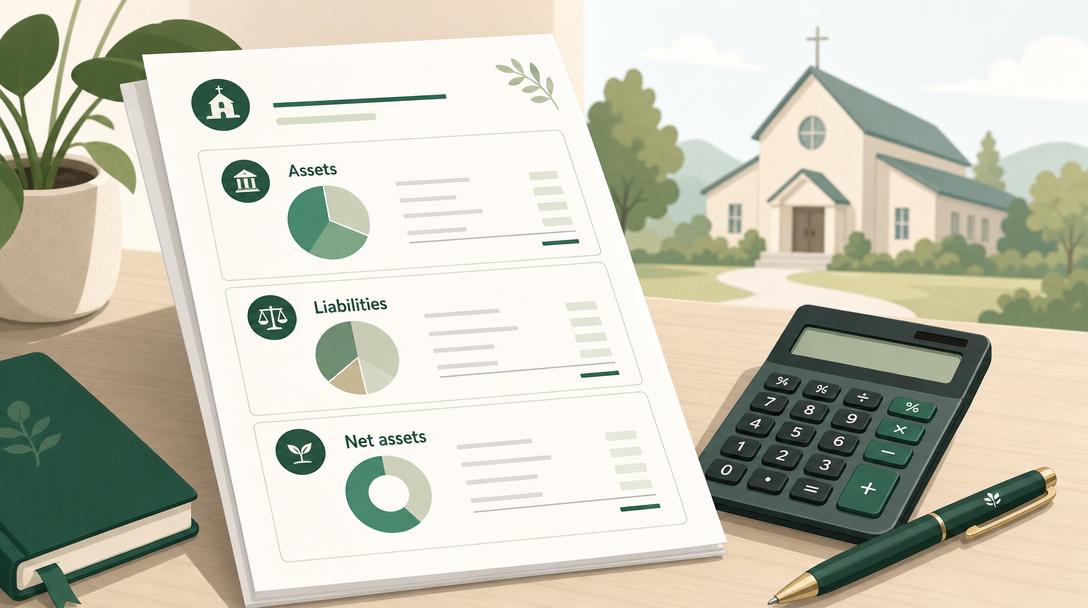
Short answer: A nonprofit balance sheet — formally the statement of financial position — is a snapshot of what an organization owns (assets), what it owes (liabilities), and what’s left over (net assets) at a single point in time. The one thing that makes it different from a business balance sheet: instead of owner’s equity, it shows net assets, split into two classes — without donor restrictions and with donor restrictions — so anyone reading it can see at a glance how much of the money is free to spend and how much is locked to a purpose.
The three parts of a nonprofit balance sheet
Every nonprofit balance sheet balances the same equation: Assets = Liabilities + Net Assets. The three parts:
- Assets — what the organization owns: cash, receivables, investments, property, and equipment.
- Liabilities — what it owes: bills, payroll due, loans, and deferred revenue.
- Net assets — assets minus liabilities, the nonprofit’s cushion. This is where it diverges from a business.
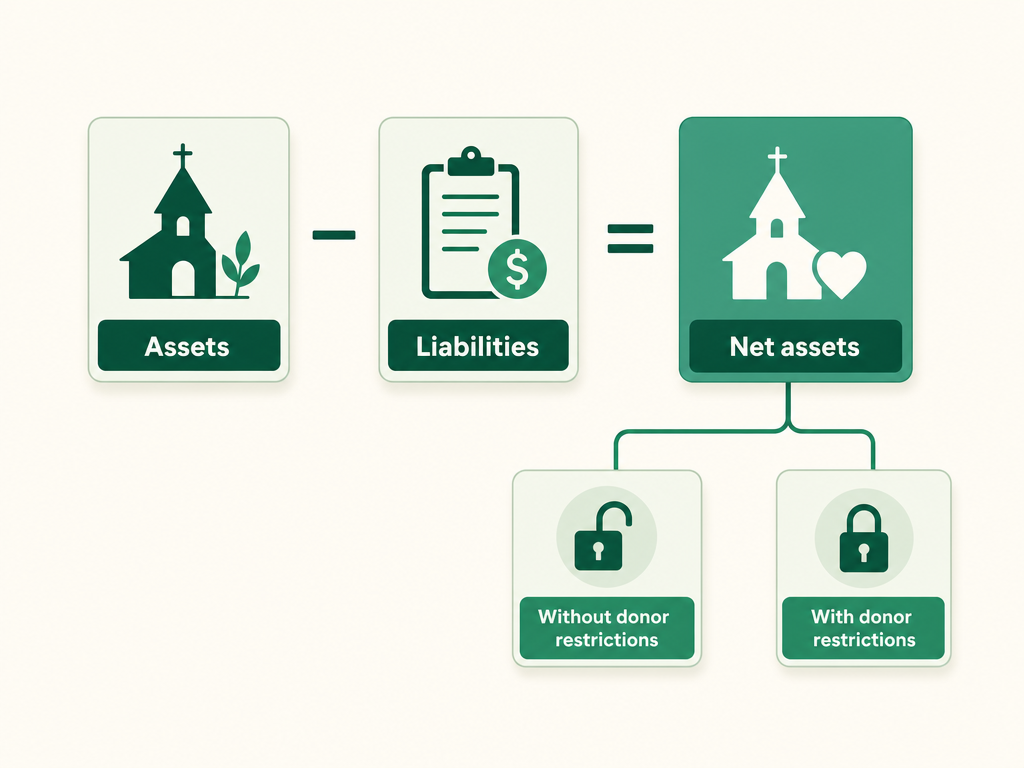
Net assets: with vs. without donor restrictions
Under accounting standards (FASB ASC 958), a nonprofit reports net assets in two buckets:
- Without donor restrictions — money the board can spend on anything, including the operating reserve.
- With donor restrictions — money a donor or grantor tied to a purpose or a time. It’s still the nonprofit’s money, but it isn’t free until the restriction is met.
This split is the whole point of the statement. A nonprofit can look “rich” in total net assets while having almost nothing it can actually spend, because most of it is restricted. Reading the balance sheet means reading that line first.
Nonprofit balance sheet vs. for-profit balance sheet
| For-profit | Nonprofit | |
|---|---|---|
| Bottom section | Owner’s / shareholder’s equity | Net assets |
| Split by | Stock, retained earnings | With vs. without donor restrictions |
| Measures | Owner value | Money free to spend vs. locked to a purpose |
| Goal | Return to owners | Stewardship of donor intent |
How to read a nonprofit balance sheet
Three quick checks tell you most of what you need:
- Cash vs. restricted net assets. If restricted net assets are larger than cash, some restricted money may already be spent — a red flag.
- Months of operating reserve. Divide unrestricted net assets by monthly expenses. Three to six months is healthy.
- Liabilities vs. assets. Rising debt against flat assets is a warning sign.
The balance sheet is one of four statements that work together; the others are the statement of activities, the statement of cash flows, and the statement of functional expenses. The full set is covered in the guide to church financial statements, which applies to any nonprofit. If you run a church specifically, see the church balance sheet version.
FAQ
Does a nonprofit have a balance sheet? Yes — it’s just called the statement of financial position. It shows assets, liabilities, and net assets at a point in time, the same role a balance sheet plays for a business.
What are the four basic financial statements for a nonprofit? The statement of financial position (balance sheet), the statement of activities (income statement), the statement of cash flows, and the statement of functional expenses.
How do you create a balance sheet for a nonprofit? List assets and liabilities from reconciled books, subtract liabilities from assets to get net assets, then split net assets into with- and without-donor-restrictions. Fund-based bookkeeping produces it automatically.
What is the 33% rule for nonprofits? The public support test: a 501(c)(3) generally must receive at least 33⅓% of its support from the public or government to stay a public charity rather than a private foundation. It’s about funding sources, not the balance sheet — though your books have to track support by source to prove it.
Vestrybooks builds the statement of financial position for you — net assets split by restriction, straight from reconciled books. See how it works.
This article is general information for church treasurers, not professional tax or legal advice. For your church's situation, consult a qualified accountant or attorney.
Church accounting a volunteer can actually do.
Vestrybooks is church accounting + giving for the volunteer treasurer — fund tracking, one-click year-end statements, and online giving with $0 taken from every gift.
A real free plan · no credit card · your data stays yours